“What do dogs do on their day off? Can’t lie around – that’s their job.”
– George Carlin, comedian
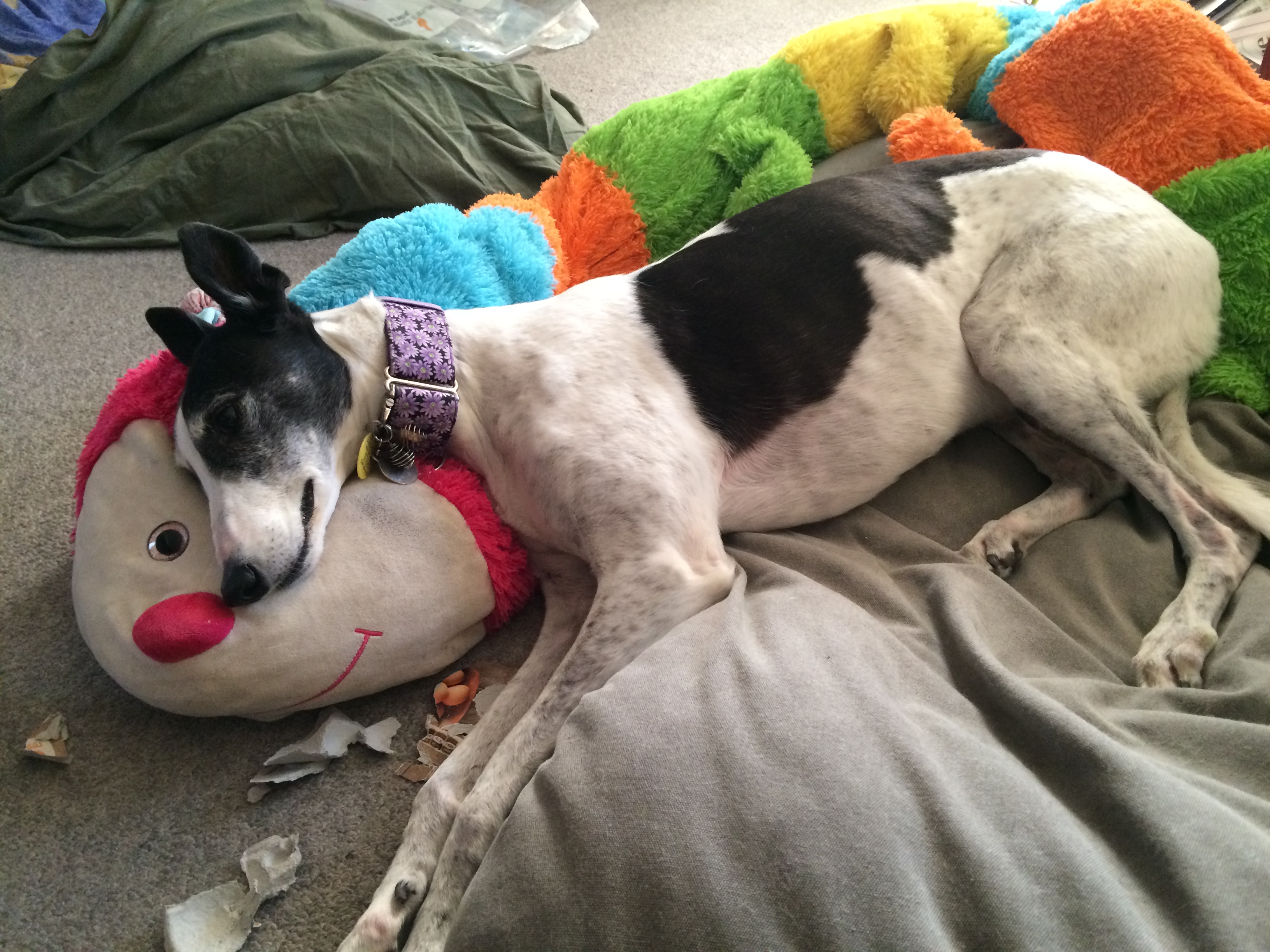
P.S. Izzy also says it is hard work modelling the latest in greyhound fashion and being the Demo Dog for The Balanced Dog’s mobile canine massage and rehab practice.
Kathleen Crisley, Fear-Free certified professional and specialist in dog massage, rehabilitation and nutrition/food therapy, The Balanced Dog, Christchurch, New Zealand
The research enables you to digitise a dog without an expensive studio motion capture camera set up
Researchers from CAMERA, the University of Bath’s motion capture research centre, have developed motion capture technology that enables you to digitise your dog without a motion capture suit and using only one camera.
The software could be used for a wide range of purposes, from helping vets diagnose lameness and monitoring recovery of their canine patients, to entertainment applications such as making it easier to put digital representations of dogs into movies and video games.
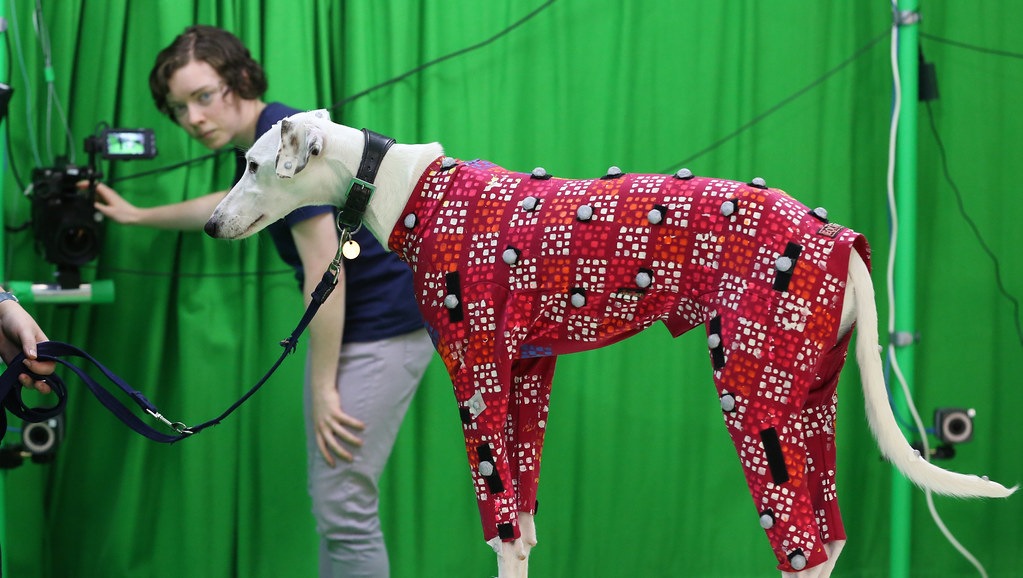
Motion capture technology is widely used in the entertainment industry, where actors wear a suit dotted with white markers which are then precisely tracked in 3D space by multiple cameras taking images from different angles. Movement data can then be transferred onto a digital character for use in films or computer games.
Similar technology is also used by biomechanics experts to track the movement of elite athletes during training, or to monitor patients’ rehabilitation from injuries. However, these technologies – particularly when applying them to animals – require expensive equipment and dozens of markers to be attached.
Computer scientists from CAMERA digitised the movement of 14 different breeds of dog, from lanky lurchers to squat pugs, which were residents of the local Bath Cats’ and Dogs’ Home (BCDH).
Wearing special doggie motion capture suits with markers, the dogs were filmed under the supervision of their BCDH handlers doing a range of movements as part of their enrichment activities.
They used these data to create a computer model that can accurately predict and replicate the poses of dogs when they’re filmed without wearing the motion capture suits. This model allows 3D digital information for new dogs – their shape and movement – to be captured without markers and expensive equipment, but instead using a single RGBD camera. Whereas normal digital cameras record the red, green and blue (RGB) colour in each pixel in the image, RGBD cameras also record the distance from the camera for each pixel.
PhD researcher Sinéad Kearney said: “This is the first time RGBD images have been used to track the motion of dogs using a single camera, which is much more affordable than traditional motion capture systems that require multiple cameras.
“This technology allows us to study the movement of animals, which is useful for applications such as detecting lameness in a dog and measuring its recovery over time.
“For the entertainment industry, our research can help produce more authentic movement of virtual animals in films and video games. Dog owners could also use it to make a 3D digital representation of their pet on their computer, which is a lot of fun!”
The team presented their research at one of the world’s leading AI conferences, the CVPR (Computer Vision and Pattern Recognition) conference on 14 June.
The team has also started testing their method on computer-generated images of other four-legged animals including horses, cats, lions and gorillas, with some promising results. They aim in the future to extend their animal dataset to make the results more accurate; they will also be making the dataset available for non-commercial use by others.
Professor Darren Cosker, Director of CAMERA, said: “While there is a great deal of research on automatic analysis of human motion without markers, the animal kingdom is often overlooked.
“Our research is a step towards building accurate 3D models of animal motion along with technologies that allow us to very easily measure their movement. This has many exciting applications across a range of areas – from veterinary science to video games.”
A team led by researchers at Baylor College of Medicine in collaboration with Medterra CBD conducted the first scientific studies to assess the potential therapeutic effects of cannabidiol (CBD) for arthritic pain in dogs, and the results could lead the way to studying its effect in humans. Researchers focused first on these animals because their condition closely mimics the characteristics of human arthritis, the leading cause of pain and disability in the U.S. for which there is no effective treatment.
Credit: CC0 Public Domain
Published in the journal Pain, the study first showed both in laboratory tests and mouse models that CBD, a non-addictive product derived from hemp (cannabis), can significantly reduce the production of inflammatory molecules and immune cells associated with arthritis. Subsequently, the study showed that in dogs diagnosed with the condition, CBD treatment significantly improved quality of life as documented by both owner and veterinarian assessments. This work supports future scientific evaluation of CBD for human arthritis.
“CBD is rapidly increasing in popularity due to its anecdotal health benefits for a variety of conditions, from reducing anxiety to helping with movement disorders,” said corresponding author Dr. Matthew Halpert, research faculty in the Department of Pathology and Immunology at Baylor. “In 2019, Medterra CBD approached Baylor to conduct independent scientific studies to determine the biological capabilities of several of its products.”
In the current study, Halpert and his colleagues first measured the effect of CBD on immune responses associated with arthritis, both in human and murine cells grown in the lab and in mouse models. Using Medterra tinctures, they found that CBD treatment resulted in reduced production of both inflammatory molecules and immune cells linked to arthritis.
The researchers also determined that the effect was quicker and more effective when CBD was delivered encapsulated in liposomes than when it was administered ‘naked.’ Liposomes are artificially formed tiny spherical sacs that are used to deliver drugs and other substances into tissues at higher rates of absorption.
Halpert and colleagues next assessed the effect of naked and liposome-encapsulated CBD on the quality of life of dogs diagnosed with arthritis.
“We studied dogs because experimental evidence shows that spontaneous models of arthritis, particularly in domesticated canine models, are more appropriate for assessing human arthritis pain treatments than other animal models. The biological characteristics of arthritis in dogs closely resemble those of the human condition,” Halpert said.
Arthritis is a common condition in dogs. According to the American Kennel Club, it affects one out of five dogs in the United States.
The 20 client-owned dogs enrolled in the study were seen at Sunset Animal Hospital in Houston. The dog owners were randomly provided with identical unidentified medication bottles that contained CBD, liposomal CBD, or a placebo. Neither the owners nor the veterinarian knew which treatment each dog received.
After four weeks of daily treatment, owners and veterinarians reported on the condition of the dogs, whether they observed changes in the animals’ level of pain, such as changes related to running or gait. The dogs’ cell blood count and blood indicators of liver and kidney function also were evaluated before and after the four weeks of treatment.
“We found encouraging results,” Halpert said. “Nine of the 10 dogs on CBD showed benefits, which remained for two weeks after the treatment stopped. We did not detect alterations in the blood markers we measured, suggesting that, under the conditions of our study, the treatment seems to be safe.”
What to do. You’re a dog. Your owner is trapped in a box and is crying out for help. Are you aware of his despair? If so, can you set him free? And what’s more, do you really want to?
That’s what Joshua Van Bourg and Clive Wynne wanted to know when they gave dogs the chance to rescue their owners.
Until recently, little research has been done on dogs’ interest in rescuing humans, but that’s what humans have come to expect from their canine companions — a legend dating back to Lassie and updated by the popular Bolt.
“It’s a pervasive legend,” said Van Bourg, a graduate student in Arizona State University’s Department of Psychology.
Simply observing dogs rescuing someone doesn’t tell you much, Van Bourg said. “The difficult challenge is figuring out why they do it.”
So, Van Bourg and Wynne, an ASU professor of psychology and director of the Canine Science Collaboratory at ASU, set up an experiment assessing 60 pet dogs’ propensity to rescue their owners. None of the dogs had training in such an endeavor.
In the main test, each owner was confined to a large box equipped with a light-weight door, which the dog could move aside. The owners feigned distress by calling out “help,” or “help me.”
Beforehand, the researchers coached the owners so their cries for help sounded authentic. In addition, owners weren’t allowed to call their dog’s name, which would encourage the dog to act out of obedience, and not out of concern for her owner’s welfare.
“About one-third of the dogs rescued their distressed owner, which doesn’t sound too impressive on its own, but really is impressive when you take a closer look,” Van Bourg said.
That’s because two things are at stake here. One is the dogs’ desire to help their owners, and the other is how well the dogs understood the nature of the help that was needed. Van Bourg and Wynne explored this factor in control tests — tests that were lacking in previous studies.
In one control test, when the dog watched a researcher drop food into the box, only 19 of the 60 dogs opened the box to get the food. More dogs rescued their owners than retrieved food.
“The key here is that without controlling for each dog’s understanding of how to open the box, the proportion of dogs who rescued their owners greatly underestimates the proportion of dogs who wanted to rescue their owners,” Van Bourg said.
“The fact that two-thirds of the dogs didn’t even open the box for food is a pretty strong indication that rescuing requires more than just motivation, there’s something else involved, and that’s the ability component,” Van Bourg said. “If you look at only those 19 dogs that showed us they were able to open the door in the food test, 84% of them rescued their owners. So, most dogs want to rescue you, but they need to know how.”
In another control test, Van Bourg and Wynne looked at what happened when the owner sat inside the box and calmly read aloud from a magazine. What they found was that four fewer dogs, 16 out of 60, opened the box in the reading test than in the distress test.
“A lot of the time it isn’t necessarily about rescuing,” Van Bourg said. “But that doesn’t take anything away from how special dogs really are. Most dogs would run into a burning building just because they can’t stand to be apart from their owners. How sweet is that? And if they know you’re in distress, well, that just ups the ante.”
The fact that dogs did open the box more often in the distress test than in the reading control test indicated that rescuing could not be explained solely by the dogs wanting to be near their owners.
The researchers also observed each dog’s behavior during the three scenarios. They noted behaviors that can indicate stress, such as whining, walking, barking and yawning.
“During the distress test, the dogs were much more stressed,” Van Bourg said. “When their owner was distressed, they barked more, and they whined more. In fact, there were eight dogs who whined, and they did so during the distress test. Only one other dog whined, and that was for food.”
What’s more, the second and third attempts to open the box during the distress test didn’t make the dogs less stressed than they were during the first attempt. That was in contrast to the reading test, where dogs that have already been exposed to the scenario, were less stressed across repeated tests.
“They became acclimated,” Van Bourg said. “Something about the owner’s distress counteracts this acclimation. There’s something about the owner calling for help that makes the dogs not get calmer with repeated exposure.”
In essence, these individual behaviors are more evidence of “emotional contagion,” the transmission of stress from the owner to the dog, explains Van Bourg, or what humans would call empathy.
“What’s fascinating about this study,” Wynne said, “is that it shows that dogs really care about their people. Even without training, many dogs will try and rescue people who appear to be in distress — and when they fail, we can still see how upset they are. The results from the control tests indicate that dogs who fail to rescue their people are unable to understand what to do — it’s not that they don’t care about their people.
“Next, we want to explore whether the dogs that rescue do so to get close to their people, or whether they would still open the box even if that did not give them the opportunity to come together with their humans,” Wynne added.









 DoggyMom.com