Category Archives: dog-friendly accommodation

For These Homebuyers, a Fenced Yard Isn’t a Bonus—It’s the Starting Point

There are two kinds of homebuyers: those with pets and those without. And for pet owners, a home purchase can hinge on whether a listing works as well for their pet as it does for them, according to new data.

Getty Images

A new survey from Realtor.com® finds that buyers with pets often evaluate homes through an animal-first lens, prioritizing features like a secure outdoor space, durable interiors, and communities where pets are allowed.

It’s not surprising to the agents who regularly see these trade-offs play out in real time.

“I’ve never seen a child influence a house decision no matter what they’ve thought of it,” says Jeff Lichtenstein, a broker with more than 25 years of experience. “A pet, however, has much more influence.”

“I see pet needs influence decisions all the time,” echoes Miltiadis Kastanis, executive director of sales at Compass. “A buyer might really like a home, but if it does not feel right for their pet, whether it is the lack of outdoor space or the overall environment, they will walk away.”

The new research from Realtor.com backs them up. For many buyers, pets were not a side consideration but a real force in the home search—one strong enough to shape decisions and even justify paying more for the right features.

What makes a pet-friendly home?

The survey drew from a mix of first-time homebuyers, repeat buyers, and sellers across the country, with pets that included dogs, cats, birds, reptiles, fish, hamsters, and guinea pigs.

For all that variety, their answers pointed to a strikingly consistent definition of what makes a home truly pet-friendly: secure outdoor space, durable and easy-to-clean interiors, and neighborhoods or developments where pets are clearly allowed.

Outdoor space came up repeatedly, especially when it was enclosed. 

“Pet friendly means having a good-sized backyard that is secured well with a fence or wall,” said Katey, a millennial first-time homebuyer. 

Rhonda, a repeat buyer of the baby boomer generation, emphasized the same priority in pet terms, saying the yard needed to be large enough that her pets could “do zoomies without destroying furniture.”

Inside the home, respondents focused on surfaces and layouts that could hold up to everyday wear and tear.

“We looked for homes with larger yards, scratch resistant floors, and neighbors who embraced pets,” said Kate, a Gen X repeat buyer. Others called out finishes that were easier to clean, safer for animals, or better suited to senior animals.

Some buyers had an even more detailed checklist. 

“A pet friendly home would have scratch resistant flooring, wall finishes that are easy to clean, built in nooks or feeding stations, and a mudroom and bathing station,” said Chi, a Gen X repeat buyer. 

And for some, the issue was not the home itself but the rules around it. “Pet friendly to me means that pets are allowed in the development,” said Brigette, a baby boomer repeat buyer.

Pets actively influenced which home they chose

Their responses suggest that pet-friendly isn’t a throwaway listing term, but a concrete standard that shaped their home search. It’s something that Kastanis says he sees often, especially in the condo market.

“Pet policies are usually the first thing we look at before even setting up a showing, since restrictions can immediately rule out a property,” he says, adding that buyers are increasingly drawn to buildings that combine pet-friendly rules with practical conveniences, especially easy access to outdoor space.

One such example is Vestra, a luxury apartment complex in Las Vegas where developers prioritized communal dog runs, a resort-style dog park, and professional grooming facilities for its four-legged residents. 
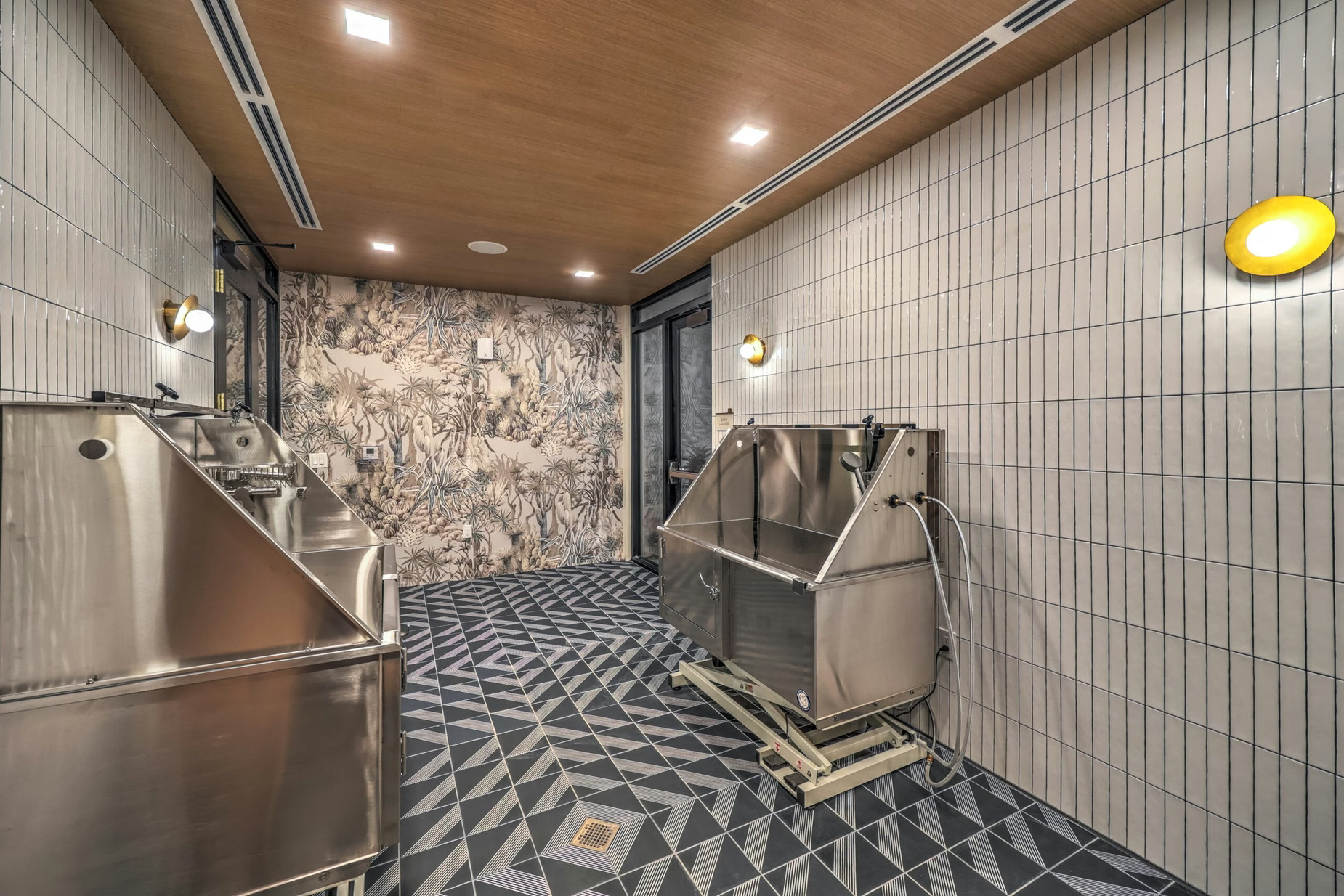
All residents at the Vestra complex have access to luxury grooming facilities for their furry friends. Photos courtesy of Matter Real Estate.

“You can walk out the front door and take your dog for a walk and run into neighbors or friends,” Jim Stuart, part of the team behind the project, told Realtor.com last year.

The survey responses suggest those considerations can be decisive features for pet owners.

“I definitely looked for outdoor space where my cat would be able to go outside but be protected by a fence or screen. Also windows he could sit in or see out. I was drawn to open loft space so he could look down,” said Tara, a Gen X first-time homebuyer. 

Stacei, a Gen X repeat buyer, was even more explicit about how much her pets narrowed the field: “My pets had a large impact on the selection of my current home. I honestly wouldn’t have even looked at a place if it didn’t have a decent sized yard and enough space for my pets to run around comfortably.”

Buyers are willing to pay up for their pets

And when buyers find those features, some are willing to pay more for them, the research found—a reality that agents say mirrors what they see in home searches every day.

“Buyers are willing to pay more for homes that already work for their pets,” says Kastanis. “A house with a fenced yard or a layout that does not require changes can make a big difference, especially when inventory is tight and buyers want something that feels move-in ready.”

But the strongest premium appears to be attached to practical features that reduce friction from day one.

“I would pay more for a property that had a fenced in backyard and decent sized backyard,” said Paul, a Gen X repeat buyer.

In some ways, it echoes what’s long been known about buying and selling a home: Some features fetch you more than others.

Research from the National Association of Realtors® found that homeowners most valued remodeling outcomes tied to improved functionality and livability (28%) and durable, long-lasting materials and appliances (23%)—the same practical qualities many pet-friendly buyers were prioritizing here.

Luxury vinyl plank, or LVP, is one example. Designed to mimic the look of hardwood while holding up better to scratches, messes, and daily wear, it came up repeatedly in the survey as a pet-friendly flooring choice.

“The LVP has been a game changer. So easy to maintain and a nonnegotiable going forward,” said Lori, a Gen X repeat buyer.

And that demand didn’t stop at closing. The survey found that while many buyers didn’t make major pet-related changes after move-in, others invested in upgrades that made the home more durable, convenient, or comfortable for their animals.

“We had the entire home re-floored with scratch resistant flooring to keep our home beautiful and our dog out of trouble,” said Chi. Cory, a millennial first-time buyer said, “I put in a dog door so they can go outside at their convenience.”

Even then, some buyers were still imagining what else a truly pet-centered home could include—touches like a catio (a cat patio), pet-cleaning stations, and other spaces tailored to their animal’s needs. It’s a reminder that for some, a home isn’t only about function—it’s also about creating a little luxury for their pets, too.

Source: Realtor.com

The Most Pet-Friendly States in the USA

Safewise.com has published its rankings of the most pet-friendly states in the USA.

Using data from diverse sources such as the Bureau of Labor, the Animal Legal Defense Fund and online resources for pet-friendly accommodation such as BringFido.com, the company assessed states for pet-friendliness.

Pet friendly states

How does your state rank? Pet-friendly states as ranked by Safewise.com

The Top 10:

  1. Maine
  2. Virginia
  3. Arizona
  4. Oklahoma
  5. Colorado
  6. Oregon
  7. Massachusetts
  8. Kansas
  9. Rhode Island
  10. Washington

Studies like these can help pet owners make informed decisions about relocation and quality of life for them and their pets.  Well done to Safewise for sponsoring this study.

Source:  Safewise.com

Kathleen Crisley, specialist in dog massage, rehabilitation and nutrition/food therapy, The Balanced Dog, Christchurch, New Zealand

USA 1, NZ 0

In today’s workplace ‘leadership’ is the prized personal quality and politicians are expected to show leadership when creating and debating policies and conducting themselves (hmmmm – some do better than others in this regard).

It is rather interesting to me that in a week of coverage about the US Government shutdown and stalemate over a budget, and in NZ where all the news is about a Prime Minister who has announced she’s pregnant, will multi-task, and be back at work in 6 weeks following the birth… that the USA’s Government is winning in one respect over New Zealand’s.

Congress and the Senate are pet-friendly.  New  Zealand’s Parliament doesn’t seem to know what that means…


In August 2017, a survey sponsored by by Nestlé Purina PetCare and conducted on behalf of the Human Animal Bond Research Institute was conducted by personal interviews in the House and Senate offices.  The purpose was to call attention the benefits of a pet-friendly workplace.

The 192 House and Senate offices who responded say they welcome pets in the office, either during recess, while Congress is in session, or both.

Capitol Hill

  • The pet-friendly Hill office findings were relatively consistent across party lines, geographic regions, and both chambers, suggesting wide bipartisan support for having pets at work.    (Common Ground!)
  • The Assistant Senate Historian, Dan Holt, said senators used to bring their hunting dogs into the Old Senate Chamber — to sit right by their feet during floor debates.

  • Circa 1800, congressional rules were enacted to prohibit pets on the Chamber floors.  Congressional rules, however, permit pets nearly everywhere else on Capitol Hill, and staffers are almost universally aware that pets are permitted throughout congressional buildings, with few limitations.

The rich tradition of pets on Capitol Hill continues today:

  • Dozens of members of Congress and their staffers are regularly seen accompanied by their four-legged friends in and around Capitol Hill offices.
  • Some dogs are known as being greeters to visitors to their offices.
  • Some congressional pets even have their own business cards, like Oklahoma Rep. Jim Bridenstine’s “Spaniel & Statesman,” Oliver
  • Staffers sometimes announce when pets are in the office, as with a recent dog photo and note taped to Tennessee Rep. Steve Cohen’s office door stating, “Stevie is in the House!”

Dear Jacinda

Source: DC Stands for Dogs and Cats: New Survey Confirms Capitol Hill is a Very Pet-Friendly Workplace

Kathleen Crisley, specialist in dog massage, rehabilitation and nutrition/food therapy, The Balanced Dog, Christchurch, New Zealand

Pet friendly senior living

TigerPlace is a retirement community that helps residents care for their pets as both age.

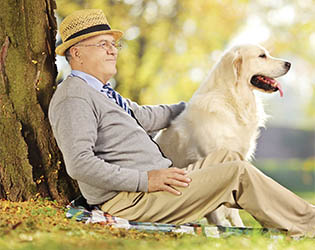
Located in Colombia, Missouri, this retirement community offers one-floor living to make it easy for owners and pets to enjoy the outdoors.  And there’s on-site veterinary care!Senior gentleman and dog sitting on ground and posing in a park

Described as “pet encouraging” as opposed to “pet tolerating”, this facility even offers dog walkers for older residents who are finding it difficult to give their dog the exercise it needs.

This article in the Missourian gives greater insight into the facility and its value to its residents.  This includes following 90-year old Elizabeth Kennedy who lives at TigerPlace with her 12-year old Boston Terrier, Dolly.

The article mentions a growing trend for retirement communities to offer pet care and the  recognition and evidence that pets keep us living longer, more active, and happier lives.

Kathleen Crisley, specialist in dog massage, rehabilitation and nutrition/food therapy, The Balanced Dog, Christchurch, New Zealand


America’s pet friendly rental markets

Finding rental housing when you own a dog (or two, or more) is a big issue here in Christchurch.  Our housing market has done some very weird things since the earthquakes of 2010 and 2011 with sky-rocketing property prices and escalated rental costs (people getting their homes repaired move to temporary accommodation – paid by their homeowners insurance, adding to the competition for rental properties).

Those people who did not own their homes pre-quakes and were dog owners have been some of the most severely affected by the increases.

And so this article from Forbes Magazine caught my eye.  It’s about renting housing in the USA when you are a dog owner; the largest 25 property rental markets are compared.

Pet friendly rental markets

Three factors were used to rank the rental markets:

a) the percentage of landlords willing to allow pets (counted by reading the ads for rental properties)

b) the least expensive pet fees.  That’s a fee that you pay on top of any deposit because you own a pet.  Most fees are refunded when you leave the property in good condition.  Others are simply higher rents for pet owners that are non-refundable.  In Christchurch, pet fees, particularly in terms of higher deposits, suddenly appeared on many properties where there were none before.

c) and my favorite criteria:  a high concentration of pet stores and services.

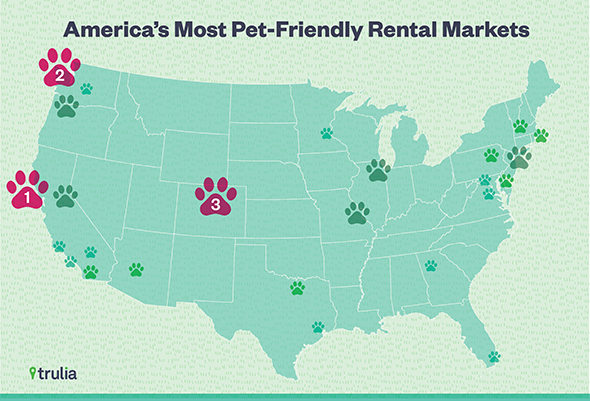
The western cities of San Francisco, Seattle, Denver, Oakland and Portland topped the list.

Sadly for dog lovers, the survey revealed that landlords are much more tolerant of cats than they are of dogs.  And the larger the dog, the harder time you have when renting.  Only 4% of landlords were prepared to allow large breed dogs like a St Bernard.

What this information reinforces is that dog ownership costs money.  If you are considering adding a dog to your pack, spend some time considering your income and life situation before making the commitment.

Source:  The Forbes article cited used data from this Trulia Trends report

Kathleen Crisley, specialist in dog massage, rehabilitation and nutrition/food therapy, The Balanced Dog Ltd, Christchurch, New Zealand

Pampered Pooches at the Opus Vancouver

The Opus Vancouver, a boutique hotel named one of the “Top 5 Trendiest Hotels in the World” by Trip Advisor, offers a Pampered Pooch add-on for guests traveling with their dogs.

The package includes:

  • A locally-designed designer dog bandana
  • A photo shoot with a pet photographer (with one 5×7 print and 6 high resolution images on disc or provided online via dropbox)
  • And a 1-hour in-room massage for your dog (I particularly liked this part)

"I'm ready for my close up" Photo by Tanya King, pet photographer to the Opus Vancouver

“I’m ready for my close up” Photo by Tanya King, pet photographer to the Opus Vancouver

Pet-friendly travel is a niche market that is growing; dog owners are looking for ways that they can treat their pets as well as themselves when on vacation.

What’s your favorite place to stay when traveling with your dog?

Kathleen Crisley, specialist in dog massage, rehabilitation and nutrition/food therapy, Canine Catering Ltd, Christchurch, New Zealand


Amtrak required to accept small pets

 Rep. Jeff Denham, R-Calif., gives some attention to Lily, his 15-pound French bulldog, Feb. 15 in his office on Capitol Hill in Washington. Lily once was rejected by Amtrak, but the House passed a measure Wednesday that would let her ride with her owner.  Photo by J. Scott Applewhite/AP

Rep. Jeff Denham, R-Calif., gives some attention to Lily, his 15-pound French bulldog, Feb. 15 in his office on Capitol Hill in Washington. Lily once was rejected by Amtrak, but the House passed a measure Wednesday that would let her ride with her owner. Photo by
J. Scott Applewhite/AP

The Passenger Rail Reform and Investment Act passed last week by a vote of 316-101 (132 Republicans joined 184 Democrats in voting for the bill; 101 Republicans voted against).  The Act holds funding for Amtrak, the USA’s national rail network, at current levels.

But, the big news for dog lovers is that the rail line  will designate at least one car per train, where feasible, for pets, so that passengers “may transport a domesticated cat or dog in the same manner as carry-on baggage.”

Representative Jeff Denham, a Republican from California, supported the bill because he likes to travel with Lily, his French Bulldog.  Lily can ride on airplanes with Denham but has been unable to do so on train trips.

In 2014, Amtrak initiated a trial project into pet-friendly travel.  That trial was only in the Chicago area – now Amtrak must accept pets on a much wider basis.

Kathleen Crisley, specialist in dog massage, rehabilitation and nutrition/food therapy, Canine Catering Ltd, Christchurch, New Zealand


The Wagington

The Wagington is a new, high-end dog hotel (kennel?) in Singapore catering to the wealthiest residents of the area.

All dogs must be temperament tested before being allowed to stay in one of the 27 suites of the hotel.  Amenities include memory foam mattresses, a bone-shaped swimming pool with supervised swimming, a gym including a treadmill (also supervised), and spa services ranging from ‘pawdicures’ to mud wraps.

A suite at the Wagington (photo courtesy of The Wagington)

A suite at the Wagington (photo courtesy of The Wagington)

Over the top?  Probably – for many of us.  But the opening of this facility, reportedly costing the owner $700,000, shows that the pet market continues its expansion with owners who can afford luxuries for their animals.

Kathleen Crisley, specialist in dog massage, rehabilitation and nutrition/food therapy, Canine Catering Ltd, Christchurch, New Zealand

Amtrak’s pet-friendly travel trial

Amtrak pets on boardFrom 5 May through 2 November 2014, Amtrak is conducting a trial program for owners traveling with their pets.  The Carry-on Pet Pilot Program will allow passengers to bring cats and small dogs, up to 20 pounds including the carrier, on selected train services in the Chicago region.

Amtrak petsThe carriers are considered a piece of carry-on baggage and the fee per pet is $25.00.  No more than four pets will be allowed  per train.

To qualify for the Amtrak scheme, your  dog will need to be harmless, odorless and at least eight weeks old.

In an Amtrak press release, Joe Boardman, president and CEO of Amtrak said, “Amtrak is supportive of accommodating pets on trains, and through direct collaboration with the Illinois Department of Transportation and a working group led by U.S. Rep. Jeff Denham of California we are optimistic a plan can be reached to address the needs and concerns of all our passengers.”

It’s a start…let’s hope the trial goes well.  All aboard!


Trends in US travel for dog owners

DogVacay, the online site the connects dog parents who need home dog boarding, pet sitting and day care with qualified caregivers, has released its second annual State of U.S. Pet Travel survey.

dogs and travelIt shows that dog parents still face obstacles when needing or wanting to travel.

For example:

  • 60% of dog owners say arranging accommodation for their dog adds complexity to travel planning
  • 34% of owners say they often struggle to find a pet sitter when they need to travel at short notice
  • 22% of owners have delayed or skipped a planned vacation because of challenges in arranging care for their dog(s)
  • 50% say finding a good kennel or pet sitter has affected planning for their vacation
  • Another three in ten (27%) say financial challenges such as kennel fees or paying a pet deposit at a hotel have impacted their vacation plans

Also, 46% of dog owners agree that worrying about their dog(s) while they’re away makes it harder to enjoy their trip (I admit that I worry about Daisy when I have to travel for work or vacation, even when I have made arrangements for her care with reputable caregivers).

What’s your travel story?