Note from DoggyMom:
Shelters need all the help they can get to increase rates of adoption. This latest research from Texas Tech University may help them do that and the results may surprise you – traditional ‘training’ may not be the answer.
Alexandra Protopopova has performed extensive research trying to increase the adoption rates and decrease euthanasia rates for animal shelters throughout the country.
Walking down the long rows of pens at any animal shelter reveals a veritable smorgasbord of canine variety.
Big dogs. Little dogs. Outgoing dogs. Shy dogs. Hyper dogs. Calm dogs. Happy dogs. Sad dogs.
But finding which one is right for a potential adopter is a big challenge for animal shelters throughout the country. The way to find that right fit between adopter and adoptee has almost always been about matching personalities and has never really had much scientific theory behind it.
Until now.
Alexandra Protopopova, a behavioral analyst and assistant professor in companion animal science in the Department of Animal & Food Sciences at Texas Tech University, has turned what started as her doctoral dissertation into a major research focus. She is attempting to determine what behavioral traits in dogs are most attractive to potential adopters and then working with shelters to train dogs to exhibit those traits when an adopter shows interest.
“Currently there are numerous pets living in animal shelters, not only in Texas but in the U.S. and around the world,” Protopopova said. “The problem is that a lot of these animals are living for quite some time at these shelters, even if the shelters are well-funded. Because of space restrictions, the animals are typically socially deprived, they are housed in single or very small groups without a lot of human interaction, and the euthanasia rates are still very high across the country.
“Can we figure out a way to train dogs in the shelter so that when people come in and see the trained dogs, it will improve their adoption rate and decreases euthanasia rates?”
The answer, through her research, appears to be a likely, yes.
But finding that answer not only meant discovering and displaying the most attractive traits in a dog, but also breaking down some of the myths that have, over time, seemed to determine the most attractive qualities in a canine companion.
Breaking assumptions
Determining what traits in dogs are most attractive to potential adopters involved not only observing canine behavior but also breaking away from some of the traditionally held assumptions from the past.
These are traits that Protopopova said she has been investigating since her time as a graduate student. Many shelters have training programs that are based on these assumptions, and it took going back to the basics and avoiding the widely held assumptions to determine what true traits in dogs were most and least attractive to potential adopters.
 “A typical assumption was that training dogs to sit and not jump or bark would result in higher adoption rates, since that is what we had assumed adopters wanted in their dogs,” Protopopova said. “I also had my own assumption that people really like a dog that would gaze lovingly into their eyes, when in fact we saw no evidence of that in our research. So why don’t we take a step back and systematically figure out what it is people want to see in a dog? We approached it from a marketing perspective, and from there we could see, after knowing what behaviors are favorable to people, what programs we needed to work on to improve behavior and ultimately increase adoption rates.”
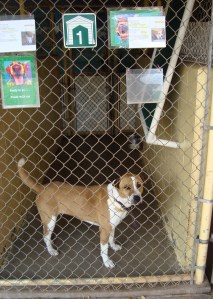
An extensive examination of canine behavior in kennels was then undertaken to determine which behaviors were the most and least favorable for potential adopters. Protopopova observed in-kennel behavior and examined everything the dogs did as people walked by.
Behaviors such as barking, sitting and jumping had no effect whatsoever on attracting potential adopters, but a dog that would pace in the kennel, turn their face away from those walking by or lean sadly to one side of the kennel would deter adopters and lengthen the dog’s stay in the shelter.
But the most telling behavior came when there was actual interaction between the dog and potential adopters outside the kennel. It is standard practice at shelters to allow potential adopters to select one or two dogs they might be interested in and allow them to interact in an outdoor area to see if they are compatible.
Two behaviors stood out among all others as the strongest determinants toward whether or not the dog was adopted. If the dog laid down in proximity to the adopter, that increased the likelihood of adoption. Conversely, if the dog ignored the initiation of the potential adopter to play, that decreased quite severely the likelihood of adoption.
Knowing those two key traits in dogs, Protopopova and her fellow researchers were able to develop a structured training program where the shelter volunteer or staff member could go with the potential adopter and guide the dog’s behavior based on its toy preference, knowing the dog would not ignore the toys it likes, or eliminate toys altogether if it was determined the dog did not like playing with toys.
Shelter volunteers and staff also would encourage the dog to lie down next to a potential adopter using treats. All these efforts, Protopopova said, resulted in a discernable increase in adoption rates.
“We also asked people why they chose the dog they adopted and why they did not choose the dog they didn’t adopt after those interactions in the experimental setting,” Protopopova said. “It’s fun to take those words the adopters use, those constructs and figure out what they mean. If an adopter told us they adopted the dogs because it was ‘social and liked me,’ they could simply mean ‘the dog lay down next to me.’”
This training program also is cost-efficient, knowing shelters do not have the resources to afford a professional training staff, which is why Protopopova considers it more behavior management than actual training.
But is it actual training? Or could this be considered more of a way of tricking the dog into behaving a certain way to increase its adoptability? That was certainly something Protopopova considered, though adopters indicated afterward the method was no more intrusive than the control group where the dog was allowed to do whatever it wanted.
“The interactions between adopters and dogs are only eight minutes long because that is how long previous research has shown it takes adopters to decide,” Protopopova said. “The dogs have only eight minutes to show their best side, so if we can do anything to show them off in the best light possible, that is a good thing for the adopter and the dog.”
The next step has been partnering with Maddie’s Fund foundation, which offers grants to shelters that works with community veterinarians, rescue groups and animal control agencies. Through Maddie’s Fund’s help, Protopopova is taking her research to a national scale, trying the same techniques at different types of shelters across the country.
“Will it work in smaller, rural community shelters? Will it work in the big city environment?” Protopopova asked. “Furthermore, will it work in different parts of the country? Our assessment was in Florida, but will it work in Texas, in Boston, in San Francisco? We will take it to six shelters nationally and try it out there.”
Other factors besides behavior
Obviously, factors beyond behavior go into why potential adopters choose the dogs they choose. Adopters can be looking for a certain breed or a certain size of a dog.
Certain breeds such as long-haired dogs, shepherd breeds and collie breeds tend to have high adoption rates, as do toy breeds such as Pomeranians or Chihuahuas. But a second question begged to be asked after the initial research by Protopopova – are some breeds more or less susceptible or accepting of behavioral training?
One problem with answering that question is the majority of dogs in a shelter are not purebreeds, but rather a mix of many breeds or dogs that have never had a purebred ancestor. So determining their trainability based on breed would be difficult.
Age also is an important factor in whether the dog’s behavior can be modified to make it more adoptable. Typically, puppies are more likely to be adopted because of their age and the fact adopters want to find a dog that can be with them for a long time. So training of puppies in an animal shelter setting might not be the best use of limited resources.
Conversely, older dogs that are well into their adulthood tend to stay in the shelter longer because adopters don’t seek them. So the ideal group for this experiment was dogs in their adolescence or just into adulthood. The good news is that, contrary to the old saying, old dogs can be taught new tricks.
“It just makes more sense if you’re a shelter volunteer to put your resources in training adolescent dogs,” Protopopova said. “But how does age affect training in general? It doesn’t affect it a whole lot. But, of course, socialization is very important for puppies. If you haven’t socialized your puppy to different people, different sounds, different environments and other dogs, you will have a much harder time young adult dog is much easier on families. Puppies engage in much worse behavior.”
Protopopova said in some cases it’s also difficult to determine how the dog was treated before arriving at the shelter. Dogs in shelters fall into one of three categories – owner-surrender, stray or confiscated due to abuse or cruelty.
The difficulty comes in owners who surrender dogs to a shelter. Shelters charge a fee to owners who give up their dogs, so in many cases, owners tell the shelter the dog was picked up as a stray to avoid paying that fee, or because they are wracked with guilt for giving up their beloved pet.
Those labels not only make a difference to potential adopters, but an owner-surrender dog, somewhat surprisingly, is more likely on a national scale to be euthanized than a stray, Protopopova said.
While the first study involved roughly 250 dogs, the bigger national study will involve many, many more and will involve dogs from a variety of shelter types, from municipal shelters to limited-admission shelters – a term Protopopova prefers over no-kill shelters. Protopopova is anxious to see how the study works on that national scale and how many adoptions encouraged by a dog’s modified behavior result in some dogs being returned.
Given what has been discovered so far, though, Protopopova is encouraged her efforts and those of her fellow researchers have forged a path to increasing adoptions across the board.
“We are very excited about this procedure because this is really the first time we have experimentally and systematically demonstrated an increase in adoption rates through behavioral training,” Protopopova said.
Source: Texas Tech University media release















 DoggyMom.com