What a veterinarian and a dog massage therapist have in common

I came across an article recently which was a sort of a “Vets Tell You What They Really Think” piece.  It listed 50 things that the veterinarian would love to say, but can’t, because it would be either too forward or too unprofessional (or both).

One of these really stood out for me:

“Here’s a pet peeve: owners who don’t want to pay for diagnostic tests but then cop an attitude because you don’t know what’s wrong with the animal. Since you wouldn’t let me do the blood work or X-rays, how the heck do you expect me to know?”A vet in South Carolina.

I’m in total agreement with this vet.  If we don’t have a diagnosis how are we able to help?

Believe it or not, I get contacted fairly regularly from people who want me to come and work on their dog because they don’t want to pay for x-rays or other tests.  In such cases, I tell them politely that I need a diagnosis to be able to confidently work with their animal.  The risk is too high that, for example, if the dog has spinal injury I can make it worse rather than better.

Costs for veterinary care can be high, but you pay for the skills and the tools that are available to a veterinarian.  The vet is your dog’s equivalent of the Family Doctor/General Practitioner and sometimes the Emergency Room Doctor combined.  Your dog needs them!
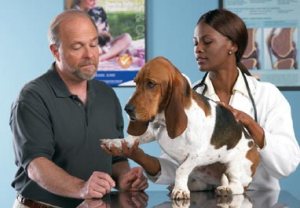
dog and vet

There are times I’ve been caught.  Such as the case where the owners said x-rays had been taken and we worked for quite a few weeks on the dog only to suffer setbacks.  The owners were getting frustrated.   I suggested other things within my scope of practice and I recommended they go back to the vet.

That’s when I found out that the owner had only allowed the vet to take a single x-ray to save money.  The x-ray didn’t reveal anything in the lower spine and so the vet  assumed a partial tear of the cruciate based solely on symptoms.  And that’s the diagnosis I was working with, too.

When the owners returned to the vet, they were persuaded to do more scans and that’s when the problem (and a totally different diagnosis) was determined.

In the end, these owners probably spent more money than they saved.  And  their dog walked around with an injury that was even more difficult to address.

My advice to owners is to only bring a dog into your life when you are confident that you can pay for their care (and that’s means more than just vaccinations, food and flea treatments).  And if you have concerns about your ability to pay for injuries and illness – get pet insurance.  Some policies even cover costs of complementary care such as dog massage when these treatments are recommended by your vet.

I know that some owners like the idea of setting aside money regularly; my concern is that you would have to be setting fairly large amounts aside regularly for a bank balance with compounding interest to reach into the thousands.  And that’s what some of my clients face when surgeries and special procedures are needed.

Your vet is an essential part of your health care team.  We all need a solid diagnosis to help your dog feel better.

Kathleen Crisley, specialist in dog massage, rehabilitation and nutrition/food therapy, The Balanced Dog, Christchurch, New Zealand
Life after Buddy

This article (Hounded by Grief), courtesy of the WBUR, Boston’s National Public Radio station, starts with the haunting words:

I am dogless.  Again.

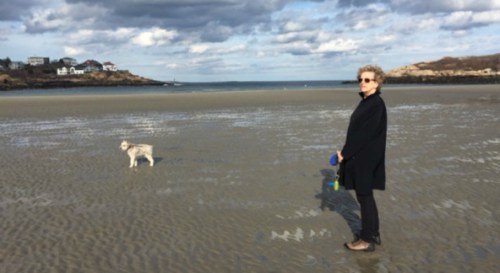
Boston journalist Anita Diamant pictured with Buddy at Good Harbor Beach in Gloucester, Mass., winter 2013. (photo by Ms Diamant)

Boston journalist Anita Diamant pictured with Buddy at Good Harbor Beach in Gloucester, Mass., winter 2013. (photo by Ms Diamant)

For all of us who have loved a series of dogs, including a special ‘heart dog,’ I think some of the words will resonate with you.

Kathleen Crisley, specialist in dog massage, rehabilitation and nutrition/food therapy, The Balanced Dog Ltd, Christchurch, New Zealand

In praise of liver

Liver

I personally can’t stand the taste of liver, but it is a different story for Izzy and the dogs I see in my practice.

Liver, an organ meat, is found in the ‘offal’ section of supermarkets.  It’s very much worth buying some liver for your dog to be fed two-three times per week and this can be done easily with a commercial food diet by boiling the liver and adding the liver and the water over the food.  A third of a cup of the meat is sufficient per serving.   (I don’t like feeding raw foods combined with cooked/commercial foods – because the digestive enzymes needed for raw vs cooked are different.)  If feeding a raw diet, it’s okay to feed raw liver.

I also make my own liver treats which I use as a reward for dogs in my massage practice.

Liver is nutrient-rich.  It’s a source of protein, Vitamin A, Vitamin B12, Phosphorus, Potassium, Iron, and Co-enzyme Q10.  It’s a good antioxidant and, for performance dogs, it’s a super food.

It’s possible to feed too much of a good thing and this is also the case with liver.  If a dog is fed too much liver, it can develop a condition known as hypervitaminosis A; this is an overdose of vitamin A.

Symptoms of a vitamin A overdose can include bone deformity, bone spurs on the dog’s legs or spine that cause him to limp, digestive upsets, muscle weakness, stiffness and sometimes weight loss.

If feeding a commercial diet, I think liver is one of the easiest ‘toppers’ you can introduce that will bring some fresh ingredients into your dog’s diet.

Kathleen Crisley, specialist in dog massage, rehabilitation and nutrition/food therapy, The Balanced Dog Ltd, Christchurch, New Zealand


If you are planning a trip to Italy this year…

….make sure you ask about the ferry companies working in the Gulf of Naples and don’t give your business to the company who refused to look for a puppy who fell overboard in freezing waters.

Noodles (photo from RYCC Savoia Yacht Club Facebook page)

Noodles (photo from RYCC Savoia Yacht Club Facebook page)

In late October Noodles, a Labrador puppy, was being taken to his new home with his owner on board a ferry in the Gulf of Naples.  Noodles slipped his leash and fell overboard.  The employees aboard the ferry refused to stop and look for the puppy explaining that he would be dead…

…and then along came a yacht from the RYCC Savoia Yacht Club.  And little Noodles paddled his heart out to get to them and was saved.

Noodles, shortly after rescue (photo by RYCC Savoia Yacht Club)

Noodles, shortly after rescue (photo by RYCC Savoia Yacht Club)

Noodles was reunited with his owners and has had his 5 minutes of fame.

I haven’t been able to find a reference to the ferry company by name, but certainly dog lovers should give their business elsewhere – to companies who would stop for a little lost puppy.

Kathleen Crisley, specialist in dog massage, rehabilitation and nutrition/food therapy, The Balanced Dog Ltd, Christchurch, New Zealand

Doggy quote of the month for January

‘An animal’s eyes have the power to speak a great language’

– Martin Buber, philosopher 1878-1965

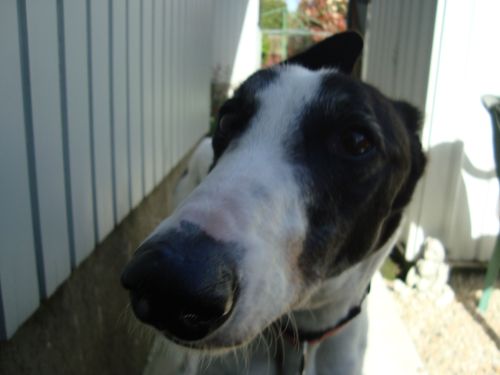
Greyhound

Happy New Year to all my readers and customers (past, present and future)!

Kathleen Crisley, specialist in dog massage, rehabilitation and nutrition/food therapy, The Balanced Dog Ltd, Christchurch, New Zealand

The gift of man’s best friend endures

After a devastating accident that killed his dog and left him in critical condition, Jeff Schwartz found his way back to walk and love again.

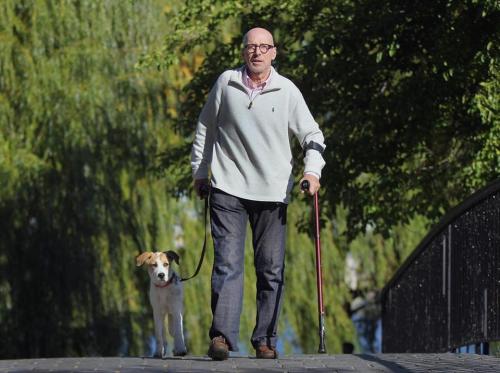
Jeff Schwartz and Mandy on an outing. After his devastating accident, Schwartz rescued a dog and his own way of living. (Photo credit: Wendy Maeda/Globe Staff)

Jeff Schwartz and Mandy on an outing. After his devastating accident, Schwartz rescued a dog and his own way of living. (Photo credit: Wendy Maeda/Globe Staff)

This story, by Eric Moskowitz of The Boston Globe, will make you cry – but at least it is a dog story with a bittersweet ending.

In a blissful life upended, the gift of man’s best friend endures

Kathleen Crisley, specialist in dog massage, rehabilitation and nutrition/food therapy, The Balanced Dog Ltd, Christchurch, New Zealand

A luxury dog house from down under

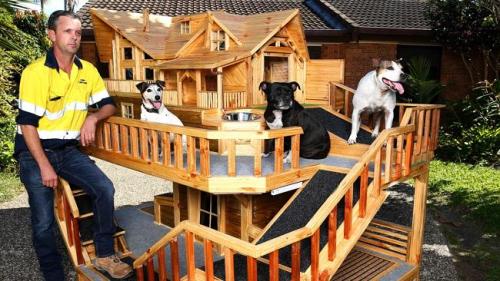
Australian man, Sean Longhurst, put in hundreds of hours over two months to build his dogs a dog house.

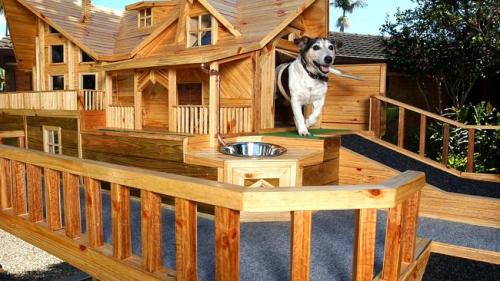
It is very much luxury accommodation with multiple stories, ramps, insulation, sensors lights and automatic-fill water bowls.

Luxury dog house

Photo by the Gold Coast Bulletin

Dog Assa shows off the house (photo by Gold Coast Bulletin)

Dog Assa shows off the house (photo by Gold Coast Bulletin)

When interviewed earlier this year, Mr Longhurst said the project has given him a new appreciation for dog house construction and he intends to go into business making dog houses that are replicas of their owner’s homes.

Kathleen Crisley, specialist in dog massage, rehabilitation and nutrition/food therapy, Canine Catering Ltd, Christchurch, New Zealand

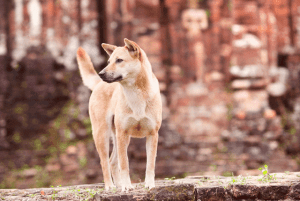
New twist in tale of dogs’ origins

The origin of dogs has inspired a lingering controversy in academia. Where and when did dogs first split off from wolves? One of the top dogs in this dispute, population genetics expert Peter Savolainen of Sweden’s KTH Royal Institute of Technology, isn’t about to roll over. He hopes his latest research will finally settle the matter.

Some researchers say canines first split off from wolves in the Middle East; others say it happened in Europe. But Savolainen has long held that dogs originated in South East Asia alone, and he says his team has compiled new evidence that confirms his earlier findings.

The study concludes that the split with wolves occurred about 33,000 years ago.

Savolainen’s earlier studies were based on analysis of mitochondrial DNA. But recently other researchers have used data from nuclear DNA to refute those findings, arguing that dogs originated in the Middle East, Central Asia or Europe.

But apparently, those researchers were thrown off the scent, according to Savolainen. The data they relied on did not include samples from South East Asia, he says. So if, as Savolainen says, dogs did indeed come from South East Asia, these studies would not have been able to detect it.

Photo by IStock

Photo by IStock

“Which is why we analysed the entire nuclear genome of a global sample collection from 46 dogs, which includes samples from southern China and South East Asia,” he says. “We then found out that dogs from South East Asia stand out from all other dog populations, because they have the highest genetic diversity and are genetically closest to the wolf.”

Savolainen says this provides strong evidence that the dog originated in South East Asia, which confirms his earlier studies of Mitochondrial DNA.

“We also found that the global dog population is based on two important events: the dog and wolf populations first began to split off about 33,000 years ago in South East Asia. The global spread of dogs followed about 18,000 years later.

He says one explanation for the split between dogs and wolves 33,000 years ago could be that the wolf population became divided and the south Chinese wolf developed into dogs. In that case, it is possible the global spread of dogs out of South East Asia is associated with domestication.

“The dog’s story thus appears to have begun 33,000 years ago, but the exact path to the fully-domesticated dogs that spread throughout the world 15,000 years ago is not yet clear,”

Savolainen, along with 14 other scientists, recently published the scientific article “Out of Southern East Asia: The Natural History of domestic dogs across the world.

Source:  AlphaGalileo media release

Dogs give friends food (prosocial behavior in dogs)

A readiness to help and a positive attitude toward others are considered foundations of human relationships and human cooperation. But not only humans cooperate and support each other, animals do so, too. A group of ethologists from the Messerli Research Institute at the Vetmeduni Vienna have shown for the first time that dogs also behave prosocially toward others – provided that they know the other dog. The results were published in Nature’s Scientific Reports.

Compared to the rest of the animal kingdom, the human capacity for cooperation is something quite special. Cooperating with one another requires a certain amount of prosocial behaviour. This means helping others without any direct personal benefit.

“Dogs and their nearest relatives, the wolves, exhibit social and cooperative behaviour, so there are grounds to assume that these animals also behave prosocially toward conspecifics. Additionally, over thousands of years of domestication, dogs were selected for special social skills,” explains study director Range. For this reason, Range and her colleagues Mylene Quervel-Chaumette, Rachel Dale and Sarah Marshall-Pescini studied 16 dogs to test their readiness to benefit familiar versus unfamiliar partners.

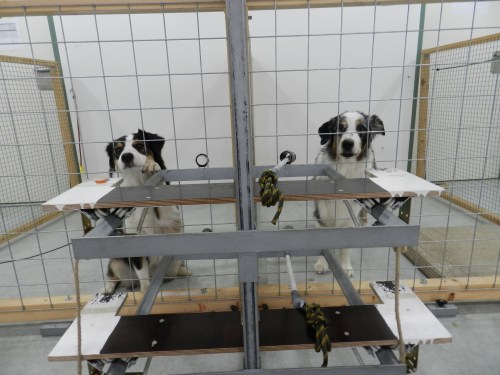
The researchers studied the prosocial behaviour of the animals using a bar-pulling task in which the dogs had to pull trays and decide whether a second dog would receive a treat or not. In the test, the donor dogs used their mouths to pull a string to bring a tray toward a second dog. They could choose either an empty tray or a tray containing a treat on the partner’s side.

The donor dog (right) can pull a tray and donate food to the receiver-dog (left). (Photo: Mylène Quervel-Chaumette/Vetmeduni Vienna)

The donor dog (right) can pull a tray and donate food to the receiver-dog (left). (Photo: Mylène Quervel-Chaumette/Vetmeduni Vienna)

Dogs donate to familiar partners more often than to unfamiliar ones

Whether the donor dogs knew the recipient made a difference. Donor dogs pulled the giving tray more often for familiar dogs than for unfamiliar ones. “Dogs truly behave prosocially toward other dogs. That had never been experimentally demonstrated before. What we also found was that the degree of familiarity among the dogs further influenced this behaviour. Prosocial behaviour was exhibited less frequently toward unfamiliar dogs than toward familiar ones.

Prosocial behaviour put to the test

In the bar-pulling task, the donor dogs decided whether another dog would receive a treat or not. The donor dog itself did not get the treat. The only purpose of the task was to benefit the other dog. By conducting several control tests, the researchers excluded the possibility that the dogs were simply pulling the trays for the fun of it. Donor dogs were reserved in pulling the tray when an unfamiliar dog was in the next enclosure.

At the end of each test run, the researchers conducted another test to show that the donor dogs knew what pulling the tray meant. They allowed the donor dogs to pull on a tray to give themselves a treat, and all dogs did just that. “This control excludes the possibility that the dogs did not pull on the tray out of fear of the unfamiliar dogs. Given the same situation, the dogs gladly gave themselves a treat,” says Range.

“We were also able to disprove the argument that the dogs pulled the string less frequently because they were distracted by the unfamiliar partner during the test. Only rarely did a donor dog interact with the unfamiliar dog,” Range explains.

Source:   Vetmeduni Vienna media release

Christmas house guest

It’s been a busy week and so the blog has been quieter than normal.  Then yesterday, on Christmas Eve, I got a text from another greyhound owner.  His kennel plans had fallen through and he wondered if I could take his dog, Sala, for a couple of days.

No worries!

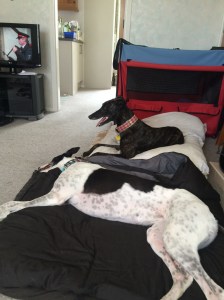
Bed switching

To make a house guest feel welcome, you let them sleep in your bed. You sleep in theirs.

Izzy has enjoyed having a playmate today (Christmas Day).  We went for an off-leash run at the Groynes dog park.

Izzy at Groynes

And after a breakfast, it was time for a big rest.

Greyhound on sofa

Izzy never goes on the sofa (she prefers the queen-sized bed). Sala found it quite comfortable, however.

Then it was time to tuck into the pigs ears that Sala’s Dad brought:

Followed later by an afternoon walk, and some cooked liver over dog food.  We are once again settling in for the night and more play time tomorrow.

Kathleen Crisley, specialist in dog massage, rehabilitation and nutrition/food therapy, Canine Catering Ltd, Christchurch, New Zealand