Tag Archives: cancer

Scientists test nanoparticle drug delivery in dogs with osteosarcoma

At the University of Illinois, an engineer teamed up with a veterinarian to test a bone cancer drug delivery system in animals bigger than the standard animal model, the mouse. They chose dogs – mammals closer in size and biology to humans – with naturally occurring bone cancers, which also are a lot like human bone tumors.

wikimedia-commons-photo-of-bmd

Dogs with naturally occurring cancers are more similar in size and biology to humans than are other mammals, such as mice. Public domain photo: Wikimedia Commons

In clinical trials, the dogs tolerated the highest planned doses of cancer-drug-laden nanoparticles with no signs of toxicity. As in mice, the particles homed in on tumor sites, thanks to a coating of the drug pamidronate, which preferentially binds to degraded sites in bone. The nanoparticles also showed anti-cancer activity in mice and dogs.

The researchers report their results in the Proceedings of the National Academy of Sciences.

These findings are a proof-of-concept that nanoparticles can be used to target bone cancers in large mammals, the researchers said. The approach may one day be used to treat metastatic skeletal cancers, they said.

The dogs were companion animals with bone cancer that were submitted for the research trials by their owners, said U. of I.  Professor Dr Timothy Fan, who led the study with materials science and engineering Professor Jianjun Cheng.  All of the dogs were 40 to 60 kilograms (88 to 132 pounds) in weight, he said.

“We wanted to see if we could evaluate these drug-delivery strategies, not only in a mouse model, but also at a scale that would mimic what a person would get,” Fan said. “The amount of nanoparticle that we ended up giving to these dogs was a thousand-fold greater in quantity than what we would typically give a mouse.”

Using nanoparticles with payloads of drugs to target specific tissues in the body is nothing new, Cheng said. Countless studies test such approaches in mice, and dozens of “nanopharmaceuticals” are approved for use in humans. But the drug-development pipeline is long, and the leap from mouse models to humans is problematic, he said.

“Human bone tumors are much bigger than those of mice,” Cheng said. “Nanoparticles must penetrate more deeply into larger tumors to be effective. That is why we must find animal models that are closer in scale to those of humans.”

Mice used in cancer research have other limitations. Researchers usually inject human or other tumor cells into their bodies to mimic human cancers, Fan said. They also are bred to have compromised immune systems, to prevent them from rejecting the tumors.

“That is one of the very clear drawbacks of using a mouse model,” Fan said. “it doesn’t recapitulate the normal immune system that we deal with every day in the person or in a dog.”

There also are limitations to working with dogs, he said. Dogs diagnosed with bone cancer often arrive at the clinic at a very advanced stage of the disease, whereas in humans, bone cancer is usually detected early because people complain about the pain and have it investigated.

“On the flip side of that, I would say that if you are able to demonstrate anti-cancer activity in a dog with very advanced disease, then it would be likely that you would have equivalent or better activity in people with a less advanced stage of the disease,” Fan said.

Many more years of work remain before this or a similar drug-delivery system can be tested in humans with inoperable bone cancer, the researchers said.

Source:  Illinois News Bureau media release

Kathleen Crisley, specialist in dog massage, rehabilitation and nutrition/food therapy, The Balanced Dog, Christchurch, New Zealand

The history of canine transmissible venereal cancer

Researchers at the University of Cambridge have produced this interesting YouTube video about how canine transmissible venereal cancer has spread over time.  If you are interested in evolution, genetics or DNA research – this video is for you.

See also my previous posts:

A dog cancer that is 11,000 years old

Global snapshot of infectious canine cancer

Kathleen Crisley, specialist in dog massage, rehabilitation and nutrition/food therapy, The Balanced Dog, Christchurch, New Zealand
 

Clinical trials to help beat cancer

Raelene Wouda’s passion for improving cancer treatment starts with our four-legged friends.

Dog cancer photo
Wouda, Kansas State University assistant professor of clinical sciences, is conducting clinical trials to treat cancers in dogs, cats and other companion animals.

When pet owners bring their dogs, cats, horses and other animals to the College of Veterinary Medicine’s Veterinary Health Center for treatment, Wouda and the Oncology Service can offer groundbreaking new treatments often at a lower cost to pet owners.

Wouda also is able to study important topics, such as improved diagnostic testing, monitoring approaches and innovative treatment options, including anti-cancer vaccines, t-cell transfer, combination chemotherapy and nanoparticle drug formulations. She has recently published her research in Veterinary Comparative Oncology and the Journal of the American Veterinary Medical Association.

“Although surgery, radiation therapy, chemotherapy and, more recently, immunotherapy have improved patient outcomes, many cancers still do not have a long-term cure,” said Wouda, a clinical veterinary oncologist. “These clinical trials are a crucial step.”

But Wouda’s research benefits humans, too. Many cancers in animals — especially dogs — are similar to those in humans, which means that the diagnosis, monitoring, treatment and response to treatment are also similar.

“Any research that we do in our patients has the potential to provide important information for how the disease can be better diagnosed, monitored and treated in human patients,” Wouda said. “That’s what I would like to do with our research. I would like to continue to improve outcomes for our veterinary patients and, by extension, help human cancer patients.”

Companion animals offer several research advantages. Wouda’s clinical trial program focuses primarily on dogs because of the similarities between their cancers and human cancers, such as osteosarcoma, melanoma, lung cancer and urogenital cancers. Osteosarcoma, for example, is both clinically and genetically almost identical in dogs and human pediatric patients.

Dogs also live with us and are exposed to the same environmental factors. Additionally, because dogs age faster than humans — one dog year is equivalent to seven human years — their diseases progress faster, which is a practical advantage for rapidly evaluating a new treatment’s efficacy and clinical benefit, Wouda said.

“We get clinical answers more quickly in dogs,” Wouda said. “The benefit of a particular therapy becomes evident in dogs more rapidly compared to people, and because of this we can preserve research and development finances, but more importantly, we save valuable time and resources.”

Animal clinical trials are structured similarly to human clinical trials and are tightly regulated and overseen. Wouda works with Mary Lynn Higginbotham, associate professor of clinical sciences, their graduate students and oncology technicians as well as the Veterinary Health Center’s referring veterinarians to conduct these clinical trials. They also collaborate with human medical researchers to discuss how the research can best be applied in the field of human oncology.

“For many pet owners, cancer is a terminal diagnosis for their beloved family member,” Wouda said. “These studies provide owners an opportunity to trial a cutting-edge therapy for their pets at a reasonable price. Moreover, owners participating in these clinical trials take comfort and are pleased to know that they are helping to achieve better treatments and outcomes for pets that may be diagnosed with cancer in the future.”

Source:  Kansas State University

The companionship of dogs helps kids undergoing cancer treatment

Although survival rates for children diagnosed with cancer have increased dramatically over the past 40 years, hard evidence of proven psychosocial benefits to improve quality of life among patients and families during treatment has remained elusive.

Many hospitals have therapy dogs who visit with patients, and anecdotal evidence underscores the positive impact these programs have on children with cancer and their families.

Preliminary findings from a new, multi-center trial provides some of the first quantitative data to validate these claims.  The study, to be presented at the American Academy of Pediatrics (AAP) National Conference & Exhibition in Washington, DC, collected data on blood pressure, pulse rates and anxiety levels of children before and after a weekly visit from a therapy dog. During the visits, children pet or talk to the dog, brush its fur, view the dog’s photos, watch the dog practicing tricks or commands, and learn about dog breeds.

Photo courtesy of University of Texas Health Science Center

Photo courtesy of University of Texas Health Science Center

Preliminary findings show that blood pressure readings in the group receiving animal-assisted interventions remains more stable across all sessions than in the control group, said lead researcher Amy McCullough, Ph.D., National Director of Humane Research and Therapy for the American Humane Association. Similarly, there was a higher degree of variability in heart rate within the control group patients than with the treatment group patients.

“These findings suggest that the dog may have a calming effect on the patient,” Dr. McCullough said.

In addition to the effects on pulse and heart rate to date, preliminary results indicate the canine encounters appear to improve anxiety levels among parents. Parents in the control group report fluctuating anxiety levels with peaks and valleys; parents in the treatment group show more consistency in anxiety levels, and even a small decline in anxiety levels by the end of their participating in the study. Overall, children in both groups saw a decrease in anxiety over the course of their study enrollment. Researchers are also gauging the therapy dogs’ temperament and behavior during the visits.

“This study will be a milestone in understanding of the benefits of the vital bond shared between people and animals,” Dr. McCullough said.

Source:  American Academy of Pediatrics media release

Puppy Up to Cancer

You’ve probably heard the terms ‘man up’ or ‘woman up’ – but how about ‘puppy up’?

That’s the origin of the name for the Puppy Up to Cancer initiative founded by the 2 Million Dogs Foundation.  Through every Puppy Up walk, funds are raised to help with cancer research.

Walks are usually led by human and canine survivors of cancer and often dogs who are infirm or who can’t walk for long distances participate by riding in wagons and carts.

Dogs are often used in comparative oncology studies because their cancers have commonalities with human cancers.

I think this  is a great idea and since we have many dogs in New Zealand who also fall to cancer, fundraising in this way would be a way of contributing to the body of knowledge.

Kathleen Crisley, specialist in dog massage, rehabilitation and nutrition/food therapy, Canine Catering Ltd, Christchurch, New Zealand

See something, do something

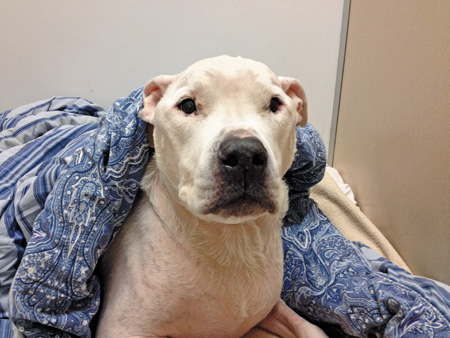
Dr Sue Ettinger is on a mission to help pet owners detect tumors early.  Her inspiration for this new program, called See Something, Do Something, was a 10-year old white pit bull named Smokey.

Smokey

Smokey

Dr Ettinger had aspirated approximately 10 masses from Smokey over the years and all came back as benign; so she wasn’t particularly worried when Smokey presented with another lump.  The clinic was so busy on the day he came in with his vet tech owner, that he never got tested that day and waited another week before returning to the clinic.

When it was aspirated, it wasn’t a lipoma and testing revealed a soft tissue sarcoma.  It hadn’t spread to other parts of the body, but a 7 cm mass with 3 cm margins was a very big surgery; they got it all and so Smokey was out of the woods.

But Dr Ettinger combed through literature to find out if there were guidelines for vets and owners about diagnosing lumps and bumps.  There weren’t and she decided to take action.

So she’s come up with:

See Something?  If a dog or cat has had a lump that is larger than a pea and has been there for more than a month…

Do Something! Go to a vet and get it aspirated or biopsied.

and even a shorter call to action:  Why Wait? Aspirate!

Simple rules that could save the life of your pet and also avoid needless pain and suffering.

Sue Ettinger is one of approximately 300 board-certified veterinary specialists in medical oncology in North America. Dr Sue is a staff oncologist and initiated the medical oncology service at the Animal Specialty Center (ASC), a private practice specialty hospital in Westchester, just north of New York City.

Sue Ettinger is one of approximately 300 board-certified veterinary specialists in medical oncology in North America. Dr Sue is a staff oncologist and initiated the medical oncology service at the Animal Specialty Center (ASC), a private practice specialty hospital in Westchester, just north of New York City

Kathleen Crisley, Fear-Free certified professional and specialist in dog massage, rehabilitation and nutrition/food therapy, The Balanced Dog, Christchurch, New Zealand

Dog sledding is an adventure for kids with cancer

A young cancer patient on the dog sled Credit: Emmanuelle Compte

A young cancer patient on the dog sled Credit: Emmanuelle Compte

A team of sled dogs racing through the snowy forests of northern Canada conjures up the timeless spirit of exploration. But the intrepid youths on the sleds may not be exactly what you’re picturing – they’re young girls and boys with cancer.

A common perception of the paediatric cancer patient is of a frail youth whose childhood experiences are tragically curtailed by the disease. Now, the results of a new preliminary study published in ecancermedicalscience show that children with cancer may benefit from a different kind of treatment – a healthy dose of adventure.

The study follows eleven children aged 10-18 years, and five chaperones including doctors and nurses, on an expedition organised by the French non-profit Sourire à la Vie, which supports the use of adapted physical activity for young cancer patients.

“What I learned from this study is that we doctors have the false belief that kids with cancer cannot practice sport because they are too tired or weak from their treatments,” says corresponding author of the study, Dr Nicolas André. He’s a paediatric oncologist at the Assistance Publique Hôpitaux de Marseille, France.

“These perceptions are at least partly wrong,” Dr André says. “Adapted physical activities can be performed by most children with cancer even during their treatment, and can bring a lot to children.”

All of the eleven children received adapted physical training and exercises before the expedition. The children successfully completed the programme without harm – and they demonstrated statistically significant improvement in both physical and psychological health.

The children participated in other activities, such as snow exercises, as well as caring for the sled dogs.

“One of the main reasons why we chose dog sledding was to create a unique sportive experience based on change of scenery and building a strong relationship with animals,” explains study author Frédéric Sotteau, founder of Sourire à la Vie.

The health and safety of the children was of paramount concern, Sotteau says. “We did not compromise regarding security, so we carefully prepared the expedition hand-in-hand with Canadian associations and doctors.”

“Based on our work over the last eight years, we all are convinced that practicing adapted physical activity is very positive for children with cancer,” comments study author Professor Laurent Grélot, a researcher at Aix Marseille University, France. “It avoids cardiovascular and muscular deconditioning, can decrease treatment induced fatigue, and can help maintaining social integration.”

“It is now time to demonstrate these results.”

Based on the success of this study, the researchers have collected enough funding to initiate a randomised trial to evaluate the benefits of adapted physical activities for children with cancer. But perhaps the best take-home message comes from the children themselves.

“Before my cancer diagnosis, I used to do a lot of sport, but then I lost self-confidence and my body was not able to cope with physical efforts,” says Merwan, an 18-year-old patient. “This trip in Canada transformed me. I am in shape again, and now I know I am able to practice sport again.”

“I have been dog sledding for 6 hours a day,” adds Nell, a 12-year-old patient. “I am very proud, and I feel so good now.”

Source:  AlphaGalileo media release

Drug trials in pet dogs with cancer

Physiological similarities between dogs and humans, and conserved genetics between some dog and human cancers, can allow pet dogs to serve as useful models for studying new cancer drugs, says Dr Timothy Fan of the University of Illinois.

Timothy Fan, professor of veterinary clinical medicine. With his personal dog, Ember

Timothy Fan, professor of veterinary clinical medicine. With his personal dog, Ember  photo by L. Brian Stauffer

In a meeting sponsored by the National Cancer Policy Forum of the National Academies’ Institute of Medicine in Washington, D.C., Fan and 15 other experts in the field described the benefits of using pet dogs with naturally occurring (rather than laboratory-induced) tumors in early cancer drug trials.

“We have a lot of dogs in the United States, approximately 70 million of them, and it’s believed that about 25 percent of pet dogs will develop some form of cancer in their lifetime,” he said. “We’re using dogs to help guide drug development for people, but at the same time we’re offering new, innovative therapies that would otherwise never be available to dogs, to help them as well.”

Several attributes make pet dogs attractive subjects for such studies, Fan said.

“Dogs tend to develop cancer as a geriatric population, just like people,” he said. “Because the tumors develop spontaneously, there is heterogeneity in that tumor population, as a human being would have. The size of the tumors and the speed of growth of those tumors are comparable in dogs and human beings. So there are many attributes of a dog that develops cancer spontaneously that recapitulate the biology that we see in people.”

Some studies have already begun using dogs to test new cancer therapies. Starting in 2007, for example, Fan began testing an anti-cancer drug called PAC-1  in pet dogs with naturally occurring lymphomas and osteosarcomas. The results in dogs allowed the scientists to advance PAC-1 as a potential therapy against human cancers. The drug is now in phase I human clinic trials.

“Another example in which dogs have been important in demonstrating drug activity was an anti-cancer compound produced by the pharmaceutical company Gilead Sciences,” he said. “The company produced a pro-drug, which must be activated by a naturally occurring enzyme in human leukocytes before it can become effective. Mice and rats lack this enzyme, but dogs have it, so the compound was tested in dogs.”

There also are limitations to the use of pet dogs in cancer drug trials.

“There are some tumors that will not be that relevant,” Fan said. “Colon cancer, for example, is heavily driven by diet, and we don’t see much colon cancer in dogs. So pet dogs might not be a suitable model for colon cancer in humans.”

“There is heterogeneity in the human population and in dogs. So I would argue that if your drug agent produces positive results in dogs, that would give me greater confidence that those findings would be translatable to people.”

Source:  University of Illinois media release

In Memory of Denali (a fitting 1000th post)

****Warning****   For anyone who has loved and lost a dog, this video will bring you to tears.  It certainly did for me.  But I couldn’t think of a more fitting 1000th post for this blog – a tribute to the human/dog bond.

This short film is about Denali, photographer/cinematographer Ben Moon’s dog, and their life story together.

Kathleen Crisley, specialist in dog massage, rehabilitation and nutrition/food therapy, Canine Catering Ltd, Christchurch, New Zealand


Dogs absorb lawn chemicals

Dogs exposed to garden and lawn chemicals may have a higher risk of bladder cancer. iStockPhoto

Dogs exposed to garden and lawn chemicals may have a higher risk of bladder cancer.
iStockPhoto


Dogs are ingesting, inhaling and otherwise being exposed to garden and lawn chemicals that have been associated with bladder cancer, according to a new study.

The paper, which will appear in the July issue of Science of the Total Environment, also found that wind could carry the chemicals to untreated properties. The researchers also found that dogs, once contaminated by the chemicals, can transfer them to their owners.

The chemicals are common herbicides containing the following: 2,4-dichlorophenoxyacetic acid (2,4-D), 4-chloro-2- methylphenoxypropionic acid (MCPP) and/or dicamba.

“The routes of exposure that have been documented in experimental settings include ingestion, inhalation and transdermal exposures,” lead author Deborah Knapp of Purdue University’s Department of Veterinary Clinical Sciences, told Discovery News.

“In the case of dogs,” she added, “they could directly ingest the chemicals from the plant, or they could lick their paws or fur and ingest chemicals that have been picked up on their feet, legs or body.”

Scottish terriers, West Highland white terriers, Shetland sheepdogs, beagles and wire hair fox terriers are all at particular risk, the researchers suggest, because these breeds have a high genetic propensity for bladder cancer.

Knapp and her colleagues first conducted an experimental grass plot study that involved spraying various defined patches with the chemicals under different conditions. These included spraying the herbicides on plots that were green, dry brown, wet or recently mowed. The researchers next measured how much of the chemicals remained on the grass up to 72 hours post treatment.

Co-author Angus Murphy, also from Purdue, explained that dead or dying plant material does not readily absorb the chemicals, “so the herbicide can remain longer on the surface of the plant.”

He continued, “If an excessive amount of herbicide is applied, then the capacity of the target plant to take up the compound may be overwhelmed.”

In a second experiment, the researchers analyzed urine samples of dogs from households that either used herbicides or didn’t. The majority of dogs from homes that used the chemicals were found to have these same herbicides in their urine. Some dogs from untreated homes also had the chemicals in their urine.

Knapp explained that wind could cause the herbicides to travel up to 50 feet away from the application site. Neighbors who use the chemicals might therefore impact other individuals in the area.

“There are industry guidelines for restricting lawn chemical application based on wind speed, although homeowners may not be aware of these,” Knapp said.

Once contaminated, dogs can pass the chemicals on to their owners and to others. The study only looked at dogs, but the researchers suspect that cats and other pets could also be affected.

“Dogs can pick up the chemicals on their paws and their fur,” Knapp said. “They can then track the chemicals inside the house, leaving chemicals on the floor or furniture. In addition, if the dog has chemicals on its fur, the pet owner could come in contact with the chemicals when they pet or hold the dog.”

John Reif, a professor emeritus of epidemiology at the Colorado School of Public Health, told Discovery News, “The paper presents important information since exposure to 2,-4-D, a widely used broad leaf herbicide, has been associated with increased risk of cancer in pet dogs and humans.”

Reif added, “This study has potentially important implications for human health since it demonstrates widespread exposure to pet dogs. The likelihood that children, who share the local environment with their pets, are similarly exposed to these chemicals is high and thus additional studies should be conducted to evaluate this possibility.”

The researchers suggest that if owners still must use herbicides, they should follow manufacturer guidelines, allow gardens and lawns to dry before allowing pets out, wash their dog’s feet each time the dog comes inside, and consider treating the back yard one week before the front (or vice versa) so that pets will have an area of less potential chemical exposure available to them.

Source:  Discovery.com


