Tag Archives: commercial foods

Oxidation of commercial pet foods

Over the world, dog owners are finding ways to cut costs in the face of high inflation.

Many who feed commercial foods (commonly referred to as kibble), will look to buying the largest size bag of food possible because typically the price per pound/kg is best when you buy a large bag.
When using kibble, you need to understand the process of oxidation. Oxidation happens as soon as you open the bag and expose the food to air and that process continues until your dog eats the food.

Oxidation happens to human food, too, by the way.

Oxidation degrades the nutrients in the food and chemically changes the fats in a process known as “going rancid.”

It’s tempting to want to empty the bag into a more convenient container and often this container will be plastic. The problem is that most containers that can hold a large bag of dog food are not food-grade plastic.

Food-grade plastics are designed to come into contact with food, to have a strong seal, and to avoid leaching of chemicals into food. Food grade plastics don’t have dyes or other additives and they often are not made from 100% recycled plastic because there is no guarantee on the quality of materials in the supply chain.

Bags for commercial dog food are produced to help protect against oxidation; it’s actually better to seal the bag as soon as you take out what you need and to keep the bag in a cool, dry and dark place rather than emptying it into another container. If a container is needed, I prefer metal to plastic because it won’t leach nasties into the food and can be washed and dried at high temperature in the dishwasher. I only transfer enough food to last between 5 and 7 days.

Regular washing of containers to remove residual fats and crumbs is essential and something that dog owners are notoriously bad at doing. It’s just too easy to refill a container without washing it.

I’m old enough to remember when dog food companies produced larger metal tins for dog food as part of their brand promotions; I still own one from Iams/Eukanuba that is over 20 years old and that’s the container I use for temporary food storage. It fits in the dishwasher and I’m confident that it is being cleaned and sterilised in the dishwasher.

Sadly, even the pet food companies have jumped on the plastic bandwagon in more recent years and now only produce plastic containers when/if they have a promotion. I’m not sure if these containers are food grade plastic, either.

There are many opinions about how much food you should buy at any given time. A good rule of thumb is 4-6 week’s worth. Of course, if your dog is small, then a 20 kg bag of food is going to last way longer than this – so that’s a good indication that the large bag is not right for you.

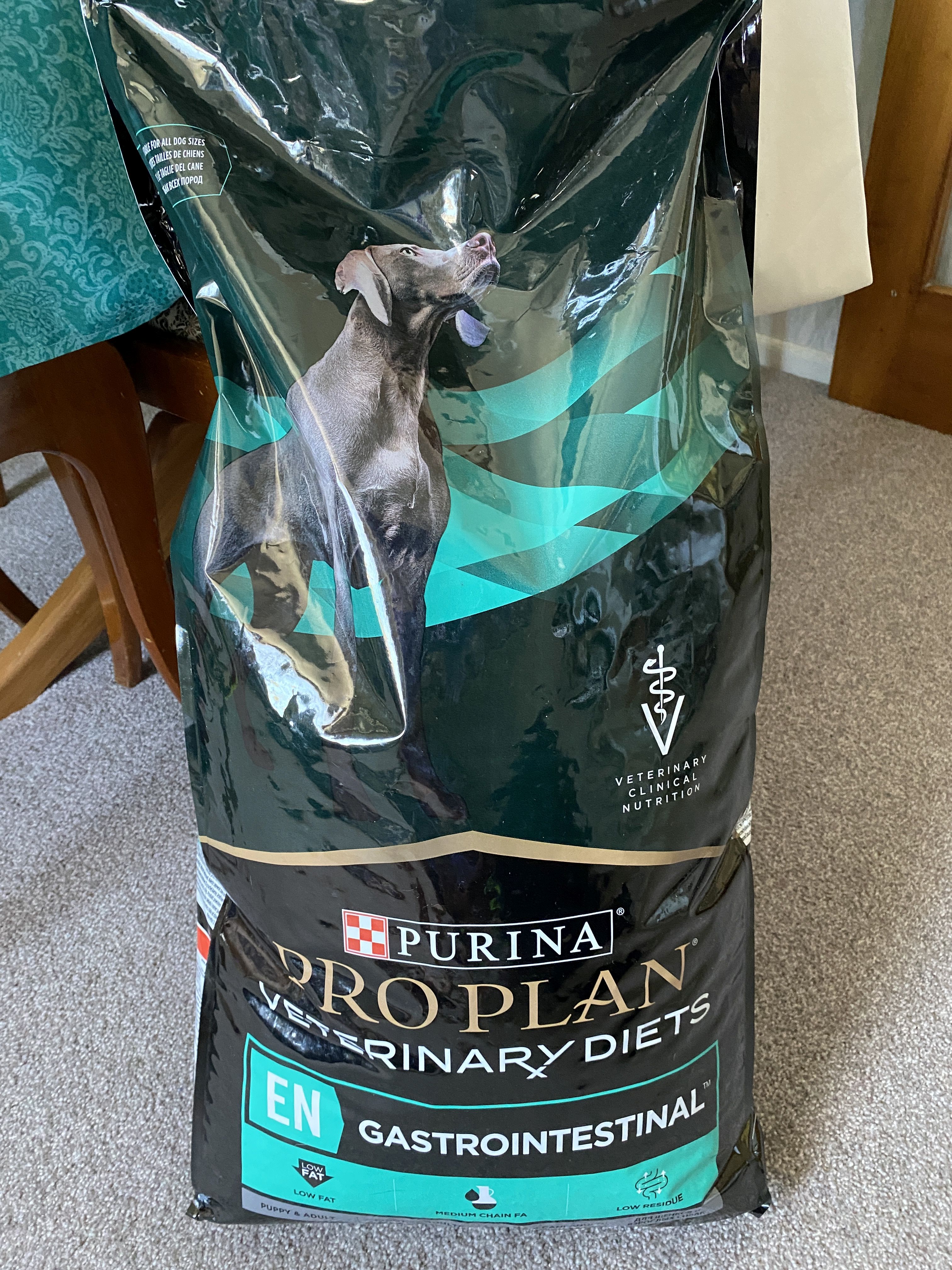
Sox easily goes through his 12 kg bag of gastrointestinal food in less than six weeks; so I’m comfortable with my decision to buy the bag.

In summary, when feeding kibble:

  • buy only 4-6 week’s worth at a time
  • keep the bag sealed after every use
  • store the bag in a cool, dry and dark place
  • if a container is convenient for you, transfer only a few days worth of food into the container, preferably metal
  • if you can’t find metal ensure you are using a food-grade plastic container
  • thoroughly wash and dry your container each time you empty it

Kathleen Crisley, Fear-Free certified professional and specialist in dog massage, rehabilitation and canine fitness,  The Balanced Dog, Christchurch, New Zealand

What’s cooking? It smells great!

A courier came to the door this morning to deliver several parcels.  She said, “What’s cooking – it smells great!”  And I replied, “I’m cooking a casserole for my dog in the slow cooker.”

This particular casserole is made with fresh broccoli, lamb heart, lean beef schnitzel, and fresh ginger.

This particular casserole is made with fresh broccoli, lamb heart, lean beef schnitzel, and fresh ginger.

After a brief pause, she smiled and said, “Lucky dog.”

I feed a combination of raw, homemade and commercial foods. It’s important to feed a nutritionally complete diet and so homemade diets will most likely need supplementation.

I consult with dog owners who want feeding advice and I incorporate Traditional Chinese Medicine assessment techniques for food matching.  I am not affiliated with any dog food manufacturer and so my advice is completely independent.

Need to know more?  Get in touch with me via my company website.

Kathleen Crisley, specialist in dog massage, rehabilitation and nutrition/food therapy, The Balanced Dog, Christchurch, New Zealand

Pukka’s Promise

Pukka's Promise coverIf I had to choose a byline for this book review, it would be ‘Ted Does It Again.”

Author Ted Kerasote has delivered another great dog book following the success of Merle’s Door which I have previously reviewed.

This book, inspired in part by the large volume of correspondence Ted received after releasing Merle’s story, documents Ted’s extensive research into the health of dogs and the factors that may determine longevity.   So many ‘dog people’ contacted Kerasote asking variations of the same question  – ‘why don’t our dogs live longer?’  And since Ted felt the same way, he did what any professional journalist would do – he asked lots of questions.

In Pukka’s Promise -The Quest for Longer-Lived Dogs, Ted tackles subjects including nutrition, the politics behind the pet food industry, and what diet is right for dogs.  Ted lays out the facts about raw food and commercial diets, the concerns about grains  and whether they are appropriate for dogs and a favourite topic of mine – variety in the diet.

Because Kerasote observes his dog so well, he realises that there are times when Pukka (pronounced PUCK-ah) rejects the food that is laid before him.  Pukka lets Ted know that he prefers something else one day when he follows him into the pantry.  Having rejected raw lamb, Pukka readily accepts some dried elk chips.  Ted then listens more often to what Pukka would like for his meals noting, “Today I do not want sardines, I want chicken.  Yes, I do love elk, but this evening I prefer dried elk.”

And just as he did in Merle’s Door, this communication between Kerasote and Pukka is not contrived nor do these moments come across as a story book type of anthropomorphism.  Kerasote is a keen observer and dog aficionado.  When he listens or hears Pukka, it’s because he understands what his dog is trying to tell him and translates it into words.  Few authors could achieve this in such a natural way.

An example of the communication between Ted and Pukka comes when Ted is frustrated by Pukka’s excessive barking.  Dog trainers should be prepared that Ted’s solution doesn’t come from clicker training or positive reinforcement, although Ted tries these things.  Ted’s solution is a direct result of understanding dog behaviour and putting that knowledge to good use.  It helps that Ted can communicate in dog.   Enough said; you’ll have to read the book for the ending of this tale.

Kerasote covers a range of health topics including vaccinations, the history of the ‘annual vaccination’ recommendation, and the latest research on why over-vaccinating is a concern.  A good message to take away from reading the book is to enquire with your vet about having your dog ‘titered’ to determine the amount of immunity they still have from previous vaccinations.

Still other issues that are tackled in a thorough way are the effects of neutering and alternatives to the traditional spay/neuter operation that may help our dogs retain the health-preserving effects of their natural sex hormones.  Kerasote also questions the spay/neuter philosophy in a constructive way and whether you agree with his conclusions or not, he does lay out the facts very well.

Another topic that I hold dear is the issue of cancer and the simple message – if you find a lump on your dog, don’t let anyone (including your vet) tell you to ‘wait and see.’  Some lumps, if caught early and tested, can be removed before the disease takes over the comparatively small body of a dog.  Take heed!

As a backdrop to the book’s hard facts, we also get to enjoy a wonderful story about Ted’s search for another dog and his choice of Pukka.  Once Pukka’s is on the scene, we share some of their adventures.

My only criticism of this book is its lack of photos.  Other than the cover photo of Pukka, we don’t get to enjoy any photos of Pukka, Ted, or their other dog friends (A.J., Burley and Goo) nor any of the great scenery from Ted’s camping and hunting trips with Pukka.  I don’t think photos would have detracted from the contents and scope of the book, but I guess that’s the publisher’s decision.

With 49 pages of references, this is a thoroughly researched book that took five years to complete.  Add it to your book collection and refer back to it as the basis for a conversation with your vet (your dog will love you for it).

Well done, Ted!  What are you cooking up for us next?