“Children and dogs are as necessary to the welfare of the country as Wall Street and the railroads.”
– Harry S Truman, 33rd President of the United States

“Children and dogs are as necessary to the welfare of the country as Wall Street and the railroads.”
– Harry S Truman, 33rd President of the United States

“Dogs are my favorite role models. I want to work like a dog, doing what I was born to do with joy and purpose. I want to play like a dog, with total, jolly abandon. I want to love like a dog, with unabashed devotion and complete lack of concern about what people do for a living, how much money they have, or how much they weigh. The fact that we still live with dogs, even when we don’t have to herd or hunt our dinner, gives me hope for humans and canines alike.”
– Oprah Winfrey, actress, writer, talk show host, philanthropist

Would you rather get 100 euros for certain, or have a fifty-fifty chance of receiving either 200 euros or nothing? Most choose the first, as humans tend to be “risk-averse”, preferring a guaranteed pay-off over the possibility of a greater reward. It is thought that the human preference for “playing it safe” has evolved through natural selection: when you live precariously, like our remote ancestors, losing all your food reserves might be catastrophic, while adding to them might not make much difference to your chances of survival.

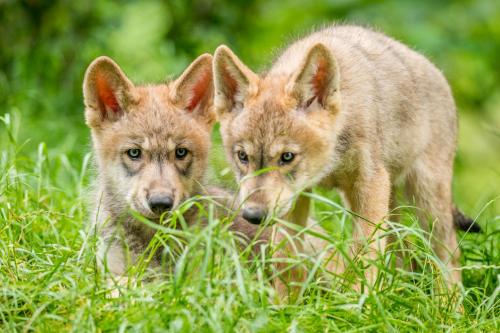
Etu and Ela, two wolf pups at the Wolf Centre Photo credit: Rooobert Bayer
Here, in one of the first studies on risk preferences in animals other than primates, scientists show that wolves are consistently more prone to take risks when gambling for food than dogs. When faced with the choice between an insipid food pellet and a fifty-fifty chance of either tasty meat or an inedible stone, wolves nearly always choose the risky option, whereas dogs are more cautious.
“We compared the propensity to take risks in a foraging context between wolves and dogs that had been raised under the same conditions,” says Sarah Marshall-Pescini, a postdoctoral fellow at the Messerli Research Institute at the Veterinary University of Vienna and the Wolf Science Centre, Ernstbrunn, Austria, the study’s first author. “We found that wolves prefer the risky option significantly more often than dogs. This difference, which seems to be innate, is consistent with the hypothesis that risk preference evolves as a function of ecology.”
The study was done at the Wolf Science Centre, Ernstbrunn, Austria, a research institute where scientists study cognitive and behavioral differences and similarities between wolves and dogs. Here, wolves and dogs live in packs, under near-natural conditions within large enclosures.
Marshall-Pescini let each of 7 wolves and 7 dogs choose 80 times between two upside-down bowls, placed side-by-side on a movable table-top. The animals had been trained to indicate the bowl of their choice with their paw or muzzle, after which they would receive the item that was hidden beneath it.
The researchers had taught the wolves and dogs that beneath the first bowl, the “safe” option, was invariably an insipid food pellet, while beneath the second bowl, the “risky” option, was either an inedible item, a stone, in a random 50% of trials, and high-quality food, such as meat, sausage, or chicken, in the other 50%. As a control, the side for the “safe” and “risky” option changed between trials, but the animals were always shown which side corresponded to which option; whether they would get a stone or high-quality food if they chose the “risky” option was the only unknown. Rigorously designed control trials confirmed that the animals understood this rule, including the element of chance.
Wolves are much more prone to take risks than dogs, show the results. Wolves chose the risky option in 80% of trials, whereas dogs only did so in 58% of trials.
The researchers believe that dogs evolved a more cautious temperament after they underwent an evolutionary shift from their ancestral hunter lifestyle to their present scavenger lifestyle, which happened between 18,000 to 32,000 years ago when humans first domesticated dogs from wolves. Previous research has suggested that species that rely on patchily distributed, uncertain food sources are generally more risk-prone. For example, chimpanzees, which feed on fruit trees and hunt for monkeys, are more risk-prone than bonobos, which rely more on terrestrial vegetation, a temporally and spatially reliable food source.
“Wild wolves hunt large ungulates — a risky strategy, not only because hunts often fail, but also because these prey animals can be dangerous — whereas free-ranging dogs, which make up 80% of the world’s dog population, feed mostly by scavenging on human refuse, a ubiquitous, unlimited resource. So dogs no longer need to take risks when searching for food, and this may have selected for a preference to play if safe,” concludes Marshall-Pescini.
Source: EurekAlert! media statement
The Olympics are in full swing, covered in all forms of media but especially television. I have to say that the Olympic-themed commercials in New Zealand are pretty bland.
My hat goes off to Farmers Insurance for their Flooded House Diving Dogs Competition commercial series – a great use of dogs and the Olympic theme. A group of unattended dogs accidentally flood their home and compete in their own diving competiton.
There are eight commercials in the series starting with the Intro. Once the Intro plays, simply click on the next video.
Enjoy watching Tank, Bubbles, Nacho, Churchill, Toby, Oksana and Montana…
Kathleen Crisley, specialist in dog massage, rehabilitation and nutrition/food therapy, The Balanced Dog, Christchurch, New Zealand
Posted in Dogs, dogs in advertising
Tagged dogs, Farmers Insurance, Flooded House Diving Competition
I write frequently about special dogs and assistance dogs. But this post isn’t about research – it’s about real-life stories where common pet dogs have detected cancer in their owner.
For example, I have a client in my massage practice who said that her dog was acting differently towards her. We initially attributed this to stress in the home – since they had recently moved house with all of the associated angst. And then came a diagnosis of bladder cancer and she’s now in the middle of aggressive treatment for it.. On reflection, I believe her dog, who is a sensitive boy, picked up on the scent of her cancer but he didn’t know how to tell her.
And then this week, I read about Banjo who lives in North Carolina with his owner, Tim Buckner. Banjo acted strangely to a wart on his Tim’s arm…and when Tim went to get it checked by a dermatologist, he was diagnosed with melanoma.
We know that dogs have extremely sensitive noses. And I include here the PBS NewsHour item about dogs and how they can detect cancer. This piece opens with yet another dog owner telling the tale of how her dog detected her cancer.
Dogs continue to show us unique ways they can help us and our quality of life. You may have saved your pet, but your pet could also save you.
Kathleen Crisley, specialist in dog massage, rehabilitation and nutrition/food therapy, The Balanced Dog, Christchurch, New Zealand
Posted in Dogs, special dogs and awards
Tagged cancer detection, cancer sniffing dogs, dogs, melanoma

“He’s a hard dog to keep on the porch”
– Presidential candidate Hillary Clinton, on her husband Bill

A fossil found in Maryland was identified by a University of Pennsylvania doctoral student as belonging to a new species of ancient dog. The hyena-like canine, with massive jaws capable of crushing bone, would have lived approximately 12 million years ago, at a time when massive sharks like megalodon swam in the oceans. Credit: Illustration of Cynarctus from “Dogs, Their Fossil Relatives and Evolutionary History.” Reprinted and used with permission of the publisher and Mauricio Antón, author of the illustration and copyright owner [2008]; Courtesy of University of Pennsylvania
The newly named species is Cynarctus wangi, named for Xiaoming Wang, curator at the Natural History Museum of Los Angeles County and a renowned expert on mammalian carnivores. This coyote-sized dog was a member of the extinct subfamily Borophaginae, commonly known as bone-crushing dogs because of their powerful jaws and broad teeth.
“In this respect they are believed to have behaved in a similar way to hyenas today,” said the study’s lead author, Steven E. Jasinski, a student in the Department of Earth and Environmental Science in Penn’s School of Arts & Sciences and acting curator of paleontology and geology at the State Museum of Pennsylvania in Harrisburg.
Fossils from terrestrial species from this region and time period are relatively rare, thus the find helps paleontologists fill in important missing pieces about what prehistoric life was like on North American’s East Coast.
“Most fossils known from this time period represent marine animals, who become fossilized more easily than animals on land,” Jasinski said. “It is quite rare we find fossils from land animals in this region during this time, but each one provides important information for what life was like then.”
Whenco-researchers Jasinski and Wallace first began their investigation of the specimen, which had been found by an amateur collector along the beach under the Choptank Formation in Maryland’s Calvert Cliffs region and was then held by the Smithsonian Institution, they presumed it was a known species of borophagine dog, a species called marylandica that was questionably referred to as Cynarctus, a fossil of which had been found in older sediment in the same area. But when they compared features of the occlusal surfaces, where the top and bottom teeth meet, of the previously known and the new specimens, they found notable differences. They concluded that the specimen represented a distinct species new to science.
“It looks like it might be a distant relative descended from the previously known borophagine,” Jasinski said.
Borophagine dogs were widespread and diverse in North America from around 30 million to about 10 million years ago. The last members went extinct around 2 millions of years ago during the late Pliocene. C. wangi represents one of the last surviving borophagines and was likely outcompeted by ancestors of some of the canines living today: wolves, coyotes and foxes.
Despite its strong jaws, the researchers believe C. wangi wouldn’t have been wholly reliant on meat to sustain itself.
“Based on its teeth, probably only about a third of its diet would have been meat,” Jasinski said. “It would have supplemented that by eating plants or insects, living more like a mini-bear than like a dog.”
“This new dog gives us useful insight into the ecosystem of eastern North America between 12 and 13 million years ago,” Jasinski said.
Source: PennNews media release
Banfield Pet Hospital has published the results of its first-ever study of pet-friendly workplaces in the United States…

Posted in dog-friendly workplaces, Dogs
Tagged Banfield Pet Hospital, dogs, human resources, pet-friendly workplaces, survey
Yes, according to a new study published in Anthrozoös, a multidisciplinary journal of the interactions of people and animals.

Photo courtesy of http://www.DogChannel.com
In collaboration with the pet store chain PetSmart, the researchers recruited 1,210 single pet owners through the online dating service Match.com. In the pool of participants, 60% were women and 40% were men; 72% were dog owners and 42% cat owners.
The subjects took a 21-question online survey about how pets entered into their dating lives and 35% percent of women and 26% of men said they had been more attracted to someone because they owned a pet.
Dogs won 500 of the 600 votes for the sexiest pet a guy could own.
Author of the recently published article entitled ‘The Roles of Pet Dogs and Cats in Human Courtship and Dating’ Peter Gray, said: “The direction of these patterns in results was toward cats being exploited less often than dogs as “social tools” in the dating world”.
So if you want to increase your dating chances, get a dog.
Source: Taylor & Francis media release
The Roles of Pet Dogs and Cats in Human Courtship and Dating, Peter B. Gray et al, Volume 28, Issue 4, 2015, Anthrozoös: A multidisciplinary journal of the interactions of people and animals.
Read the full article online:http://www.tandfonline.com/doi/pdf/10.1080/08927936.2015.1064216