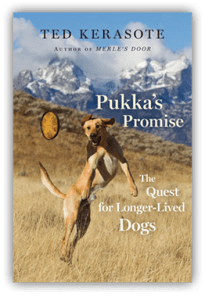
 If I had to choose a byline for this book review, it would be ‘Ted Does It Again.”
Author Ted Kerasote has delivered another great dog book following the success of Merle’s Door which I have previously reviewed.
This book, inspired in part by the large volume of correspondence Ted received after releasing Merle’s story, documents Ted’s extensive research into the health of dogs and the factors that may determine longevity. So many ‘dog people’ contacted Kerasote asking variations of the same question – ‘why don’t our dogs live longer?’ And since Ted felt the same way, he did what any professional journalist would do – he asked lots of questions.
In Pukka’s Promise -The Quest for Longer-Lived Dogs, Ted tackles subjects including nutrition, the politics behind the pet food industry, and what diet is right for dogs. Ted lays out the facts about raw food and commercial diets, the concerns about grains and whether they are appropriate for dogs and a favourite topic of mine – variety in the diet.
Because Kerasote observes his dog so well, he realises that there are times when Pukka (pronounced PUCK-ah) rejects the food that is laid before him. Pukka lets Ted know that he prefers something else one day when he follows him into the pantry. Having rejected raw lamb, Pukka readily accepts some dried elk chips. Ted then listens more often to what Pukka would like for his meals noting, “Today I do not want sardines, I want chicken. Yes, I do love elk, but this evening I prefer dried elk.”
And just as he did in Merle’s Door, this communication between Kerasote and Pukka is not contrived nor do these moments come across as a story book type of anthropomorphism. Kerasote is a keen observer and dog aficionado. When he listens or hears Pukka, it’s because he understands what his dog is trying to tell him and translates it into words. Few authors could achieve this in such a natural way.
An example of the communication between Ted and Pukka comes when Ted is frustrated by Pukka’s excessive barking. Dog trainers should be prepared that Ted’s solution doesn’t come from clicker training or positive reinforcement, although Ted tries these things. Ted’s solution is a direct result of understanding dog behaviour and putting that knowledge to good use. It helps that Ted can communicate in dog. Enough said; you’ll have to read the book for the ending of this tale.
Kerasote covers a range of health topics including vaccinations, the history of the ‘annual vaccination’ recommendation, and the latest research on why over-vaccinating is a concern. A good message to take away from reading the book is to enquire with your vet about having your dog ‘titered’ to determine the amount of immunity they still have from previous vaccinations.
Still other issues that are tackled in a thorough way are the effects of neutering and alternatives to the traditional spay/neuter operation that may help our dogs retain the health-preserving effects of their natural sex hormones. Kerasote also questions the spay/neuter philosophy in a constructive way and whether you agree with his conclusions or not, he does lay out the facts very well.
Another topic that I hold dear is the issue of cancer and the simple message – if you find a lump on your dog, don’t let anyone (including your vet) tell you to ‘wait and see.’ Some lumps, if caught early and tested, can be removed before the disease takes over the comparatively small body of a dog. Take heed!
As a backdrop to the book’s hard facts, we also get to enjoy a wonderful story about Ted’s search for another dog and his choice of Pukka. Once Pukka’s is on the scene, we share some of their adventures.
My only criticism of this book is its lack of photos. Other than the cover photo of Pukka, we don’t get to enjoy any photos of Pukka, Ted, or their other dog friends (A.J., Burley and Goo) nor any of the great scenery from Ted’s camping and hunting trips with Pukka. I don’t think photos would have detracted from the contents and scope of the book, but I guess that’s the publisher’s decision.
With 49 pages of references, this is a thoroughly researched book that took five years to complete. Add it to your book collection and refer back to it as the basis for a conversation with your vet (your dog will love you for it).
Well done, Ted! What are you cooking up for us next?










 DoggyMom.com