“Heaven Is People Smiling and Dogs Playing”
– Stephen Huneck, artist, author and founder of Dog Mountain, 1948 – 2010


“Heaven Is People Smiling and Dogs Playing”
– Stephen Huneck, artist, author and founder of Dog Mountain, 1948 – 2010
I have wanted to write this blog post for a while.
The motivation behind this post rests squarely with the contents I have been reading on some Facebook groups I belong to. There are consistently posts which say:
So let’s get this straight – what my mother always said holds true for our dogs as well as us – no one I know is getting any younger.

Stan having a snooze. Rest is important for recovery and older dogs will sleep more.
The basic principles of well being are the same for us and our dogs. It’s called positive ageing – and to look out for ourselves we need:
We can’t be rehabilitated out of old age and neither can our dogs. We can, however, facilitate a long and happy life by managing all of the basic principles. We’re responsible for taking care of ourselves and, if you’ve chosen to have a dog in your life, you’ve made a commitment to care for them for their lifetime as well and so you need to look out for age-related changes and adjust your dog’s lifestyle and routines.
Case study – Stan
The picture above is Stan, who is now aged 10+. I first met him when his Mum joined one of my massage workshops for dog owners almost 3 years ago. She then brought me in to work with him directly because he was stiff and would occasionally limp.
We’ve worked as a team on things like weight loss, making good food choices and adding fresh ingredients, supplementation, and things to ask the vet during consults.
Unfortunately, Stan ruptured a cruciate ligament in 2017 when playing on wet grass and then (as the textbooks suggest), he also ruptured the ligament on the other leg earlier this year. But his Mum has managed through it all and has kept up with exercises for rehab and committed to his diet and supplement regime.
Stan benefits from having a family member care for him when Mum is at work – so no noisy day cares for Stan which also helps him rest.
His Mum told me today that she looks back on the last couple of years and it has been a challenge (in many ways – including financial) to manage ‘one surgery after another’ but because Stan is happy, she knows she’s done the right thing for him.
Positive Ageing. Are you ready to give your dog what he/she needs?
Kathleen Crisley, Fear-Free certified professional and specialist in dog massage, rehabilitation and nutrition/food therapy, The Balanced Dog, Christchurch, New Zealand
Izzy is my greyhound and, periodically, I fill her food toy which has been made from plastic drink bottles with some of her dinner. When she’s hungry enough, it’s game on!
With experience, Izzy has become an expert at figuring out this toy. Each of the bottles has a different degree of tightness and spin – and so some are more difficult than others to get food from.
That’s called enrichment – something meaningful and rewarding.
Kathleen Crisley, Fear-Free certified professional and specialist in dog massage, rehabilitation and nutrition/food therapy, The Balanced Dog, Christchurch, New Zealand
A better understanding of the way dogs communicate distress could be the first step in reducing the risk of dog bites for both children and adults, a new study has found.
Psychologists investigating how children and parents perceive and interpret dog’s body language found that both groups significantly underestimate and misinterpret the way that dogs display distress or anxiety, including behaviours such as snarling or growling which can cause a significant risk to children.

The project consisted of three phases involving children aged three, four and five years old and one group of parents. Initially, each group was shown a series of short video clips of dogs displaying a full range of behavioural signals which ranged from happy dogs through to high-risk conflict-escalating behaviours such as growling, snarling or biting. Participants were then asked to rate their perception of the behaviours on a simple, child-friendly scale from ‘very happy’ to ‘very unhappy/very angry’.
The groups then took part in a training phase where the videos were repeated, this time accompanied by simple information explaining the type of behaviour the dog was displaying, for example, ‘the dog is licking its nose’, how to interpret the behaviour – i.e. the dog is worried, followed by a safety message such as ‘you should leave the dog alone’. Participants then also saw novel videos with all behaviours. Once the training phase was completed, participants were immediately tested to establish their judgements of the dogs’ behaviours then testing again after six months and after one year to measure whether the training had a lasting effect.
Results showed that younger children found it harder to correctly interpret dog distress signals with 53 per cent of three year olds misinterpreting high risk signals such as growling or snarling. Of the children who made mistakes, 65 per cent thought that these dogs were happy. Results showed 17per cent of the parents also incorrectly interpreted these behaviours.
After the training intervention, both children and adults showed better understanding. Most improvement was found on conflict-escalating signals such as staring, growling or snarling with adults and older children showing the highest levels of improvement. Pre-training, only 55 per cent of four year olds were able to correctly interpret high risk dog behaviours with this rising to 72 per cent post training. The training was also shown to have a lasting effect with the figure rising to 76 per cent twelve months post-training.
Lead researcher Professor Kerstin Meints from the University of Lincoln’s School of Psychology said: “We observed that children often try to apply an explanation for the dog’s signals that would be appropriate to explain human behaviour. For example, children often wrongly interpreted a dog snarling and showing its teeth to mean that the dog was happy, which could put them at significant risk if they were to approach a dog displaying these signals.
“This project is the first to offer an intervention to significantly enhance children’s and adults’ abilities to correctly interpret dog signalling and has shown that with simple training we can improve their awareness, knowledge, recognition and interpretation skills.”
Journal citation: Teaching Children and Parents to Understand Dog Signalling, Frontiers in Veterinary Science, https://www.frontiersin.org/articles/10.3389/fvets.2018.00257/full
Posted in research
There are many dog trainers who advise against letting your dog sleep with you in bed. Some new research by Dr Christy Hoffman at the Canisius College will challenge that notion.

In a survey of 962 women living in the United States, dogs who slept with their female owners were found to disturb sleep less than a human counterpart and they provided stronger feelings of comfort and security.
Dogs’ sleep patterns more closely coincide with sleep patterns in humans than do the sleep patterns of cats, which may explain why dog moms stick to a stricter sleep schedule and go to bed earlier.
Cats didn’t fare quite as well in this research. Cats were reported to be equally disruptive as human partners and were associated with weaker feelings of comfort and security compared to dogs or humans.
Journal citation: An Examination of Adult Women’s Sleep Quality and Sleep Routines in Relation to Pet Ownership and Bedsharing
Source: Canisius College
In one week, I’ll be drawing the winners for my Love Me, Massage Me competition. I’m on a mission to raise awareness of the benefits of dog massage for dogs of all ages and conditions.
Customers have been given a bandana for their dog and encouraged to submit photos of their dogs going about their stuff – regular activities and fun activities.
Here are a range of the photos that have been taken since the competition began in October. As you can see, dogs of all ages, sizes and breeds – proving that all dogs can benefit from massage.
Listen to what your dog is telling you…”Love me? Massage Me!”
Kathleen Crisley, Fear-Free certified professional and specialist in dog massage, rehabilitation and nutrition/food therapy, The Balanced Dog, Christchurch, New Zealand


This research was delivered to the 69th Annual Meeting of the European Federation of Animal Science meeting in August 2018.
It’s important to clean your dog’s water bowl regularly – don’t be tempted to simply keep filling it up because bacteria grows on the sides of the bowl. (Run your finger over it and you’ll probably feel a slippery surface – that’s called biofilm)
I personally like stainless steel bowls because they can be washed in very hot water in the dishwasher and because they are durable and recyclable.

The number of pet dogs (Canis lupus familiaris) in the common household is continually rising. The increasingly close contact between humans and cohabitant pets is leading to concerns regarding bacterial transmission of zoonoses. The dog water bowl has been identified as the third most contaminated item within the household, suggesting that it is able to act as a fomite for bacterial transmission, particularly where young or immunocompromised individuals are present.
Studies in livestock have identified that water trough construction material influences bacterial count; however no similar research has been conducted for dog water bowls.
The objectives of the current study were to identify which dog bowl material, plastic, ceramic or stainless steel, harbours the most bacteria over a 14 day period and whether the species identified varies between bowl materials. The study took place over 6 weeks. A sample of 6, medium sized (10-25kg) dogs, aged 2-7 (mean= 3.8 ± 1.95), was used. All dogs were clinically healthy, housed individually and located within a rural environment. All bowls were purchased brand new and sterilised prior to a two week sampling period.
On day 0, day 7 and day 14 swabs were taken from each bowl and 10-fold serial dilutions were conducted on blood agar. The cultured bacteria were subjected to biochemical testing and the most prominent bacteria from day 14 were further identified using PCR. A significant difference was identified for all bowl materials when comparing total CFU/ml between day 0 and day 7 and day 0 and day 14 (p<0.05). No significant difference was identified between total CFU/ml and bowl material (P>0.05), however descriptive statistics suggest that the plastic bowl material maintains the highest bacterial count after 14 days.
Several medically important bacteria were identified from the bowls, including MRSA and Salmonella, with the majority of species being identified from the ceramic bowl. This could suggest that harmful bacteria may be able to develop biofilms more successfully on ceramic materials. Further research is required to identify the most suitable or alternative materials for dog water bowls.
Source: Microbiological Assessment of Canine Drinking Water and the Impact of Bowl Construction Material
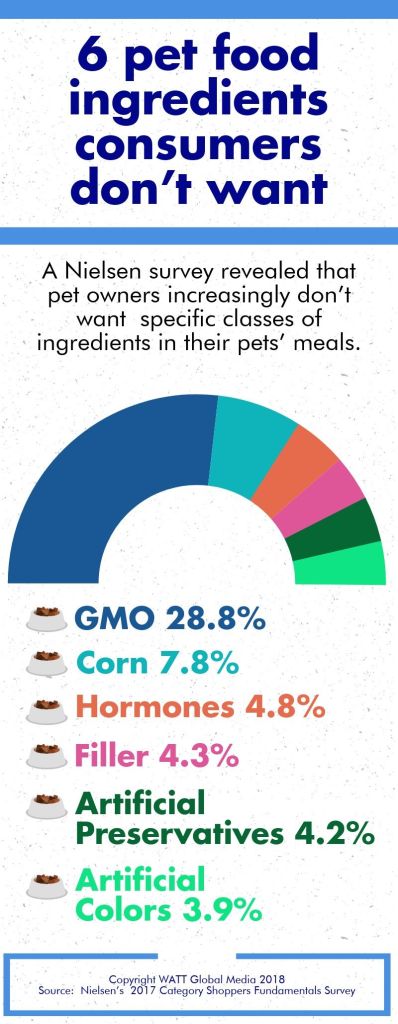
To keep up-to-date with developments in dog health and welfare, I follow a number of publications. This graphic appeared in a trade journal about pet food and I thought I’d share it – in its entirety and with attribution of course!
These results are not particularly surprising, but they do serve as a reminder to read your dog food labels and also to understand that there are still products out there using these ingredients.
Kathleen Crisley, Fear-Free certified professional and specialist in dog massage, rehabilitation and nutrition/food therapy, The Balanced Dog, Christchurch, New Zealand
Posted in dog nutrition and labelling, Dogs
Tagged artificial color, corn, GMO, ingredients
Earlier this year, I gained my Fear Free certification. For those of you who haven’t yet heard of this, Fear Free is a comprehensive program with certifications for veterinary professionals, trainers, groomers and practices that teaches these carers about the emotional well-being of pets. Enrichment and the reduction of fear, anxiety and stress are all aspects of Fear Free.
So instead of posting the ‘traditional’ pre-Christmas warnings about tinsel, pancreatitis risks, chocolate etc. that go along with the season – I’d like you to consider making your dog’s Christmas Fear Free.
Let’s consider the Christmas holidays from your dog’s point of view:

If you think your dog will be feeling anything like these examples this Christmas, now is the time to make adjustments and plans to help them through the fear and stress of the holiday season. Because the holidays should be Fear Free for everyone.
Kathleen Crisley, Fear-Free certified professional and specialist in dog massage, rehabilitation and nutrition/food therapy, The Balanced Dog, Christchurch, New Zealand









 DoggyMom.com