Author Archives: DoggyMom.com

Time to budget

It’s a holiday weekend in New Zealand  – for Labour Day.  And every year this holiday also marks the start of the pre-Christmas season.  christmas_dog_highdefinition_picture_168935

As many of you understand, Christmas falls in the summer school holiday period in New Zealand. Many companies shut down during this time and require their workers to take some of their annual leave, since trading can be minimal or non-existent.    If workers don’t have enough paid days, then it can mean time off without pay.

And every year, for a range of reasons including more money being spent on holidays, entertaining and gifts, I see owners who can’t fund the full costs of their dog’s care.

This blog post is a reminder about the items you need to set money aside for in your end of year budget. And the time to budget is NOW.

dog-budgeting

  • Food
  • Treats
  • Medications
  • Supplements
  • Costs for vet care, such as visits for required vaccinations if you are boarding your dog
  • Boarding and care costs, if you are heading away

Just as in people, medications and supplements are only effective if their dosage is kept up.  And dogs on things like pain medication will suffer with break-through pain as medications wear off.  In other cases – let’s say heart medication – stopping this medication could be life-threatening.

Because of their stoic nature, dogs often hide their pain and/or owners miss the signals – such as withdrawing from activity – which are indicators of a dog in pain.  For this reason, some owners think they can get away with a ‘short break’ from medication.

With supplements, once the loading doses are given and the effective dose is reached, there is a level of stability with the coverage given by the supplement.  Stop giving it and you are faced with starting a loading dose all over again.  Many owners miss this step and go back to regular dosages, further compromising the value to the dog of giving the supplement in the first place!

When we take on a dog into our family, we’re responsible for lifetime care as with any other family member.  When there is only so much money to go around, sometimes the silent member of the family – the dog – is the one to miss out.

Please remember health care is a basic right for all animals and plan your holiday budget accordingly.  If that means less money for Christmas festivities – so be it.

Kathleen Crisley, specialist in dog massage, rehabilitation and nutrition/food therapy, The Balanced Dog, Christchurch, New Zealand

Controlling the spread of dog diseases

My comments:

In my experience, the boarding operations and day cares that I and my clients have used have all been diligent about infection control. This isn’t surprising.  Provision of care to multiple dogs in the same environment is their core business and they would be risking their livelihoods and reputation by having an outbreak of disease.

The use, however, of dog parks – at least in Christchurch – seems to be on the rise and this is not always a good thing.  Many of us have experienced dogs that are out of control and owners that don’t seem particularly interested in their responsibilities for picking up poo or training/socialising their dogs.  For this reason, I also question whether or not these owners understand the importance of the core vaccinations along the lines of accepted protocols, or if they recognise when their dog is under the weather.  As the guidelines note, not all diseases are fully preventable with vaccines.

There are only a handful of dogs I have met through my massage courses where the vet has agreed the dog shouldn’t be vaccinated – based on reactions in the past – and have documented this on the dog’s health record.

So, for anyone who organises events with dogs – these guidelines should be useful.  They are geared to North American conditions, but still useful elsewhere.  They are also useful for owners to understand infection control. If you choose to go to events with other animals, reviewing the guidelines and the risk calculator will help you be prepared.

Prevention is better than cure!

Kathleen Crisley, specialist in dog massage, rehabilitation and nutrition/food therapy, The Balanced Dog, Christchurch, New Zealand


Dogs aren’t exactly famous for their personal hygiene or for maintaining a respectful distance from their canine pals. With a nuzzle, a shared ball or a bark, a dog battling a bug can easily pass it to others and, in some cases, people.
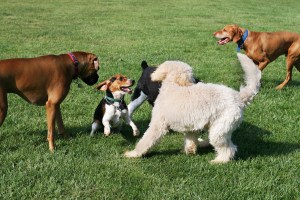
dog-play-group

Photo by Ohio State University

This becomes especially worrisome in group settings, such as dog parks, dog shows and doggie daycare, where animals can spread illness rapidly and then carry it back into their homes and neighborhoods. Protocol for keeping disease transmission at bay has, until now, lagged decades behind efforts to contain human infectious disease.

New guidance for halting the spread of a multitude of dog diseases is now available, thanks to an effort led by veterinary experts at The Ohio State University.

The advice, which appears in a user-friendly guide and in a scientific paper in the Journal of the American Veterinary Medical Association, is intended to be a tool for those in charge of canine group settings and for dog owners, said Jason Stull, a veterinarian and assistant professor of veterinary preventive medicine at Ohio State.

“When you have many dogs in a fairly confined space, the opportunities for disease transmission are everywhere,” Stull said.

Stull and his co-authors want their work to lead to written infection prevention and control plans for settings where dogs congregate.

“In veterinary medicine we’re probably 30 years behind in our infection control efforts compared to human medicine,” he said. “But a lot of the risks really can be managed with some simple steps.”

Stull and his collaborators embarked on the effort at the urging of the American Kennel Club. The researchers reviewed more than 400 academic papers related to the topic and examined published reports of outbreaks of disease in dogs before developing their advice.

The guidance they provide is intended to be an outline of the best possible approach to infection control, Stull said.

But what works in one setting won’t necessarily be practical or possible in another and those who make use of it are expected to tailor the guidelines to their needs, he said.

Among the recommendations:

• Dogs with signs of infection should be kept out of group settings.
• People who touch dogs in group settings, such as handlers, staff and judges, should frequently wash their hands or use sanitizer.
• Community surfaces and items should be regularly disinfected and sharing of items such as leashes, toys and bowls should be avoided.
• Dogs should have up-to-date vaccinations, including against distemper, parvovirus, adenovirus, parainfluenza, Bordetella and rabies – all highly contagious diseases that can lead to severe disease and death.
• Efforts should be made to keep rodents and wildlife out of areas where dogs will be, and to keep dogs out of areas most likely to include ticks, fleas and other disease-carrying pests.
• Those in charge of group settings and those who participate should avail themselves of a new online risk calculator to help them determine the potential for disease spread.
• Dogs should be kept clean – and cleaned up after.
• Organizers of group events should avoid overcrowding of dogs.
• Care should be taken with puppies and other dogs with weaker immune systems. The benefits of socialization should be weighed against the risk of illness.
• Every group setting should have on-site or off-site access to a veterinarian who can help with disease-prevention guidelines.

In practice, following this advice could mean a judge uses hand sanitizer between groups of dogs when pulling up their jowls to look at their teeth.

It could mean a parks and recreation department works to eliminate standing water in a dog park, and to stay on top of keeping the grass mowed short.

It could mean a doggie daycare operator assigns dogs to smaller play groups so that if disease spreads it will be limited.

Stull said vaccines are an excellent guard against disease spread, but many of the threats to dog health aren’t vaccine-preventable and require additional thoughtful prevention.

“It’s going to be a bit of a culture change and we need everyone involved – from the dog owners to group organizers to large organizations such as the AKC,” he said.

“People who care about dogs are really invested and want to do what they can to protect their loved ones and that’s what we’re trying to do. On top of that, a lot of these diseases can be transmitted to people.”

Patricia Haines, past president of the Ohio Veterinary Medical Association and a consultant to Stull and his collaborators, said the information they’ve provided is invaluable and science-based.

“This project will be informative to the experts, those planning competitive events and for people who manage private facilities and public situations, such as dog parks,” said Haines, who raises and shows pointers.

“Many of the dog-loving public have never thought of the risks at dog parks and other group settings,” she said.

The new infectious disease guidelines do not focus on animal shelters and rescues, which have other factors to consider and for which there are some existing established recommendations, but rather on settings in which the dogs have owners.

About 35 percent of households in the U.S. and Canada have at least one dog – totaling about 75 million canine companions in North America.

The full report, including the risk calculator and fact sheets addressing particular infectious diseases, are available through the Ohio State College of Veterinary Medicine: http://go.osu.edu/IDk9risk.

Source:  Ohio State University media release

Intestinal health can impact dog behavior

intestinal-health-can-impact

Photo credit: University of Helsinki

General fearfulness, sensitivity to noise as well as hyperactivity and impulsiveness are the most common behavioural problems in dogs. At their worst, they can have a very negative impact on the wellbeing of the dog and owner alike.

“Behaviour and behavioural disorders often develop as a combination of hereditary and environmental factors, which makes studying them challenging. Metabolomics, or the study of the metabolism, provides us with new clues on the biological issues underpinning behavioural disorders while promoting genetic research. At the moment, metabolomics research in dogs is rare, and the purpose of this pilot study was to examine new approaches and attain information on any metabolic abnormalities associated with hyperactivity in dogs,” explains Professor Hannes Lohi of the University of Helsinki  and the  Folkhälsan Research Centre.

Ab­nor­mal meta­bolic blood test res­ults in hy­per­act­ive dogs

Determining the blood metabolites in hyperactive and normally behaved German Shepherds revealed a significant link between hyperactivity and lower blood phospholipid levels.

“We knew to expect this discovery from research on the human side, as several studies have recorded lower blood lipid and fatty acid levels in ADHD patients than in control groups. However, the causal relationship is not clear and requires further studies, particularly ones with more extensive research data. Our discovery supports the existing belief that human and canine diseases are similar, which suggests dogs can serve as excellent models for human illnesses,” states doctoral student Jenni Puurunen.

“It is significant that the dog’s age, sex or fasting had little impact on the link between behaviour and metabolites. We also controlled for dietary changes by feeding all dogs the same food for two weeks before testing,” explains Puurunen.

In­test­inal health can im­pact can­ine be­ha­viour

One of the most interesting discoveries in the study was the negative correlation between hyperactive behaviour and the levels of the metabolites of tryptophan, a vital amino acid. This metabolite is only produced when intestinal bacteria process the tryptophan received in food. The discovery suggests differences in the gut bacteria of hyperactive and normally behaved dogs, which is very significant in light of the discovery made a few years ago about the connection between the brain and the intestines.

“We know that the composition of the gut microbiota significantly influences the creation of neurotransmitters, for example, those which regulate mood and behaviour. The effect also works vice-versa, so that a stress reaction in the brain can have an adverse effect on the gut microbiota. Consequently, we cannot tell whether our discovery is the cause of canine hyperactivity or its consequence,” Puurunen says.

A glob­ally unique meta­bolo­m­ics pro­ject is un­der­way

Earlier this year, Lohi’s research group released an article on a study of the metabolomics of fearful dogs, which revealed differences between the blood counts of fearful and fearless dogs. However, more extensive research is required to confirm these pilot-stage findings. The research group has launched an extensive collection of samples to test new metabolomics technology together with the company Genoscoper. If successful, the new system could become a significant tool to speed up genetic research, particularly as it relates to behavioural studies.

The study is part of a more extensive canine behaviour project underway at the research group. The project seeks to determine the environmental and hereditary factors as well as metabolic changes relating to behaviour and behavioural disorders, and map their similarities with corresponding illnesses in humans.

Source:  University of Helsinki media release

Choosing the right day care

Over the last couple of months, I have taught a number of massage workshops for dog owners.  I ask each participant about their dog’s daily routines as part of the pre-workshop questionnaire.  I was pleased to hear about the steps most had taken to provide their dog with daytime stimulation and care.

My customers tend to consider their dogs as family and they put their dog’s needs very high on their importance list.  They also know their dogs very well – in terms of likes, dislikes and temperament and so they chose day care arrangements based on their dog first.

Animal Medical Center in Tuscaloosa AL

Here are our collective tips about choosing a doggy day care:

  • Layout and facilities

Commercial operators should allow inspection at any time of the day.

Does the facility smell and look clean?  What are the noise levels?

Does the facility have adequate outdoor exercise yards and indoor areas where dogs can rest in peace and quiet?  Are there comfy beds that are regularly washed for dogs to rest on?

Does the facility use natural cleaning products? (ask to see the labels of what they use!)

  • Who works there

Caregivers at a doggy day care are no different to caregivers at a child’s day care facility.  You should be able to meet with them, have a chat, and understand their qualifications and experience.  Get a commitment to staffing ratios.

By far the best successes of my customers are with facilities staffed by people their dog already knows – and that can include family members (more on this below).

  • Are special needs catered for?

If your dog has a special diet, is the facility able to deal with it?  How do they keep treats and foods separated for their different clients?

If dogs are elderly or recovering from an injury, will the day care be able to isolate the dog for rest periods?

  • Temperament testing and ‘admittance criteria’

With the rise of commercial day care businesses has also come standards that some facilities adhere to.  Quite often, this means that dogs are temperament tested and if they don’t pass, they are not allowed in.

Don’t despair, however, this may mean that the facility’s operations aren’t for your dog as much as the reverse.  It’s not a criticism of your dog.

It’s possible for dogs to become overstimulated or over-tired in facilities that rely on group-play operations.  These facilities tend to be the most profitable for their operators because they can have one handler supervise a larger number of animals throughout the day- and so the temperament tests are geared to assessing dogs that will cope in the group environment.

But is that right for your dog? – there are a range of operators out there and so biggest is always best.

So here’s where asking around, networking and being creative become important.

  • Small, niche and family arrangements

Here’s what I found the most interesting amongst my customers.  Their arrangements for day care relied more on retired family members (usually parents) and smaller operators offering in-home care for a few dogs.  Day care operators with individual kennels for dogs and supervised play time were also favoured.

Why?

Well, in the case of family, they loved the dog and were prepared to offer day care for free or  in exchange for help around the home.

Smaller operators offered in-home care arrangements similar to the family home and there was a high level of trust in terms of the care and attention given to the dog (although often these arrangements are more informal – so understand what contractual arrangement you are entering into and what recourse you have against the operator if something isn’t right).

In smaller care situations, there were reduced chances of dog fights or aggression since only a few dogs were involved.

And in the case of operators with kennel-type arrangements, the staff tended to smaller groups at play sessions and so a higher level of supervision and personality matching could be achieved than through ‘temperament testing.’  Dogs were also allowed to rest for periods of the day in private (as they would be if left at home).

Since I incorporate enrichment techniques in my own practice, I think day care has its place for some dogs.  Most dogs don’t require full-time care throughout the week, particularly if they are exercised daily with enrichment and bonding time at home.

Kathleen Crisley, specialist in dog massage, rehabilitation and nutrition/food therapy, The Balanced Dog, Christchurch, New Zealand

Blessing of the animals

Each year, at the beginning of October, there are celebrations of the feast of St Francis of Assisi as part of World Animal Week.  St Francis is the Patron Saint of Animals and Ecology.

Today was our annual blessing service at the ‘Cardboard Cathedral’ – the Transitional Cathedral in Christchurch.

Izzy and her friend Bergie attended.  It gives me comfort to know that Izzy has been blessed officially.

Kathleen Crisley, specialist in dog massage, rehabilitation and nutrition/food therapy, The Balanced Dog, Christchurch, New Zealand


Breed Labels: When Guesses Turn Into Predictions

The NZ Government has proposed breed specific legislation that would prohibit animal shelters from re-homing ‘menacing’ breeds. These breeds would be identified solely based on appearance. This is a wonderful blog post on the subject of labeling of breeds.  It’s certainly timely – since the City of Montreal has also proposed a ban on pit-bull type dogs (which has been temporarily stopped by the courts – with the Mayor of Montreal promising to fight to retain the law).

Fingers crossed for all rescues and dogs out there.  These are challenging times.

Kathleen Crisley, specialist in dog massage, rehabilitation and nutrition/food therapy, The Balanced Dog, Christchurch, New Zealand

Dog Poop Microbiome Predicts Canine Inflammatory Bowel Disease

Our gut microbiomes — the varieties of microbes living in our digestive tracts — may play a role in inflammatory bowel disease (IBD). Since dogs can also suffer from IBD, researchers at University of California San Diego School of Medicine analyzed fecal samples from dogs with and without the disease. They discovered a pattern of microbes indicative of IBD in dogs. With more than 90 percent accuracy, the team was able to use that information to predict which dogs had IBD and which did not. However, they also determined that the gut microbiomes of dogs and humans are not similar enough to use dogs as animal models for humans with this disease.

The study is published October 3, 2016 in Nature Microbiology.

jorgie
This French Bulldog, named Jorgie, has recently been diagnosed with IBD. A test based on this research would likely be more cost effective for diagnosis and lead to earlier detection. Photo: K Crisley, The Balanced Dog

“One of the really frustrating things about IBD in humans is that it’s hard to diagnose — it usually requires intestinal biopsies, which are not only imperfect, but invasive and expensive to collect,” said senior author Rob Knight, PhD, professor in the Departments of Pediatrics at UC San Diego School of Medicine and Computer Science and Engineering and director of the Center for Microbiome Innovation at UC San Diego.

According to Knight, most people with IBD have similar changes in the types of microbes living in their intestinal tracts, relative to healthy people. Yet it’s still difficult to discern healthy people from those with IBD just by looking at the microbes in their fecal samples. In addition, Knight said it’s not yet clear whether the microbial patterns associated with IBD contribute to the disease’s cause or are a result of the disease.

In a separate line of study, pets appear to be a conduit for microbe sharing in a house. Knight and collaborators previously found that microbial communities on adult skin are on average more similar to those of their own dogs than to other dogs. With a fair amount of precision, they can pick your dog out of a crowd based solely on overlap in your microbiomes.

In this latest study, Knight and team collected fecal samples from 85 healthy dogs and 65 dogs with chronic signs of gastrointestinal disease and inflammatory changes confirmed by pathology. To determine which microbial species were living in each sample, they used a technique Knight and collaborators popularized, called 16S rRNA sequencing, to quickly identify millions of bacterial species living in a mixed sample, based on the unique genes they harbor.

With this information, the researchers were able to look for similarities and differences in the microbial species found in IBD and non-IBD dogs. The differences were significant enough that they could distinguish IBD dog feces from non-IBD with more than 90 percent accuracy.

The researchers also compared the dog data to 2014 parallel findings in humans. The team found some similarities in the microbial interactions of IBD samples between dogs and humans, however the overlap was only partial. For example, Fusobacterium bacteria are associated with diseases in humans, but in dogs was associated with the non-IBD samples.

The study’s first author, Yoshiki Vázquez-Baeza, a graduate student in UC San Diego Jacobs School of Engineering’s Department of Computer Science and Engineering and a member of Knight’s lab, noted a potential limitation of the study — there were fewer healthy human samples than IBD samples in the 2014 human data set. But to best of their knowledge, he said, their statistical methods should not be affected by that.

“One of the really nice things about this study is that all of the statistical software packages we used to analyze data are available online, and anyone can see our exact calculations,” said Vázquez-Baeza. “Too often we read about a study with interesting conclusions, but it’s not completely clear how the authors got there. This approach is more open and transparent.”

This approach to diagnosing IBD in dogs is not yet available to veterinarians or dog owners, Vázquez-Baeza said. Moving forward, the researchers would like to study the overlap in IBD and non-IBD gut microbiomes among a series of animals. Zoo animals, for example, experience IBD more often than their wild counterparts, and studying them might help Knight, Vázquez-Baeza and team find key microbial players in IBD across species.

IBD is a family of diseases that includes ulcerative colitis and Crohn’s disease. IBD is characterized by chronic inflammation in the digestive tract, which can cause pain, severe diarrhea and weight loss. IBD can be debilitating and sometimes leads to life-threatening complications. The Centers for Disease Control and Prevention (CDC) estimate that more than 1 million Americans are living with IBD.

Source:  University of California San Diego media release

Why aren’t some dogs walked regularly? (The Lassie Effect)

A new study from the University of Liverpool in collaboration with The University of Western Australia has examined why some people feel motivated to walk their dogs regularly and others don’t.

There are more than 8 million dogs in households across the UK. Unfortunately not all of them are taken for regular walks.

dog-walking

Photo: K Crisley, The Balanced Dog

The study, led by Dr Carri Westgarth from the University’s Institute of Infection and Global Health, examined the demographic and behavioural factors that contribute towards owners reporting having a strong sense of encouragement and motivation to walk provided by their dogs, which the team call ‘the Lassie effect’.

Encouragement and motivation

As part of the study data was collected from 629 dog owners participating in the RESIDE study, a 10-year study of 1813 residents in Perth, Western Australia.

The results of two survey outcomes, ‘Dog encouragement to walk’ (how often dog encouraged me to go walking in last month) and ‘Dog motivation to walk’ (Having a dog makes me walk more), were analysed to identify both positive and negative factors associated with them.

Dog and owner factors

Explaining her findings Dr Westgarth said: “There are both dog and owner factors that are associated with an owner’s sense of encouragement and motivation to walk the dog, which in turn has been found to be associated with increased dog walking behaviour.

“We now know that owners feel more motivated to walk larger dogs, and if they believe that walking keeps the dog healthy. A strong relationship or attachment to the dog and reporting feeling that their dog enjoys walks is also motivating to owners.

“They are less motivated to take their dog out if they perceive that it is too old or sick, or if other family members usually walk the dog instead. These factors may be targeted in future interventions to increase and maintain physical activity levels of both people and pets.”

Source:  University of Liverpool news release

Doggy quote of the month for October

“Dogs are my favorite role models. I want to work like a dog, doing what I was born to do with joy and purpose. I want to play like a dog, with total, jolly abandon. I want to love like a dog, with unabashed devotion and complete lack of concern about what people do for a living, how much money they have, or how much they weigh. The fact that we still live with dogs, even when we don’t have to herd or hunt our dinner, gives me hope for humans and canines alike.”

– Oprah Winfrey, actress, writer, talk show host, philanthropist

oprah-winfrey-with-dogs

Scientists test nanoparticle drug delivery in dogs with osteosarcoma

At the University of Illinois, an engineer teamed up with a veterinarian to test a bone cancer drug delivery system in animals bigger than the standard animal model, the mouse. They chose dogs – mammals closer in size and biology to humans – with naturally occurring bone cancers, which also are a lot like human bone tumors.

wikimedia-commons-photo-of-bmd

Dogs with naturally occurring cancers are more similar in size and biology to humans than are other mammals, such as mice. Public domain photo: Wikimedia Commons

In clinical trials, the dogs tolerated the highest planned doses of cancer-drug-laden nanoparticles with no signs of toxicity. As in mice, the particles homed in on tumor sites, thanks to a coating of the drug pamidronate, which preferentially binds to degraded sites in bone. The nanoparticles also showed anti-cancer activity in mice and dogs.

The researchers report their results in the Proceedings of the National Academy of Sciences.

These findings are a proof-of-concept that nanoparticles can be used to target bone cancers in large mammals, the researchers said. The approach may one day be used to treat metastatic skeletal cancers, they said.

The dogs were companion animals with bone cancer that were submitted for the research trials by their owners, said U. of I.  Professor Dr Timothy Fan, who led the study with materials science and engineering Professor Jianjun Cheng.  All of the dogs were 40 to 60 kilograms (88 to 132 pounds) in weight, he said.

“We wanted to see if we could evaluate these drug-delivery strategies, not only in a mouse model, but also at a scale that would mimic what a person would get,” Fan said. “The amount of nanoparticle that we ended up giving to these dogs was a thousand-fold greater in quantity than what we would typically give a mouse.”

Using nanoparticles with payloads of drugs to target specific tissues in the body is nothing new, Cheng said. Countless studies test such approaches in mice, and dozens of “nanopharmaceuticals” are approved for use in humans. But the drug-development pipeline is long, and the leap from mouse models to humans is problematic, he said.

“Human bone tumors are much bigger than those of mice,” Cheng said. “Nanoparticles must penetrate more deeply into larger tumors to be effective. That is why we must find animal models that are closer in scale to those of humans.”

Mice used in cancer research have other limitations. Researchers usually inject human or other tumor cells into their bodies to mimic human cancers, Fan said. They also are bred to have compromised immune systems, to prevent them from rejecting the tumors.

“That is one of the very clear drawbacks of using a mouse model,” Fan said. “it doesn’t recapitulate the normal immune system that we deal with every day in the person or in a dog.”

There also are limitations to working with dogs, he said. Dogs diagnosed with bone cancer often arrive at the clinic at a very advanced stage of the disease, whereas in humans, bone cancer is usually detected early because people complain about the pain and have it investigated.

“On the flip side of that, I would say that if you are able to demonstrate anti-cancer activity in a dog with very advanced disease, then it would be likely that you would have equivalent or better activity in people with a less advanced stage of the disease,” Fan said.

Many more years of work remain before this or a similar drug-delivery system can be tested in humans with inoperable bone cancer, the researchers said.

Source:  Illinois News Bureau media release

Kathleen Crisley, specialist in dog massage, rehabilitation and nutrition/food therapy, The Balanced Dog, Christchurch, New Zealand