Author Archives: DoggyMom.com

Bandito and Luigi

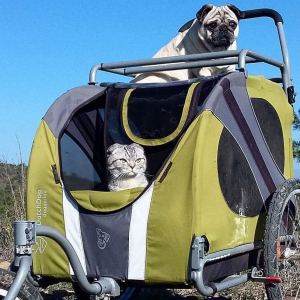
A pug named Bandito and a cat named Luigi have taken social media by storm. These companions,with over 25,000 followers across Facebook and Instragram, have walked 1500km across Spain with their humans, who purchased them a doggy stroller specifically for their travels.

Bandito and Luigi in stroller


Partners Finn and Sebastian let the pair become accustomed to the stroller at home for weeks before venturing out.  Eventually they walked the 497 mile Camino de Santiago trail together, a trip that took six weeks.

The stroller is a safe haven for Bandito and Luigi who use it as a resting place or a place to go when they are scared.

According to co-owner, Sebastian, Bandito and Luigi are the best of friends but he cautions that this style of travel would not suit all pets.

“It is easy if you act like it is their holiday but not if you overestimate your pet’s abilities.  We have had to be vigilant at all times. Inner cities are not ideal places, but fortunately we are in the countryside the vast majority [of time]. Because of this we can really enjoy our time together like climbing trees with the cat and running around with the pug.”   

I particularly like the style of stroller chosen for Bandito and Luigi.  It reminds me of the Pope Mobile used by Handsome Dan, the Vicktory dog featured in the documentary film The Champions.

Source:  The Telegraph and Pug and Cat Facebook

Gobi and her ultra marathoner

The story of Dion Leonard and the dog who accompanied him through the Gobi Desert ultra marathon earlier this year has been making its rounds through the internet this week.

What dog lover could pass up the chance to hear about the dog who decided to bond with a man she had never met, through an grueling endurance event?  It sounds very much the like the 2014 story of Arthur who adopted the Swedish Peak Performance team in the Amazon.

Dion Leonard and Gobi

I suggest you listen to Dion Leonard himself in this interview on WBUR radio in Boston.  There’s nothing like hearing the story first-hand!

(Dion Leonard is currently fundraising to adopt Gobi and bring her to Scotland to live with him.  I hope he reaches his goal.)

Kathleen Crisley, specialist in dog massage, rehabilitation and nutrition/food therapy, The Balanced Dog, Christchurch, New Zealand


Will’s raffle

Will

I follow a number of greyhound sites on Facebook because Izzy is a greyhound and greyhound owners are well known for wanting to share photos of their hounds.

This year has been particularly hard on Will’s family.  Will was very ill and required surgery.  The vets couldn’t find anything that was causing the massive inflammation in Will’s chest and abdomen.  Lots of drugs and he still wasn’t getting better.  So more surgery and finally, they think they got the problem under control.

Will’s family stuck by him, but as you can imagine the vet bills were massive.  A call went out for raffle prizes to help them pay the bills (something they reluctantly agreed to) and I had to contribute.

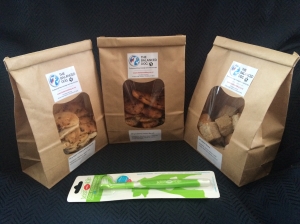
Today I am sending this prize to the winner of the raffle.  It contains three bags of my preservative-free dog treats  – Cranberry & Coconut Biscotti, Apple, Cranberry & Ginger Biscotti and Salmon Squares – and a triple-headed toothbrush which is ideal for greyhounds (who are known to have lots of dental problems).

Will's raffle prize

As an independent business, I get lots of requests for support.  Some resonate more than others.  Will’s family weren’t going to give up on him without a fight and in this case, I think they made the right decision.  We are all hopeful that his inflammatory condition doesn’t return (it was thought to be a foreign body of some type, that has never revealed itself on scans, etc).

Kathleen Crisley, specialist in dog massage, rehabilitation and nutrition/food therapy, The Balanced Dog, Christchurch, New Zealand


10 tips for first-time dog fosters

This post is full of useful information about fostering. Rescue groups always need people to foster – fostering increases the chances of an animal being adopted dramatically because they come with some basic life skills already taught to them and some idea of what it is like to live in a real home.

The dogs of the In Situ Foundation

The In Situ Foundation based in Chico, California, has spent the last 12 years developing scientific protocols that are needed to train cancer detection dogs and their handlers.  In collaboration with top research universities including Duke and UC Davis, they rescue dogs and train them to sniff out specific cancers.  All training is reward based.

What I particularly like about this registered charitable foundation is their mission to use rescue dogs “Our mission is to use shelter/rescue dogs whenever possible. We adopt dogs and give them loving homes, so what could have been a dog on death row, is now being trained to save human lives. All dogs are “super sniffers”, so we do not believe in breeding them, or creating a “super sniffer” breed.”

The dogs of In Situ live in residential homes with their adoptive families.  Their day jobs are to go to work at the Foundation.

Here are the current dogs in the In Situ team:

Stewie

Stewie is a 5 year-old, female, Australian Shepherd. She has been one of In Situ’s best dogs, and has been trained to detect early stage lung, ovarian, and breast cancer. She was one of our star dogs in a 2012 ovarian cancer study, and she is also on Duke University’s canine team for breast cancer. Stewie has also competed in agility, obedience, and is a certified therapy dog with Pet Partners and LA Children’s Hospital, where she visits sick children. Stewie was nominated for the 2015 American Hero Dog Award, given by the American Humane Association. Stewie is a beautiful, loving, smart and talented dog, who loves her work more than anything, except the frisbee.

Leo

Leo is a 2 year-old, male German Shepherd, that In Situ Foundation adopted from Westside German Shepherd Rescue. Leo was on death row, and he was scheduled to be euthanized. He is a wonderful, loving, friendly and well-trained dog, and he’s very valuable to In Situ’s team. Leo is on the team of dogs working in conjunction with Duke University on a two-phase, breast cancer trial.
Charlie

Charlie is the newest addition to the team.  She is a six week-old German Shepherd from champion lines (from Nadulhaus German Shepherds) and will be one of the first dogs in the world trained on upper thoracic (head, neck and throat) cancer, using saliva samples. After 12 to 18 months of training with In Situ Foundation, she will be owned and loved by Dr. Peter Belafsky (University of California, Davis) and will work with him to sniff samples in clinical trails, which will help advance protocols to detect cancer at its earliest stages through olfaction.
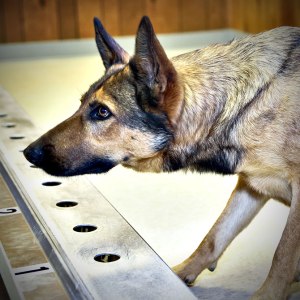
Linus
Linus is a 3 year-old male German Shepherd who was also on death row, and adopted by In Situ Foundation. He was returned to the shelter three times by his previous owner. When he came to our ranch and got his first “job”, it literally transformed Linus’s life. Linus went from a small “jail cell” to a life of love and play. He’s happy, balanced, and well adjusted, and he’s the most loving boy around! Linus loves his work, and he’s a gem on our cancer detection team. Linus also works on the Duke team of breast cancer detection dogs.
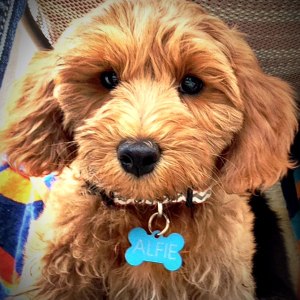
alfie
Alfie is another new addition to the In Situ team. He will be owned and loved by Dr. Hilary Brodie, Chair of Otolaryngolgy at University of California, Davis. Alfie is a Labradoodle (Lab/Poodle hybrid) who will also be trained to detect upper thoracic cancers, and he will be working toward advancing bio-detection by canines at UC Davis.
Kathleen Crisley, specialist in dog massage, rehabilitation and nutrition/food therapy, The Balanced Dog, Christchurch, New Zealand

Limber tail – it’s more common than previously thought

Limber tail photo

Limber tail is a condition that affects mostly large working dog breeds.  It’s a distressing condition that causes the tail to become limp and painful and it’s official name is acute caudal myopathy.

A research team at the University of Edinburgh compared 38 cases of limber tail that were identified from owners’ reports about their dogs’ health with 86 dogs that had no tail symptoms.

Their goal was to gain insight into habits and lifestyle factors that might explain why some dogs are affected and not others.

The majority of dogs in the study were pets but those affected by limber tail were more likely to be working dogs, they found.

Swimming has previously been thought to be a risk factor for limber tail, which is sometimes known as ‘swimmers’ tail’. Some but not all of the affected dogs had been swimming prior to the onset of symptoms, the study found.

Dogs with the condition were more likely to live in northern areas, lending support to anecdotal reports that limber tail is associated with exposure to the cold.

Labradors that had suffered limber tail were more likely to be related to each other than unaffected dogs, which may indicate an underlying genetic risk.

Experts hope that further studies will identify genes associated with the condition, which could one day help breeders to identify animals that are likely to be affected. Over time, this could help to reduce the prevalence of the disease.

The symptoms usually resolve within a few days or weeks so many cases are not reported to vets. This may be why it has been so underestimated in the past. However, owners report that it can be very painful and distressing for the animals.

The study is the first large-scale investigation of limber tail and was conducted as part of the Dogslife project, which follows the health and wellbeing of more than 6000 Labradors from across the UK.  (Note:  the disorder also commonly affects English Pointers, English Setters, Foxhounds and Beagles.)

The study has been published in the Veterinary Record.

Source:  University of Edinburgh media release

A turtle’s best friend

In January, during the northern hemisphere’s winter, a Newfoundland named Veda found a loggerhead turtle in distress.

Veda the Newfoundland

Veda a two year old, 120 pound female Newfoundland, owned by Leah and Brad Bares found a stranded sea turtle on Ellisville Beach in Plymouth. (photo courtesy of NE Aquarium)

Her owners phoned the New England Aquarium, who responded quickly and rescued it.  It was nursed back to health for over 5 months before it could be released to the wild again at Assateague State Park in Maryland.

If it weren’t for Veda, the turtle is unlikely to have been saved.  There’s not a lot of people on the beach in January!

Just another case of how special dogs are and how their skills can be put to good use for the benefit of humans and other animals.

Kathleen Crisley, specialist in dog massage, rehabilitation and nutrition/food therapy, The Balanced Dog, Christchurch, New Zealand

The shoplifting dog

Some dogs will do anything for a treat.

This Siberian Husky walked almost 12 miles (round trip) for a rawhide chew – with the added excitement of an illegal trip into the grocery store!

What lengths has your dog gone to for a treat?

Kathleen Crisley, specialist in dog massage, rehabilitation and nutrition/food therapy, The Balanced Dog, Christchurch, New Zealand
 

Doggy quote of the month for August

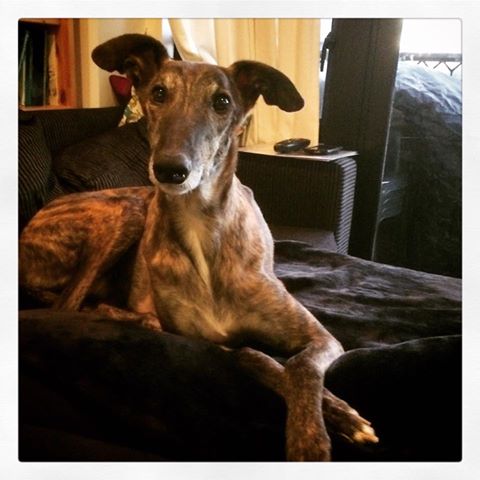
Izzy at Jenny's October 2015

“I think we are drawn to dogs because they are the uninhibited creatures we might be if we weren’t certain we knew better.”

– George Bird Evans, dog breeder (Old Hemlock line of English Setters ), author, artist (28 December 1906 – 5 May 1998)

Scientists warn about health of English Bulldog

According to new research it could be difficult to improve the health of the English bulldog, one of the world’s unhealthiest dog breeds, from within its existing gene pool. The findings will be published in the open access journal Canine Genetics and Epidemiology.

The English bulldog’s limited genetic diversity could minimize the ability of breeders to recreate healthy phenotypes from the existing genetic stock, which were created by human-directed selection for specific desired physical traits.

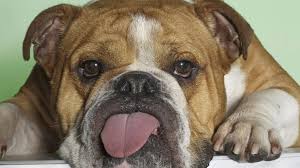
English Bulldog

Many large regions of the bulldog’s genome have been altered to attain the extreme changes in its outward appearance. This includes significant loss of genetic diversity in the region of the genome that contains many of the genes that regulate normal immune responses. Despite this, the English bulldog is one of the most popular dog breeds, particularly in the US, where the bulldog was the fourth most popular pure breed in 2015.

Lead author, Niels Pedersen from Center for Companion Animal Health, University of California, US, said: “The English bulldog has reached the point where popularity can no longer excuse the health problems that the average bulldog endures in its often brief lifetime. More people seemed to be enamoured with its appearance than concerned about its health. Improving health through genetic manipulations presumes that enough diversity still exists to improve the breed from within, and if not, to add diversity by outcrossing to other breeds. We found that little genetic ‘wiggle room’ still exists in the breed to make additional genetic changes.”

Pedersen adds: “These changes have occurred over hundreds of years but have become particularly rapid over the last few decades. Breeders are managing the little diversity that still exists in the best possible manner, but there are still many individuals sired from highly inbred parents. Unfortunately eliminating all the mutations may not solve the problem as this would further reduce genetic diversity. We would also question whether further modifications, such as rapidly introducing new rare coat colors, making the body smaller and more compact and adding more wrinkles in the coat, could improve the bulldog’s already fragile genetic diversity.”

This is the first broad-based assessment of genetic diversity in the English bulldog using DNA analysis rather than pedigrees. DNA analysis is needed to measure, monitor and maintain genetic diversity. This has been done in several other breeds including Standard and Miniature Poodles, American Golden Retrievers, and American and European Italian Greyhound.

The researchers sought to identify whether there is enough genetic diversity still existing within the breed to undertake significant improvements from within the existing gene pool. The researchers examined 102 English bulldogs, 87 dogs from the US and 15 dogs from other countries. These were genetically compared with an additional 37 English bulldogs presented to the US Davis Veterinary Clinical Services for health problems, to determine that the genetic problems of the English bulldogs were not the fault of commercial breeders or puppy mills.

Many Swiss breeders have started to outcross the breed with the Olde English Bulldogge (an American breed) to create the Continental Bulldog, hoping to improve the breed’s health. Although outcrossing the English bulldog could improve its health, many breeders feel that any deviations from the original standard will no longer be an English bulldog.

The breed started from a relatively small genetic base with a founder population of 68 individuals after 1835 and has undergone a number of human created artificial bottlenecks (drastic reductions in population size). These could also have greatly diminished genetic diversity.

Source:  BioMed Central media release