Category Archives: dog ownership

A perspective on time, a precious resource

Time is a precious resource.  We only have so much time in our day – you don’t get any more or any less than anyone else.

I have often said that one of the most important things we have to give our dogs is our time.  Time for play, time for love, time for care…That said, since I often work with sick or elderly dogs in my massage practice, I am also very mindful of how time can get away on us.

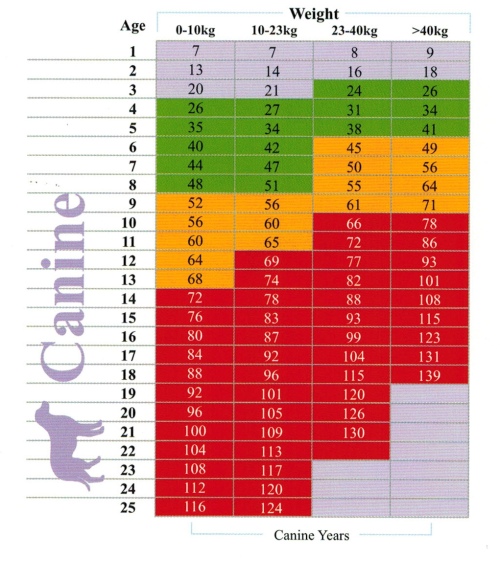
Our dogs live at a different time scale than we do.  There are many illustrations of the this  – here’s just one:

dog age chart

With our dogs aging at a faster rate than we do,  we don’t always understand the impact of a delay.

For example:

I meet many dog owners who come to see me because they have a fear of putting their dog on medications such as those that are used for arthritis.  Let me be clear on this – although I practice natural therapies – I am not against using traditional medications like non-steroidal anti-inflammatory drugs (NSAIDs).  Actually, quite the opposite.

Many dogs benefit from pain relief just like we humans do.

One of the better ways to assess the levels of pain in a dog is to give it a short course of NSAIDs and simply watch for changes in the dog’s behaviour and levels of activity.   If the dog improves, this is often the best indicator we have about the dog’s level of discomfort.

If pain is managed, then we can do even more hands-on work like acupressure, stretching, acupuncture and massage and this often means dosages of the ‘hard drugs’ can be reduced without sacrificing pain management.

In this example, the owner is hesitating to make a decision on using medication – even with the idea that we go into the arrangement knowing the medications will be used for only a short period – perhaps 2-3 weeks.

The dog weighs 25 kg and is 10 years old.

I start working with the dog and suggest a number of times that I believe the dog is in pain or at a minimum – uncomfortable.

The owner takes 2 months to make a decision before agreeing to try some pain relief.

In human years, since the dog is aging at a rate of 6 years to 1 human year at this life stage… 

The owner has waited the equivalent of one human year to make a decision!

 I will ask– if this was your grandma/grandpa/father/mother –  would you allow them to live like this without pain relief?

The answer has always been ‘no.’

We have a duty to care for our dogs which involves acting in their best interests.  They can’t tell us in words how much pain they are in, it’s up to us to figure it out.  And in deciding what to do, we must always be mindful of how precious time is.

Kathleen Crisley, specialist in dog massage, rehabilitation and nutrition/food therapy, The Balanced Dog, Christchurch, New Zealand

Dog registration

It’s that time of year again – time to renew Izzy’s registration.

Dog registration is a legal requirement throughout New Zealand and dogs must be registered before they reach the age of 3 months.

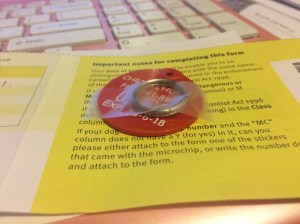
Licence tag

Dog registration fees vary widely across different city and district councils but most offer discounts for spaying/neutering and also holding responsible dog owner status.  In my case, I have held responsible dog owner status for years and this qualifies me for the lowest rate possible.

My $57 fee goes towards the support of services like impounding lost dogs until they can be re-united with their families (hopefully) and officers responding to complaints about dog bites or attacks.

Unfortunately, there’s a portion of our community who don’t register their dogs and so they are not paying their fair share for services.  I know that some people will say that they can’t afford to pay the fees; but I have to ask – if you can’t pay your registration fee how can you afford to care for your dog?

I support efforts to make people better dog guardians.  It starts with an understanding that having a dog is a privilege and not a right.  If you are going to be a good dog owner, then pay your fair share to manage dogs in your community.

Below is the schedule of dog registration fees for 2017/2018 in the Christchurch City Council area:

Item Fee
Dogs classified as dangerous
If paid on or before 31 July $137.00
If paid on or after 1 August $169.00
Un-neutered dogs (other than Responsible Dog Owner status)
If paid on or before 31 July $91.00
If paid on or after 1 August $124.00
Spayed/neutered dogs (other than Responsible Dog Owner status)
If paid on or before 31 July $80.00
If paid on or after 1 August $112.00
Owner granted Responsible Dog Owner status
First dog
If paid on or before 30 June $57.00
If paid between 1 July and 31 July $80.00
If paid on or after 1 August $112.00
Second and subsequent dogs
If paid on or before 30 June $39.00
If paid between 1 July and 31 July $80.00
If paid on or after 1 August $112.00
Working / Rural dogs
First dog
If paid on or before 31 July $27.00
If paid on or after 1 August $39.00
Second and subsequent dogs
If paid on or before 31 July $22.00
If paid on or after 1 August $32.00
Disability Assist dogs NIL
More Than Two Dogs licence (other than rural zoning and Banks Peninsula wards)
Licence for 3 dogs $70.00
Re-inspection fee – same property $32.00

Kathleen Crisley, specialist in dog massage, rehabilitation and nutrition/food therapy, The Balanced Dog, Christchurch, New Zealand

The Dog Lawyer

Earlier this year, I had the opportunity to interview Jeremy Cohen of Boston Dog Lawyers.

Yes – your dog can have a lawyer.  Or, more accurately, you can hire a lawyer to advocate for you and your dog.

Boston Dog Lawyers picture

It’s a sad fact that many dogs are often destroyed because poor laws and policy deem them to be dangerous.  Jeremy thinks we can do better and has a range of trainers, behaviorists and other experts he can call upon to represent an alternative position.

Couples who haven’t married legally may find themselves fighting over ‘ownership’ of their pet.  Custody battles are another area of the practice.

Jeremy is profiled in my column this month in NZ Dog World magazine.

I particularly like Jeremy’s simple to understand bite prevention tips:

Boston Dog Lawyers – Bite Prevention Tips

Never allow your dog to be alone with children under age 12
Integrate your dog into your family and don’t segregate it
Follow the leash law
Use the leash when entering and exiting the car
Exercise your dog daily
Post signs if dog is aggressive
Keep current with licensing and shots

Boston Dog Lawyers logo

Kathleen Crisley, specialist in dog massage, rehabilitation and nutrition/food therapy, The Balanced Dog, Christchurch, New Zealand

Who Rescued Who?

I hear about it a lot from my clients and I’ve experienced it myself.

Your dog came into your life at a time when you really needed them.  Unconditional love & companionship.

So my thought for the day is simple:

Who Rescued Who

Kathleen Crisley, specialist in dog massage, rehabilitation and nutrition/food therapy, The Balanced Dog Ltd, Christchurch, New Zealand

My diary

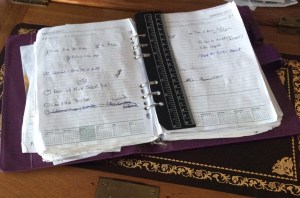
I still use a paper diary despite having access to online calendars and tools. There’s a reason for that.

Diary photo

I successfully managed my time through the Auckland Power Crisis of 1998 without a hitch, thanks to my paper diary. My colleagues, who were already relying on electronic schedules, didn’t know where they were supposed to be for weeks.  Meetings had to be rescheduled; service delivery slowed.

My diary also helped me through the days and weeks following the Canterbury Earthquake of February 2011. During these trying times, I could still make and keep appointments, keep notes as reminders, and generally have something to hold onto that was part of ‘normal’ life.

Most pages include reminders of what I need to finish that day.

And reflecting on my diary over the weekend, I see that it includes Izzy’s social calendar.

Going forward over the next couple of months, Izzy has engagements for play dates, appearances at the Riccarton Market for Greyhounds as Pets, and dates for sleepovers when I have to travel for business.  She also has a birthday party date with her best mate (and boyfriend) Bergie.

I often say that the best thing we can give our dogs is quality time.  One way of ensuring you make time for your dog is to commit to them in writing.  I’m pretty confident that I’ve got the right priorities and tools to do just that.

Kathleen Crisley, specialist in dog massage, rehabilitation and nutrition/food therapy, The Balanced Dog Ltd, Christchurch, New Zealand


Life skills

Prospective dog owners who do their research will consistently find recommendations for things like dog training (obedience, walking on leash, etc.) and regular veterinary care.

However, in my experience there are 2 essential life skills that some dogs are missing.

They are:

  • handling on a table
  • touching of the paws

As a canine massage therapist, I was trained to work with dogs on a table.  It’s good professional practice.  It helps me have a better view and leverage for working on dogs and it also is good health and safety for me because it preserves my posture and the health of my knees.

When a dog is injured or infirm, or so large that even the efforts of the owner and I are not enough to get them onto the table, then I will work with them on the floor.

However, I meet dogs that won’t tolerate handling on a table and in some (not all) cases this is because they just were never taught to accept it.  Since I don’t want to be bitten, I have to go to Plan B – which is the floor.
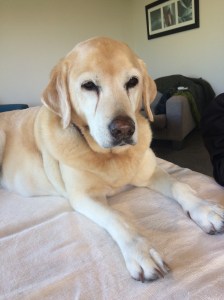
Abbie table photo

Abbie is a 12 1/2 year old Labrador Retriever cross. She’s been a client for over a year. Abbie needs to be lifted onto my table but is otherwise an easy client to have. Food treats helped her accept the table over successive sessions.

One reason why I recommend massage for puppies is that it teaches them to accept table work at a young age.  My table is a cushioned and friendly table – not a cold stainless steel one that you will find in veterinary practice.

All of my canine clients get a treat at the end of their session- so my techniques are reward-based.

And I’ve done sufficient professional training in behavior that I can work to reinforce a timid, shy or scared dog so they get become more accustomed to table work.

Dogs can also be paw sensitive, but through positive training techniques, there is no reason to think that 99.9% of them can’t be trained to accept touching of their feet.  When a dog has mobility issues, I want to massage their toes and work acupoints in the feet and legs.  That’s hard to do if they are growling, snarling or too scared to let me touch them.

Dog groomers and vets will agree with me – it’s no fun having to muzzle a dog because they need their nails clipped, for example. We’re just reinforcing bad experiences if we do.

In the 8 years I have been practising, I have never used a muzzle.

If you are a dog parent reading this – ask yourself how your dog reacts to being on a table or having their paws touched.  If they are reluctant or worse, I’d say it’s time to review your training and schedule in a course of massage therapy.

Kathleen Crisley, specialist in dog massage, rehabilitation and nutrition/food therapy, The Balanced Dog Ltd, Christchurch, New Zealand


Pawternity leave (puppy parental leave)

Well done to UK-based brewing company BrewDog.  The company was dog-friendly from its 2007 start – with 2 human founders and 1 dog.

Now with employees in the USA and UK, and already with dog-friendly offices, they have instituted one week of puppy parental leave for their employees.  When a new dog comes into your life, you can have a week off to get it settled.

This video tells you a bit more about it:

The Puppy Parental Leave policy is a first for the brewing industry.  Let’s hope more follow – along with companies in other industries.

Dogs are great for our health and well-being.  Happy dog owners also make happy and engaged employees when they feel that their status as dog parents is recognised.

Source:  BrewDog

Time to budget

It’s a holiday weekend in New Zealand  – for Labour Day.  And every year this holiday also marks the start of the pre-Christmas season.  christmas_dog_highdefinition_picture_168935

As many of you understand, Christmas falls in the summer school holiday period in New Zealand. Many companies shut down during this time and require their workers to take some of their annual leave, since trading can be minimal or non-existent.    If workers don’t have enough paid days, then it can mean time off without pay.

And every year, for a range of reasons including more money being spent on holidays, entertaining and gifts, I see owners who can’t fund the full costs of their dog’s care.

This blog post is a reminder about the items you need to set money aside for in your end of year budget. And the time to budget is NOW.

dog-budgeting

  • Food
  • Treats
  • Medications
  • Supplements
  • Costs for vet care, such as visits for required vaccinations if you are boarding your dog
  • Boarding and care costs, if you are heading away

Just as in people, medications and supplements are only effective if their dosage is kept up.  And dogs on things like pain medication will suffer with break-through pain as medications wear off.  In other cases – let’s say heart medication – stopping this medication could be life-threatening.

Because of their stoic nature, dogs often hide their pain and/or owners miss the signals – such as withdrawing from activity – which are indicators of a dog in pain.  For this reason, some owners think they can get away with a ‘short break’ from medication.

With supplements, once the loading doses are given and the effective dose is reached, there is a level of stability with the coverage given by the supplement.  Stop giving it and you are faced with starting a loading dose all over again.  Many owners miss this step and go back to regular dosages, further compromising the value to the dog of giving the supplement in the first place!

When we take on a dog into our family, we’re responsible for lifetime care as with any other family member.  When there is only so much money to go around, sometimes the silent member of the family – the dog – is the one to miss out.

Please remember health care is a basic right for all animals and plan your holiday budget accordingly.  If that means less money for Christmas festivities – so be it.

Kathleen Crisley, specialist in dog massage, rehabilitation and nutrition/food therapy, The Balanced Dog, Christchurch, New Zealand

When a neighbour complains…

In my practice, I have met a few owners who have received complaints about their dog’s excessive barking.  Unlike the note seen below, most complaints in Christchurch seem to be made by people to Animal Control, which instigates a visit by an officer to your home.

your-dog-has-been-barking

It’s natural that a complaint will put you into a defensive mode, but being in that frame of mind often means you don’t handle the situation as well as you should.

Here’s my advice on how to constructively approach a barking dog complaint.

Be Considerate and Listen

Don’t get angry.

If a neighbour complains to you directly, listen to what they have to say.  Ask questions about the time of day that the dog is barking, length of time the barking lasts for, and understand the location of your section and proximity to the neighbour.

If the Animal Control Officer pays you a visit, pay attention to what they are saying and the steps they want you to take.  Don’t feel intimidated because they are a Council officer – ask questions to understand the scope of the complaint, and how much time you have to respond.

Be Empathetic

Put yourself in the position of your neighbour and show some empathy for their stress.  Particularly if you have a neighbour complain to your directly, try to build a bridge from the complaint to ways to solve the problem so both of you can remain happy.

Investigate

Ask your neighbour to keep a log book of the barking (I know that one of my clients had an Animal Control officer ask for this).  Make random visits to your home at off-hours to see if you can hear your dog barking.  To make this effective, park your car a couple of blocks away and walk to your property – your dog knows the sound of your car!

Check all of your fencing for security.  If your dog is being visually stimulated by activity over the fence, find ways to cover and reduce the gaps in your fence.

Keep Documentation – You Can Still Be Cooperative While Defending Yourself

I’ve seen situations where a neighbour is hard to satisfy and perhaps ultra-sensitive to barking.  When this has been the case, I’ve suggested that the owner take their dog to a day care centre on random dates.  When compared to their neighbour’s barking diary,  they can show that their dog was not on the property that day.  (This can be a very powerful defense in dealing with the Council.)

It may pay to seek the support of either an animal behaviourist or a dog trainer (there is a difference in scope of practice).  If you hire professional expertise, then provide receipts and a report to show along with any other evidence of what you have done to help decrease  your dog’s barking.

If you’ve reinforced your fencing to reduce your dog’s visual stimulation – take photos before/after.

dogs-at-fenc

The Animal Control section has the option of installing bark recorders, which can help you track the problem.  They can confirm (or not) the extent of the barking to validate a complaint.

The good news is that most barking complaints can be resolved, through management of your dog’s environment, focusing on the problem, and being constructive.

Kathleen Crisley, specialist in dog massage, rehabilitation and nutrition/food therapy, The Balanced Dog, Christchurch, New Zealand

Cars and dogs threaten koalas in Australia

koala

Dogs could be banned from some south-east Queensland suburbs in a bid to protect at-risk koalas

Koalas in Queensland are under threat and the primary reasons are cars and dogs associated with urban development.  As the demand for residential development continues, the number of cars and dogs introduced into koala habitat increases.

According to the Queensland Department of Environment and Heritage Protection, approximately 110 koalas are attacked and killed by dogs each year.

Unlike in New Zealand, where the problem is free-roaming domestic cats attacking birds, most attacks on koalas occur in the dog’s backyard when the koala roams into their territory, particularly after dark when koalas are most active.  That’s a major reason why researchers are suggesting that an outright ban on dog ownership in some areas may be required.

koala-mother-and-baby

Of particular concern is an area known as The Koala Coast which is located 20 km south-east of Brisbane and covers an area of 375 km2 around Redland City, some of Logan City and the south-east section of Brisbane itself.  It is regarded nationally as one of the most significant koala populations because of its size and genetic structure.

There’s a definite risk that koalas may face extinction.  While I love dogs, I also love koalas and Australia would lose out on biodiversity as well as a national icon which generates many tourist dollars.

Under a directive from Environment Minister Steven Miles, a panel of koala experts – University of Queensland’s Associate Professor Jonathan Rhodes, Central Queensland’s Dr Alistair Melzer and Dreamworld’s Al Mucci – have convened to recommend last-ditch efforts to stop koala extinction.

Of their efforts, Dr Melzer has said, “The reality is this is crunch time for the koalas of the Koala Coast at least. The measures that have put in place to date – although extremely well-meant – just haven’t worked. So a radical re-thinking is needed and that is what the minister has initiated.”

The panel has also noted that there will be winners and losers from initiatives to save the koala and that may very well be dogs and dog ownership in these areas.  A sobering thought I’m sure for our Australian neighbours.

Source:  Sydney Morning Herald

Kathleen Crisley, specialist in dog massage, rehabilitation and nutrition/food therapy, The Balanced Dog, Christchurch, New Zealand