Category Archives: Dogs

Teddy’s journey: big improvement this week

Teddy 10_9_14Teddy, bright and alert, met me at the door this week.  He’s looking and feeling much better now that his pain is under control.  It is great to see him up on his feet again.  The mood in the entire household has lifted, too.

Teddy’s medication regime has been changed from Previcox to Rimadyl as the preferred NSAID (non-steroidal anti-inflammatory drug) with Tramadol for added pain relief.  He’s also had a second acupuncture treatment which is clearly helping to improve his energy and pain levels.

Since last week’s osteopathic adjustment, the compression in Teddy’s back has been relieved and I have been able to use more massage and acupressure techniques on him because he is no longer in pain.  I’m still using laser on Teddy, but the ability to manipulate his muscles and limbs is essential to help with the movement of blood and lymphatic fluids.

Yesterday, I gave Teddy a full body massage with emphasis on lengthening and stretching important muscles.   I did a lot of work on the latissimus dorsi – one of the major muscles that supports the back.   All of Teddy’s remaining legs have good range of motion, although some of the muscles in them need a little help to be warmed and stretched.

Teddy slept through most of his massage – another great sign that he is able to tolerate rehabilitation and that his body is able relax, which will support recovery.

The right hind leg, which has arthritis and is affected by hip dysplasia, is causing us some concern.  Teddy is noticeable wobbling on this leg and so we’re focusing on giving this leg extra attention with lasering and acupressure points.

Jill says, “To hear Teddy’s cries and whimpers was distressing for all of us.  I’m so happy that Teddy’s condition has improved.  I feel like we have turned a corner.”

The floor layout in the main living area has been improved, too.  Baby gates still restrict Teddy to a small area.  Jill has installed rugs with a foam underlay in the areas where Teddy walks.  These will help with shock absorption.

A couch with a very low seat is now Teddy’s preferred sleeping place – he can watch the garden from this position.  A foam mattress crash pad is below the sofa to ensure Teddy doesn’t do any damage to his remaining foreleg when he decides gets down.

Kathleen Crisley, specialist in dog massage, rehabilitation and nutrition/food therapy, Canine Catering Ltd, Christchurch, New Zealand

Image

Wordless Wednesday, part 47

Lex with his Canine Catering cakeBlog Hop

Teddy’s journey: pain and anxiety come to the fore

The past week has been a tough one for Teddy and for Jill.

When Teddy first came home from the hospital, he seemed to be adjusting quickly.  He’s always been an independent boy and so he has rejected any support such as a strap or harness when taken out for toileting.

However, this week, Teddy became noticeably withdrawn.  For much of the time, he was restless and would whimper frequently.  We were sure he was in pain.  Because he was so out of sorts, we also felt that he was suffering from anxiety.

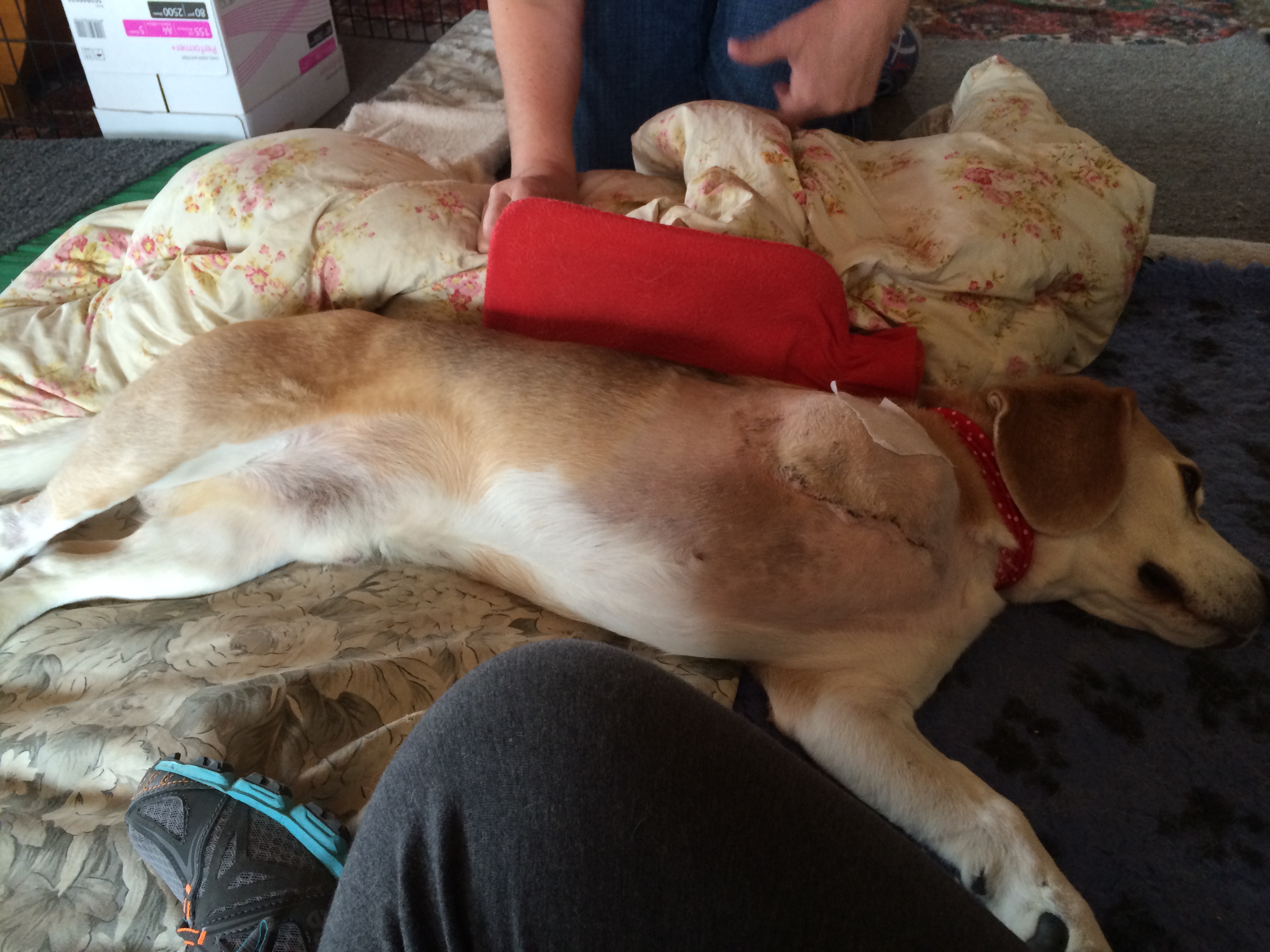
When I saw Teddy on Monday, Jill was stressed and Teddy was clearly not himself.  We introduced a hot water bottle (or ‘hottie’ as they are known here) on his back which seemed to provide relief and comfort.  I also gave Jill a CD from the Through a Dog’s Ear range.  This music is designed specifically for dogs to help calm and treat anxiety.  These seemed to assist Teddy in the short term to relax and rest.

But Teddy needed better pain management…
Teddy and his 'hottie'

Teddy and his ‘hottie’

Jill took Teddy back to his vet several times this week to discuss pain relief.  She freely admits, “I didn’t feel that I was being listened to as the owner.  I knew Teddy better than anyone.  Persistence, in my case, finally paid off.”

We seemed to agree on Monday that he was taken off his pain medication too quickly – he was taking only Previcox at the time –  and his body had been left vulnerable.  A Fentanyl patch was re-introduced on Monday and replaced again on Thursday.  Jill also started Teddy on Tramadol on Thursday and Teddy received a ketamine injection, too.

Meanwhile, I could tell that Teddy’s back muscles were stiff; his top line did not seem normal, and he was clearly distressed at being handled along the withers and the back.  Thankfully, since Teddy was too uncomfortable for deep massage, I was able to use the low level laser along his spine and muscles to help with blood flow and pain relief.  I know I want to passively stretch Teddy’s spine but we agreed to wait until Teddy was more comfortable before attempting this.  I was able to do passive range of motion stretching on Teddy’s legs.

Armed with this information Jill took Teddy for acupuncture on Tuesday and an osteopathic adjustment on Friday.  Both his acupuncture vet and his osteopath agreed that Teddy was in pain and that support with traditional veterinary medicines were needed.  The osteopath used gentle traction on Teddy’s back since she found his spine has become compressed.

With his pain properly managed, we can do more to help Teddy’s muscles, tendons and ligaments to adjust to his new gait.  And then true rehabilitation and exercise can begin including a greater focus on core muscle strength.

During this stressful week, Jill took to the Internet for help with Teddy’s condition.  She found a wonderful site – Tripawds Blogs – for owners of amputee dogs.  Owners soon responded with news that helped to assure Jill she had made the right decision for Teddy and gave her information to help her discuss pain management with her vet.

Owners who have been through similar adjustments with their dogs said:

  • Amputees go through an initial ‘good’ period after coming home, only to suffer because they do too much, too soon
  • The muscles of the body are under incredible strain because the body’s mechanics have changed rapidly
  • In Teddy’s case, his amputation was not preceded by a period of pain or dysfunction in the front leg – so his body had no time to adjust (such as would be the case for an osteosarcoma patient, for example)
  • Pain management medication is critical; the switch from Fentanyl to Tramadol was recommended
  • Teddy’s size is a big advantage – he’s a lot smaller than, say, a Labrador with the same conditions
  • Every dog is different and it takes a little time to find the right balance of therapies

Jill says, “In hindsight, we really took things too quickly and allowed Teddy to move around the garden area with enthusiasm.  I wish I had thought of this sooner and we may have avoided him seizing up so badly.  The Tripawds site has been a fabulous resource for me  knowing that there are others who have been through this before us.

I do feel that vets should listen to owners when it comes to understanding their animal.  And if you are not happy with your vet, you need to find someone who you are more comfortable with.  The vet can’t have all the answers when they are not with the dog as often as the owner is.  This proves that vets are not the final word in recovery – and I’m grateful that complementary practitioners are part of Teddy’s healthcare team”

It’s a new week – and we are all hopeful that Teddy is back on track to recovery.  He’s booked for massage and acupuncture this week.

Kathleen Crisley, specialist in dog massage, rehabilitation and nutrition/food therapy, Canine Catering Ltd, Christchurch, New Zealand

The bond between the homeless and their pets

The Lifelines Project, based in Austin, Texas, has a mission:  it is to depict the bond between people and their pets by sharing images of the homeless with their animals.  This is done through the lens of photographer Norah Levine.

Profits from the project (mainly through sale of prints) go to support 4PAWS (“For People and Animals Without Shelter”), a program run by the Animal Trustees of Austin.  The program provides essential veterinary care to the homeless population – things like basic vaccinations, spaying and neutering.  If a homeless person’s animal needs urgent surgery, the program aims to fund these needs as well.

The Lifelines Project helps to show that responsible dog owners are not limited to those with employment and a home.  Many of the homeless portrayed in the project have a strong understanding of what their pet needs – and they are grateful for the financial support to make it happen.

Kathleen Crisley, specialist in dog massage, rehabilitation and nutrition/food therapy, Canine Catering Ltd, Christchurch, New Zealand

Joan Rivers was a dog lover

I was never a fan of Joan Rivers.  Her sense of humor was always a bit too course for my liking and, in her recent years as a fashion critic, I found many of her comments to be septic and often downright rude.

Nonetheless, I sympathize with her family, friends and fans at her loss.

There is, however, one very positive thing I can say about Joan Rivers.  She loved dogs.  This goes to show that we may have common ground with people who, on the face of it, we dislike.  Anyone who loves dogs cannot be all bad; perhaps this fact alone will remind us to keep an open mind…

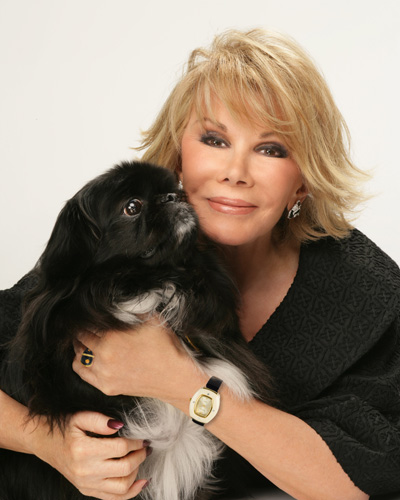
Joan Rivers and her dog, Max, who passed away earlier this year (Photo by Chicago Now)

Joan Rivers and her dog, Max, who passed away earlier this year
(Photo by Chicago Now)

“Dogs are easier to love than people; they’re certainly more dependable,” Rivers once said in an interview with Chicago Now. “Once they love you, that’s it. A true friend in life is a dog.”

In her last known interview conducted in July of this year, Rivers spoke about her darker moments when, after the death of her husband in 1987 and a career that had bottomed-out, she contemplated suicide.  Her dog stopped her:

What saved me was my dog jumped into my lap. I thought, “No one will take care of him.” It wasn’t a friendly dog — only to me. I adored this dog. He was theoretically a Yorkie, his mother cheated. His name was Spike. He was the way you want your dog to be, devoted only to you. I was sitting in this big empty house in Bel Air, with a phone with five extensions which we no longer needed. I had the gun in my lap, and the dog sat on the gun.

An earlier photo of Ms Rivers with her dogs (photo originally from Architectural Digest)

An earlier photo of Ms Rivers with her dogs (photo originally from Architectural Digest)

Rest in piece, Ms Rivers.  I hope all of your dogs were there to meet you when you crossed the Rainbow Bridge.

Kathleen Crisley, specialist in dog massage, rehabilitation and nutrition/food therapy, Canine Catering Ltd, Christchurch, New Zealand

The benefits of being dog-friendly (Christchurch take note)

Here’s more research that backs up my position on dogs and the Christchurch rebuild.  Hopefully the CCDU and CERA will take note…

A study from the University of Liverpool has recommended investing in dog owner education and facilities as a strategy to target physical inactivity and problems such as obesity in both people and their pets.

The research team reviewed scientific papers published since 1990 (31 studies from the UK, USA, Australia and Japan) and found that access to dog-friendly walking environments and better education about dogs’ physical needs could all motivate people to get out and take more exercise with their pets.

An exercised dog is a healthy one, less likely to be obese, and who is less likely to develop behavioural problems like aggression and excessive barking. 

Among the most common findings of all studies was that dog owners have a varied understanding of how much exercise their dog needs. This affected how much they took their dog for a walk; something that could be addressed with education programs.

People without access to high quality local areas that support dog walking, for example parks where dogs are allowed off-leash and poo-disposal facilities are provided, were less likely to walk with their dog and missed out on the associated health benefits.

There are a large number of reasons why people do or don’t walk their dog and it is worth considering how we can address this when designing strategies for reducing obesity, or when planning urban areas and public open space. Not being able to let their dog off the leash is a particular put-off,” said Dr Carri Westgarth, co-author of the study.

Study authors Dr Carri Westgarth and Dr Hayley Christian take an off-lead walk (photo courtesy of University of Liverpool)

Study authors Dr Carri Westgarth and Dr Hayley Christian take an off-lead walk (photo courtesy of University of Liverpool)

The study also found that some people are worried about their dogs’ behaviour and may be less likely to take it out to the park – potentially out of embarrassment or worry about how it might act – but lack of walks may also be causing this bad behaviour, due to boredom, frustration or lack of socialisation.”

When I submitted to the CCDU in November 2012, I made the point that by having greater accessibility, owners have more opportunity to take dogs out – and that increases opportunity not only for exercise but also socialisation.   We want good ownership to be more visible in our communities – thus making it the norm.  Poor ownership would also be more visible – and subject to peer pressure combined with enforcement approaches.

Let’s have a dog-friendly central city with walking accessibility from one end to the other!

Kathleen Crisley, specialist in dog massage, rehabilitation and nutrition/food therapy, Canine Catering Ltd, Christchurch, New Zealand

Source:  University of Liverpool media release


Outdoor dining in California (bone appetit)

California’s Governor Jerry Brown has signed into law Assembly Bill 1965.  The law will take effect on 1 January 2015 and will officially remove a ban on pets in restaurants.

For restaurants who want to allow dogs in their outdoor dining areas, the law officially allows them to do so.  (Technically, restaurants that have allowed dogs in patio and other outdoor areas were breaking the law.)

This lead to inconsistent enforcement across the State.

Gary Ellis, left, and his dog Wilco, a Saluki, enjoy dinner at Zazie restaurant in San Francisco. Photo: Brant Ward, San Francisco Chronicle

Gary Ellis, left, and his dog Wilco, a Saluki, enjoy dinner at Zazie restaurant in San Francisco. Photo: Brant Ward, San Francisco Chronicle

“Amidst all the horrific and depressing news around us, I hope this bill helps make people a little happier, and businesses who wish to accommodate diners with dogs safe from being unnecessarily cited,” said assembly member Mariko Yamada, who championed the bill, on her Facebook page.

To comply, a restaurant must have an outdoor entrance that doesn’t require the pet to walk through the restaurant to get to the outdoor area and pets are not allowed in areas of food preparation.

“It will soon be legal to take your beagle with you to dinner,” Yamada said.   “I wish everyone ‘bone-appétit’.”

Image

Wordless Wednesday, part 46

Noble

Blog Hop

Powered by Linky Tools

Click here to enter your link and view this Linky Tools list…

Skull shape and its implication for animal welfare

Syringomyelia (SM) is a painful condition in dogs that is more common in toy breeds like the Chihuahua and the Cavalier King Charles Spaniel. It involves the formation of fluid-filled cavities, known as syrinxes, in the spinal cord.  In these toy breeds, SM is usually secondary to a specific malformation of the skull called Chiari-like Malformation, CM for short.

Cavalier King Charles Spaniel

New research conducted at the University of Bristol’s School of Veterinary Sciences has identified two significant risk factors associated with these painful neurological conditions.

Identifying a head shape in dogs that is associated with these diseases would allow for selection away from these conditions and could be used to further breeding guidelines. Dogs were measured in several countries using a standardised “bony landmark” measuring system and photo analysis by trained researchers.

The researchers found two significant risk factors associated with CM/SM in the skull shape of the Cavalier King Charles Spaniel.  These were the extent of the broadness of the top of skull relative to its length, also known as brachycephaly, and the distribution of doming of the skull. The study suggests that brachycephaly, with resulting doming towards the front of the head, is associated with both conditions.

Thomas Mitchell, who was the undergraduate involved in the study, says “The study also provides guidance to breed clubs, breeders and judges that have a responsibility to avoid obvious conditions or exaggerations which would be harmful in any way to the health, welfare or soundness of the breed.  It will also provide vets with verified advice to provide to breeders outside the show ring and to occasional hobbyists.”

This research has been published online in the journal Canine Genetics and Epidemiology.

Source:  University of Bristol media release

Please also see my earlier post on Your dog may have a permanent headache, which discusses the Chiari malformation and earlier research on the Griffon Bruxellois.

Kathleen Crisley, specialist in dog massage, rehabilitation and nutrition/food therapy, Canine Catering Ltd, Christchurch, New Zealand

Doggy quote of the month for September

“The dog is the perfect beast, companion, friend, shoulder to lean on, and scapegoat when too many cookies are missing.  And a dog won’t hold that against you, either.  I am at peace sitting in silence with a dog.”

– Rick Springfield, musician/actor

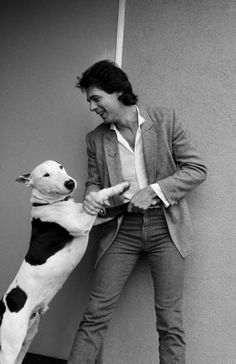
Rick Springfield with Ron