Category Archives: special dogs and awards

Sniffing out error in detection dog data

A new study in the journal Scientific Reports gets to the bottom of it: Why do dogs that are trained to locate poop sometimes find the wrong kind of poop?
Sniffer dog reseawrcgh

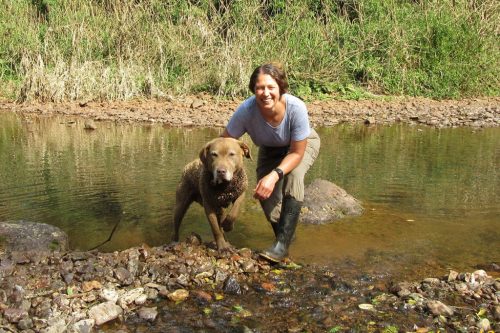
Washington University researcher Karen DeMatteo and her scat-sniffing dog Train are on a mission to preserve jaguars, pumas, bush dogs and other carnivores in the forests of Northeastern Argentina. (Photo: courtesy of Karen DeMatteo/Washington University)

It happens anywhere from 4 percent to 45 percent of the time, said Karen DeMatteo, a biologist in Arts & Sciences at Washington University in St. Louis. Her new research confirms that there are three viable, alternative explanations beyond errors in handler or dog training that can explain the collection of non-target scats with detection dogs in some ecosystems.

Detection dogs are trained to use scent, not their eyes, to locate specific kinds of scat. They’re useful partners in conservation projects as an alternative to camera photo traps or other more invasive means of identifying which individual animals are present in an area.

And while finding the wrong kind of poop doesn’t ultimately muck up research results — researchers who use scat to track animals usually use DNA tests to confirm the identity of target and non-target evacuators — collecting and testing false positives costs a project time and resources.

“To date, when non-target samples are found in detection dog studies, it is assumed it may be due to errors in detection dog or handler training; however, our study determined that this is not always the case,” DeMatteo said. “Instead, the complexity of ecosystems where a study is conducted can affect the perceived accuracy of detection dog studies because the natural behaviors of non-target species, like coyotes in our study, can alter the genetic profile of target scat, like that from a puma.”

In her own work, DeMatteo has successfully used scat-detection dogs to identify the routes traveled by endangered pumas and other reclusive carnivores along a biologically important corridor in Argentina.

Detection dogs are great at determining the presence of specific animals because they can find droppings hidden in grass, droppings that have been rained on and disintegrated into the mud — or even droppings that have been eaten and then recycled.

Yes, that’s right, and it’s a normal part of life for many animals, DeMatteo said.

“Humans have a natural aversion to coprophagy, which is reflected in the visual horror on an owner’s face when they see their dog gobble down their own scat or the scat of another dog or cat,” DeMatteo said. “Once this shock subsides, the owner typically worries that the scat will cause health problems or there is something psychologically wrong with their four-legged friend.”

“While the reasons underlying coprophagy in domestic dogs are still fuzzy, it is known in wild canids that coprophagy is natural and is often associated with territoriality or nutritional benefits,” she said. “So while the finding that coyotes will consume puma scat is novel and has various ecological implications, coprophagy occurs naturally under a variety of circumstances.”

The tendency of one animal to eat another’s scat is one of three behaviors that might alter the type of scat, or the state of the scat, that a detector dog might encounter, and thus affect the perceived accuracy of the technique.

Researchers also considered how urine-marking by non-target species might affect a detector dog’s ability to locate scat from a species of interest, and also what happens if one animal picks up another’s scat and moves it using its mouth, potentially bringing it into contact with saliva. Field trials were conducted in the St. Louis area and in northwest Nebraska.

The researchers found that each of the proposed behaviors alters the genetic profile of the scat in question, and all were confirmed to play a role in the detection dog indicating on non-target scats.

The pool of conservation-trained detection dogs is constantly growing in number, as are the types of target species and the areas where they are being used, DeMatteo said. One of the continuing questions surrounding their use for these types of projects is how to maintain a high quality standard for training detection dogs and their handlers.

“In reality, the dog is easier to train than the handler, with the latter having a higher chance of introducing error,” DeMatteo said. “Even with these variables, these results are extendable to other dog-handler teams with less experience, as long as consistency is used.”

While this study, “How behavior of nontarget species affects perceived accuracy of scat detection dog surveys,” demonstrates that there are alternative explanations for why dogs sometimes collect non-target samples, it also shines a light on behaviors that humans may not understand — but that could play a role in ecosystem functioning.

“Genetic testing can eliminate these samples and maintain accuracy in the [detection dog-assisted] studies,” DeMatteo said. “However, this non-target interaction with target scat potentially has important implications for other ecological questions, including parasite/disease transmission, zoonotic diseases and general health of wild populations.”


Source:  Washington University in St Louis media statement


Roles of emotional support animals examined

Airlines are not the only organizations grappling with the complexities surrounding emotional support animals. Colleges and courts are also questioning the need for these animals and the effects they may have on students and juries, respectively, according to research presented at the annual convention of the American Psychological Association.

The recent, rapid rise of emotional support animals has left colleges and universities struggling to understand the laws and how they can be applied to best support their communities, said Phyllis Erdman, PhD, professor at Washington State University, who chaired a symposium on emotional support animals and service dogs.

Emotional support animal photo by esadoctors

Emotional support animal on campus (photo by esadoctors.com)

College and university counseling centers are seeing an uptick in the number of students seeking mental health services, as students report anxiety, depression and stress about relationships and academic performance, she said.

“It’s not surprising that many schools are confronted with the growing phenomenon of emotional support animals. For many, the topic is a contentious one centered on whether students are taking advantage of the laws,” said Erdman. “This is further compounded by the fact that laws pertaining to emotional support animals are different from those governing disability service animals and therefore schools may need to develop new policies.”

A service animal falls under the Americans with Disabilities Act and is usually a dog that is trained to do work or perform tasks for the benefit of an individual with a physical, sensory, psychiatric or intellectual disability, Emotional support animals are not trained in specific tasks and are not recognized under the ADA. Although emotional support animals are allowed in campus housing, they may not necessarily be allowed in classrooms or elsewhere on campus, according to the study Erdman presented.

Erdman and her colleagues wanted to understand the state of emotional support animal requests on campuses and how colleges and universities are responding. They surveyed 248 university counseling centers about student requests for letters to allow them to have emotional support animals. The survey questions included how often the counseling centers received requests from students, how the schools handled those requests and how they handled requests to diagnose a disability in order to obtain an emotional support animal. It also asked counseling centers if they had emotional support animal policies in place.

Fifty-seven percent of the centers reported almost never receiving such requests. Thirty-one percent did several times a year and only 2 percent got requests more than once a week, according to the study.

Despite the lack of an overwhelming demand, a majority of university counseling centers reported concern about having policies in place to handle such requests, according to Erdman.

“Even a limited number of requests for emotional support animals can cause stress for student affairs offices, housing offices, counseling centers and disability offices,” she said. “Most schools wanted guidance and support for developing guidelines and navigating requests that come through.”

Erdman suggested that schools establish general definitions of the terms disability, service animal and emotional support animal when crafting a policy. The definition of a disability should adhere to ADA guidelines, she said. Any policy development must follow federal and state laws and should include the perspectives of various campus constituencies, including counseling centers, accessibility services, general counsel’s offices, campus safety departments and students themselves, according to Erdman.

“College students today are facing a great deal of stress and emotional support animals may help some students,” said Erdman. “We hope our study can serve as a guide for colleges and universities to develop policies that help students thrive.”

Uncertainty about emotional support animals is also occurring in courts, according to Dawn McQuiston, PhD, of Wofford College, who presented her research at the symposium. While objects such as dolls or teddy bears have been used for decades to calm vulnerable witnesses, courts began to include dogs in the mid-1990s to provide emotional support to alleged victims of child abuse. At least 144 courthouse facility dogs are now included in about three dozen states, she said. These dogs are provided by the court at the request of prosecutors to assist victims with the anxiety of testifying and reliving traumatic events.

Supporters say the dogs have made a huge difference in helping children and vulnerable adult witnesses open up on the stand, but some defense attorneys say having a friendly, sweet-looking canine in the witness box can prejudice a jury against a defendant by making the witness appear more believable and sympathetic, according to McQuiston.

“The concern is that the presence of a courthouse dog emphasizes that the witness is a victim, thereby playing to jurors’ sympathies. As a result, witnesses may be viewed as even more vulnerable or likeable, thus conflicting with a defendant’s right to a fair trial,” said McQuiston.

She cited two notable appeals cases involving courtroom dogs. In both cases, the victims had a support dog during testimony, the defendants were convicted and the convictions were subsequently appealed on the grounds that the presence of the dog led to undue sympathy for the victim and violated the defendant’s right to a fair trial. In both cases, the courts found no sign of prejudice due to the dogs’ presence.

McQuiston and her colleagues investigated whether courthouse dogs, compared to inanimate comfort items, resulted in more prejudice against defendants involved in two hypothetical crimes: A child sexual abuse case and a robbery of a child. They set up mock trials in which participants, in the role of jurors, read transcripts of the testimony and were shown several pictures depicting the child witness with a dog, with a teddy bear or with nothing.

They found that the presence of the dog had no significant effect on the juries’ outcomes, which McQuiston called surprising because the researchers had expected the dog to prejudice the jury against the defendant. Interestingly, their findings showed some biasing effects when the child clutched a teddy bear.

“Across two studies utilizing mock jury paradigms we found that, contrary to popular beliefs and our own predictions, courthouse dogs did not exert undue influence on juror decision-making regardless of the severity of the crimes tested, and did not differentially impact perceptions of child witnesses,” she said.

Source:  American Psychological Association

Empathetic dogs lend a helping paw

Many dogs show empathy if their owner is in distress and will also try to help rescue them. This is according to Emily M. Sanford, formerly of Macalester College and now at Johns Hopkins University in the US. She is the lead author of a study in Springer’s journal Learning and Behavior that tested whether there is truth in the notion that dogs have a prosocial and empathetic nature. Interesting to note, the study found that dogs specially trained for visitations as therapy dogs are just as likely to help as other dogs.

Helping paw

Many dogs are ready to lend a helping paw if needed. Credit: © Mat Hayward / Fotolia

In one of their experiments, Sanford and her colleagues instructed the owners of 34 dogs to either give distressed cries or to hum while sitting behind a see-through closed door. Sixteen of these dogs were registered therapy dogs. The researchers watched what the dogs did, and also measured their heart rate variability to see how they physically reacted to the situation. In another part of the experiment, the researchers examined how these same dogs gazed at their owners to measure the strength of their relationship.

Dogs that heard distress calls were no more likely to open a door than dogs that heard someone humming. However, they opened the door much faster if their owner was crying. Based on their physiological and behavioural responses, dogs who opened the door were, in fact, less stressed than they were during baseline measurements, indicating that those who could suppress their own distress were the ones who could jump into action.

The study therefore provides evidence that dogs not only feel empathy towards people, but in some cases also act on this empathy. This happens especially when they are able to suppress their own feelings of distress and can focus on those of the human involved. According to Sanford, this is similar to what is seen when children need to help others. They are only able to do so when they can suppress their own feelings of personal distress.

“It appears that adopting another’s emotional state through emotional contagion alone is not sufficient to motivate an empathetic helping response; otherwise, the most stressed dogs could have also opened the door,” explains co-author Julia Meyers-Manor of Ripon College in the US. “The extent of this empathetic response and under what conditions it can be elicited deserve further investigation, especially as it can improve our understanding of the shared evolutionary history of humans and dogs.”

Contrary to expectation, the sixteen therapy dogs in the study performed as well as the other dogs when tested on opening the door. According to Meyers-Manor this may be because registered therapy dogs, despite what people may think, do not possess traits that make them more attentive or responsive to human emotional states. She says that therapy dog certification tests involve skills based more on obedience rather than on human-animal bonding.

“It might be beneficial for therapy organizations to consider more traits important for therapeutic improvement, such as empathy, in their testing protocols,” adds Meyers-Manor. “It would also be interesting to determine whether service dogs show a different pattern of results given their extensive training in attentiveness to their human companions.”

Reference: Sanford, E.M. et al (2018). Timmy’s in the well: Empathy and prosocial helping in dogs, Learning & Behavior DOI: 10.3758/s13420-018-0332-3

Source:  Springer media release

Therapy Dogs Effective in Reducing Symptoms of ADHD

In a first of its kind randomized trial, researchers from the University of California Irvine School of Medicine found therapy dogs to be effective in reducing the symptoms of attention deficit/hyperactivity disorder (ADHD) in children.  The study’s main outcomes were recently published by the American Psychological Association in the Society of Counseling Psychology’s Human-Animal Interaction Bulletin (HAIB).  Additional new findings were presented at the International Society for Anthrozoology 2018 Conference held July 2-5 in Sydney, Australia.

Titled, “A Randomized Controlled Trial of Traditional Psychosocial and Canine-Assisted Interventions for Children with ADHD,” the research involved children aged 7 to 9 who had been diagnosed with ADHD and who had never taken medicines for their condition.  The study randomized participants to compare benefits from evidenced-based, “best practice” psychosocial interventions with the same intervention augmented by the assistance of certified therapy dogs.  The research was led by Sabrina E. B. Schuck, PhD, MA, executive director of the UCI Child Development Center and assistant professor in residence in the Department of Pediatrics at UCI School of Medicine.

UCI study

New study led by Sabrina E. B. Schuck, PhD, MA, executive director of the UCI Child Development Center and assistant professor in residence in the Department of Pediatrics at UCI School of Medicine, finds therapy dogs to be effective in reducing the symptoms of attention deficit/hyperactivity disorder (ADHD) in children. Photo by UCI

Results from Schuck’s research indicate children with ADHD who received canine assisted intervention (CAI) experienced a reduction in inattention and an improvement in social skills.  And, while both CAI and non-CAI interventions were ultimately found to be effective for reducing overall ADHD symptom severity after 12 weeks, the group assisted by therapy dogs fared significantly better with improved attention and social skills at only eight weeks and demonstrated fewer behavioral problems. No significant group differences, however, were reported for hyperactivity and impulsivity.

“Our finding that dogs can hasten the treatment response is very meaningful,” said Schuck.  “In addition, the fact that parents of the children who were in the CAI group reported significantly fewer problem behaviors over time than those treated without therapy dogs is further evidence of the importance of this research.”

Guidelines from the American Academy of Pediatrics for the management of ADHD underscore the importance of both psychopharmacological and psychosocial therapies.  Patients who receive psychosocial therapy prior to medications have shown to fare better.  Additionally, many families prefer not to use medications in young children.

“The take away from this is that families now have a viable option when seeking alternative or adjunct therapies to medication treatments for ADHD, especially when it comes to impaired attention,” said Schuck. “Inattention is perhaps the most salient problem experienced across the life span for individuals with this disorder.”

This study is the first known randomized controlled trial of CAI for children with ADHD. It illustrates that the presence of therapy dogs enhances traditional psychosocial intervention and is feasible and safe to implement.

Animal assisted intervention (AAI) has been used for decades, however, only recently has empirical evidence begun to support these practices reporting benefits including reduced stress, improved cognitive function, reduced problem behaviors and improved attention.

The study was supported by the Eunice Kennedy Shriver National Institute of Child Health and Human Development (NICHD) and Mars-WALTHAM® grant R01H066593.

Source:  University of California Irvine media release

Therapy dogs as an employment benefit

Trained dogs can be employed in so many ways that help humans and here’s another one:  stress therapy in the office.

Pet Partners based in Washington began sending trained dogs into the office setting two years ago as part of a workplace wellbeing program.

Well-known employers like Intel and Aetna have employed the services of the dogs.

A dog being petted by an Aetna employee

A dog receiving attention by an Aetna employee, photo by Alexandra Gunnoe

Instead of allowing dogs in the office full-time (which I obviously prefer), these programs are a novelty that also manages other issues such as employees who have dog allergies or who are extremely fearful of dogs.

In settings where people have very demanding jobs, and expectations of long working hours, a visit by a well-behaved dog must certainly be a welcome relief!

Source:  MarketWatch

Veterans with PTSD receive physiological and behavioral benefits thanks to service dogs

A new study shows how veterans with PTSD may benefit physiologically from using service dogs.

This study, led by the Purdue University College of Veterinary Medicine, is the first published research to use a physiological marker to define the biobehavioral effects of service dogs on veterans with PTSD.

The findings were published in the journal Psychoneuroendocrinology, and they may be significant as scientific evidence of potential mental health benefits experienced by veterans with PTSD who have service dogs.

rodriguez-ohaire

Kerri Rodriguez, human-animal interaction graduate student (left), and Maggie O’Haire, assistant professor of human-animal interaction in the College of Veterinary Medicine, look at cortisol samples. Cortisol was one of the measurements used in a new study that shows how veterans with PTSD may benefit physiologically from using service dogs. (Purdue University photo/ Kevin Doerr)

The study was co-funded by the Human Animal Bond Research Institute (HABRI) and Bayer Animal Health.  The research was led by Maggie O’Haire, assistant professor of human-animal interaction in the College of Veterinary Medicine, and Kerri Rodriguez, human-animal interaction graduate student, with the help of K9s For Warriors, an accredited nonprofit organization that provides veterans with service dogs. The study also was in collaboration with the Institute for Interdisciplinary Salivary Bioscience Research at the University of California, Irvine.

“Our long-term research goal is to quantify how service dogs may affect the health and well-being of military members and veterans with PTSD,” O’Haire said. “This study compared a group of veterans with PTSD who had a service dog to a group on the waitlist to receive one. Our previous research suggests that the presence of a service dog reduced clinical PTSD symptoms and improved quality of life. In this study, we wanted to determine if those beneficial effects also included changes in the physiology of stress.”

“We chose to focus our assessments on cortisol as it is a biomarker centrally involved in the stress response system,” said Rodriguez, lead author on the paper. In this way, the study seeks to improve the understanding of the potential mechanisms for how and why a service dog may help this population.

Cortisol can be measured non-invasively in saliva, which enabled the veterans to collect samples themselves at home immediately after waking up in the morning and about 30 minutes later. This allowed researchers to look at how much cortisol was being produced during the morning. The magnitude of the “cortisol awakening response” has been extensively studied and is used as a metric of the effects of chronic and acute stress. Non-PTSD, healthy adults experience an increase in cortisol after waking up.

“We found that military veterans with a service dog in the home produced more cortisol in the mornings than those on the waitlist,” Rodriguez said. “This pattern is closer to the cortisol profile expected in healthy adults without PTSD. Having a service dog was also associated with less anger, less anxiety, and better sleep.”

O’Haire says, though, while this finding is important, it should be taken in context.

“These findings present exciting initial data regarding the physiological response to living with a service dog. However, the study did not establish a direct correlation, on an individual level, between cortisol levels and levels of PTSD symptoms, and further study is needed. It is important to keep in mind that service dogs do not appear to be a cure for PTSD,” O’Haire said.

The next step, already underway, involves a large-scale National Institutes of Health clinical trial in which the researchers are studying veterans with and without service dogs over an extended period of time.

“Our research team will be able to look at morning cortisol levels both before and after getting a service dog to see how these physiological effects manifest over time,” O’Haire said. “The longitudinal nature of this clinical trial should bring about a better understanding of the interrelationships between physiological and behavioral processes, PTSD symptoms, and service dogs.”

She also emphasizes that the participation of veterans in the studies should not be taken for granted. “We are most grateful to the military veterans and their families who have participated in the research thus far,” O’Haire said. “We are honored to be collaborating with these individuals to advance the science behind our interactions with animals and how they affect human lives.”

Source:  Purdue University media release

Older Adults and Animal Programming

The Human-Animal Bond Research Initiative and the National Council on Aging have published a new guide to assist senior centers in implementing animal programmes.

There’s a large and growing body of evidence on the value of animals (especially dogs and other companion animals) in combating obesity, loneliness, mental health issues and inspiring memory recall in dementia patients.  In the western world, we also have a growing population of senior citizens and so there’s a strong rationale for rolling out animal programs in senior centers.

The guide cites real-life policy examples and literature in an easy-to-read guide.

Key recommendations on getting started include:

• Establish clear and measurable goals for your senior center
• Develop policies, protocols, and training programs for staff, volunteers, and animals
• Gain acceptance of your program and ensure participant awareness of policies and programming, including the benefits
• Assess risk and develop appropriate procedures to mitigate risk
• Measure successes and failures of your programs through record keeping, questionnaires, and other research

Back in the late 1990s, my Labrador Ebony and I were a therapy team at a local rest home as part of Canine Friends.  I saw first hand the faces of our human friends who looked forward to our visits, with conversations about pets they had in their lives.  The power of a dog sitting at their feet was strong!

This slideshow requires JavaScript.

Kathleen Crisley, specialist in dog massage, rehabilitation and nutrition/food therapy, The Balanced Dog, Christchurch, New Zealand

Human encouragement and how it may help dogs solve problems

Human encouragement might influence how dogs solve problems, according to a new Oregon State University study.

The study, published in the journal Applied Animal Behaviour Science, sheds light on how people influence animal behavior, said study lead author Lauren Brubaker, a doctoral student in OSU’s Human-Animal Interaction Lab.

Brubaker evaluated the behavior of search and rescue dogs and pet dogs when presented with the same problem-solving task. Both sets of dogs persisted at the task for about the same proportion of time, but the search and rescue dogs were more successful at solving the task when encouraged by their owners.

However, the search and rescue dogs didn’t solve the task when they were alone. Further, pet dogs that solved the task with their owner present – but not encouraging them – also solved it when they were alone, Brubaker said.

“We thought that was unusual,” Brubaker said. “Because search and rescue dogs are trained to work independently, we expected that they would out-perform pet dogs on this independent task and that wasn’t the case. This suggests that the behavior of the owner, including their expectation of their dog and how they engage with their dog on a day-to-day basis, may influence the dog during a problem-solving task.

“This leads us to believe that communication between search and rescue dogs and their owner could be more effective than communication between pet dogs and their owners,” she said.

In the study, the dogs were given a solvable task with a person present: open a puzzle box containing a sausage within two minutes. They compared a group of 28 search and rescue dogs and a group of 31 pet dogs.

Search and rescue dogs were used as a comparison to pet dogs because they are traditionally trained to work independently from their owner. The search and rescue dogs were provided by Mountain Wave Search and rescue in Portland, Douglas County Search and Rescue in Roseburg, and Benton County Search and Rescue in Corvallis.

Pet dogs were recruited at random from the community through online advertisement and by way of word of mouth. Data from pet dogs from a 2015 study conducted by Udell were also used in the analysis. The dogs in both groups were from a variety of breeds.

The dogs were given the puzzle box under two conditions: alone in the room, and with their owner in the room standing neutrally. During the neutral phase, owners were instructed to stand in the room with their arms by their side and to avoid communicating with the dog. In the encouragement condition, the owner was instructed to encourage the dog however they saw appropriate, typically by using verbal praise or gestures, but without touching the dog or the container and without making contact with the dog or the container.

Before each condition the owner was instructed to “bait” the container by picking the container up, placing the food inside the container while the dog watched, and showing it to the dog to allow the dog to see that the container had food in it. Then they placed it on the ground in a designated location. In the neutral-human condition, the owner took three steps back and stood neutrally for two minutes. During the alone condition the owner left the room after placing the object on the ground.

In the human-neutral condition, three of the pet dogs and two of search and rescue dogs solved the task. Two pet dogs solved the task in the alone condition. In the encouragement condition, nine of the search and rescue dogs solved the task, while only two pet dogs did.

“When the owner’s social cues direct the dog towards the independent problem-solving task, then we see something interesting,” said Monique Udell, an animal scientist who directs the Human-Animal Interaction Lab in the College of Agricultural Sciences. “While most dogs increase the amount of time they spend attending to the puzzle when encouraged, pet dogs often end up treating the puzzle like a toy. Instead of engaging in goal directed behavior, they act as if their owner was encouraging them to play.”

Udell continued, “It’s possible that when directed by their owners, search and rescue dogs instead see opening the box as their job. Their owners may be more effective at communicating about the task at hand. Or maybe there is something inherently different about dogs that are selected for search and rescue that makes them more apt to solve the problem. More research is needed to know for sure.”

Source:  Oregon State University media statement

Emotional support animals

10+ years ago when I was working as a science manager in a local council, I recall that a member of staff had been trying unsuccessfully to get pregnant.  Her doctor suggested that she and her husband adopt a dog (which they did) because he felt that caring for the dog would help relieve the anxiety about not getting pregnant.

In effect, her doctor prescribed an emotional support animal.   This is an animal that, simply by virtue of its presence in the person’s life, provides companionship and support.

Such animals have been increasingly in the news for all the wrong reasons.  Untrained animals being brought onto US-based airlines and causing havoc including going to the toilet in the aisles and biting passengers.

Emotional support animals are not trained service dogs.   Whenever an incident occurs that makes the news, it makes life a little harder for people who truly need a service dog.

Denver International Airport

Photo courtesy of Denver International Airport

According to the Americans with Disabilities Act, a service animal must be trained to perform tasks for a person with a disability, be it physical or psychiatric. Disabilities include things like being blind or deaf, using a wheelchair, relying on a dog to remind you to take meds, or having a dog around in case of an anxiety attack.

Under federal law, only dogs and miniature horses weighing less than 100 pounds qualify for the “service animal” designation.

The major airlines are responding with tightened rules for traveling with emotional support animals and I think this is a good thing.

Here are the steps passengers have to take to bring an emotional support animal into the main cabin on one of the three major US airlines:

  • American – Passengers must submit a document signed by a licensed doctor or medical health professional which states that the passenger has a “mental health or emotional disability” and needs the animal “for emotional support or psychiatric service” on the flight or at the passenger’s destination. The document needs to have been signed within the past year and must be submitted at least 48 hours before the flight.
  • Delta – Starting March 1, passengers will have to submit three documents if they wish to travel with an emotional support animal. In addition to a signed statement from a medical professional, passengers will have to provide vaccination dates and the contact information of the animal’s veterinarian and sign a statement that claims the animal is properly trained “to behave in a public setting” and take the passenger’s “direction upon command.” The document needs to have been signed within the past year and must be submitted at least 48 hours before the flight.
  • United – Passengers must submit a document from a medical or mental health professional which states that the passenger has a “mental health-related disability” and that the emotional support animal “is necessary to the passenger’s mental health or treatment.” The document needs to have been signed within the past year and must be submitted at least 48 hours before the flight.

I’m not against the designation of emotional support animals, particularly if a health professional has prescribed one.

That said, let’s be honest that most of us don’t train our dogs to the standard of a service dog because we don’t have to.  Subjecting the traveling public to a dog that you love but isn’t properly trained is just wrong.

Kathleen Crisley, specialist in dog massage, rehabilitation and nutrition/food therapy, The Balanced Dog, Christchurch, New Zealand

Source:  Business Insider


Sit, Stay, Heal: Study finds therapy dogs help stressed university students

Therapy dog sessions for stressed-out students are an increasingly popular offering at North American universities. Now, new research from the University of British Columbia confirms that some doggy one-on-one time really can do the trick of boosting student wellness.

“Therapy dog sessions are becoming more popular on university campuses, but there has been surprisingly little research on how much attending a single drop-in therapy dog session actually helps students,” said Emma Ward-Griffin, the study’s lead author and research assistant in the UBC department of psychology. “Our findings suggest that therapy dog sessions have a measurable, positive effect on the wellbeing of university students, particularly on stress reduction and feelings of negativity.”

In research published today in Stress and Health, researchers surveyed 246 students before and after they spent time in a drop-in therapy dog session. Students were free to pet, cuddle and chat with seven to 12 canine companions during the sessions. They also filled out questionnaires immediately before and after the session, and again about 10 hours later.

The researchers found that participants reported significant reductions in stress as well as increased happiness and energy immediately following the session, compared to a control group of students who did not spend time at a therapy dog session. While feelings of happiness and life satisfaction did not appear to last, some effects did.

“The results were remarkable,” said Stanley Coren, study co-author and professor emeritus of psychology at UBC. “We found that, even 10 hours later, students still reported slightly less negative emotion, feeling more supported, and feeling less stressed, compared to students who did not take part in the therapy dog session.”

While previous research suggested that female students benefit from therapy dog sessions more than male students, the researchers found the benefits were equally distributed across both genders in this study.

Since the strong positive effects of the therapy dog session were short-lived, the researchers concluded that universities should be encouraged to offer them at periods of increased stress.

“These sessions clearly provide benefits for students in the short-term, so we think universities should try to schedule them during particularly stressful times, such as around exam periods,” said Frances Chen, the study’s senior author and an assistant professor of psychology at UBC. “Even having therapy dogs around while students are working on their out-of-class assignments could be helpful.”

The therapy dog sessions were organized in partnership with UBC’s Alma Mater Society and Vancouver ecoVillage, a non-profit organization that provides therapeutic services, including therapy dog sessions, and mental health wellness services.

Source:  University of British Columbia press release