According to a new survey of 2,000 cat and dog owners, 32% admit they’re more excited to see a family member or friend’s pet than they are to see them. kerkezz – stock.adobe.com
Nearly half of Americans (43%) believe that their loved ones are more excited to see their pet this holiday season than they are to see them.
According to a new survey of 2,000 cat and dog owners, that’s a two-way street as 32% admit they’re more excited to see a family member or friend’s pet than they are to see them.
In fact, 20% believe that their pet enjoys the holiday season more than they do.
Almost half (48%) of respondents do something special for their pet during the most wonderful time of the year.
This includes custom ornaments or decorations (64%), dressing them up in holiday clothing or pajamas (60%) as well as giving them their own tree (49%) and stocking (47%).
Half (49%) also like to give them extra treats, and 45% admit they give their pet more treats at Christmas than any other time of the year.
More than two-thirds (68%) are likely to give their four-legged friend their own special holiday meal.
Conducted by OnePoll on behalf of Nulo, the survey found that more than three-quarters (77%) of pet owners believe that their pet is happier with increased visitors during the holiday season.
Begging for attention (51%), welcoming guests (47%) and playing with a new holiday toy (34%) are some of the top ways respondents can tell if their pet is in the holiday spirit.
Forty-two percent give them gifts for the holidays.
Those respondents give an average of three gifts and will spend over $100 total ($106.54).
The most popular gifts include toys (61%), clothing (59%) and treats (56%).
But who’s most likely to spoil their pet?
According to the results, their brother comes out on top (37%), followed by their pets’ grand”paw”rents, or the respondents’ father (36%) and mother (34%).
Healthy treats and special occasion meals are a great way to involve your dog or cat in fun holiday moments – and can add a nutritional boost as a bonus,” said Heather Mendoza, Ph.D., Nulo’s Director of Research & Development.
“It’s wonderful to see that pet owners are already giving their pets special meals that align with their own holiday feasts (30%) or their favorite kind (49%) this season. The holidays offer the opportunity for quality time and memorable experiences with our families, including finding meaningful ways to show extra affection for our incredible pets.”
During the holiday season, pets are spoiled by having their person home with them (60%), going on more walks or adventures (42%) and getting to sleep more (40%).
Pets also partake in traditions such as bringing them along to celebrations at other people’s homes (59%), “opening presents” with the rest of the family (50%) and even going to visit Santa (45%).
Almost one-third (30%) have a bed for their pet in the dining room so they can be near the table during holiday meals, and 73% admit their pet is likely to be underfoot while cooking in the kitchen.
This may be because an overwhelming 78% of pet owners agree that it doesn’t feel like the holiday season if they aren’t able to spend it with their pet.
“Results showed that 40% of respondents believe Christmas is their pet’s favorite holiday – far ahead of the second favorite (New Year’s Day) at 19%,” said Mendoza.
“Between more together time, more treats and more spoiling, it’s no surprise that pets love this most wonderful time of the year. Giving your pet the highest quality treats and meals can make the holiday celebrations extra tasty and nutritious!”
This year has marked another achievement in Sox’s life – his stage debut.
Local dance school Defy Dance Academy was choreographing a number entitled “Legs” and wanted greyhounds to accompany the dancers on stage. These dogs would need to be social and confident. Could Sox be included? My answer was (of course), yes. Sox is very social, greeting everyone with the expectations of pats to the extent that I have to keep him on a short leash when passing our local bus stop.
I want him to have new experiences to reinforce his confidence and this was the perfect opportunity.
When asked about my weekend plans, I never thought I would be in a position to say, “I’m taking my dog to dance practice.” But that is what happened (twice):
Dance practice, December 2023. Greyhounds from left to right are Misty, Mouse, Luke and Sox
Yesterday, was the the big day – the performance. We (the dog parents) were allocated our own dressing room and dog chaperone.
Sox checks himself out in the mirror. (His eyeliner is permanent)No, not pre-show jitters. Just an opportunity to have more cuddles with our well-dressed, designated chaperone.Sox’s friend Misty gets up close and personal in the dressing room while our dear friend Luke takes time to rest
All that work – for a couple minutes of fame!
Sox is available for commercial work, provided animal handling meets my Fear Free principles.
Kathleen Crisley, Fear-Free certified professional and specialist in dog massage, rehabilitation and canine fitness, The Balanced Dog, Christchurch, New Zealand
Cat and dog owners tend to experience slower cognitive decline than those who don’t have pets, according to the latest research released by the University of Maryland.
The study, published in the journal Scientific Reports in September, examined the data of 637 participants aged between 51 and 101 years old.
Of the participants, 185 were pet owners, with 11% owning cats and 13% owning dogs.
The research showed that over the span of a decade, those who had the pets experienced “less decline in cognitive function as they aged, after considering both their pre-existing health and age.”
This included memory function, language function and psychomotor speed.
“Cat owners experienced less deterioration in memory and language function. Dog walking also was associated with slower deterioration in cognitive function,” the authors of the study added.
Owning dogs can also lead to an increase in physical activity through their need to be taken out for daily exercise, which is known to be beneficial for health, they added.
Previous studies have shown that interacting with pets can also provide other benefits, including lowering the risk of heartdisease and regulating blood pressure.
The researched said they hoped that policy makers would use their findings to “support inclusion of pets in care plans, designing housing and neighbourhoods for seniors that are friendly for dog walking, and developing programs to support pet ownership.”
“They say it takes a village to raise a child. I think it takes almost half a planet to rescue a dog.”
– Dion Leonard in his book, Finding Gobi
Dion Leonard was competing in a 155-mile race through China’s Gobi Desert when he was befriended by a stray dog who ran with him. He worked to adopt the little girl, whom he named Gobi, but she went missing in China before formalities could be completed.
Read their story in Finding Gobi, one of my book recommendations for Christmas buying.
The FDA has yet to approve any drugs for life extension. But biotech company Loyal is now a step closer to bringing one to market—for dogs.
Photograph: MartinFredy/Getty Images
There’s a well-established inverse relationship between a dog’s size and its expected lifespan. Bernese mountain dogs and Great Danes live just six to eight years, for example, while corgis can live up to 15 years and Chihuahuas up to two decades.
San Francisco biotech company Loyal wants to close that gap, and is developing an experimental drug to extend the lifespan and improve the quality of life of large and giant dog breeds. Today, the company announced that based on early data, the US Food and Drug Administration has determined that Loyal’s drug has a “reasonable expectation of effectiveness.” The company hasn’t yet shown that its drug actually extends lifespan, but the FDA decision signals the agency’s confidence in Loyal’s approach, and the drug will soon be tested in a bigger trial.
“Big dog owners want more time with their dogs,” says Loyal CEO Celine Halioua. “It’s really heartbreaking to people that they don’t live that long.” She argues that the wide variety in dog sizes isn’t natural, but a result of selective breeding by humans to create dogs with certain physical traits or that can perform specific tasks. On average, mixed-breed dogs live longer than their purebred counterparts.
So far, the FDA has not approved any drugs to expand the lifespan of animals—or humans, for that matter. “This is completely novel,” says Linda Rhodes, former CEO of pet biotech company Aratana Therapeutics and a consultant for Loyal. It’s difficult to study life-extension drugs in people, she says, because humans live relatively longer lives than other species. But starting with dogs—and the breeds with the shortest lives—could yield important clues. “The implication for other species, including humans, is pretty profound,” she says.
Loyal’s experimental drug is an injection designed to be given every three to six months by a veterinarian. The drug is meant to lower levels of a hormone called IGF-1, which is involved in growth and metabolism and has been linked to dog size. Large dogs have a genetic variant that leads to high levels of IGF-1 and small dogs have a different variant that results in lower levels.
Inhibiting this hormone has been shown to increase lifespan in worms, flies, and rodents. In humans, both very high and very low levels increase mortality risk, while a midrange is associated with the lowest mortality.
In early studies, Loyal dosed 130 research dogs with its investigational drug. Halioua says the company has shown that it can reduce IGF-1 levels in large dogs to those seen in medium-size dogs. Two dogs had loose stools for a day or two after receiving the injection, but beyond that, Halioua says, no major side effects have been observed.
To determine the drug’s effect on lifespan, the company is planning a bigger study that will start in 2024 or 2025, and enroll about 1,000 large and giant breed companion dogs that are at least 7 years old. Each will receive either the experimental drug or a placebo.
Halioua says the company aims to have its drug on the market by 2026. But first, Loyal still has to prove to the FDA—which regulates both human and veterinary medicines—that the injection is safe and that the drug can be reliably manufactured. At that point, the FDA can grant conditional approval, a temporary authorization that lasts five years and allows the drug to be sold by prescription. During that time, Loyal will collect effectiveness data and apply for full approval.
Loyal is also working on two other drugs: a pill version for large and giant dog breeds, and a pill for older dogs of all breeds.
Danika Bannasch, a veterinary geneticist at the University of California, Davis, who specializes in canine genetics, says that IGF-1 is only one factor thought to be associated with dog size and longevity. “As for targeting it, I think it’s a bit premature. We know that smaller breed dogs live longer than larger breed dogs, but we don’t know how much of that is due to the influence of IGF-1,” she says.
In a study published last month, Bannasch and her colleagues identified another possible driver of dog longevity, a gene called ERBB4. Studying more than 300 golden retrievers, they compared the DNA from blood samples of dogs that were still alive at 14 years of age to those that died before age 12. They found that dogs with certain variants of the gene survived longer—on average, 13.5 years compared to 11.6 years. Bannasch cautions that the work was conducted in only one breed and that it’s not known whether these variants are associated with longer life in other types of dogs.
The ERBB4 gene is the canine version of HER4, a human gene closely related to HER2, which is associated with cancer. Studying the canine gene could have implications for human health. Researchers are also testing new cancer treatments in dogs with the hope that these therapies could help people.
Giving an experimental drug to healthy dogs is different from treating sick dogs. Bannasch says Loyal’s drug will need to clear a high safety bar for owners to be comfortable giving it to their pets. She also thinks a drug would need to show more than a few months of life extension before people would want to buy it for their dogs. “As a pet owner, I think anything over a year would be great. I suspect people would be really interested in that,” she says.
Linda Rhodes says that humans owe it to dogs to make up for the genetic misfortunes they’ve inherited due to hundreds of years of breeding. “We’ve bred dogs to have problems because we want them to look or act a certain way,” she says. “It’s our responsibility to figure out how we can help.”
There has been a rush of enthusiasm to use Beransa in older dogs suffering from arthritic and other pain since it arrived here in NZ. It’s understandable when you hear stories of dogs moving more freely. But, as with any drug, there are pros and cons.
I would also add that just because your dog is more comfortable on Beransa (or any other pain management drug) does not mean that you should be taking them for long hikes in the hills. Why? Because that’s not age appropriate exercise and just because they can’t feel the pain doesn’t mean that they suddenly have young joints. There is still underlying wear and tear…
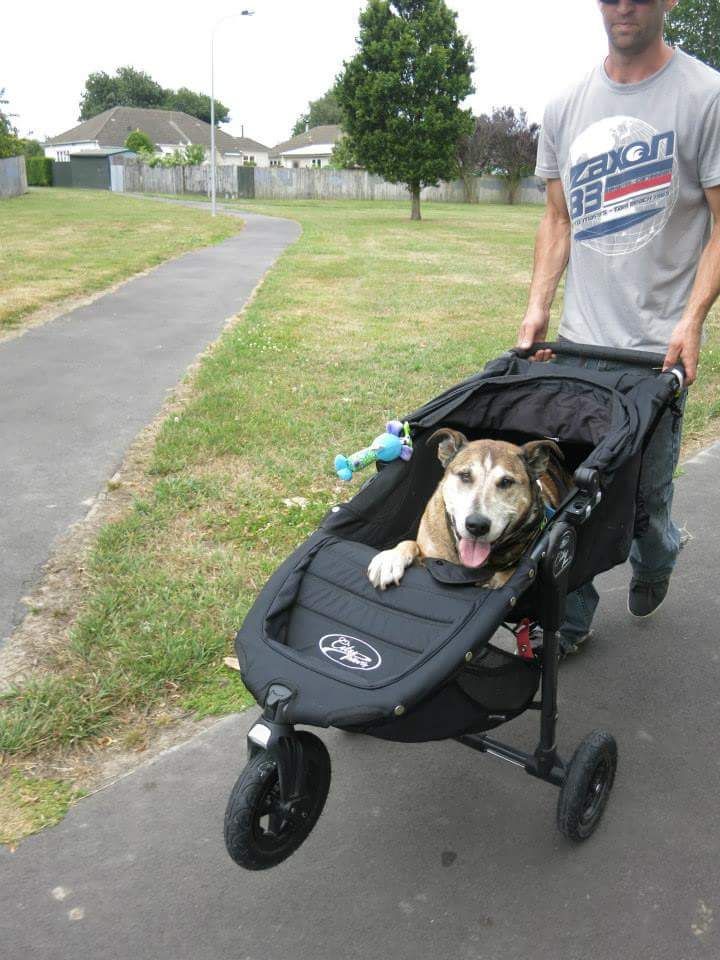
Old boy Kenny rode in a stroller when he was uncomfortable.
In this blog post, I share the blog of Dr Darryl Millis, who is a Diplomate of both the American College of Veterinary Surgeons and the American College of Veterinary Sports Medicine and Rehabilitation, and a Professor of Orthopedic Surgery and Director of the CARES Center for Veterinary Sports Medicine at the University of Tennessee College of Veterinary Medicine. (Dr Millis created the Certified Canine Fitness Trainer qualification which I completed earlier this year).
What about Librela, Anti-Nerve Growth Factor Antibody Treatment?
Osteoarthritis affects approximately 50% of large breed adult dogs. It is therefore necessary to develop effective treatments to alleviate lameness, pain, and mobility disorders. Anti-nerve growth factor antibody treatment is a newly approved drug that has shown promising results.
But how effective is it, and how should it be used? These are critical questions because there is a certain amount of “hype” with any new drug that is purported to be an effective treatment for a difficult and common condition. Further, there is a tendency to use it freely for other conditions that it is not approved for. Is it safe for other conditions? We don’t know yet, but it is important to understand the mechanism of action to predict if there are concerns using it to treat other conditions.
What is Nerve Growth Factor?
Nerve Growth Factor (NGF) is a protein that plays a role in pain transmission, and elevated levels of NGF contribute to pain and inflammation in the joints. NGF also plays a crucial role in promoting the growth, maintenance, and survival of nerve cells (and this gives some clues regarding when NOT to use anti-NGF antibodies – see below). By blocking the action of NGF, anti-NGF antibodies can reduce pain signals from the joints, resulting in pain relief for dogs with arthritis.
What is Anti-Nerve Growth Factor Antibody?
Anti-NGF antibodies are genetically engineered proteins that specifically target and neutralize nerve growth factor. The concept behind anti-NGF antibody treatment is to block the action of nerve growth factor, thereby reducing the pain signals transmitted to the brain. By inhibiting the function of nerve growth factor, anti-NGF antibodies effectively alleviate arthritis symptoms in dogs. But how exactly do these antibodies work?
When administered by injection, anti-NGF antibodies bind to nerve growth factor molecules in the body, preventing them from binding to nerve cells and transmitting pain signals. By interrupting this process, anti-NGF antibodies offer a targeted approach to pain management in arthritic dogs.
Research studies have shown promising results regarding anti-NGF antibodies in treating arthritis in dogs. Treated dogs have shown some improvement in mobility and reduced pain.
What is Anti-Nerve Growth Factor Antibody Used for, and What is it Not Used For?
It’s important to note that anti-NGF antibody therapy should only be administered under the supervision of a veterinarian. Each dog’s condition and response to treatment may vary, which is why a professional assessment is crucial. Remember it is ONLY APPROVED FOR OSTEOARTHRITIS. It has not been approved for immune-mediated arthritis, such as Rheumatoid arthritis, or post-operative pain. Your veterinarian should evaluate factors such as your dog’s age, breed, medical history, and any pre-existing health conditions that could affect the treatment’s efficacy or safety. It should only be administered to dogs with confirmed osteoarthritis (radiographs and clinical diagnosis). A neurological evaluation should also be performed because the use of anti-NGF antibodies in dogs with spinal cord or nerve conditions may worsen the condition. It’s essential to discuss the potential benefits and risks associated with this treatment option with your veterinarian to make an informed decision for your pet.
Are There Any Side Effects or Precautions?
As with all drugs, there are potential side effects and limitations of anti-NGF antibody therapy. Common side effects may include allergic reactions (including anaphylactic shock – your dog should stay in the clinic for at least 20 minutes after the injection), injection-site reactions, and increased blood urea nitrogen (BUN – associated with kidney function). Severe adverse effects may be possible when it is administered inappropriately, which emphasizes the importance of close monitoring and regular check-ups during the treatment period. Until further studies are available, in my opinion, it should not be used in dogs with neurologic conditions or in dogs with unstable joints. It goes to reason that if a dog has a neurologic condition, such as degenerative myelopathy or intervertebral disk herniation, that NGF should NOT be inhibited. When there is damage to the spinal cord, you want nerve growth factor to help with healing the spinal cord and nerves. In addition to pain receptors in the joint, there are also nerves that sense changes in joint position. If there is joint instability, such as a cranial cruciate ligament rupture, joint position awareness or joint proprioception is important to allow correction of abnormal joint positions by muscle contraction to help protect the joint. Anti-NGF antibody may inhibit the function of these nerves, resulting in “sloppy motion” and cause arthritis to progress much faster. Experimentally, inhibition of joint position awareness may drastically increase the amount of arthritis that develops in an unstable joint. In fact, this may explain why this drug has not been approved in people, because some individuals receiving treatment develop rapidly progressive osteoarthritis. Moreover, as anti-nerve growth factor antibody treatment is a relatively new approach, long-term effects and safety concerns are still being studied. It is crucial to stay informed about the latest research and maintain open communication with your veterinarian regarding your dog’s response to the treatment.
How Well Does It Work?
It is important to note that the response to this treatment can vary among dogs. Some may experience significant relief, others may have a more gradual response, and many dogs may have no response. Patience is key during this process, and it is essential to maintain regular check-ups with your veterinarian to assess the effectiveness of the treatment.
There are several studies that have been published, but we will focus on the study performed in the US that was used for FDA approval because these are monitored very closely and the data are scrutinized by the investigators, the sponsoring company, and independent evaluators. They evaluated 135 dogs in the Librela group and 137 in the placebo group. Dogs were treated on days 0, 28 and 56, and were followed for 84 days. First, realize that there is a high placebo rate in studies of dogs with osteoarthritis. The dogs do not know if they have the active drug or a placebo, so why does this occur? First, osteoarthritis does not have a constant level of clinical signs – the signs wax and wanr. So, depending on what has happened the day before the evaluation, the clinical signs may be improved or worse when the dog is evaluated. Further, many outcome evaluations are subjective in nature (either the owner or veterinarian assesses lameness or pain by their observations), and as such, are prone to inaccurate assessments of pain or lameness severity, and there is a “caregiver effect”, meaning that we want the drug to work and may score the assessment more favorably. Objective outcome evaluations, such as measuring weight bearing with a force platform, are much better and do not “over-interpret” the assessment while giving an actual amount of force being placed on the lame limb. Unfortunately, the studies for approval only used subjective assessments.
The Canine Brief Pain Inventory was used in this study and has been used in other arthritis studies. It relies solely on owner assessment, with the following questions addressed using a 10-point scale.
Pain Severity
Fill in the oval next to the one number that best describes the pain at its worst in the last 7days.
Fill in the oval next to the one number that best describes the pain at its least in the last 7 days.
Fill in the oval next to the one number that best describes the pain at its average in the last 7 days.
Fill in the oval next to the one number that best describes the pain as it is right now.
Pain Interference
Fill in the oval next to the one number that best describes how during the last 7 days pain has interfered with your dog’s:
General Activity
Enjoyment of Life
Ability to Rise to Standing from Lying Down
Ability to Walk
Ability to Run
Ability to Climb Stairs, Curbs, Doorsteps, etc.
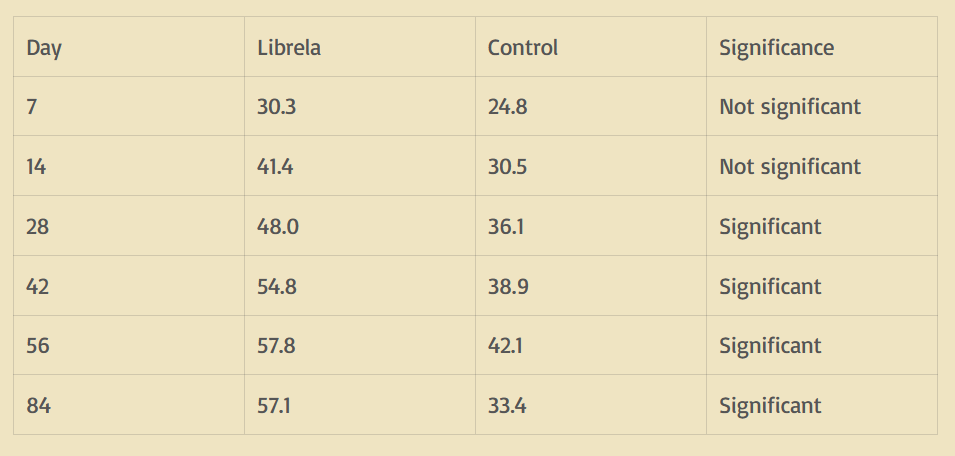
Treatment success was defined as a reduction of 1 or greater in the Pain Severity Score and 2 or greater in the Pain Interference Score vs. Day 0. So, in practical terms, an improvement of 1 out of 40 in the Pain Severity Score and 2 out of 60 in the Pain Interference Score. Not exactly earth-shattering improvement. They reported the percentage of dogs in each group that met the treatment success category as the main support of efficacy for FDA approval. The results are shown in the table below.
The results of a similar study done for approval in Europe showed results that were relatively the same, with the Librela group having a 50% success rate and the placebo group having a 24% success rate by day 84.
So what does this mean? If we look at day 28 when the treatment reached statistical significance over the placebo, 48 out of 100 dogs given Librela met the criteria for treatment success, while 36 of 100 dogs given the placebo met the criteria for treatment success. This means that Librela helped 12 more dogs out of 100 achieve mild improvement compared to the placebo. If we look at the day 84 time period (which was the biggest difference), 57/100 dogs given Librela improved, and 33/100 given placebo improved, meaning the drug helped 24/100 dogs.
Bottom Line?
The anti-NGF antibody took at least 1 month to work, and given for at least 3 months, the drug helped roughly half the dogs improve with treatment, while 1/3 of dogs receiving placebo improved using their criteria for treatment success. How does this stack up with other treatments? Other FDA studies that have evaluated nonsteroidal anti-inflammatory drugs (which generally have the most complete data) suggest that approximately 25-50% receiving a placebo show improvement in whatever criteria are being evaluated, while approximately 70-90% of dogs receiving an NSAID show improvement. Also, most dogs receiving an NSAID show improvement by 7 to 14 days after starting treatment. Our studies show approximately 70-75% of dogs receiving extracorporeal shockwave treatment improve, compared to 25% in the placebo group. So overall, it seems a bit difficult to get excited about a drug that helps fewer patients than most other treatments and takes at least a month to show improvement. Now, social media (for whatever that’s worth) suggests some dogs have improvement within 4-5 days. Similarly, some owners report severe side effects within that time frame, many related to weakness, near paralysis, and incontinence, with most of these presumably neurologic in origin. In a discussion with a company representative, they indicated that they were unaware of any neurologic signs after treatment. So there seems to be a disconnect on this issue. Some of the dogs with neurologic side effects may have had an underlying neurologic condition that may have been exacerbated with anti-NGF antibody treatment, emphasizing that dogs should be thoroughly evaluated and only receive treatment for osteoarthritis, and no other conditions that cause pain.
I’m often asked what I would do if it was my dog. Based on the current information regarding possible side effects and treatment effectiveness, I would only use it if my dog was already thin (not overweight), current pain management for osteoarthritis was no longer effective or liver or kidney disease was present rendering them unable to take NSAIDs, and had end stage osteoarthritis. My concerns are that other available treatments may be more effective, treatment of early osteoarthritis may result in reduction of joint position awareness, potentially increasing the progression of osteoarthritis, and there is the possibility of neurologic side effects.
Don’t Forget About Other Treatments for Osteoarthritis
Additionally, providing your dog with a comfortable and supportive environment is crucial. Maintaining a healthy weight for your dog is particularly important because excess weight can aggravate arthritis symptoms. Consider investing in orthopedic bedding or ramps to minimize stress on their joints and allow for easier mobility. Other treatments to provide a comprehensive approach to arthritis management include appropriate pain management, physical rehabilitation, and, when necessary, surgical interventions.
National air carrier Air New Zealand has recently announced that it is expanding its efforts in conservation by becoming the principal sponsor for the Conservation Dogs Programme. This programme helps mentor, certify and manage over 120 detection dogs to support conservation outcomes.
Conservation is a big deal in New Zealand and dogs make great conservation workers!
The dogs and their handlers will receive free travel on Air New Zealand to get them to where they are most needed.
Enjoy this indogtion (induction) video:
Kathleen Crisley, Fear-Free certified professional and specialist in dog massage, rehabilitation and canine fitness, The Balanced Dog, Christchurch, New Zealand
It’s not often the dog but the person holding the leash who creates the conditions, often by neglect or abuse, for a dog to attack.
***This is a wonderful opinion piece by Marcela Garcia of The Boston Globe. The words are hers, but I agree entirely***
Supporters of the XL bully dog breed held placards during a protest against the UK government’s plans for the breed, in central London on Oct. 7.HENRY NICHOLLS/AFP via Getty Images
“They’re not dangerous if you raise them right. Neither are the dogs.”
Those lines are from a sign carried by one of the hundreds of demonstrators who recently took to the streets in London to protest Prime Minister Rishi Sunak’s proposed ban on the American XL bully.
Sunak’s measure came after a string of biting incidents, at least two of them fatal, involving canines believed to be American bully XL dogs, a relatively new breed. In one short but horrific incident caught on camera in Birmingham, England, an 11-year-old girl is attacked and bit by a dog.
But such a policy ignores the real cause behind aggressive and dangerous dogs. It’s not often the dog but the person holding the leash who creates the conditions, often by neglect or abuse, for a dog to attack. While it’s true that the American bully XL has a history of being used in dogfighting, the boxer, the shar-pei, the Boston terrier, and the English bull terrier also all have histories of fighting.
Kara Holmquist, director of advocacy at the Massachusetts Society for the Prevention of Cruelty to Animals, said in an interview that there are many factors that can come into play and compel a dog to bite — “how the dog is socialized, how the dog is managed, and whether it’s spayed or neutered plays a role. So when places enact policies that just look at breed, not only is it not fair, but it’s just not effective.” It’s making a blanket judgment on what a dog breed is perceived to be, she said. Nowadays it has become very difficult “to look at a dog and know or make a guess as to what type of breed it is.”
That’s why the MSPCA, Holmquist said, helped push for a law, passed in 2012, that prevents cities and towns from enacting dog breed bans. It was around the time that there was hysteria around pit bulls and Dobermans. But discrimination against certain dog breeds still occurs in some spaces, and the MSPCA is working to remove dog breed bans in housing policies.
“Responsible Massachusetts dog owners are often not welcome in certain housing markets, particularly if they own medium or large dogs, or certain dog breeds (or a dog that looks like one of these breeds),” read testimony presented jointly by animal rights advocates, including the MSPCA, during a hearing last month on a bill that would prevent some housing providers, such as condo associations and public housing, “from arbitrarily refusing responsible dog owners as tenants.” The organizations also noted that this “discrimination occurs in some publicly-funded housing, making this a particularly pernicious practice.” It makes it a housing equity issue, as well.
Massachusetts’ cities and towns do have the power to police specific dogs through the dangerous dog law, the purview of the animal control officer. “If there is a dog that is of concern that’s demonstrated some behavior that’s outlined in the law, there’s a process for addressing that through a dangerous dog hearing,” Holmquist said.
Meanwhile, it’s looking like there will be no such dog hearings for the American bully XL in England. Prime Minister Sunak has pledged to ban the dogs but, thankfully, existing ones will receive amnesty. The dogs, which can weigh over 130 pounds, have risen in popularity since the COVID-19 lockdowns, which saw dog ownership rise. Under Sunak’s plan, owners of those existing dogs will have to register them, as well as muzzle them in public places. They will also be required to neuter them in an attempt to eradicate the dog type within a decade.
What’s baffling is that the UK has evidence that banning breeds does not make the public safer. The country has in place a Dangerous Dogs Act, which was enacted more than three decades ago. It bans four breeds: the pit bull terrier, Japanese Tosa, Dogo Argentino, and Fila Brasileiro. Despite that, the number of dog bite incidents has gone up in the UK.
The English dog-owning community is not taking the proposal lying down, but it seems clear the British government has the authority to deem a breed dangerous and ban it. In the case of the American bully XL, it still isn’t officially recognized as a breed by the UK’s Kennel Club. So the breed needs to be declared a breed before it can be banned.
I’m still waiting for a ban on bad dog owners, because when you follow the trail leading to a terrible dog incident, often the owner’s treatment of the dog is to blame. The American bully XL may become extinct in Britain, but you can bet the country’s bad dog owners eventually will find another breed to mistreat. And sadly it, too, will be banned.
Evidence shows human and pet support services should be integrated to avoid people having to relinquish their pets in a time of crisis. Keeping them often results in better health outcomes for both the owner and animal.
Sonya McDowall with her dog, Dashii. Photo credit: La Trobe University
Sonya McDowall, a Ph.D. student presenting her research at the Big Hairy People & Pets Summit and Workshops held 10–14 October on the Gold Coast, wants policy makers to understand the documented positive outcomes when human support services work with animal support services.
“It’s cost-effective for the community, and people are healthier if they can keep their animals during a time of crisis,” Sonya McDowall said.
A 2020 survey by Domestic Violence NSW found that 42% of respondents said victim-survivors delayed leaving a perpetrator for over 12 months due to barriers to accessing support related to their animals.
A recent U.S. survey showed 91% of people had experienced some degree of financial stress in the past year related to the cost of pet care.
Even before the cost of living and rental market crisis, a study in the United States found between 35.1% and 42.1% of participants relinquished their pet due to moving as the landlord would not allow pets. (Source: Moving as a reason for pet relinquishment: a closer look)
Studies have shown that between 26% and 71% of female companion animal guardians experiencing family violence reported that the offender had seriously harmed or killed the companion animal.
18%–48% of domestic violence survivors have delayed entering a domestic violence shelter due to the presence of welfare concerns for their pet that they have had to leave behind. (Source)
Foodbank Australia hunger report 2022 highlighted that over half a million people in Australia are struggling with the cost of food; of this population 67% have pets. This has resulted in a challenge for pet owners of which studies have reported between 30% and 50% of participants identifying that having access to low-cost or free pet food would have prevented them from relinquishing their pet.











 DoggyMom.com