Busy Dog = Happy Dog

Dogs need enrichment and variety in their day; this is an excellent example of how a simple trip to post a few letters became a fun day out for Abby the Beagle.

Marcela's avatarAllMyCanineCompanions

mail1

This morning I told Abby, “We have to go to drop off some mail at the post office.  But, this time you, meaning Abby, will be carrying all 30 envelopes”.  She looked at me with a surprised look.  Yes, like the one above.

mail2

Since Abby “agreed” to carry all 30 envelopes, I decided that as a reward she could smell the flowers – I know there are no flowers in the picture – which she loves to do.  Let’s remember she is part Beagle.

mail3

Abby was so good that she even posed for this picture.  I do my best to give Abby a job.  Why?  Because as a pet parent, I need and have to make sure that her needs are met.  Going to the post office took us almost an hour.  Once we got home, she drank some water and fell asleep.  Like I said, “Busy Dog = Happy…

View original post 1 more word

Health benefits of owning a dog (video version)

Throughout this blog, you’ll find articles about research involving dogs.  Some of these articles can be quite lengthy, so I was pleased when Time published this short video – all of the key points about the health benefits of owning a dog in one place.

If you’re really busy, or simply not interested in reading the full research, this video is for you!

Kathleen Crisley, specialist in dog massage, rehabilitation and nutrition/food therapy, The Balanced Dog, Christchurch, New Zealand

Successful guide dogs have ‘tough love’ moms

Much has been written on the pitfalls of being a “helicopter parent,” one who insulates children from adversity rather than encouraging their independence.

A new study seems to back up this finding — in dogs. Researchers showed that doting mothers seem to handicap their puppies, in this case reducing their likelihood of successfully completing a training program to become guide dogs.

Mother dogs nursing style

Mother dogs’ nursing style is one factor that seems to predict their offspring’s success in guide dog training. (Photo courtesy of The Seeing Eye)

The study, published in Proceedings of the National Academy of Sciences, was conducted at The Seeing Eye, an organization in Morristown, New Jersey, that breeds, raises and trains dogs to guide visually impaired people.

“You need your mom, but moms that are too attentive don’t give their puppies a chance to respond to small challenges on their own,” said lead study author Emily Bray, a postdoctoral researcher in the Arizona Canine Cognition Center at the University of Arizona’s School of Anthropology. “Puppies need opportunities to deal with obstacles without their mom always being there.”

Early interactions between puppies and their mothers seem to have lasting effects.

“These puppies were with their mom for only five weeks, and it’s having an effect on their success two years later,” Bray said. “It seems that puppies need to learn how to deal with small challenges at this early age, and if they don’t, it hurts them later.”

Bray’s results contribute to an understanding of the long-term effects of maternal style and suggest ways that guide-dog-training organizations might better identify dogs who are more likely to succeed.

Observing Mother-Pup Interactions

Scientists have long been interested in the impact of early-life experiences on adult behavior, studying the phenomenon in rodents, primates and people. But hardly any studies had been done in dogs.

Guide dogs presented a useful group to study for several reasons. First, at The Seeing Eye, many puppies are raised in a single location under fairly controlled conditions. Second, the dogs have a clear measure of success: Either they graduate from the program to become a working guide dog or they are released. And third, success as a guide dog isn’t easy; the dog must be willing and able to navigate a complex and often-unpredictable environment while remaining obedient and attentive to its owner.

To gather information about the puppies’ early-life experiences, Bray and a team of undergraduate research assistants essentially embedded themselves at The Seeing Eye’s breeding facility, taking video and closely observing 23 mothers and their 98 puppies for their first five weeks of life.

“We wanted to know if we could differentiate the moms based on how they interacted with their puppies,” Bray said. “We documented things like her nursing position, how much time she spent looking away from the puppies and how much time she spent in close proximity to her puppies or licking and grooming them.”

Analysis of the data revealed differences across the mothers, with some being particularly attentive and others less so.

When the researchers tracked the puppies a couple of years down the line, they found that those with mothers that were more attentive were less likely to graduate from The Seeing Eye’s training program to become guide dogs. In particular, those dogs whose mothers nursed more often lying down, as opposed to sitting or standing up, were less likely to succeed.

“If a mother is lying on her stomach, the puppies basically have free access to milk, but if the mother is standing up, then the puppies have to work to get it,” said study co-author Robert Seyfarth, a psychology professor at the University of Pennsylvania. “A hypothesis might be that you have to provide your offspring with minor obstacles that they can overcome for them to succeed later in life because, as we know, life as an adult involves obstacles.”

Cognition, Temperament Also Predict Success

The study also found that dogs’ cognition and temperament were associated with program success or failure.

The researchers conducted a second part of the study after the puppies had gone to live with foster families and then returned to The Seeing Eye for specific guide-dog training. The dogs — at this point young adults at 14 to 17 months old — were given tests to measure their cognition and temperament. A test of cognitive problem-solving skills, for example, involved a game in which the dog has to perform a multistep task to reach a treat. Tests of temperament included observing the dogs’ reactions, such as how long they took to bark at an umbrella being opened or how they reacted when they entered a room with a mechanical cat they had never seen before.

“We saw that some dogs were calm and collected and solved problems quickly, while others were more reactive and perseverated at the problem-solving tasks,” Bray said.

Perhaps unsurprisingly, dogs that did well at the problem-solving tasks and took longer to bark at novel objects were more likely to succeed in the guide-dog-training program.

Although Bray’s work underscores the connection between maternal behavior and offspring’s behavior later in life, further research is needed to tease out exactly why the attentive mothers were more likely to have puppies that were released from the program, and whether or not genetics could be a factor.

“With mothering, it seems like it’s a delicate balance,” Bray said. “It’s easy to be like, ‘Oh, smothering moms are the worst,’ but we aren’t exactly sure of the mechanisms yet and we don’t want to tip too far in the other direction, either.”

Source  University of Arizona media release


Housing affordability is a dog issue

I’ve been wanting to write this post for some time.  There’s been trouble brewing for a while now when it comes to housing availability and affordability in New Zealand.  But if you’re a dog owner, the problem is usually magnified.

Take this case from the Waikato; a gainfully employed immigrant to New Zealand struggles to find a rental home that will allow both his children and his beloved dog, Blue, to live there.

Welcome dog

In the months and years following the 2011 earthquake in Christchurch, the rate of surrenders of dogs increased as people were displaced from their damaged homes.  Most rentals prohibited dogs. (Only now – in 2017 – is the housing market adjusting again with something of a rental surplus.  Creative rental owners are starting to open their minds about dogs.)

Last week, I shared this article on my Facebook page about Millennials, a generation of men and women who are buying homes to secure their futures as dog owners.  It created the highest readership of the page in almost two years, with many of my clients and other readers agreeing that they bought a home because they wanted a secure place to live with their dog(s).

I moved from Auckland to Christchurch in large part because of better housing affordability and the goal of having my own dog.  (In Auckland, the best I could achieve was a regular dose of ‘dog therapy’ by volunteering at the SPCA as part of a regular roster.)

But housing affordability is a barrier to many owning their first home.  Loan-to-value ratios require a minimum of 20% deposit.  If you are already paying a high rent, savings to reach that 20% can be very difficult.  In the Auckland region, I’ve read that many employed people are paying up to one-half of their income in rent.  So much for saving a 20% deposit!

If people can’t find homes that allow pets, what happens to all the dogs needing loving homes?  They face a bleak future.

So in this – an election year in New Zealand – think about housing affordability as a key issue particularly if you are a dog lover or prospective dog owner. If you’ve made it into your own home with a dog, think of those who are still trying.

And if you are an owner of one or more rental properties, you can be part of the solution.  Do you allow your tenants to have dogs?

Kathleen Crisley, specialist in dog massage, rehabilitation and nutrition/food therapy, The Balanced Dog, Christchurch, New Zealand

No simple way of predicting breathing difficulties in pugs, French bulldogs and bulldogs from external features

As many as a half of all short-nosed dogs such as pugs, French bulldogs and bulldogs experience breathing difficulties related to their facial structure. However, research published by the University of Cambridge suggests that there is no way to accurately predict from visible features whether an apparently healthy pug or French bulldog will go on to develop breathing difficulties.

The findings have implications for attempts to ‘breed out’ this potentially life-threatening condition.

French bulldog.jpg

Pugs and bulldogs have become popular breeds in recent years – the French bulldog is set to become the UK’s most popular canine, according to the Kennel Club. However, a significant proportion are affected by a condition known as Brachycephalic Obstructive Airway Syndrome (BOAS) related to their head structure.

Studies suggest that for over half of such dogs, BOAS may lead to health problems, causing not just snoring but also difficulty exercising and potentially overheating. It can even prove life-threating. But as symptoms often do not arise until after the dog has begun breeding, veterinary scientists have been searching for markers that can predict whether a dog is likely to develop breathing difficulties – and hence potentially help breed out the condition.

A study in 2015 led by researchers at the Royal Veterinary College, University of London, working across many breeds suggested that dogs whose muzzles comprised less than half their cranial lengths and dogs with thicker neck girths were at increased risk of BOAS. However, this new study suggests that these measures applied to individual breeds are not dependable for this purpose.

The Cambridge researchers took external measurements of features of head and neck shape, and of the external appearance of nostrils, together with measurements of body size and body condition score (an approximation to the degree of fatness/obesity) in just over 600 pugs, bulldogs and French bulldogs, the most numerous breeds that show this problem. Each of the dogs had also been graded objectively for respiratory function.

The team found that while the external head measurements did have some predictive value for respiratory function, the relationship was not strong, and the measurements that showed the best predictive relationship to BOAS differed between breeds. They were unable to reproduce conclusively the findings from the previous study by the Royal Veterinary College in any breed.

“It can be incredibly difficult to take measurements such as distance between eyes or length of nose accurately, even for experienced vets, as the dogs don’t keep still,” says Dr Jane Ladlow, joint lead author. “This may explain why it is so difficult to replicate the findings of the previous study or find any conclusive markers in our own.”

Neck girth was a slightly more reproducible measurement, and larger neck girth in comparison to chest girth or neck length was associated with disease in the bulldogs and French bulldogs. In male bulldogs, neck girth showed a close enough association with disease to give moderately good predictive accuracy for the presence of clinically significant BOAS.

The best measure identified by the Cambridge team was the degree of nostril opening, which proved a moderately good predictor of the presence and severity of BOAS in pugs and French bulldogs, and was also a useful marker for disease in bulldogs.

Altogether the variables measured, when combined, gave an 80% accuracy in predicting whether or not dogs will have BOAS, the difficulty of taking some of the measurements accurately, and the need to make multiple measurements and combine them in order to produce a prediction means that the researchers would not recommend using them as a guide to breeding.

Dr Nai-Chieh Liu, first author of the study, says: “Breeding for open nostrils is probably the best simple way to improve these breeds. Dog breeders should also avoid using dogs with extremely short muzzles, wide faces, and thick necks. These traits are all associated with increased risk of having BOAS.”

Joint lead author Dr David Sargan adds “At this moment there is no conclusive way of predicting whether any individual pug or bulldog will develop breathing difficulties, so we are now looking for genetic tests that may help breeders get rid of BOAS more rapidly.

“The best advice we can give to owners of short-nosed dogs is to make sure you get your dog checked annually for any potential difficulties in breathing, even if you have not yourself observed any in your dog, and to keep your dog fit and not let it get fat.”

Source:  University of Cambridge media release

Happy National Book Lovers Day

I have a large and growing collection of dog books in my home.  I don’t own a Kindle or other form of e-reader and prefer to hold a real book in my hands.

Today – 9th August – is National Book Lovers Day in the USA.

And in honor of this day, I’m sharing one of my favourite books – which also happens to be one of the first dog books of my collection – Dogs and Their Women by Barbara Cohen and Louise Taylor.

Published in 1989, Dogs and Their Women is a collection of photographs and stories which celebrate the emotional bond between dogs and their women. I remember seeing it in the window of a local bookshop and asking for a copy for Christmas.Dogs and their women

All of the photos in the book are in black and white, which is another reason why I like this book.  Black and white photos seem to preserve very well and they have a depth to them that many colour photos lack.

Although the hair styles and clothes are now very dated, the sentiments of the stories are timeless.

Here’s just a taste:

“A former Grade A racer, Touch would have been destroyed  because of an injury incurred while racing, had I not adopted him…”

Copies of this out-of-print book are available online through websites like Abe Books for only a few dollars.

Kathleen Crisley, specialist in dog massage, rehabilitation and nutrition/food therapy, The Balanced Dog, Christchurch, New Zealand

Fish oil supplements – beware!

I regularly see posts on Facebook about supplementing dogs with fish oils.  I meet new clients fairly regularly who feel they are doing the right thing by feeding fish oil supplements to their dogs as a source of Omega 3 and for anti-inflammatory support.

However, most owners seem unaware of the studies that most commercial fish oil supplements in New Zealand are oxidised – meaning that the levels of polyunsaturated fatty acids is dramatically lower than claimed on the label.  I’m not in favour of ingesting rancid oils!

In fact, this 2015 study found that only 8% of the supplements tested in the New Zealand market met the levels expected by international recommendations.  And higher-priced supplements and those with brand name labels were no indicators of better quality.

Another study based on supplements available in Canada showed that 50% of the supplements tested were oxidised.

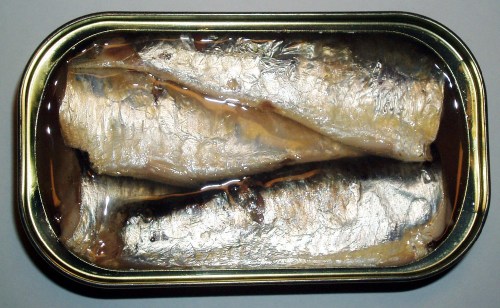
In keeping with my philosophy of food as a source of wellness, I’ve moved away from the concept of fish oil supplementation using commercial supplements and instead choose real-life salmon and sardines as a source of fish oils.

If I was a dog, I’d choose a few sardines over a fish oil capsule any day!

tinned sardines

Kathleen Crisley, specialist in dog massage, rehabilitation and nutrition/food therapy, The Balanced Dog, Christchurch, New Zealand

UCLA researcher finds that feeding pets creates the equivalent of 64 million tons of carbon dioxide a year

Note from DoggyMom:  It’s important for us to understand the environmental impacts of our activities.

On a scale with the huge consumption of meat in the USA, not to mention the environmental impacts of livestock production in other countries such as New Zealand’s dairy industry, the impact of pets is minor in comparison.

I recommend home-cooking and particularly the use of toppers with commercial foods to use meat leftovers and organ meats that we often discard.  But more importantly, if you move your human family to a plant-based diet, this will hugely offset any impacts from your pets eating meat!


With many Americans choosing to eat less meat in recent years, often to help reduce the environmental effect of meat production, UCLA geography professor Gregory Okin began to wonder how much feeding pets contributes to issues like climate change.

All that meat has important consequences. Okin calculated that meat-eating by dogs and cats creates the equivalent of about 64 million tons of carbon dioxide a year, which has about the same climate impact as a year’s worth of driving from 13.6 million cars.

dog eating food out of a bowl

Photo by: Patricia Marroquin/UCLA

“I like dogs and cats, and I’m definitely not recommending that people get rid of their pets or put them on a vegetarian diet, which would be unhealthy,” Okin said. “But I do think we should consider all the impacts that pets have so we can have an honest conversation about them. Pets have many benefits, but also a huge environmental impact.”

In a paper published  in the journal PLOS One, Okin says he found that cats and dogs are responsible for 25 to 30 percent of the environmental impact of meat consumption in the United States. If Americans’ 163 million Fidos and Felixes comprised a separate country, their fluffy nation would rank fifth in global meat consumption, Okin calculated, behind only Russia, Brazil, the United States and China. And it all has to go somewhere — America’s pets produce about 5.1 million tons of feces in a year, as much as 90 million Americans. If all that were thrown in the trash, it would rival the total trash production of Massachusetts — from the humans, at least.

Compared to a plant-based diet, meat requires more energy, land and water to produce, and has greater environmental consequences in terms of erosion, pesticides and waste, Okin noted. Previous studies have found that the American diet produces the equivalent of 260 million tons of carbon dioxide from livestock production. By calculating and comparing how much meat 163 million cats and dogs eat compared to 321 million Americans, Okin determined how many tons of greenhouse gases are tied to pet food.

His calculations start with publicly available information, like the number of dogs and cats in the country and the ingredients in market-leading pet foods, leading to complicated equations like the mathematical menagerie below, and producing estimates that create a starting point for conversation.

He found that the nation’s dogs and cats eat about 19 percent as many calories as the nation’s people, on par with all the calories consumed by the population of France in a year. Because dog and cat food tends to have more meat than the average human diet, this means that dogs and cats consume about 25 percent of the total calories derived from animals in the United States.

Okin, a member of UCLA’s Institute of the Environment and Sustainability, usually researches dust bowls, desert landscape dynamics and wind erosion, and how those things can impact individual ecosystems and the global climate. Pinning down the environmental impact of canine companions and feline friends was more of an — ahem — pet project that occurred to him while he was thinking about the growing trend of raising backyard chickens.

“I was thinking about how cool it is that chickens are vegetarian and make protein for us to eat, whereas many other pets eat a lot of protein from meat,” he said. “And that got me thinking — how much meat do our pets eat?”

Okin recognizes that some of the products in pet food aren’t something people should or would eat. But some of it is. In his research, he confirmed his hunch that premium pet foods usually contain more animal products than other brands, and that premium pet food purchases are increasing. As growing numbers of people consider pets less as animals and more as family members, Okin said, pampering has increased and the options for pet food with high-quality meat has kept pace. This means pets are increasingly eating cuts of meat suitable for humans.

“A dog doesn’t need to eat steak,” Okin said. “A dog can eat things a human sincerely can’t. So what if we could turn some of that pet food into people chow?”

A commitment to snout-to-tail consumption, where as much rendered product as possible is produced for human use, could significantly reduce national meat consumption. Okin estimates that if even a quarter of the meat in pet food could be consumed by humans, it would equal the amount of meat consumed by 26 million Americans, nearly the population of Texas. Okin noted that ideas about what is edible vary dramatically by culture. He also pointed to a controversy in 2012 about “pink slime,” also called lean finely textured beef.

“It’s perfectly edible and completely safe, but it’s unappetizing, so people don’t want it in their food,” Okin said. “But frankly, it’s a good, inexpensive protein source.”

As eating less meat expands from vegetarian to environmental circles as a way to reduce one’s carbon footprint, considering what to feed pets is a natural next step, Okin said. It’s not just an issue in the United States, he noted. In places like China, Brazil and other emerging countries, as the population becomes more affluent, they’re eating more meat and they’re getting more pets.

“I’m not a vegetarian, but eating meat does come at a cost,” he continued. “Those of us in favor of eating or serving meat need to be able to have an informed conversation about our choices, and that includes the choices we make for our pets.”

He doesn’t see a simple solution. Pets provide friendship and other social, health and emotional benefits that can’t be discounted, Okin said. People concerned about meat intake could consider vegetarian pets, like birds or hamsters, he suggested. The pet food industry, he noted, is also beginning to take steps toward sustainability, and could work to reduce overfeeding and consider alternative sources of protein. But it’s a complicated issue, and where pets are concerned, Okin knows it’s important to have a sense of humor about it.

“Maybe we could all have little ponies,” he said, half-jokingly. “We’d all get more exercise taking them for walks, and they would also mow the lawn.”

Source:  UCLA Newsroom

Elevated cholesterol’s link with canine osteosarcoma includes a better prognosis

Note from Doggy Mom:  I follow lots of areas of research in the canine field, but anything to do with osteosarcoma is interesting to me since greyhounds are known for suffering from this type of cancer.  Izzy is a greyhound!


Usually thought of as a health detriment, elevated cholesterol may play a role in longer survival times for dogs with a common form of bone cancer.

In addition to their veterinary significance, the findings by Oregon State University researchers advance the understanding of a type of malignant tumor, osteosarcoma, that’s often diagnosed in humans as well, typically afflicting teenagers and young adults.

Dog with cancer

A dog with osteosarcoma; Photo courtesy of Oregon State University

“This is one of the first steps into identifying cholesterol as a potential biomarker for canine osteosarcoma,” said Haley Leeper, a veterinary oncology resident at the OSU College of Veterinary Medicine. “We don’t have answers as to why high cholesterol is associated with this disease and with a better prognosis, but we’re hoping to advance these findings in future research.”

Leeper and collaborators at OSU and Iowa State University compared 64 dogs with osteosarcoma against two control groups: 30 dogs that had suffered traumatic bone fractures and 31 healthy dogs similar in age and weight to the animals with cancer.

Researchers found nearly half of the dogs with cancer – 29 of the 64 – had elevated levels of total serum cholesterol, a dramatically higher rate than occurred in either control population; just three of the 30 dogs with broken bones, and only two of the 31 healthy animals, showed high cholesterol.

Of the dogs stricken with osteosarcoma, 35 had the cancer in a leg which was subsequently amputated, followed by chemotherapy, which is the standard-of-care treatment; the dogs with elevated total cholesterol had a median survival time of 455 days, more than 200 days greater than the median survival time  for dogs with normal cholesterol.

“When people think of cholesterol they think of cheeseburgers and heart attacks,” Leeper said. “However, cholesterol is involved with many key processes and structures in the body like cell membranes, bone health and the immune system.”

Future studies that follow dogs long term and look at specific lipid content in the blood may shed light on the mechanisms behind cholesterol’s role in enhanced survival, Leeper said.

“There are a lot of things we plan on investigating,” she said. “This is exciting and fascinating, partly due to the comparative medical aspects between human research and our research.”

Source:  Oregon State University media release

Doggy quote of the month for August

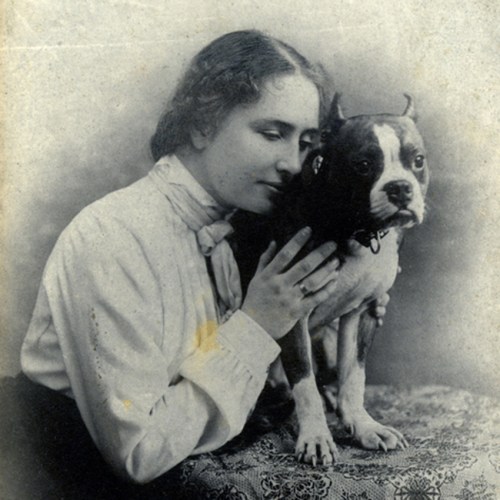
“The charming relations I have had with a long succession of dogs results from their happy spontaneity.  Usually they are quick to discover that I can not see or hear.  Considerately they rise as I come near, so that I may not stumble.  It is not training but love which impels them to break the silence about me with the thud of a tail rippling against my chair, or gambols round the study, or news conveyed by expressive ear, nose, and paw.  Often I yearn to give them speech, their motions are so eloquent with things they can not say.  Truly, as companions, friends, equals in opportunities of self-expression, they unfold to me the dignity of creation, and in their joy smiles the blessing of St. Francis.”

– Helen Keller in A Tribute to a Dog

Helen Keller with companions

Helen Keller with Phiz (a Boston Terrier). Photo courtesy of Perkins School for the Blind