High meat diets – a NZ study

An independent study from New Zealand has found that a high meat diet is easier for dogs to digest, meaning more nutrients are able to be absorbed, resulting in higher levels of bacteria associated with protein and fat digestion.

The study found:

  • High meat diets are more digestible for dogs
  • More nutrients from a high meat diet are able to be absorbed
  • Dogs on a high meat diet had higher levels of the bacteria associated with protein and fat digestion
  • Dogs on a high meat diet had smaller poo and better fecal health

The research paper ‘Key bacterial families (Clostridiaceae, Erysipelotrichaceae and Bacteroidaceae) are related to the digestion of protein and energy in the dog’ is accessible here.

With Government funding and funding from the NZ Premium Petfood Alliance, which is a collaboration between Bombay Petfoods, K9 Natural and ZiwiPeak, the research is being undertaken at AgResearch and Massey University.

“To date there has been hardly any published research, so this study is a significant contribution to the international animal nutrition field. A lot of diets on the market have been designed to ensure a dog survives, but this research shows that high meat diet is the best to help a dog thrive,” said New Zealand Premium Petfood Alliance spokesperson Neil Hinton.

Another study, about cat diets, is underway.

Source:  Beehive.govt.nz media release and AgResearch media release

Breed-specific dog foods

Back in January, I posted a blog about Prescription diets – what’s the truth?

In this post, I’m again going into the controversial world of commercial dog food and sharing some information on breed-specific dog foods.

The two labels most associated with breed-specific foods are Eukanuba and Royal Canin, although there are others.


In the November 2016 issue of Your Dog (published by the Cummings School of Veterinary Medicine at Tufts University), veterinary nutritionist Cailin Heinze provided opinion about such foods.

Dr Heinze re-iterated the common theme about the lack of rules for marketing.  “It’s a free for all.”

Although these pet foods must meet the AAFCO (Association of American Feed Control Officials) standard, ‘tweaking’ recipes to make them slightly more suitable for a particular breed isn’t a big change to make.

The article points out that there are no feeding trials to support the claims made for breed-specific dog foods and that the breed-specific formulations are not therapeutic diets.

You will need to buy access to read the article in its entirety (follow the link above), and I won’t break copyright by printing too much of the article in this blog.

It is heartening to see a veterinary nutritionist making these comments.  Too often, criticism of commercial dog foods is discounted because the writers are not veterinarians.

Kathleen Crisley, specialist in dog massage, rehabilitation and nutrition/food therapy, The Balanced Dog Ltd, Christchurch, New Zealand

My diary

I still use a paper diary despite having access to online calendars and tools. There’s a reason for that.

Diary photo

I successfully managed my time through the Auckland Power Crisis of 1998 without a hitch, thanks to my paper diary. My colleagues, who were already relying on electronic schedules, didn’t know where they were supposed to be for weeks.  Meetings had to be rescheduled; service delivery slowed.

My diary also helped me through the days and weeks following the Canterbury Earthquake of February 2011. During these trying times, I could still make and keep appointments, keep notes as reminders, and generally have something to hold onto that was part of ‘normal’ life.

Most pages include reminders of what I need to finish that day.

And reflecting on my diary over the weekend, I see that it includes Izzy’s social calendar.

Going forward over the next couple of months, Izzy has engagements for play dates, appearances at the Riccarton Market for Greyhounds as Pets, and dates for sleepovers when I have to travel for business.  She also has a birthday party date with her best mate (and boyfriend) Bergie.

I often say that the best thing we can give our dogs is quality time.  One way of ensuring you make time for your dog is to commit to them in writing.  I’m pretty confident that I’ve got the right priorities and tools to do just that.

Kathleen Crisley, specialist in dog massage, rehabilitation and nutrition/food therapy, The Balanced Dog Ltd, Christchurch, New Zealand


Officer Goodboy

New Zealand takes biosecurity very seriously.  That’s because our economy relies on agricultural and horticultural production and because our relative isolation from other continents has kept us free from some pests and diseases.

One of the best parts of coming home from overseas is heading into the baggage area and seeing the Ministry of Primary Industries’ (MPI, for short) detector dogs doing their job.  Usually Beagles, but sometimes other breeds, these dogs are focused on sniffing your bags to see if they contain any at-risk items.

Last year, MPI created a commercial using Officer Goodboy to explain the entry procedures into New Zealand.  A very good use of dogs in advertising.

Kathleen Crisley, specialist in dog massage, rehabilitation and nutrition/food therapy, The Balanced Dog Ltd, Christchurch, New Zealand

Life skills

Prospective dog owners who do their research will consistently find recommendations for things like dog training (obedience, walking on leash, etc.) and regular veterinary care.

However, in my experience there are 2 essential life skills that some dogs are missing.

They are:

  • handling on a table
  • touching of the paws

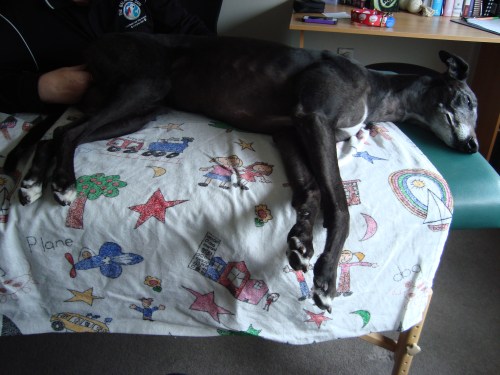
As a canine massage therapist, I was trained to work with dogs on a table.  It’s good professional practice.  It helps me have a better view and leverage for working on dogs and it also is good health and safety for me because it preserves my posture and the health of my knees.

When a dog is injured or infirm, or so large that even the efforts of the owner and I are not enough to get them onto the table, then I will work with them on the floor.

However, I meet dogs that won’t tolerate handling on a table and in some (not all) cases this is because they just were never taught to accept it.  Since I don’t want to be bitten, I have to go to Plan B – which is the floor.

Abbie table photo

Abbie is a 12 1/2 year old Labrador Retriever cross. She’s been a client for over a year. Abbie needs to be lifted onto my table but is otherwise an easy client to have. Food treats helped her accept the table over successive sessions.

One reason why I recommend massage for puppies is that it teaches them to accept table work at a young age.  My table is a cushioned and friendly table – not a cold stainless steel one that you will find in veterinary practice.

All of my canine clients get a treat at the end of their session- so my techniques are reward-based.

And I’ve done sufficient professional training in behavior that I can work to reinforce a timid, shy or scared dog so they get become more accustomed to table work.

Dogs can also be paw sensitive, but through positive training techniques, there is no reason to think that 99.9% of them can’t be trained to accept touching of their feet.  When a dog has mobility issues, I want to massage their toes and work acupoints in the feet and legs.  That’s hard to do if they are growling, snarling or too scared to let me touch them.

Dog groomers and vets will agree with me – it’s no fun having to muzzle a dog because they need their nails clipped, for example. We’re just reinforcing bad experiences if we do.

In the 8 years I have been practising, I have never used a muzzle.

If you are a dog parent reading this – ask yourself how your dog reacts to being on a table or having their paws touched.  If they are reluctant or worse, I’d say it’s time to review your training and schedule in a course of massage therapy.

Kathleen Crisley, specialist in dog massage, rehabilitation and nutrition/food therapy, The Balanced Dog Ltd, Christchurch, New Zealand


Tax implications for fostering

Americans resident in the United States have to file their taxes by 15th April each year – it’s a busy time for accountants and bookkeepers.

Second Hand Dogs

But I came across a tax decision,  VanDusen vs IRS Commissioner, which is very promising for volunteers who foster dogs for designated 501(c)(3) not-for-profit animal rescue organizations.  If the foster carer incurs unreimbursed expenses directly related to fostering, they can claim these on their tax returns as charitable deductions.  Things like food, veterinary care, and mileage are included; so too are utility costs for the portion of the home’s space that is used for care of the foster animal.

Careful record-keeping is important to ensure against audit troubles later on, of course.

Wish we had something like that in the tax code in New Zealand!

Kathleen Crisley, specialist in dog massage, rehabilitation and nutrition/food therapy, The Balanced Dog Ltd, Christchurch, New Zealand

Vaccination management

I meet owners who express concern about over-vaccination; more often than not, this has led them to the decision on not to vaccinate their dog. If they don’t send their dog to a boarding kennel or day care, there is little motivation for them to do so – other than any regular visits to their vet.

I can understand the concerns, but I also get concerned that these owners are relying on herd immunity – the odds that the majority of the herd (in this case, the dog population) are immunised and so their dog isn’t at risk because most animals are protected.

But then we have communities, like last year on the West Coast, who experience parvovirus infections across a range of puppies and dogs…

This blog is a re-print of an article I wrote for NZ Dog World magazine in 2014.  There is the option to titre test our dogs to test their levels of immunity and to give us more information on whether to vaccinate or not.


Titre testing is available in New Zealand but few dog owners appear to know about it, says Karen Cooper, Laboratory Manager with Gribbles Veterinary in Auckland.  “This testing option was not previously available here, but despite its recent introduction the uptake of the testing has not been huge.”

calming a cute puppy patient at the vet's

Vaccination time… or is it? (photo courtesy of Gribbles Veterinary)

A titre test measures the levels of antibodies in the blood.  Testing can be done for immunity to canine parvovirus and canine distemper virus.

Dr Jean Dodds, who is a leading holistic veterinarian and founder of Hemopet, a non-profit blood bank for dogs in the USA, says that research has found that an animal’s titre level remains constant for years.  Therefore, there is little risk that an animal will be misdiagnosed as having sufficient immunity.

A negative titre test would mean that the dog requires a booster vaccination, whereas a positive test would mean it does not.

Dr Dodd’s vaccination protocol calls for vaccine antibody titres to be undertaken every three years.  For most veterinary practices in New Zealand, three-yearly booster vaccination is routine.  Titre testing could be done in lieu of an automatic vaccination but in most cases the dog owner needs to ask for it.

The NZVA’s policy on vaccine use states:

Veterinarians should maintain a professional approach to all aspects of the use of vaccines. This includes encouraging widespread vaccination as an important means of preventing and controlling infectious diseases while ensuring that vaccines are not used unnecessarily.  Veterinarians should aim to maintain the profession as the source of informed knowledge on the use of vaccines and be responsible for the correct use of these agents.

Veterinarians should adhere to their ethical and legal obligations by informing their clients of the risks and benefits of vaccination of companion animals, keeping comprehensive patient records and vaccination certificates.

Why titre?

The most popular application is in puppies to check for an effective immune response; a titre test can be performed approximately two weeks following the final vaccination.

In older dogs, the main concern is avoiding the risks that are associated with vaccination.  These risks may involve localised swelling, lethargy, fever and allergic reactions ranging from mild to severe.   There may be no need to expose their bodies to the pressures associated with vaccination if they have sufficient immunity.  With rescue dogs, titre testing can provide insight into their immune status.

One issue for some owners is whether their boarding kennel will accept the tests.  The kennels I spoke to for this article varied in their position from “We require dogs to have a current vaccination certificate to “We would like to think of ourselves as educated and discerning and therefore we are happy to accept results of a titre test.” 

When boarding your dog, it is important to understand that there is no titre for kennel cough and so vaccination is likely to be needed.

Titre testing may not be suitable for every dog; re-vaccination may not be suitable for every dog.  It’s up to the owner to make an informed choice.

Kathleen Crisley, specialist in dog massage, rehabilitation and nutrition/food therapy, The Balanced Dog Ltd, Christchurch, New Zealand

Reflecting my values

They say that entrepreneurs start businesses because they want to do something that they enjoy.  I believe that.  I also believe that those of us who have started a business want it to reflect our personal values.

I remember that, when I was employed in my ‘first career’ as a manager, we were reminded about studies involving employee engagement.  These studies show that employees leave an organisation when they don’t feel that it matches their value system.  If the business reflects your values – you’ll be a happy employee.

So, I decided that when my practice was large enough, I wanted to give back to the local community by supporting dog adoptions and welfare.  Agencies involved in animal welfare always need money to operate and are financially stressed on a regular basis.  I decided to use my fundraising skills through organising and sponsoring an annual fundraiser.

This is my third year organising an event and the beneficiary is Second Chance Dog Rescue.

This fundraiser has a Second Chance theme – also reflecting my interests in the environment and sustainability.  It’s a swap party – and everyone who attends is being asked to bring a good, used item to swap with others.  We’ll also accept donations of good, used toys and other items for the rescue.

This means that the environment wins as much as the dogs.  And I think it will be an entertaining Sunday afternoon – 21 May 2017.

I’ll let you know how it goes after the event.

Kathleen Crisley, specialist in dog massage, rehabilitation and nutrition/food therapy, The Balanced Dog Ltd, Christchurch, New Zealand

Swap party announcement

Caption this

Since a lot of my posts are about really serious topics, today I decided to start the week with a cute photo.

How would you caption this?

malamutes

Kathleen Crisley, specialist in dog massage, rehabilitation and nutrition/food therapy, The Balanced Dog Ltd, Christchurch, New Zealand

Perspectives on dog walking

Rather than there being a one-way flow of power where the human is dominant, the dog walk is where humans and dogs negotiate power within their relationship. This new study highlights a delicate balance between ‘listening’ to what a dog wants and needs from a walk and acting out a human’s own dispositions and interpretations of what is best for themselves, their dog and others within the communal space.

off-lead-dog-walking

The study was led by Dr Thomas Fletcher, Senior Lecturer and Researcher within the Institute for Sport, Physical Activity and Leisure at Leeds Beckett University with Dr Louise Platt, Senior Lecturer at Manchester Metropolitan University.

Twelve people in Northern England, between the ages of 28 and 66 and who walk with dogs, took part in in-depth interviews as part of the research. The aim of the study was to examine how humans share spaces with their animal counterparts, and how walking experiences with animal companions are negotiated.

Respondents were asked to broadly discuss their dog’s personality, what their dogs meant to them and how their relationships with their dogs had developed and been negotiated. Respondents were asked to reflect on what walking meant, how it featured in their lives, how it was experienced and how they attempted to understand the relationship between themselves and their dog.

Dr Fletcher explained: “The study reveals that humans walk their dogs in large part because they feel a deep-rooted emotional bond with them and hold a strong sense of obligation to ensure they stay fit and healthy. Perhaps more interestingly, humans also walk their dogs because they believe their dogs have fun and are able to be more ‘dog-like’ while out on a walk.

“We found that it was whilst out on the walk that many respondents felt their relationship with their animal was most strongly enacted outside the confines of the domestic setting. This sense of humans ceding authority and providing the freedom and space for their dogs to enact their ‘dog-ness’ was important to the respondents.”

With 40% of UK households being home to a domestic pet and 8.5 million dogs living in UK homes (source: Pet Food Manufacturers Association, 2016), the average person walks with their dog for eight hours and 54 minutes a week, covering 36 miles (source: Esure Pet Insurance, 2011). The new research shows that a dog walk is a partnership, involving co-knowing and anticipatory knowledge, all of which is negotiated (and, to a degree, managed) by human walkers.

The study found that dog walkers commonly thought of the walk as something they did for their dog. Each respondent believed that dogs possess their own unique personality, likes and dislikes.

Dr Fletcher said: “In most cases, characteristics of the walk such as timing, length and place, were determined by their dog’s personality and what they, as humans, thought the dogs liked and disliked the most.”

Also important were ideas of caregiving and responsibility, and of walking being good for a dog’s health and wellbeing. Whilst walking patterns varied significantly, there was consensus that around 30 minutes twice a day was acceptable.

Whilst previous research suggests that the dog walk is seen as a human obligation, or even a chore, the new study found that, in most cases, this sense of obligation was actually overshadowed by the respondents’ want to walk, based on a desire to see their dogs having fun.

Dr Fletcher explained: “The walk was seen as an invaluable opportunity for dogs ‘to be dogs’. There was widespread belief that dogs are happiest when out in the open, and it is here that they are able to best demonstrate their ‘dog-ness’. This was important because, despite the respondents acknowledging that their dogs had been domesticated, they also took pleasure from seeing them behave ‘like dogs’.”

One respondent articulated this by saying: “One of the biggest joys for us is when one of us stands at one part of the field and the other; and he just runs. And we’ve managed to time him. He does 30 miles an hour. And he looks like a cheetah, he looks like a wild animal. And it just makes your heart, I mean, I feel a physical change in my body when I watch him run, which has never been created by anything else, really.”

Some respondents discussed modifying their walks as a result of anticipating their companion’s behaviour, which highlighted the tension between human authority and animal submission. For example, one walker generally kept his dog on a lead due to a perception of that breed being ‘poachers’. This walker feared if, let loose, his dog would kill rabbits and other small animals.

Dr Fletcher commented: “The dog’s ability to run free was often curtailed by her ‘other’ instincts and the human interpretation of these. In the case of the respondent highlighted above, whilst his intention was undeniably good, it does raise a number of questions about the ethics of domesticating animals to suit human needs.”

Similarly, respondents tended to frame their commitment to their dogs’ wellbeing and fun in terms of allowing them to behave in certain ways.

Dr Fletcher continued: “In spite of this, respondents did attempt to ‘listen’ to their companions and wanted to please them. They acknowledged and appreciated the ‘beastly’ nature of dogs in needing the freedom to explore and do their own thing independently. However, this ‘listening’ relies on humans imposing their own interpretations onto animals and their actions.”

Whilst dog walking is commonly thought of as a social activity, the researchers found that most of the respondents preferred to walk alone and some actively avoided interacting with other walkers. One noted that a culture of judgement existed in her dog walking community, where people known to walk their dogs less regularly were actively excluded.

Dr Fletcher said: “Respondents acknowledged the problematic nature of human and dog interaction, with some discussing how the spaces chosen for walks were selected purposefully to ensure a relatively straightforward (and pleasurable) experience is maintained for both dog and walker. Some respondents chose to walk routes they knew would be quiet. They did this for two reasons. Firstly, they did not want to socialise with other humans (or their dogs); and secondly, some believed their walk would be easier and less stressful if their route was human and dog-free.”

One participant commented: “Sometimes I have had to apologise for no reason, like even when my dog hasn’t done anything wrong. Just sometimes you get children who are scared of dogs and they would run away and have a little cry, even though he hasn’t gone anywhere near them. You just say “sorry”. I suppose it is just another etiquette thing really.”

Dr Fletcher said: “Walking with dogs represents a potentially important cultural space for making sense of human-animal relations. Our research has shown how the personalities of both dog and walker can shape not only walking practices, but also the human-animal bond.”

The researchers feel that future research in order to understand how humans attempt to fulfil the needs and wants of their dogs (and other animal companions), is vital.

Dr Fletcher added: “Moving forward, we would like to see research taking place that can capture the ‘beastly’ nature of animals, allowing them to act without human interference. Technology, such as ‘dog-cams’ and GPS, has great potential for furthering our understanding of the world of dogs beyond their relationships with human companions.”

Source:  Leeds Beckett University