The FBI is now tracking cases of animal abuse

This year, the Federal Bureau of Investigation (FBI) will begin collecting data on animal cruelty crimes throughout the USA to prevent animal abuse and help flag those who might become violent offenders.

This is a change in departure in how statistics are kept and used.  In the past, animal cruelty was simply classified in an ‘other’ category.

The link between violent offenders and animal abuse is undeniable; animal welfare advocates have universally applauded the move.

This article in The Christian Science Monitor explains the importance of the shift.


Kathleen Crisley, specialist in dog massage, rehabilitation and nutrition/food therapy, The Balanced Dog, Christchurch, New Zealand


It’s safe to cuddle when you’re sick

This winter, when you are home sick with the cold or flu cuddling with your dog or cat may feel like just what the doctor ordered.

A Vanderbilt infectious disease expert, while stopping short of actually prescribing in-home “pet therapy” for colds or flu, says that if having your companion by your side makes you feel better, go right ahead. Pets won’t catch or spread human viruses.

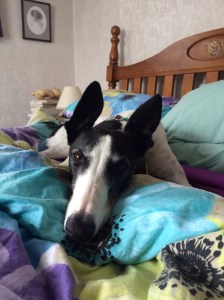
Izzy, greyhound, uin bed and ready to cuddle
“The pet is a comfort, not a hazard,” said William Schaffner, M.D., professor of Preventive Medicine at Vanderbilt University Medical Center. Even somebody who pets the dog or cat after you is unlikely to catch your virus that way, and “you can’t get a cold or the flu from your dog or cat,” Schaffner said.

While pets are pretty much off the hook, Schaffner says the true hazard in catching a virus comes from fellow two-legged creatures.

“Flu is transmitted person-to-person through close personal contact. If you get within my breathing zone, within three feet, I can transfer the influenza virus to you. I breathe it out, you breathe it in, and you can be infected,” Schaffner said.

Colds and flu can also be transmitted by hand—handshaking extroverts take note—or via some surfaces, such as when a sick person touches a doorknob, for example, and somebody else touches the same surface, and then touches his or her face.

“People should wash their hands often and use hand sanitizer,” Schaffner said. “Also, when flu is rampant in the community, greet friends with an elbow bump rather than a handshake.”

People and their pets have this in common: the best way to avoid getting sick is to be immunized—with pets it’s their vaccinations, and with people it’s a flu shot.

Source:  Newswise media release

Kathleen Crisley, specialist in dog massage, rehabilitation and nutrition/food therapy, The Balanced Dog, Christchurch, New Zealand

Study shows dogs can recognise human emotions

Dogs can recognise emotions in humans by combining information from different senses – an ability that has never previously been observed outside of humans, a new study reveals.

For the first time, researchers have shown that dogs must form abstract mental representations of positive and negative emotional states, and are not simply displaying learned behaviours when responding to the expressions of people and other dogs.

The findings from a team of animal behaviour experts and psychologists the University of Lincoln, UK, and University of Sao Paulo, Brazil, are published in the Royal Society journal Biology Letters.

The researchers presented 17 domestic dogs with pairings of images and sounds conveying different combinations of positive (happy or playful) and negative (angry or aggressive) emotional expressions in humans and dogs. These distinct sources of sensory input – photos of facial expressions and audio clips of vocalisations (voices or barks) from unfamiliar subjects – were played simultaneously to the animals, without any prior training.

The team found the dogs spent significantly longer looking at the facial expressions which matched the emotional state (or valence) of the vocalisation, for both human and canine subjects.

Dogs and emotions study

The integration of different types of sensory information in this way indicates that dogs have mental representations of positive and negative emotional states of others.

Researcher Dr Kun Guo, from the University of Lincoln’s School of Psychology, said: “Previous studies have indicated that dogs can differentiate between human emotions from cues such as facial expressions, but this is not the same as emotional recognition.

“Our study shows that dogs have the ability to integrate two different sources of sensory information into a coherent perception of emotion in both humans and dogs. To do so requires a system of internal categorisation of emotional states. This cognitive ability has until now only been evidenced in primates and the capacity to do this across species only seen in humans.”

Co-author Professor Daniel Mills, from the School of Life Sciences at the University of Lincoln, said: “It has been a long-standing debate whether dogs can recognise human emotions. Many dog owners report anecdotally that their pets seem highly sensitive to the moods of human family members.

However, there is an important difference between associative behaviour, such as learning to respond appropriately to an angry voice, and recognising a range of very different cues that go together to indicate emotional arousal in another. Our findings are the first to show that dogs truly recognise emotions in humans and other dogs.

“Importantly, the dogs in our trials received no prior training or period of familiarisation with the subjects in the images or audio. This suggests that dogs’ ability to combine emotional cues may be intrinsic. As a highly social species, such a tool would have been advantageous and the detection of emotion in humans may even have been selected for over generations of domestication by us.”

Source: AlphaGalileo media release

The Warehouse – another example of dogs in advertising

My business is a member of the BizRewards program by retailer The Warehouse/Warehouse Stationery.

Today, like most weeks, a sales flyer popped up in my inbox.  To my delight, it has a dog theme:

Get excited about going back to work

Never underestimate the appeal of a dog in your advertising.

Kathleen Crisley, specialist in dog massage, rehabilitation and nutrition/food therapy, The Balanced Dog, Christchurch, New Zealand

David Bowie – the dog connection

Over the last couple of days, I’ve seen the groundswell of tributes to David Bowie.  Because the man had dignity, he kept his disease largely private and out of the public eye (I admire that).  We live in an age where too many often share too much.

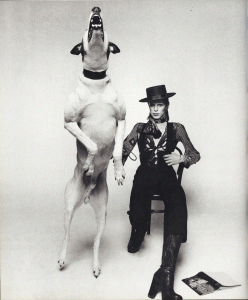
I’m pleased to report that, as with so many things, there’s a dog connection to David Bowie.  His 1974 album Diamond Dogs has a canine-themed cover:

Diamond dogs cover

During a photo shoot around the same time, this photo was taken.  Apparently both the photographer and Bowie were startled when, according to them, the dog jumped up to try and sing:

David Bowie and dog - ziggy stardust

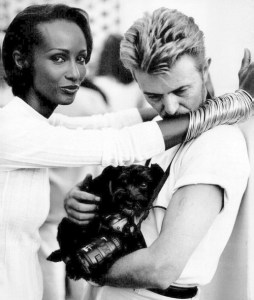
Mr Bowie and his wife, Iman, also shared a love of dogs:

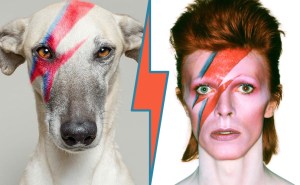
Iman, David Bowie and pet dogAnd now, as fans mourn his passing, I see that many are using their dogs for artistic tributes:

Aladdin Sane Bowie tribute

Given Bowie’s artistic talents, I think he’d approve that people are involving their dogs in expressing grief.  RIP, Mr Bowie.

Kathleen Crisley, specialist in dog massage, rehabilitation and nutrition/food therapy, The Balanced Dog, Christchurch, New Zealand


When Dogs Heal

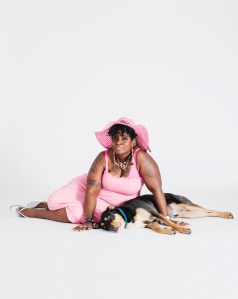
When Dogs Heal is a photographic exhibition supported by the charity Fred Says, which helps people diagnosed with HIV.

The photographs tell the stories of the dogs who helped their HIV-positive owners through tough times.

When Dogs Heal photograph

Paolo and Stud

The photographs have been shown in Chicago and New York, and through the When Dogs Heal website, galleries can express interest in hosting an exhibit.

When Dogs Heal photograph

Sharon and Dulk

The stories behind the photographs are pretty hard-hitting, but then again so is HIV and the impact of an HIV diagnosis.  Just another example of the human-animal bond and the connection between dogs and good health.

Kathleen Crisley, specialist in dog massage, rehabilitation and nutrition/food therapy, The Balanced Dog, Christchurch, New Zealand


Jimmy the Bull

On artist’s Rafael Mantesso’s thirtieth birthday, his wife left him.

She took their cookware, their furniture, their photos.  But she left Rafael with Jimmy, their bull terrier who she had named after shoe designer Jimmy Choo.

With only Jimmy for company in an apartment painted white, Rafael found inspiration in his blank walls and his best friend and started snapping photos of Jimmy Choo.  Then, when Jimmy collapsed in happy exhaustion next to the white wall, on a whim Rafael grabbed a marker and drew a new world around his pup.

Jimmy with champagne

And this began a collaboration of the artist and his bull terrier which gained fame through social media – even attracting the attention of the Jimmy Choo brand.  In May 2015, they launched a limited edition line of accessories featuring Jimmy the Bull.

Jimmy Stop Wars

And a book of Mantesso’s drawings, A Dog Named Jimmy is also available.  In November 2015, it made the New York Times bestseller list.

A Dog named Jimmy

I love bullies and clearly many other people do, too.  Jimmy even has a 2016 calendar featuring his image.

Kathleen Crisley, specialist in dog massage, rehabilitation and nutrition/food therapy, The Balanced Dog, Christchurch, New Zealand


What a veterinarian and a dog massage therapist have in common

I came across an article recently which was a sort of a “Vets Tell You What They Really Think” piece.  It listed 50 things that the veterinarian would love to say, but can’t, because it would be either too forward or too unprofessional (or both).

One of these really stood out for me:

“Here’s a pet peeve: owners who don’t want to pay for diagnostic tests but then cop an attitude because you don’t know what’s wrong with the animal. Since you wouldn’t let me do the blood work or X-rays, how the heck do you expect me to know?”A vet in South Carolina.

I’m in total agreement with this vet.  If we don’t have a diagnosis how are we able to help?

Believe it or not, I get contacted fairly regularly from people who want me to come and work on their dog because they don’t want to pay for x-rays or other tests.  In such cases, I tell them politely that I need a diagnosis to be able to confidently work with their animal.  The risk is too high that, for example, if the dog has spinal injury I can make it worse rather than better.

Costs for veterinary care can be high, but you pay for the skills and the tools that are available to a veterinarian.  The vet is your dog’s equivalent of the Family Doctor/General Practitioner and sometimes the Emergency Room Doctor combined.  Your dog needs them!
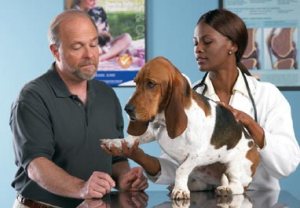
dog and vet

There are times I’ve been caught.  Such as the case where the owners said x-rays had been taken and we worked for quite a few weeks on the dog only to suffer setbacks.  The owners were getting frustrated.   I suggested other things within my scope of practice and I recommended they go back to the vet.

That’s when I found out that the owner had only allowed the vet to take a single x-ray to save money.  The x-ray didn’t reveal anything in the lower spine and so the vet  assumed a partial tear of the cruciate based solely on symptoms.  And that’s the diagnosis I was working with, too.

When the owners returned to the vet, they were persuaded to do more scans and that’s when the problem (and a totally different diagnosis) was determined.

In the end, these owners probably spent more money than they saved.  And  their dog walked around with an injury that was even more difficult to address.

My advice to owners is to only bring a dog into your life when you are confident that you can pay for their care (and that’s means more than just vaccinations, food and flea treatments).  And if you have concerns about your ability to pay for injuries and illness – get pet insurance.  Some policies even cover costs of complementary care such as dog massage when these treatments are recommended by your vet.

I know that some owners like the idea of setting aside money regularly; my concern is that you would have to be setting fairly large amounts aside regularly for a bank balance with compounding interest to reach into the thousands.  And that’s what some of my clients face when surgeries and special procedures are needed.

Your vet is an essential part of your health care team.  We all need a solid diagnosis to help your dog feel better.

Kathleen Crisley, specialist in dog massage, rehabilitation and nutrition/food therapy, The Balanced Dog, Christchurch, New Zealand

Life after Buddy

This article (Hounded by Grief), courtesy of the WBUR, Boston’s National Public Radio station, starts with the haunting words:

I am dogless.  Again.

Boston journalist Anita Diamant pictured with Buddy at Good Harbor Beach in Gloucester, Mass., winter 2013. (photo by Ms Diamant)

Boston journalist Anita Diamant pictured with Buddy at Good Harbor Beach in Gloucester, Mass., winter 2013. (photo by Ms Diamant)

For all of us who have loved a series of dogs, including a special ‘heart dog,’ I think some of the words will resonate with you.

Kathleen Crisley, specialist in dog massage, rehabilitation and nutrition/food therapy, The Balanced Dog Ltd, Christchurch, New Zealand

In praise of liver

Liver

I personally can’t stand the taste of liver, but it is a different story for Izzy and the dogs I see in my practice.

Liver, an organ meat, is found in the ‘offal’ section of supermarkets.  It’s very much worth buying some liver for your dog to be fed two-three times per week and this can be done easily with a commercial food diet by boiling the liver and adding the liver and the water over the food.  A third of a cup of the meat is sufficient per serving.   (I don’t like feeding raw foods combined with cooked/commercial foods – because the digestive enzymes needed for raw vs cooked are different.)  If feeding a raw diet, it’s okay to feed raw liver.

I also make my own liver treats which I use as a reward for dogs in my massage practice.

Liver is nutrient-rich.  It’s a source of protein, Vitamin A, Vitamin B12, Phosphorus, Potassium, Iron, and Co-enzyme Q10.  It’s a good antioxidant and, for performance dogs, it’s a super food.

It’s possible to feed too much of a good thing and this is also the case with liver.  If a dog is fed too much liver, it can develop a condition known as hypervitaminosis A; this is an overdose of vitamin A.

Symptoms of a vitamin A overdose can include bone deformity, bone spurs on the dog’s legs or spine that cause him to limp, digestive upsets, muscle weakness, stiffness and sometimes weight loss.

If feeding a commercial diet, I think liver is one of the easiest ‘toppers’ you can introduce that will bring some fresh ingredients into your dog’s diet.

Kathleen Crisley, specialist in dog massage, rehabilitation and nutrition/food therapy, The Balanced Dog Ltd, Christchurch, New Zealand