Tag Archives: arthritis

Does my dog have arthritis?

Fireplace photo

Arthritis is a common condition in older dogs.  At first, though, owners may not always realise when their dog is suffering.  That’s because dogs tend to hide discomfort and pain from their pack.

Signs that your dog may be suffering from arthritis include:

  • Difficulty sitting or standing
  • Sleeping more
  • Weight gain
  • Reluctance to jump, run, walk or climb stairs
  • Decreased interest in playing or engaging in activities
  • Being less alert
  • Favouring a limb
  • Changes in attitude or behaviour

One day in 2011, Daisy let me know something was wrong.  We were out walking and she slowed down and stopped and the look in her eyes was one of pain.  She had finally let me know that she wasn’t feeling herself.

A series of x-rays confirmed arthritis in her lumbosacral spine and left hip.

Since then, she has responded to rest, conventional treatments, hydrotherapy, and other complementary therapies including my massage and laser treatments.

Quality of life for an arthritis sufferer can be attained – once the owner is aware of the problem!

The State of Pet Health in 2013 – The Banfield Report

As most of my regular readers know, I’m passionate about holistic health for our dogs. It helps, though, when we have statistics like the Banfield State of Pet Health Report 2013 to show us the ailments that are more common. In this report, we see that obesity and dental health are 2 major problems.

So ask yourself honestly – is my dog a bit heavier than he/she should be? Is the dog’s bad breath a sign of something more sinister? Through my practice, I can help dogs with both conditions (plus others, like arthritis).

Get in touch!

Mel's avatarNo Dog About It Blog

Chihuahua Wearing EyeglassesLast year, I shared a summary of Banfield Pet Hospital’s 2012 report on the state of pet health in America. The report was full of interesting information on the common ailments and diseases they see in the cats and dogs who visit their hospitals. It also called out a disturbing trend being seen in both types of pets – an increase in pet obesity.

In their 2013 State of Pet Health Report, Banfield shares even more interesting information on the average lifespan of pets and some frequently occurring themes (also seen in the 2012 report). This year’s report provides pet owners and veterinarians with even greater insight into the health of all our pets and where we should be focusing our attention.

Here is a summary of some of the more interesting findings:

  • Toy or smaller breed dogs live 41% longer than large breed dogs.
  • Large breeds reach their senior…

View original post 223 more words

Developing methods in pain management and osteoarthritis

Researchers at Kansas State University are devoting their time to the study of improvements in pain management and the treatment of osteoarthritis in dogs.   (For more information on pain management, see my June 2012 blog)

The projects are led by James Roush, a professor of clinical sciences.

In one study, the research team determined that the maximum effective time for using hot and cold packs for pain management is 10 minutes.   The researchers studied how packing affects tissue temperature in beagles and beagle-sized dogs after surgery because hot and cold packing is a common technique for reducing swelling.   After 10 minutes, the maximum change in tissue temperature has been reached.

In another study, a special mat is being used to study lameness in dogs suffering from osteoarthritis.  When dogs step on the mat, it measures the pressure in their step and the study team can determine in which leg the lameness is worse.

“We’ve designed the study to help improve osteoarthritis treatment,” Roush said. “We will also use it to measure clinical patients when they come in for regular checkups. We can measure their recovery and a variety of other aspects: how they respond to nonsteroidal anti-inflammatories, how they respond to narcotics or how they respond to a surgical procedure that is designed to take that pressure off the joint.”

And in a third study,  Roush is collaborating with researchers to study the effectiveness of a painkiller used to treat dogs to identify potential alternatives.

“To achieve the drug’s effect, the dosage in dogs is much higher than in people,” Roush said. “It also may not be a very good analgesic in dogs. We want to see if there is an alternative that requires smaller doses and does not have not as much of a discrepancy for patients.”

Source:  Kansas State University media release

Would a raised dog feeder help my dog?

A massage client asked me this question earlier this week.   The dog in question is a Boxer (beautiful boy) who happens to be suffering from degeneration in his spine.

Although he is doing well with regular swimming, acupuncture and massage therapy, his owner knows that he is comparatively young (8) and she wants him to have a good quality of life for a long time.  So that’s when we started talking about changes she could make to his physical environment to make things less stressful for him (ramps, steps, etc.)

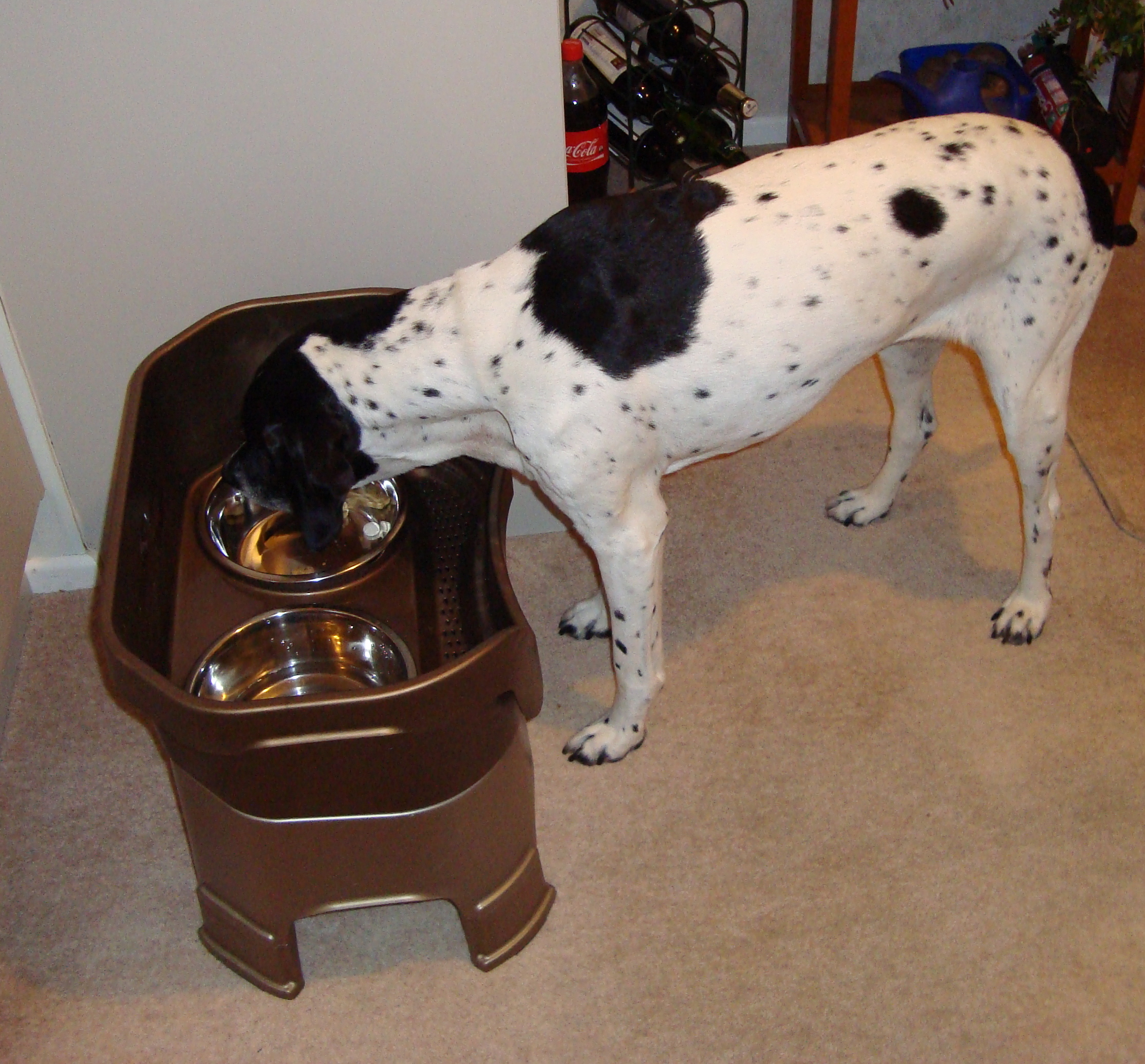
Would a raised feeder help my dog?

Raised feeders can be a real advantage for a dog with orthopaedic problems or arthritis.  Eating from a raised feeder helps to relieve strain on the neck and back, allowing the dog to eat without dramatically altering their posture and helping them to retain balance.

But – some studies have shown that dogs who are susceptible to bloat have an increased risk from eating from a raised feeder.  The most notable reference for this link is an article by Dr Larry Glickman in Journal of the American Veterinary Medical Association, Vol. 17, No. 10.

Gastric dilation-volvulus (GDV) is known by the common term ‘bloat’  and other terms such as ‘stomach torsion’ or ‘twisted stomach.’  Regardless of what name you use, the condition is life-threatening.  Dogs can die of bloat within several hours.   Even with treatment, as many as 25-33% of dogs who develop bloat will die.

In bloat, the stomach fills up with air and puts pressure on the other organs and the diaphragm. The pressure on the diaphragm makes it difficult for the dog to breathe. The air-filled stomach also compresses large veins in the abdomen, preventing blood from returning to the heart.

Filled with air, the stomach can easily rotate on itself, pinching off its blood supply. This rotation is known as volvulus.  The stomach begins to die and the entire blood supply is disrupted.  A dog with this condition can deteriorate very rapidly – meaning a trip to the vet as an emergency.

Purdue University ranks Boxers as the 16th breed most susceptible to bloat (Great Danes are the highest).  So, in this case, the owner decided not to opt for a raised feeder.  Not only is her Boxer on the higher risk list, but he also is a gobbler – making quick work of his food!

This is just one example where it pays to do a little research.  An idea that seems like a good one may not be so.

9/11 Search and Rescue Dog Receives Stem Cell Therapy

Here’s the Fox 5 story of rescue dog ‘Red’ – one of the last surviving rescue dogs from the 9/11 attacks.  Red has arthritis and degeneration in her back and has undergone stem cell therapy at a Virginia clinic.

9/11 Search and Rescue Dog Receives Stem Cell Therapy at Va. Clinic.

Weight gain and obesity are not only human conditions

We live in modern times, and in western societies such as ours, obesity and weight gain are consistent problems.  And not just for people.

36 million pets in the United States are obese, according to the Association for Pet Obesity Prevention.  In dog population terms, that’s 55% of the dog population.  The Association does a pet obesity survey each year, timed with National Pet Obesity Prevention Day (in October), where it asks pet owners to fill out a survey about their pet’s size, breed and eating habits.

Veterinarian Ernie Ward is a co-founder of the Association and he says that the focus on reward-based training has helped to contribute to the obesity problem.  Simply put, owners are not adjusting their dog’s daily intake of food at mealtime to compensate for treats being given as a reward.

And once a dog is fully trained, the rewards seem to keep coming for sometimes very basic tasks.  Like pooping, for example.

(Ask yourself:  once your child is potty-trained, do you keep praising him/her each time they use the toilet? – even into their teenage and adult years?)

And I’ve found that delivering the news to a client that their dog could lose some weight can often be a reason for not being asked to return for another massage treatment.  According to a recent article in The Boston Globe, I’m not alone.  Vets that deliver the news that a pet is overweight may find that the owner becomes defensive or, worse, takes their business elsewhere!

However, when I am dealing with a dog with arthritis or other mobility disorder, I am looking for ways to relieve their pain.  If they are carrying around extra weight, their sore joints and muscles are pulling double-duty.  I remember a client with a Pug, for example, who was easily twice its normal body weight.  Sure, the dog had arthritis, but it was so fat that it didn’t want to exercise and so weight loss was going to be a challenge and something the owner had to a) recognise and b) act on.

The Globe article also discusses the wide range of calorie content amongst commercial dog foods.    People may change their dog’s food, but continue feeding the same number of cups per day.  Weight gain is insidious and many people don’t recognise that their dog has put on weight until a vet or someone else points it out to them.

I do nutritional assessments for this reason.  I ask questions about the dog’s lifestyle, exercise habits and eating.  And I can run caloric calculations based on the dog food label to give advice on how much to feed.

There are many health professionals including your vet that have your dog’s best interest at heart.  Don’t be afraid to ask if they think your dog is overweight and be humble enough to make changes.

P.S.  When I take Daisy to her acupuncture treatments, my vet asks me to weigh her prior to each consultation.  This keeps me very disciplined to ensure that Daisy remains in her ideal weight range.

Some full-service pet shops and veterinary practices are happy for you to drop in to use their scales.  Why not make it a habit of walking your dog to these places for a weigh-in?  It’s a new routine that will keep you focused on your dog’s weight in a more positive way.