Tag Archives: breed specific legislation

Why dog breed bans are misguided and harmful

It’s not often the dog but the person holding the leash who creates the conditions, often by neglect or abuse, for a dog to attack.

***This is a wonderful opinion piece by Marcela Garcia of The Boston Globe. The words are hers, but I agree entirely***
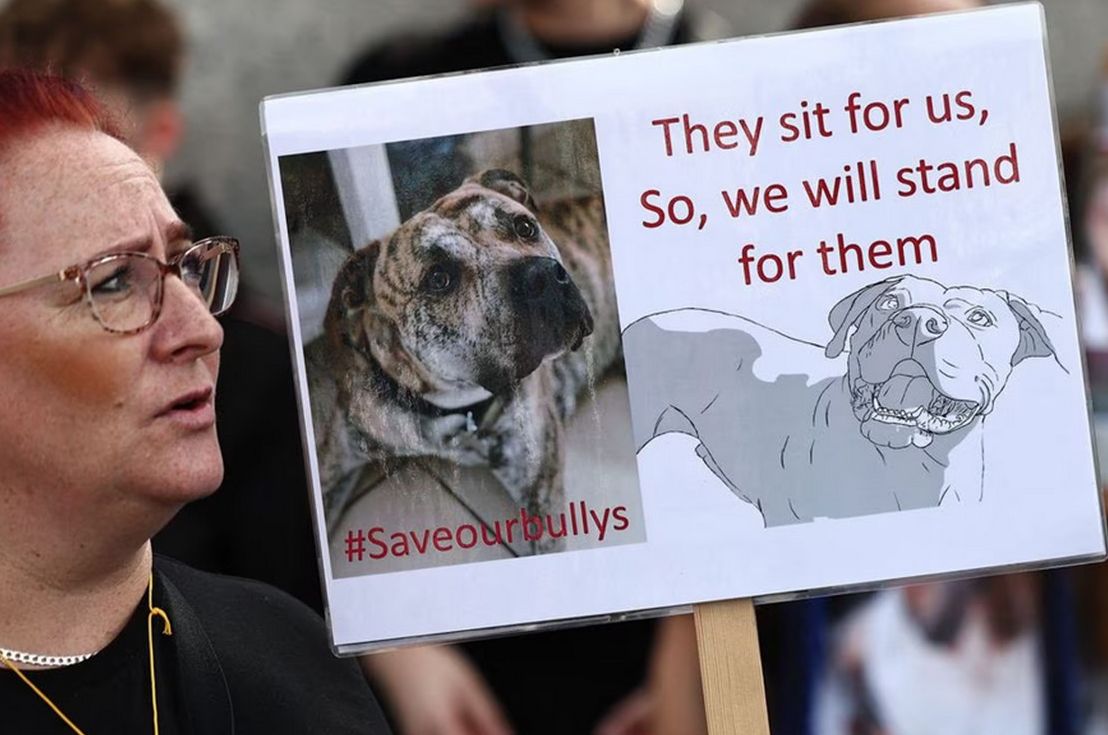
Supporters of the XL bully dog breed held placards during a protest against the UK government’s plans for the breed, in central London on Oct. 7.HENRY NICHOLLS/AFP via Getty Images

“They’re not dangerous if you raise them right. Neither are the dogs.”

Those lines are from a sign carried by one of the hundreds of demonstrators who recently took to the streets in London to protest Prime Minister Rishi Sunak’s proposed ban on the American XL bully.

Sunak’s measure came after a string of biting incidents, at least two of them fatal, involving canines believed to be American bully XL dogs, a relatively new breed. In one short but horrific incident caught on camera in Birmingham, England, an 11-year-old girl is attacked and bit by a dog.

But such a policy ignores the real cause behind aggressive and dangerous dogs. It’s not often the dog but the person holding the leash who creates the conditions, often by neglect or abuse, for a dog to attack. While it’s true that the American bully XL has a history of being used in dogfighting, the boxer, the shar-pei, the Boston terrier, and the English bull terrier also all have histories of fighting.

Kara Holmquist, director of advocacy at the Massachusetts Society for the Prevention of Cruelty to Animals, said in an interview that there are many factors that can come into play and compel a dog to bite — “how the dog is socialized, how the dog is managed, and whether it’s spayed or neutered plays a role. So when places enact policies that just look at breed, not only is it not fair, but it’s just not effective.” It’s making a blanket judgment on what a dog breed is perceived to be, she said. Nowadays it has become very difficult “to look at a dog and know or make a guess as to what type of breed it is.”

That’s why the MSPCA, Holmquist said, helped push for a law, passed in 2012, that prevents cities and towns from enacting dog breed bans. It was around the time that there was hysteria around pit bulls and Dobermans. But discrimination against certain dog breeds still occurs in some spaces, and the MSPCA is working to remove dog breed bans in housing policies.

“Responsible Massachusetts dog owners are often not welcome in certain housing markets, particularly if they own medium or large dogs, or certain dog breeds (or a dog that looks like one of these breeds),” read testimony presented jointly by animal rights advocates, including the MSPCA, during a hearing last month on a bill that would prevent some housing providers, such as condo associations and public housing, “from arbitrarily refusing responsible dog owners as tenants.” The organizations also noted that this “discrimination occurs in some publicly-funded housing, making this a particularly pernicious practice.” It makes it a housing equity issue, as well.

Massachusetts’ cities and towns do have the power to police specific dogs through the dangerous dog law, the purview of the animal control officer. “If there is a dog that is of concern that’s demonstrated some behavior that’s outlined in the law, there’s a process for addressing that through a dangerous dog hearing,” Holmquist said.

Meanwhile, it’s looking like there will be no such dog hearings for the American bully XL in England. Prime Minister Sunak has pledged to ban the dogs but, thankfully, existing ones will receive amnesty. The dogs, which can weigh over 130 pounds, have risen in popularity since the COVID-19 lockdowns, which saw dog ownership rise. Under Sunak’s plan, owners of those existing dogs will have to register them, as well as muzzle them in public places. They will also be required to neuter them in an attempt to eradicate the dog type within a decade.

What’s baffling is that the UK has evidence that banning breeds does not make the public safer. The country has in place a Dangerous Dogs Act, which was enacted more than three decades ago. It bans four breeds: the pit bull terrier, Japanese Tosa, Dogo Argentino, and Fila Brasileiro. Despite that, the number of dog bite incidents has gone up in the UK.

The English dog-owning community is not taking the proposal lying down, but it seems clear the British government has the authority to deem a breed dangerous and ban it. In the case of the American bully XL, it still isn’t officially recognized as a breed by the UK’s Kennel Club. So the breed needs to be declared a breed before it can be banned.

I’m still waiting for a ban on bad dog owners, because when you follow the trail leading to a terrible dog incident, often the owner’s treatment of the dog is to blame. The American bully XL may become extinct in Britain, but you can bet the country’s bad dog owners eventually will find another breed to mistreat. And sadly it, too, will be banned.

Source: The Boston Globe

Breed Labels: When Guesses Turn Into Predictions

The NZ Government has proposed breed specific legislation that would prohibit animal shelters from re-homing ‘menacing’ breeds. These breeds would be identified solely based on appearance. This is a wonderful blog post on the subject of labeling of breeds.  It’s certainly timely – since the City of Montreal has also proposed a ban on pit-bull type dogs (which has been temporarily stopped by the courts – with the Mayor of Montreal promising to fight to retain the law).

Fingers crossed for all rescues and dogs out there.  These are challenging times.

Kathleen Crisley, specialist in dog massage, rehabilitation and nutrition/food therapy, The Balanced Dog, Christchurch, New Zealand

Diggy the dog – a BSL success story

Imagine falling in love with a dog at a shelter, bringing him home, and then because he’s a Facebook success having authorities deem him unacceptable because of his breed.

That’s what happened to Diggy and his adoptive owner, Dan Tillery from Waterford Township in Michigan.

detroit-dog-rescue-photo

Diggy was labelled a pit bull and Dan was charged with a code violation for owning a banned breed.

But Diggy wasn’t a pit bull and Dan had veterinarians willing to testify to his breed.  In the intervening time, bills were introduced so local communities couldn’t introduce BSL ordinances and 100,000 people signed petitions on Diggy’s behalf.

The court dropped the charges once the signed affidavits of the veterinarians were entered into evidence.

Breed specific legislation doesn’t work.  And in Diggy’s case, he was identified solely based on appearance – which is fraught with difficulties since so many dogs can appear to be one breed but are, in fact, a mixed breed or a different breed altogether.

I’m just glad that Diggy and Dan are allowed to remain a family.

Kathleen Crisley, specialist in dog massage, rehabilitation and nutrition/food therapy, The Balanced Dog, Christchurch, New Zealand

Source:  Boston.com

The mis-labelling of pit bulls

DNA results show that shelter workers are often mistaken when they label a dog as a pit bull, with potentially devastating consequences for the dogs, a new University of Florida study has found.

DNA pit bull study

Dr. Julie Levy holds a dog currently up for adoption at the Alachua County Animal Services facility in Gainesville, Florida

“Animal shelter staff and veterinarians are frequently expected to guess the breed of dogs based on appearance alone,” said Julie Levy, D.V.M., Ph.D., a professor of shelter medicine at the UF College of Veterinary Medicine and the lead author of a study published recently in The Veterinary Journal.

“Unlike many other things people can’t quite define but ‘know when they see it,’ identification of dogs as pit bulls can trigger an array of negative consequences, from the loss of housing, to being seized by animal control, to the taking of the dog’s life,” she said. “In the high-stakes world of animal shelters, a dog’s life might depend on a potential adopter’s momentary glimpse and assumptions about its suitability as a pet. If the shelter staff has labeled the dog as a pit bull, its chances for adoption automatically go down in many shelters.”

The past few decades have brought an increase in ownership restrictions on breeds including pit bulls and dogs that resemble them. The restrictions are based on assumptions that certain breeds are inherently dangerous, that such dogs can be reliably identified and that the restrictions will improve public safety, the study states.

The study focused on how accurately shelter staff identified dogs believed to be pit bulls. ‘Pit bull’ is not a recognized breed, but a term applied to dogs derived from the heritage breeds American Staffordshire terrier or Staffordshire bull terrier. The purebred American pit bull terrier is also derived from these breeds and is often included in the loose definition of ‘pit bull.’

The research team evaluated breed assessments of 120 dogs made by 16 shelter staff members, including four veterinarians, at four shelters. These staff members all had at least three years of experience working in a shelter environment. The researchers then took blood samples from the dogs, developed DNA profiles for each animal and compared the DNA findings against the staff’s initial assessments.

“We found that different shelter staffers who evaluated the same dogs at the same time had only a moderate level of agreement among themselves,” Levy said. Results of the study also showed that while limitations in available DNA profiles make absolute breed identification problematic, when visual identification was compared with DNA test results, the assessors in the study fared even worse.

Dogs with pit bull heritage breed DNA were identified only 33 to 75 percent of the time, depending on which of the staff members was judging them. Conversely, dogs lacking any genetic evidence of relevant breeds were labeled as pit bull-type dogs from 0 to 48 percent of the time, the researchers reported.

“Essentially we found that the marked lack of agreement observed among shelter staff members in categorizing the breeds of shelter dogs illustrates that reliable inclusion or exclusion of dogs as ‘pit bulls’ is not possible, even by experts,” Levy said. “These results raise difficult questions because shelter workers and veterinarians are expected to determine the breeds of dogs in their facilities on a daily basis.

Additionally, they are often called on as experts as to whether a dog’s breed will trigger confiscation or regulatory action. The stakes for these dogs and their owners are in many cases very high.”

Dog breeds contain many genetic traits and variants, and the behavior of any individual dog is impossible to predict based on possible combinations.

“A dog’s physical appearance cannot tell observers anything about its behavior. Even dogs of similar appearance and the same breed often have diverse behavioral traits in the same way that human siblings often have very different personalities,”Levy said.

Even though most pet dogs are of unknown mixed breeds, there is a natural inclination among pet owners to speculate on what their dog’s breed heritage might be, the authors said.

“This has fueled an entire industry of pet dog DNA analysis,” Levy said. “These tests are fun, but they won’t help predict behavior or health traits. Shelters and veterinary clinics are better off entering ‘mixed breed’ or ‘unknown’ in their records unless the actual pedigrees are available.”

As for legal restrictions on dogs based on their appearance, Levy said public safety would be better served by reducing risk factors for dog bites, such as supervising children, recognizing canine body language, avoiding an unfamiliar dog in its territory, neutering dogs and raising puppies to be social companions.

Source:  University of Florida media release

See also my 2013 post on Visual identification of breed – one reason why BSL doesn’t work

Now Paw-tucket can live up to its name

The city of Pawtucket, Rhode Island had a 10-year old ordinance banning the ownership of pit bulls until earlier this week.  A judge ruled that a 2013 state law banning breed-specific legislation meant that the city’s law was now illegal.

This is a win for the fight against breed specific laws and restrictions.

Pit bull owners in Pawtucket celebrated on Sunday with a parade.  There was also a free dog training class offered afterwards.  A local group, Pit Bulls for PTSD, also participated in the parade.  The group trains pit bulls to become service dogs for autistic children and veterans suffering from PTSD.

Please remember:  punish the deed and not the breed!

Kathleen Crisley, specialist in dog massage, rehabilitation and nutrition/food therapy, Canine Catering Ltd, Christchurch, New Zealand

Life lessons from the Vicktory dogs

I do not support breed specific legislation.  One of the agencies leading the way in changing the perception of pit bulls, and breed specific legislation more generally, is Best Friends Animal Society.

In this TEDx talk filmed in Salt Lake City, Julie Castle, the Chief Marketing and Development Officer for Best Friends Animal Society, talks about the 22 pit bulls rescued from Michael Vick’s fighting kennels that were sent to the Best Friends sanctuary.  Alongside their journey of recovery, Castle discusses how Best Friends built a coalition to change perceptions about pit bulls and to advocate for saving rather than killing pit bull dogs.

I hope you find this story as inspirational as I do.

Kathleen Crisley, specialist in dog massage, rehabilitation and nutrition/food therapy, Canine Catering Ltd, Christchurch, New Zealand


Is that dog a pit bull?

A recently published Open Access article “Is That Dog a Pit Bull? A Cross-Country Comparison of Perceptions of Shelter Workers Regarding Breed Identification” asserts that shelter workers operating in areas restricted by breed-specific legislation (BSL) are more likely to consciously mislabel a dog’s breed if they felt it were to increase the dog’s chances of being adopted and/or avoid being euthanized.

The study, published in Journal of Applied Animal Welfare Science, compares the breed identification process between workers in the United States and the United Kingdom, noting that often the process relies on the individual worker’s intuition and prior experiences with other dogs. A survey with photos of the same twenty dogs were sent to shelters in the US and UK. American shelter workers were more likely to consider a dog a pit bull than their counterparts in the UK.

These are the photos that the research subjects were shown:

Pit bull identification photos

The pit bull terrier is banned or restricted by BSL in parts of the United States and throughout the United Kingdom. Shelters in both countries are often tasked with accepting unwanted animals and finding new homes for them; many of these animals are pit bulls or other bull breeds. BSL restrictions may include a total breed ban, or some lesser rules such as (but not limited to): higher licensing fees, registering the dog as dangerous with local governments, liability insurance coverage, mandatory sterilization, muzzling on public property, placement of warning signage on private property, and standardized caging requirements.

Shelter workers in areas affected by BSL know that a dog’s identification can influence micro-level trends such as adoption rates, but also macro-level trends such as breed perception nationally and even globally. The study highlights the fact that there exists a lack of consensus on what exactly a pit bull is, and calls to question the validity of determining breeds based on visual assessment.

Source:  Taylor & Francis media release

More evidence against breed specific legislation

UK legislation that targets ‘dangerous dogs’ has not been shown to reduce dog bites and policies should be based on evidence and risk assessment, suggests a new article.

Rachel Orritt, a PhD student of psychology at the University of Lincoln says that dog bites present a “public health risk of unknown magnitude but no scientific evidence upon which to base a reliable UK estimate has been obtained in the past two decades.”

She also says that discussion by medical professionals about the impact of dog-human interactions “sometimes ignores the health benefits concomitant with dog ownership” with one writer in The British Medical Journal suggesting that “the only way to stop dog bites will be to ban dogs.”

Orritt says there are several studies that show owning a dog is associated with increased physical activity, better self esteem and fewer annual visits to the doctor. She adds that “eradicating dogs would have negative consequences for human health.”

She argues that the British news media “confound the matter further through inaccurate representation of the risk posed by dogs.”

Inaccurate reporting of dog bites, coupled with public pressure “have contributed to the drafting of legislation,” she writes. The Dangerous Dog Act 1991 has been amended in an effort to improve this legislation “but has been shown to be ineffective at reducing dog bite incidence.”

Orritt says that to reduce dog bite incidence, “academics and medical and veterinary practitioners need to cooperate to develop effective, scientifically sound risk management strategies. These should be evidence based and should not depend on politically driven initiatives such as the current legislation.”

Risk assessment for human violence has proved to be accurate and reliable and Orritt says this “might be a practical preventative measure to reduce injury from dog bite” along with medical and veterinary professionals “familiarising themselves with evidence based resources.”

She says that attention must also be given to the psychological health of patients after trauma.

Orritt believes that research is needed to improve care and an “estimate of dog bite incidence” but until this is done, “the scale of the problem is entirely unknown.”

She concludes that evidence based measures to inform ongoing risk management, such as developing effective risk assessments, “should result in the reduction in dog bite injuries that punitive legislation has not achieved.”

Source:    EurekAlert! media statement

Journal Reference

R. Orritt. Dog ownership has unknown risks but known health benefits: we need evidence based policy. BMJ, 2014; 349 (jul17 7): g4081 DOI: 10.1136/bmj.g4081

If a pit bull could talk

Pit bull poster

DoggyMom.com and Canine Catering do not support breed specific legislation in any form!

No correlation between breed and aggression

Researchers from the University of Bristol’s School of Veterinary Sciences have investigated the occurrence of dog aggression towards people with a survey of UK dog owners.

The 4,000 responses revealed:

  • aggression towards unfamiliar people was reported more commonly by owners than aggression to family members
  • 7 per cent of owners responded that their dog barked, lunged, growled or actually bit when people came to the house
  • 5 per cent of owners said that these things happened when out on walks
  • 3 per cent of owners reported aggression towards family members

Dog bearing teeth

The study highlighted that the majority of dogs showing aggression do so in just one type of situation. This indicates that the tendency to categorise dogs as either generally ‘safe’ or ‘vicious’ is a misconception, and that most dogs show aggression as a learnt response to particular situations.  (A lot of trainers working in animal shelters probably already knew this.)

The research also highlighted that although general characteristics, such as breed type, are significant risk factors across large populations they explain only a small amount of the overall difference between aggressive and non-aggressive dogs.   Therefore, it is not appropriate to evaluate the risk of aggressive behaviour in an individual dog using characteristics such as breed type.

That’s another black mark for supporters of breed specific legislation!

The results of this research have been published in the journal of Applied Animal Behaviour Science.

Source:  University of Bristol media release