Tag Archives: Dog Aging Project

New Study Dispels Myth That Purebred Dogs Are More Prone To Health Problems

It’s a common belief that purebred dogs are more prone to disease than mixed-breed dogs, but a new study led by researchers at the Texas A&M School of Veterinary Medicine and Biomedical Sciences (VMBS) has busted this myth. 

A study by researchers at Texas A&M University and the Dog Aging Project has found that purebred and mixed-breed dogs are mostly equal when it comes to overall frequency of health condition diagnoses. Jacob Svetz/Texas A&M University Division of Marketing and Communications

The study, published in the journal Frontiers In Veterinary Science, found that while certain dog breeds are prone to specific diseases, purebred and mixed-breed dogs are mostly equal when it comes to overall frequency of health condition diagnoses.

“There are several well-known diseases that frequently occur in specific dog breeds,” said Dr. Kate Creevy, chief veterinary officer of the Dog Aging Project and a professor in the VMBS’ Department of Small Animal Clinical Sciences. “This has helped perpetuate the misconception that all purebred dogs are more prone to disease, but that is not the case.”

The study — which surveyed the owners of more than 27,000 companion dogs — also found that some of the most common diagnoses, like ear infections or osteoarthritis, occur in both purebreds and mixed-breed dogs. 

Breaking Down The Data

According to the study, 25 breeds make up about 60% of the purebred dog population within the Dog Aging Project. In order of popularity, those breeds are: 

  • Labrador retriever
  • Golden retriever
  • German shepherd
  • Poodle
  • Australian shepherd
  • Dachshund
  • Border collie
  • Chihuahua
  • Beagle
  • Pembroke Welsh corgi
  • Boxer
  • Shi Tzu
  • Miniature schnauzer
  • Pug
  • Havanese
  • Cavalier King Charles spaniel
  • Yorkshire terrier
  • Great Dane
  • Greyhound
  • Boston terrier
  • Siberian husky
  • Shetland sheepdog
  • English springer spaniel
  • Australian cattle dog
  • Doberman pinscher

Within these 25 breeds, a total of 53 unique medical conditions make up the top owner-reported medical conditions. 

“The medical conditions reported by owners of purebred dogs varied considerably,” Creevy said. “However, some conditions appeared frequently in the top 10 reported health conditions by breed.”

Across the 25 most popular breeds, those 10 conditions were:

  • Dental calculus (hardened plaque)
  • Dog bites
  • Extracted teeth
  • Giardia (a parasite)
  • Osteoarthritis
  • Seasonal allergies
  • Ear infection
  • Heart murmur
  • Fractured teeth
  • Cataracts

For mixed-breed dogs, the most common reported conditions were highly similar, with cataracts and heart murmur being replaced by torn/broken toenail and chocolate toxicity.

Some conditions, like dental calculus and osteoarthritis, appeared with roughly the same frequency in both purebred and mixed-breed dogs. Other conditions were more common in one than the other; extracted teeth and dog bites were more common in purebreds, versus ear infections in mixed-breed dogs.

“Out of the 53 medical conditions that owners reported, 26 did not differ significantly between mixed-breed and purebred dogs,” Creevy said.

Implications For Dog Owners

Ultimately, one of the most important findings from the study is that dog breed is only one aspect of pet health to consider when creating a pet’s care plan or researching what kind of dog to adopt.

“People should consider many factors when choosing a dog, including environment, lifestyle, social interactions and physical activity that will be available to the dog,” Creevy said. “Planning for both preventive veterinary care and medical care as the dog ages is also prudent. Dog owners should also talk with their primary care veterinarians about the kinds of medical problems to which their new dog might be particularly prone based on breed, size, sex, etc.”

As the study also showed, some of the most common reasons owners take their dogs to the vet have little or nothing to do with breed.

“Dental disease, allergies and osteoarthritis are among the most common conditions for all dogs,” Creevy said. “Owners should work with their primary care veterinarians on a plan to manage dental health. Regular exercise and maintaining lean body weight may help delay, prevent or lessen the impact of osteoarthritis.”

Expanding Dog Health Understanding

Though the study is already one of the largest cross-sectional studies of canine health, researchers at the Dog Aging Project are far from done examining its findings.

“We were surprised by the number of owners who reported that their dogs had experienced a bite from another dog,” Creevy said. “More investigation is needed to determine what this means and what particular factors might put an individual dog at risk.”

The DAP is a collaborative, community scientist-driven data-gathering research project that enrolls companion dogs from all backgrounds to study the effects of aging and gain a better understanding of what contributes to a long and healthy life for a dog. 

The DAP continues to accept dogs of all breeds into the project. To date, more than 50,000 dogs have been enrolled.

Many of their research projects have led to translational studies that inform not only dog health, but also human health. To enroll your dog, or learn more, visit dogagingproject.org.
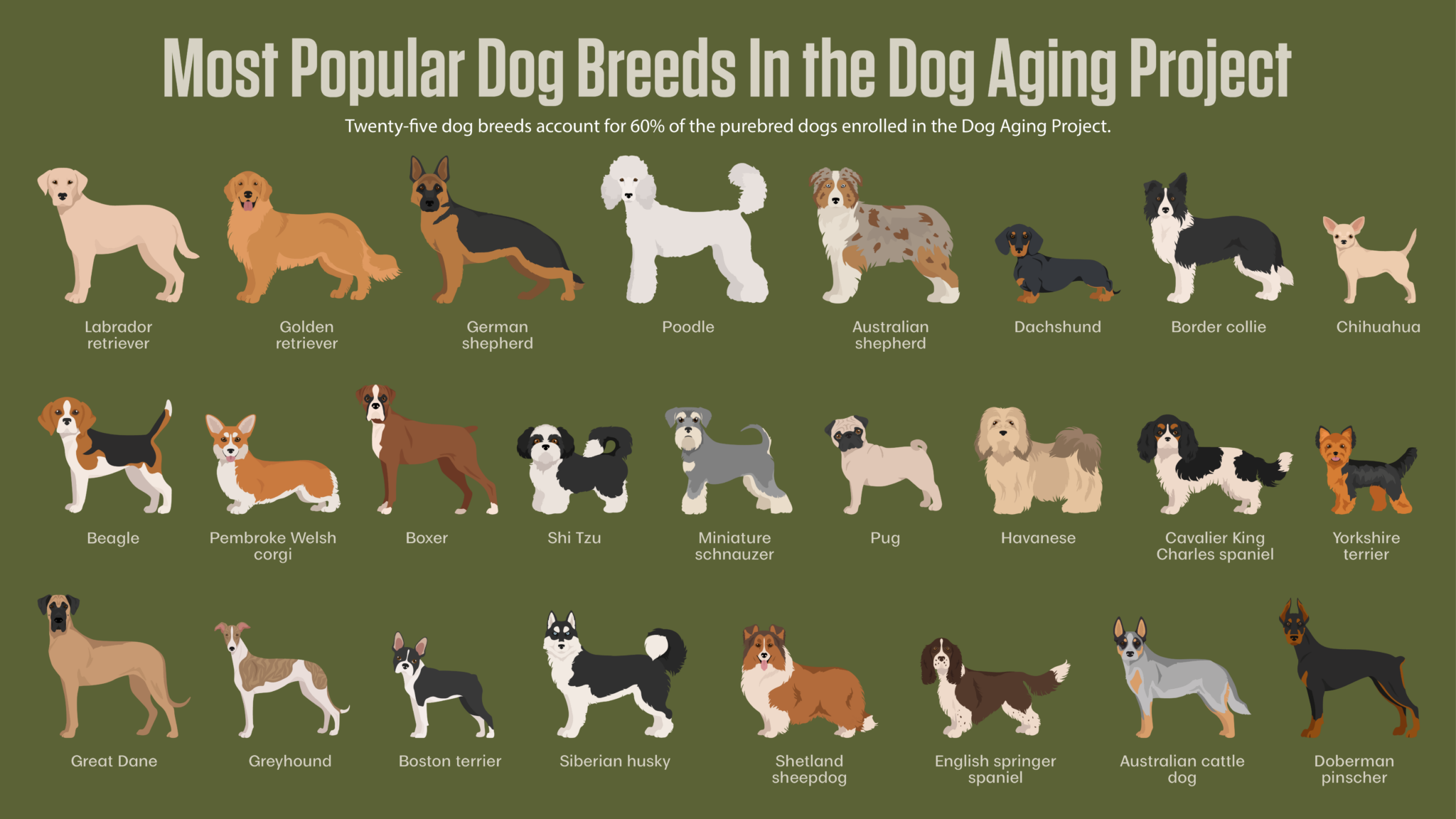
Twenty-five dog breeds account for 60% of the purebred dogs enrolled in the Dog Aging Project. Aubree Herrold/School of Veterinary Medicine and Biomedical Sciences

Source: Texas A&M University

Dogs can age healthier by socializing with humans and pets, study says

Social interaction is good for human health, and a new study suggests it might be good for your dog, too.

“Where we live and who we interact with has a really strong effect on our health and well-being,” said Noah Snyder-Mackler, who is lead author of the study and an associate professor at Arizona State University’s school of life sciences and its center for evolution and medicine. “This link between our social environments and our health extends to many social animals. Animals with stronger social relationships live longer, healthier lives.”

Social companionship helps with healthy aging for dogs, a study says. (Katherine Frey/The Washington Post)

The research, published in Evolution, Medicine & Public Health, surveyed the human parents of more than 21,000 dogs and found that social companionship — with both people and other animals — had the largest influence on healthier aging among dogs. The effect was five times greater than anything else they looked at, such as family finances, household children or the pet parent’s age.

Improving dog and human health

The study is part of the Dog Aging Project, a large community-science research effort started in 2018 and funded by the National Institute on Aging and private donations. It’s led by the University of Washington and Texas A&M schools of medicine and includes more than a dozen institutions, including Arizona State University.

Its goal is to learn how genes, lifestyle and the environment influence aging and disease among dogs. Researchers also hope the insights can help human health.

“Dogs are often considered our closest animal companions and share many aspects of our daily lives,” said Brianah McCoy, an ASU doctoral student and a co-author of the paper. “By studying how the social environment affects dog health, we can gain insights that may also be relevant to human health.”

More than 45,000 dogs overall are enrolled in the aging project. A subset, about 1,000 dogs, are part of a more focused cohort from whom Snyder-Mackler and his collaborators are collecting blood and other biological samples over many years to uncover additional clues.

Having furry friends is linked to better health

The researchers used statistical tools to analyze factors in the dogs’ social environments obtained from surveys completed by dog parents. The questionnaires asked about, among other things, physical activity, environment, dog behavior, diet, medications and preventive medications, health status and owner demographics.

The scientists narrowed their analysis to five key factors — neighborhood stability, total household income, social time with children, social time with animals and owner age — that together might explain how the social environment could affect a dog’s well-being.

They found poorer health among dogs who lived in households with financial difficulties and other stressors, and better health among dogs who experienced more social companionship, such as living with other dogs.

The researchers, however, did not quantify life span, although they plan to do so in the future. “While we can’t say ‘having another dog in the house adds X years to your dog’s life,’ we were able to compare the strengths of the effect of different environmental factors on health,” Snyder-Mackler said.

The researchers cautioned that the results don’t mean that pet parents need to add more dogs to the family or rush their pets to dog parks or doggy day-care.

“We don’t know if the environmental factors we measured caused the health outcomes, so we don’t want to make any strong statements about what owners should or shouldn’t do,” Snyder-Mackler said. “The study just looked at whether you had other animal companions in the house. But it does suggest that having more furry friends is linked to better health outcomes.”

Some dogs may not benefit from social interactions

Scientists not involved in the study pointed out that not all dogs respond similarly.

“Some dogs may find social interactions stressful,” said Clara Wilson, a postdoctoral researcher in the Penn Vet Working Dog Center at the University of Pennsylvania School of Veterinary Medicine, “and it may not be in the dog’s best interests to force these interactions.”

Courtney Sexton, postdoctoral researcher at Virginia-Maryland College of Vet Med — and who contributes other research to the Dog Aging Project — said her dog would rather play with a ball than with other dogs, and it’s the pet parents’ “job to pay attention to the signals dogs give us.”

Surprising findings

Several findings were surprising, the study authors said.

  • Having children in the household had a negative impact on a dog’s health.
  • Dogs in wealthier households were diagnosed with more diseases than those in less affluent homes.
  • Dogs seemed to be healthier when they lived with older humans, and this effect was stronger in younger dogs.

Children may be detrimental to the health of dogs because of resource allocation, the researchers suggested. “It’s not that kids hurt the dogs or directly affect their health,” said Layla Brassington, a doctoral student at Vanderbilt University, who worked on the study as a master’s student at Arizona State University. “The more children or time that owners dedicate to their children likely leads to less time and effort they can dedicate to their furry children.”

The authors theorize that wealthier households have better access to medical care, and pet parents might seek veterinary services more frequently, which leads to identifying more diseases.

The ages of the dogs also affected the findings, with younger dogs seeming to be “more tuned into the age of their owner and how it impacts their well-being,” McCoy said.

Could dogs benefit from a cat companion?

The researchers did not specifically look at the effect of breeds — they did not have enough detail on individual breeds — or exercise, Snyder-Mackler said. (The Dog Aging Project recently released a study that found physical activity is associated with a better cognitive outcome in dogs.) “What we did see was that the strength of the relationship between the environment and health was similar when we looked separately at mixed-breed versus purebred dogs,” he said.

They also acknowledged one study limitation — the sample consisted of mostly high-income dog parents. A more diverse set could help “unravel the true magnitude of certain variables’ influence on canine well-being,” McCoy said. “It is possible that the effects we found in this study would be even stronger if we had a more varied and inclusive population.”

Most of the pets in the multi-animal households were dogs, and the scientists said there was insufficient data to distinguish between the effects of having additional dogs vs. other species.

“It could be that having other pets — even cats — provides health benefits through companionship,” Snyder-Mackler said.

Source: Washington Post


