Tag Archives: dog training

Crate training

I like crate training, particularly because it helps ‘future proof’ your dog.

If your dog needs surgery or rest from an injury at any time, having them used to comfortably resting in a crate saves a lot of time and stress (for both dog and owner).

If you need to travel with your dog, whether for a holiday or for relocating, crate training helps you manage your dog’s comfort as well as your own (e.g. limits the risks of accidents in hotel rooms that will charge you an additional cleaning fee).

Greyhound in crate

Izzy, mostly in her crate, but enjoying a summer breeze coming from the back door. Izzy’s crate is her safe place (the way it should be)

Crate training can be particularly useful for re-homed dogs because dogs will seek out a place that is safe (den-like if you are thinking of wolves).  Giving a re-homed dog a place they can retire to – and not be bothered – is useful for getting them accustomed to life in a domestic home.  It’s also a useful boundary for children to learn.  If the dog is in its crate, then leave it alone.

Unfortunately, over the last 10 or so years, as crate training became more normalised as a concept, it also has been abused.  Owners who are not consistent with their training or not taking the time to truly get their new puppy or dog settled in their home (taking on a dog is a lifetime responsibility, but initially you have to put in the time to get your dog set up for success  for life), have begun using crates as a cage.  A place to go when the owners are out at work (all day, in most cases) or when the dog has mis-behaved and the owner has had enough.

That’s the wrong use of a crate.  There were even stories of dogs locked in their crates during the Christchurch earthquake of 2011 – the dogs were up to their necks in liquefaction by the time they were saved.  That’s not a heartening story if you ask me.  That’s a story of an irresponsible dog owner.

There are many resources to help owners learn crate training.  The Humane Society of the United States, for example, has this useful video:

Kathleen Crisley, specialist in dog massage, rehabilitation and nutrition/food therapy, The Balanced Dog, Christchurch, New Zealand

Odorology – the science behind training scent dogs

Dog training for scent tracking

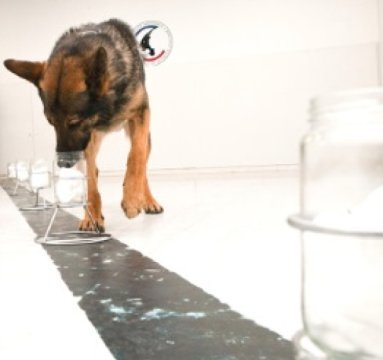
Cisko, one of the police dogs, during a scent detection test. The dog sniffs the reference scent and then smells a series of five jars containing human scents, one of which corresponds to the reference. If the dog recognizes the reference scent it lies down in front of the relevant jar; if the dog does not find a match, then it does not stop or lie down. Credit: © DGPN – SICOP

Odorology is a technique that uses specially-trained dogs to identify human scent. It is used in police investigations to establish that an individual has been at the scene of a crime. However, there is no international norm on how these dogs are trained. At the Centre de recherche en neurosciences de Lyon (CNRS/Université Claude Bernard Lyon 1/Inserm), researchers specializing in scents and their memorization have analyzed data, provided since 2003 by the Division of the Technical and Scientific Police (DTSP, Ecully) on dog performances in scent identification tasks.

Their results show that, at the end of a 24-month training program, the dogs are able to recognize the smell of an individual in 80-90% of cases and never mistake it for that of another. These findings validate the procedures that are currently in use and should convince the international community of the reliability of this method.

Odorology, or the science of smells, is a method of identifying human scents. It has been used in France since 2003 in police investigations to establish that an individual has been present at a crime scene. The method is based on the fact that each person has their own scent and relies on the powerful canine sense of smell (which can be 200 to 10,000 times more sensitive than that of a human being1). It involves a long period of dog training.

This technique consists in using a specially-trained dog to compare a human scent collected from an object found at a crime scene with scents from several people, including that of a suspect or victim. As the results of these tests are of critical importance for investigators, they need to be obtained through viable and reproducible methods. However, there are no internationally recognized norms for the training of these dogs or for their inclusion in investigations—hence the occasional reluctance to treat their evidence as proof. By analyzing results collected since 2003 at the Division of the Technical and Scientific Police (DTSP, Ecully), researchers from the Centre de recherche en neurosciences de Lyon have succeeded in demonstrating the viability of the technique used.

During basic training, the German and Belgian shepherd police dogs must learn to make the link between two scents from the same individual through the completion of increasingly complex tasks. By the end of this training, the dogs are able to carry out identification exercises during which they sniff a reference human scent and then compare it with five different human odors, one of which is the reference scent. When a dog matches the scent in the jar to the reference one (which it shows by lying down in front of the correct jar) it is rewarded with a treat or a game. The human odors may consist of traces collected from an object that someone has touched or of a scent collected directly from a person.

The analysis of the data obtained with the 13 DTSP dogs since 2003 shows that after they have learned the task’s principles, 24 months of regular training is necessary for stable and optimal performances. At the end of the first twelve months, the dogs no longer made any recognition errors, i.e., they did not confuse the scent of one person with that of another. Furthermore, their olfactory sensitivity increased significantly over the training period: on average, after two years, the dogs managed to recognize two scents from the same person in 85% of cases. The remaining 15% of cases in which no match was obtained, were mostly the result of poor scent sampling rather than poor recognition.

The researchers also found that German shepherds were better than Belgian shepherds.

At the end of their basic training, the dogs are able to participate in criminal cases and receive continuing training throughout their lives. In practice, each identification test is carried out by at least two dogs. Additionally, each dog performs at least two tests with the same panel of scents: the collected scent is presented either as a sample to be sniffed at the start of the task, or in one of the jars that the dog sniffs successively. Between 2003 and 2016, odorology was used in 522 cases at the SDPTS and helped to resolve 162 cases.

In these criminal cases, the sampled scents were only a few hours or days old. The researchers now want to study how the dogs perform on older scents. Scent samples can in fact be stored in scent libraries over several years.

The Hongi (dog style)

Most of my readers know that I am based in New Zealand, where the Māori people are the indigenous culture.  The hongi is a traditional greeting which is done by pressing your nose and forehead to the other person.

Well, I have a client who has used the hongi as a training cue for her dog, Dixie.  This is uniquely New Zealand cue!

And just so I am not accused of being culturally insensitive, here’s what a human hongi looks like:

A hongi performed at a welcoming ceremony (U.S. Air Force photo/Tech. Sgt. Shane A. Cuomo)

A hongi performed at a welcoming ceremony (U.S. Air Force photo/Tech. Sgt. Shane A. Cuomo)

And here’s an instructional video on how to participate in a hongi correctly so as to not offend your host:

What unique dog training cues does your country have?


Rin Tin Tin: The Life and the Legend

rin tin tin book cover

I have just finished reading Rin Tin Tin:  The Life and the Legend by Susan Orlean.  Having previously blogged about the Dogs on the Hollywood Walk of Fame, I was intrigued when this book made the New York Times bestseller list.

If you like biography, you will like this book.  It has been expertly researched by Orlean who spent weeks reviewing the archived personal files of Lee Duncan, the owner and trainer of the original Rin Tin Tin.  Duncan fought in France during WWI and found the young ‘Rinty’ in an abandoned kennels.  He was able to secret Rin Tin Tin away on a ship returning servicemen to the United States along with his sister, who unfortunately died shortly after arriving in the USA.

Duncan bonded with the dog like no other individual (human or otherwise) in his life and found the dog exceptionally bright (although cranky with other humans).  In the 1920s, he was certain that Rinty was movie material.  Orlean does a superb job describing old Hollywood – before sound was even introduced to films and Duncan’s efforts to make his dog a film star.

Rin Tin Tin’s popularity is the main reason why German Shepherd dogs became a popular breed in the United States.

During this period in American history, dog training was not even recognised as a discipline.  In large part thanks to Rin Tin Tin’s popularity, the benefits of dog training were introduced to the American public.  Orlean again does a superb job in explaining how trained dogs were exhibited to Americans as entertainment, eventually spawning an entire industry.

It is very entertaining to read about Rin Tin Tin’s early success and the challenges posed by the introduction of sound to the movies.  Duncan, perhaps in denial, didn’t make provisions for a successor to Rin Tin Tin and – as was inevitable – the original Rinty died.  Rinty’s son was not up to scratch for acting duties and there was a time before a suitable successor was trained.

From there, the story becomes one of how Rin Tin Tin became a legend and an industry.   Other dogs, including subsequent descendents, take on the role of Rin Tin Tin and he is even transformed to a television star in the Adventures of Rin Tin Tin.  At this point, there are spin-off benefits of merchandising.

So many people invested emotional energy (as well as lots of money) in keeping Rin Tin Tin in front of the American public, well into the 1970s.  By the 1980s, however, American tastes had changed.

This book is well written and with a good pace throughout.  I recommend it  particularly if you have a German Shepherd in your life, or someone who is a German Shepherd fan, this book would make an excellent Christmas gift.

Going postal

Postal worker with dog

A mailman meets a boy and a huge dog. ‘Does your dog bite?’ asks the mailman. ‘No,’ replies the boy. And the dog bites the mailman’s leg. ‘You said he doesn’t bite!’ yells the mailman. ‘That’s not my dog,’ replies the boy.

Letter carriers and other delivery personnel regularly face a hazard when delivering to properties with untrained or unrestrained dogs.  Although there are many cartoons and jokes about dogs and postal workers, the issue is no laughing matter.

In the United States last year, nearly 5,900 letter carriers were bitten by dogs.  Letter carriers are encouraged to report homes with dogs that appear menacing and they may choose not to deliver to a property or even a neighbourhood if dogs are running loose.

Ken Snavely, Acting Postmaster of Los Angeles, says, Working with animal behavior experts, the Postal Service has developed tips to avoid dog attacks, and for dog owners, tips for practicing responsible pet ownership.’

These tips include:

How to be a Responsible Dog Owner

  • Obedience training can teach dogs proper behavior and help owners control their dogs in any situation.
  • Dogs can be protective of their territory and may interpret the actions of a letter carrier as a threat. Please take precautions when accepting mail in the presence of your pet.
  • When a letter carrier comes to your home, keep your dog inside, away from the door, in another room or on a leash.
  • Dogs that haven’t been properly socialized, receive little attention or handling, or are left tied up for long periods of time frequently turn into biters.

The US Postal Service also keeps statistics on dog bites, with the City of Los Angeles topping the list of incidents.

Fiscal Year 2012 U.S. Postal Service Dog Attack City Ranking

Ranking City, State Attacks
1 Los Angeles, CA 69
2 San Antonio, TX and Seattle, WA 42
3 Chicago, IL 41
4 San Francisco, CA 38
5 Philadelphia, PA 34
6 Detroit, MI 33
7 St. Louis, MO 32
8 Baltimore, MD and Sacramento, CA 29
9 Houston, TX and Minneapolis, MN 27
10 Cleveland and Dayton, OH 26
11 Buffalo and Brooklyn, NY 24
12 Denver, CO 23
13 Dallas, TX and Tacoma, WA 21
14 Wichita, KS 20

Source:  US Postal Service media statement

Pukka’s Promise

Pukka's Promise coverIf I had to choose a byline for this book review, it would be ‘Ted Does It Again.”

Author Ted Kerasote has delivered another great dog book following the success of Merle’s Door which I have previously reviewed.

This book, inspired in part by the large volume of correspondence Ted received after releasing Merle’s story, documents Ted’s extensive research into the health of dogs and the factors that may determine longevity.   So many ‘dog people’ contacted Kerasote asking variations of the same question  – ‘why don’t our dogs live longer?’  And since Ted felt the same way, he did what any professional journalist would do – he asked lots of questions.

In Pukka’s Promise -The Quest for Longer-Lived Dogs, Ted tackles subjects including nutrition, the politics behind the pet food industry, and what diet is right for dogs.  Ted lays out the facts about raw food and commercial diets, the concerns about grains  and whether they are appropriate for dogs and a favourite topic of mine – variety in the diet.

Because Kerasote observes his dog so well, he realises that there are times when Pukka (pronounced PUCK-ah) rejects the food that is laid before him.  Pukka lets Ted know that he prefers something else one day when he follows him into the pantry.  Having rejected raw lamb, Pukka readily accepts some dried elk chips.  Ted then listens more often to what Pukka would like for his meals noting, “Today I do not want sardines, I want chicken.  Yes, I do love elk, but this evening I prefer dried elk.”

And just as he did in Merle’s Door, this communication between Kerasote and Pukka is not contrived nor do these moments come across as a story book type of anthropomorphism.  Kerasote is a keen observer and dog aficionado.  When he listens or hears Pukka, it’s because he understands what his dog is trying to tell him and translates it into words.  Few authors could achieve this in such a natural way.

An example of the communication between Ted and Pukka comes when Ted is frustrated by Pukka’s excessive barking.  Dog trainers should be prepared that Ted’s solution doesn’t come from clicker training or positive reinforcement, although Ted tries these things.  Ted’s solution is a direct result of understanding dog behaviour and putting that knowledge to good use.  It helps that Ted can communicate in dog.   Enough said; you’ll have to read the book for the ending of this tale.

Kerasote covers a range of health topics including vaccinations, the history of the ‘annual vaccination’ recommendation, and the latest research on why over-vaccinating is a concern.  A good message to take away from reading the book is to enquire with your vet about having your dog ‘titered’ to determine the amount of immunity they still have from previous vaccinations.

Still other issues that are tackled in a thorough way are the effects of neutering and alternatives to the traditional spay/neuter operation that may help our dogs retain the health-preserving effects of their natural sex hormones.  Kerasote also questions the spay/neuter philosophy in a constructive way and whether you agree with his conclusions or not, he does lay out the facts very well.

Another topic that I hold dear is the issue of cancer and the simple message – if you find a lump on your dog, don’t let anyone (including your vet) tell you to ‘wait and see.’  Some lumps, if caught early and tested, can be removed before the disease takes over the comparatively small body of a dog.  Take heed!

As a backdrop to the book’s hard facts, we also get to enjoy a wonderful story about Ted’s search for another dog and his choice of Pukka.  Once Pukka’s is on the scene, we share some of their adventures.

My only criticism of this book is its lack of photos.  Other than the cover photo of Pukka, we don’t get to enjoy any photos of Pukka, Ted, or their other dog friends (A.J., Burley and Goo) nor any of the great scenery from Ted’s camping and hunting trips with Pukka.  I don’t think photos would have detracted from the contents and scope of the book, but I guess that’s the publisher’s decision.

With 49 pages of references, this is a thoroughly researched book that took five years to complete.  Add it to your book collection and refer back to it as the basis for a conversation with your vet (your dog will love you for it).

Well done, Ted!  What are you cooking up for us next?