Tag Archives: genomics

Paleogenomics: humans and dogs spread across Eurasia together

Dogs have been part of human societies across Eurasia for at least 20,000 years, accompanying us through many social and cultural upheavals. A new study by an international team, published in the journal Science, and led by Laurent Frantz, paleogeneticist at the Ludwig Maximilian University of Munich (LMU) and Queen Mary University of London (QMUL) shows that the spread of new cultures across Eurasia, with different lifeways, was often associated with the spread of specific dog populations.

A comparison of ancient dog and human genomes reveals a striking concordance between genetic shifts in both species across time. | © IMAGO/NurPhoto/xSubaasxShresthax

Scientists from LMU, QMUL, the Kunming Institute of Zoology and Lanzhou University in China, and the University of Oxford, sequenced and analyzed the genomes of 17 ancient dogs from Siberia, East Asia, and the Central Asian Steppe – including, for the first time, specimens from China. Important cultural changes occurred in these regions over the past 10,000 years, driven by the dispersal of hunter-gatherers, farmers, and pastoralists. The specimens came from archaeological sites between 9,700 and 870 years old. In addition, the researchers included publicly available genomes from 57 ancient and 160 modern dogs in their analyses.

Dogs followed metalworkers across the Eurasian Steppe over 4,000 years ago

A comparison of ancient dog and human genomes reveals a striking concordance between genetic shifts in both species across time and space, most notably during periods of population turnover. This link is especially evident during China’s transformative Early Bronze Age (~4,000 years ago), which saw the introduction of metalworking. The research shows that the expansion of people from the Eurasian Steppe, who first introduced this transformative technology to Western China, also brought their dogs with them.

This pattern of human-dog co-movement extends back far beyond the Bronze Age. The research traces signals of co-disperal back at least 11,000 years, when hunter-gatherers in northern Eurasia were exchanging dogs closely related to today’s Siberian Huskies.

“Traces of these major cultural shifts can be teased out of the genomes of ancient dogs,” says Dr. Lachie Scarsbrook (LMU/Oxford), one of the lead authors of the study. “Our results highlight the deeply rooted cultural importance of dogs. Instead of just adopting local populations, people have maintained a distinct sense of ownership towards their own dogs for at least the past 11,000 years.”

“This tight link between human and dog genetics shows that dogs were an integral part of society, whether you were a hunter-gatherer in the Arctic Circle 10,000 years ago or a metalworker in an early Chinese city,” says Prof. Laurent Frantz. “It’s an amazing, enduring partnership and shows the sheer flexibility of the role dogs can play in our societies, far more than with any other domestic species.”
Source: Ludwig-Maximilians-Universität München

Genetic links to herding behaviours

It’s a win for Darwin’s Dogs and open access data! A new study published in the journal Science Advances has identified genomic links to the behaviours of herding breeds. The study used data entirely sourced from open-access databases.


Researchers at Korea’s Gyeongsang National University and the U.S. National Institutes of Health analyzed data exclusively from publicly available repositories, including genomic and behavioral data from the community science initiative, Darwin’s Dogs. Their findings are powerful examples of how open science—making research data freely and publicly available—can accelerate discovery by helping scientists leverage existing data in innovative ways.

Herding breeds carry genes linked to cognitive function

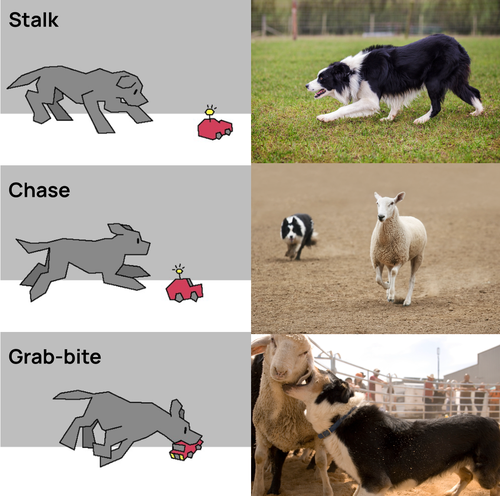
Herding breeds like the Australian cattle dog, Belgian Malinois, and border collie have a long history of helping humans move and manage livestock. These dogs are renowned for their precise motor control, sharp intellect, and unwavering drive. In fact, motor patterns required for effective herding—like eyeing, stalking, and chasing animals without killing them—have been so deeply ingrained in herding dogs through generations of selective breeding that even non-working lines often display these traits. But while herding behaviors have been recognized and refined for centuries, their genetic roots have remained largely unknown.

To explore the genetic foundations of herding behaviors, researchers conducted a large-scale genomic comparison across dogs from 12 herding breeds and 91 nonherding breeds. They identified hundreds of genes that have been naturally selected in herding breeds, several of which, through additional analysis, they found linked to cognitive function.

Narrowing their focus to the border collie, a breed celebrated for its intelligence, the research team identified more than eight genes strongly associated with cognition. One of the standouts was EPHB1, a gene involved in spatial memory. Several variants of EPHB1 appeared across herding breed genomes, suggesting that this gene may support the array of complex motor patterns and decision-making skills essential for herding.

Darwin’s Dogs’ database connects genomic discoveries with behavioral insights

Identifying genes associated with breeds is one thing, but understanding their function is another. This is where Darwin’s Dogs’ open-access behavioral and genomic datasets became critical to expanding the impacts of the study’s findings.

Darwin’s Dogs invites dog owners to participate in scientific research by taking behavioral surveys about their dogs and contributing DNA samples for whole genome sequencing. As part of Darwin’s Ark’s open science commitment, this data is de-identified and made available to researchers around the world, creating a unique open-access resource that allows scientists to explore connections between canine DNA and behavioral traits.

The researchers analyzed data from 2,155 dogs in the Darwin’s Dogs database to see whether dogs with the EPHB1 gene behaved differently than dogs without the gene. They found a strong link between EPHB1 and behavior: dogs with this gene were significantly more likely to show toy-oriented behaviors such as stalking, chasing, and grab-biting toys. These actions closely resemble motor patterns seen in herding behaviors.

This link held true even among dogs with mixed breed ancestry, and within border collies from working versus non-working lines, reinforcing the strong connection between EPHB1 and herding-related behaviors.

Open science opens doors to discovery

This study’s discoveries were made possible through open science. Data from open science initiatives like Darwin’s Dogs—and the thousands of community scientists who shared behavioral insights about their dogs—helped researchers connect genomic markers to observable behaviors. The scale and scope of the Darwin’s Dogs database helped the research team analyze behavioral associations to the EPHB1 gene across dogs with varied breed ancestry.

This research serves as a model for how professional researchers and community scientists can come together to accelerate scientific progress. When community scientists contribute to open repositories like Darwin’s Dogs, the possibilities for discovery are endless.


Resources

Read the paper published in Science Advances: Hankyeol Jeong et al. , Genomic evidence for behavioral adaptation of herding dogs. Sci. Adv. 11,eadp4591(2025).DOI:10.1126/sciadv.adp4591

Source: Darwin’s Ark blog

These 59 genes may make your dog more athletic

Compare the sprinting Shetland sheepdog with the sluggish St. Bernard, and it’s clear a dog’s genes play a large role in how athletic it is. Now, at the Biology of Genomes meeting here, scientists report identifying 59 genes linked to canine athletics, which apparently affect everything from heart rate to muscle strength. Early results suggest some may eventually help us understand human superstars.

Athletic dog

Some dogs are great athletes and genome studies are showing why. Gallia Painter Mackinnon/500px

“Across dogs, all sorts of traits have been selected for in an extreme way,” says Alexander Godfrey, a genomicist at the Massachusetts Institute of Technology Whitehead Institute in Cambridge, who was not involved in the work. As such, dog genomics represents “a pretty unique and powerful system” for studying how genotypes, or sets of genes, result in phenotypes, or sets of observable characteristics in all types of animals, he says.

Past work on dogs has yielded genes for friendliness, hair type, and other relatively simple traits. But this new study looked at more complex ones, thanks to a new resource: a soon-to-be-released global database of the whole-genome sequences of 722 dogs across about 450 breeds, along with sequences for canine relatives, including wolves, foxes, and jackals.

Jaemin Kim, a postdoc working with canine genomicist Elaine Ostrander at the National Human Genome Research Institute in Bethesda, Maryland, focused on athleticism, in part because he wondered why he wasn’t any better at his favorite sport: basketball. He decided to start with the genes that turn sport dogs such as pointers, setters, and retrievers into the Michael Jordans of the canine world. He and colleagues compared the genomes of 21 individuals from 10 sport hunting breeds with 27 individuals from nine terrier breeds.

Fifty-nine genes, or the regions that control them, stood out, with certain versions of the DNA much more common in the sport dogs, Kim reported at the meeting. He and his colleagues could not easily verify their effects on athletic performance, but most are linked to traits including blood flow, heart rate, muscle strength, and even pain perception. One seems to help dogs remain calm after they hear a gunshot, he added, which may make them stable hunting companions; a different version in terriers may account for their well-known neuroticism.

To examine the role of these genes in other breeds, Kim needed a standard way of assessing athleticism. He decided to use agility trials, competitions in which dogs, guided by their owners, maneuver through an obstacle course in the shortest time possible. Data from the United States Dog Agility Association allowed him to calculate the best performing breeds: border collies and Shetland sheepdogs. The worst were Newfoundlands, bulldogs, and mastiffs.

Then, he compared whole genomes from the best and the worst, looking for differences in the 59 genes. Only one proved to be significant, a gene called ROBO1 that affects learning ability. So when it comes to agility, Kim said, it seems that a mental attribute may matter more than physical ones do. “It looks like it’s more of a training thing,” says Sarah Tishkoff, an evolutionary geneticist at the University of Pennsylvania who was not involved with the work.

“It’s interesting to think about what genes are associated with what traits,” Godfrey says. “That it would be a gene that’s not involved with muscles is not obvious.” Even though agility trials are a good measure, Godfrey cautions that in general humans are notoriously bad at objectively evaluating their own and other people’s dogs. And he wonders whether, even in agility, judges wind up “scoring aspects of human[like] behavior that they like” and not agility per se, he points out. Another issue is that there are other types of athleticism. Herding dogs, for example, are great athletes that race around keeping livestock together and headed in the right direction, even though they are not that muscular looking. Kim is starting to look at the genetic basis of that behavior.

Ostrander says the new results might one day help us better understand the genetic basis of athleticism in humans. Already, other researchers have implicated one of the 59 genes in improving human performance by improving blood flow, and it’s likely, she says, that others will also prove important. Dogs suffer many of the same health problems that people do, and canine versions of the relevant genes will be easier to track down. Because breeders work hard to bring out specific traits in their dogs, “you get mutations in pathways that have dramatic effects,” Tishkoff explains.

Source:  Science


