Tag Archives: scat

Research dog helps scientists save endangered carnivores

Scat-sniffing research dogs are helping scientists map out a plan to save reclusive jaguars, pumas, bush dogs and other endangered carnivores in the increasingly fragmented forests of northeastern Argentina, according to a new study from Washington University in St. Louis.
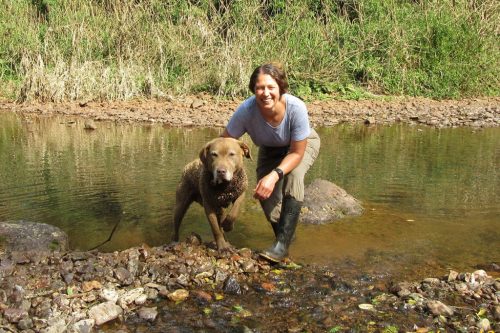
Scat sniffing dog Train

Washington University researcher Karen DeMatteo and her scat-sniffing dog Train are on a mission to preserve jaguars, pumas, bush dogs and other carnivores in the forests of Northeastern Argentina. (Photo: courtesy of Karen DeMatteo/Washington University)

The study explores options for mitigating the impact of human encroachment on five predators who cling to survival in isolated pockets of protected forest surrounded by a mosaic of roadways, unprotected forest, plantations and pastures.

“The study details a least-cost plan for the development of a multispecies biological corridor that connects protected areas in the Upper Parana Atlantic Forest Region of Misiones, Argentina,” said co-author Karen DeMatteo, a biology research scientist and lecturer in environmental studies in Arts & Sciences.

DeMatteo, who has spent 10 years working on the project,  said completion of the corridor model will allow researchers and community leaders to begin working with property owners to establish the habitat corridors.

“This plan is exciting not only for the future of the local biodiversity, but also because it involved a lot of collaboration from the local government and universities to make it happen,” she said.

Recent studies have argued that establishing small, protected reserves for endangered species, even in the best of habitats, is not enough to ensure long-term survival because species must move across their range to breed with other scattered populations and maintain genetic diversity.

Using dogs trained to detect the scat of specific species, DeMatteo’s team searched for evidence of the carnivores’ presence across a broad swath of northeastern Argentina, including public and private wildlife reserves, privately owned plantations, farms and pastures, and along roads and pathways leading to scattered communities.

DNA analysis of more than 900 scat samples collected over several summers allowed researchers to develop detailed maps of the species frequenting these habitats, including a sense of how their movements were influenced by habitat quality, topography, roadways and other human disturbances.

For species such as the jaguar, which rarely crosses into territory disturbed by humans, survival may hinge on the creation of habitat corridors linking isolated population pockets. Because the jaguar is so averse to human interaction, some studies have suggested that habitat corridors designed for it also would cover the needs of other predators.

DeMatteo’s study, which examined the habitat needs of jaguars, pumas, ocelots, oncillas and bush dogs, offers a more nuanced approach, suggesting that the optimal footprint for habitat corridors should be drawn with the overlapping needs of many species in mind.

While some species were less intimidated by the presence of humans, each had its own unique requirements in terms of what constitutes a suitable habitat and the length and width of possible corridor connections.

“Despite variation in body size, the jaguar, puma, ocelot, oncilla and bush dog overlap in their ecological requirements,” the study said. “However, this is not without variation in the degree of habitat flexibility. Puma, oncilla, and bush dog have comparatively higher levels of modified habitats in their potential distributions compared to the jaguar and ocelot.”

By combining data on all five of these species, researchers developed a model that provides maximum habitat connectivity for all species while minimizing the cost of establishing these corridors through privately owned lands and communities.

“The findings illustrate the benefit of using multiple species versus a single species to develop corridors, because using only the highly restricted jaguar to develop the corridor would mean that the potential distributions of the other four carnivores would be restricted and decreased by as much as 30 percent,” DeMatteo said. “So, it appears that, at least in the Misiones province, the jaguar should not be modeled as an umbrella species because the results fail to capture the varied requirements of coexisting species across the breadth of potential habitats.”

DeMatteo and colleagues hope the study provides a methodology for identifying the optimal footprint for proposed habitat connection corridors, while incorporating enough flexibility to ensure that the needs and desires of private landholders can be incorporated into the process.

“The approach in making a corridor a reality is multi-pronged and involves a strong investment from the local community, especially when developing corridors that use existing protected areas as ‘stepping stones,’ as private land will inevitably be involved to varying degrees in and around the corridor,” the study concludes.

Source:  Washington University media statement

Scat sniffer dogs help tell the story of endangered lizards

Dogs can be trained to find almost anything (people, drugs, weapons, poached ivory) but one York University researcher had them detect something a little unusual – the scat of endangered blunt-nosed leopard lizards.

The scat detection dogs helped biology PhD student Alex Filazzola discover not only scat, but the importance of shrubs in preserving lizard populations in the face of climate change.

“The loss of these lizards would likely have a cascade effect on other species,” said Filazzola, the study lead.

The research team geo-tagged 700 Ephedra californica shrubs in a 32.3-hectare area of the Panoche Hills Management Area in San Joaquin Valley, California. They then took two scat detection dogs from Working Dogs for Conservation on the hunt for lizard scat in 2013 and 2014.

In 2014, there was a drought during which time lizard scat was found more frequently under shrubs, especially those with dense canopy cover, than out in the open. The shrubs proved instrumental in providing critical micro-environments for the blunt-nosed leopard lizards, in particular, shady places to regulate their body temperature in extreme heat, as well as refuge from predators. The lizards use rodent burrows, most often found under shrubs, to escape predators.

“As the climate warms and lizards find it more difficult to regulate their body temperatures in the heat, these findings could help preserve them not only in California, but globally,” said Filazzola of York U’s Faculty of Science. “It demonstrates how much animals rely on plants for survival that goes beyond that of simply eating them. Positive plant-animal interactions could further support animal populations that are already threatened.”

The research, “Non-trophic interactions in deserts: Facilitation, interference, and an endangered lizard species,” was published in the journal Basic and Applied Ecology.

Once abundant in the San Joaquin Valley, agriculture and industrialization has reduced the lizards’ range by close to 85 per cent. Predictions of increased drought in the area put the lizards at a high risk of being wiped out. The study also pointed out that management techniques used over the past 50 years have done little to change the endangered status of the lizards.

“Planting shrubs, such as the Ephedra californica, could prove critical in managing and preserving endangered species in high-stress or arid ecosystems, such as a desert,” said Filazzola. “Continuing to remove these shrubs to install solar panels, however, further endangers this species.”

In addition, the study found that invasive grasses in the desert were not beneficial. They interfered with the lizards’ ability to move around and limited available habitat by reducing the variety of rodent species which create burrows. The invasive grasses also competed for space with shrubs and caused diminished shrub growth. Managing invasive plant species is therefore crucial in these ecosystems.

The research was funded by the Central Coast Field Office of the Bureau of Land Management, Department of the Interior, a Discovery Grant from the Natural Sciences and Engineering Research Council of Canada and York University.

Source: York University media release

Bear’s best friends

Detection dog for bears

Camas, of Working Dogs for Conservation, on the job in the Centennial Mountains.  Photo credit:  Julie Larsen Maher

A recently released study from WCS (Wildlife Conservation Society) details a new method using  “detection dogs,” genetic analysis, and scientific models to assess habitat suitability for bears in an area linking the Greater Yellowstone Ecosystem (GYE) to the northern U.S. Rockies.

The method, according to the authors, offers an effective, non-invasive approach to the collection of data that could play a vital role in the further recovery of grizzly bears during the coming decades.

“The use of detection dogs allowed us to quantify and map key areas of habitat for black bears in the Centennial Mountains located along the Idaho-Montana border west of Yellowstone National Park,” said Jon Beckmann, WCS Scientist and lead author of the study. “Black bears are a proxy species useful for predicting likely grizzly bear habitat. With recovery, a larger grizzly bear population needs room to roam and to reconnect with other populations. The Centennial Mountains region of the U.S. northern Rockies can provide room and safe linkages— critical to connecting the bear population in the GYE area to others further north and west”. 

During the study, two Labrador retrievers and two German shepherds owned and trained by Working Dogs for Conservation, located 616 scat samples of black bears and 24 of grizzly bears (identified by DNA extraction and analysis) in the 2500 square kilometer (965 square mile) study area.

“Dogs excel at searching for multiple scents at once, even if one is far more common than the other,” according to Aimee Hurt, Working Dogs for Conservation co-founder. “In this case, the dogs easily alerted us to a multitude of black bear scat, while also readily locating the rare grizzly bear scat, resulting in a multitude of data points and a robust model.”

“We recognize that black bears do not always utilize the landscape in precisely the same manner as grizzly bears,” said Beckmann. “But given the paucity of grizzly bears in the study area—especially  during the years of our study—our  approach, data, and model have value to grizzly bear conservation and management. This is especially true given that black bears and grizzly bears in the GYE are known to utilize very similar habitats spatially, but at different times.” 

Plugging the scat sample location data into their scientific model, the scientists examined the landscape with respect to habitat parameters, private lands, public land management and human activity in the area. Results of modeling provided insight into bear habitat use and resource selection patterns.

Among the findings it was determined that distance to roads matters; bears use habitat that is farther from roads, and when road density increased within 4 kilometers of a location bears used that habitat less. Bears also used a habitat less if it were high elevation, or privately owned. With this information land managers, land trusts, and others will be better informed to make bear habitat management and conservation decisions. This study may also inform human-bear conflict avoidance, and so help people and bears better co-exist.

“Using Detection Dogs and RSPF Models to Assess Habitat Suitability for Bears in Greater Yellowstone,” appears in the current edition of Western North American Naturalist. Co-authors include: Jon P. Beckmann of WCS; Lisette P. Waits of the Department of Fish and Wildlife, University of Idaho; Aimee Hurt and Alice Whitelaw of Working Dogs for Conservation; and Scott Bergen of Idaho Department of Fish and Game.

WCS’s work in this region is supported by the Turner Foundation, Wilburforce Foundation, Brainerd Foundation, The New York Community Trust, and the Bureau of Land Management–Dillon, Montana office.

Source:  Wildlife Conservation Society media release


