Tag Archives: science

Laika the space dog

Sky TV (our cable channel) has been airing the film Apollo 13 for the millionth time and so, as my mind wanders, I started thinking about the first dog in space.

Her name was Laika, which means Barker in the Russian language.  She was found as a stray dog but ultimately was sent into orbit on Sputnik 2 on November 3, 1957.

A photo of Laika in her specially designed space capsule

Her successful launch into space was the subject of a lot of fanfare and heralded as an achievement by the Russian space programme.  Over the years, her launch into space was celebrated in a range of postage stamps from around the world.

This slideshow requires JavaScript.

Back in 1957, people were told that Laika lived almost a week in space before dying a painless death.  In 2002, those facts were disputed at the World Space Congress in Houston, Texas, by Dimitri Malashenkov of the Institute for Biological Problems in Moscow.

He reported that Laika died from overheating and panic just a few hours after the mission started.

Dr Malashenkov  revealed several new details about Laika’s mission at the conference, including that the dog was chained to prevent her turning around and that her food was prepared in a jelly format for space travel.  There was a carbon dioxide absorbing device in the cabin to prevent the accumulation of this toxic gas as well as an oxygen generator (similar to what was used in Apollo 13).

Medical sensors attached to Laika showed that her heart rate increased by to 3 times its resting rate during the launch.   Other sensors showed that temperature and humidity increased as the space ship attained orbit.  Within five to seven hours of flight, mission control in the Soviet Union stopped receiving life signs from Laika.

Laika achieved a place in history for her flight into space, which proved that life forms could survive (with support) in orbit.  Unfortunately for Laika, she lived in a time when animal experimentation was an accepted norm.
Source:  BBC News
Dog intelligence

Most dog owners have an opinion about their dog’s intelligence.  I regularly hear comments like, “He’s so smart, he’s ahead of the rest of his obedience class” or “He’s not very bright, but we love him.”

 When I was working on my management qualification years ago, we were told to go home and ask our partner/flatmate about how they solved problems.  Ebony, my Labrador flatmate at the time, came up with these tips, which I thought were very intelligent:

  1. Remember that chasing your tail does not get you anywhere.  It also makes you dizzy and less able to focus on the task at hand.
  2. Eat regularly and often.  Problem solving is hard work and requires energy.
  3. Don’t underestimate the value of a nap.  A problem looks different after you’ve had a good sleep.
  4. If you stare at a problem long enough, it might move on its own.
  5. Don’t be afraid to ask for help.  Try looking cute.
  6. If looking cute doesn’t work, try whining.
  7. If whining fails, loud retching noises are guaranteed to get the attention of those around you.
  8. Some problems soften over time.  Burying them in the garden hastens this process.
  9. Some problems require more immediate attention.  An immediate problem, if left unattended, is likely to result in a much more smelly mess to be cleaned up later.

There are many published works on the subject of dog intelligence.  Over the years, I’ve read countless research studies into this subject.  There are many institutions involved in the research.  All projects have the goal of understanding how dogs think.

Professor Stanley Coren of the University of British Columbia has authored several books about dog intelligence.  He states that dogs have the intellectual capacity of a two-year old and can understand more than 150 words.[1]

Researchers at the Max Planck Institute for Evolutionary Anthropology have studied the ability of dogs to interpret human gestures.  When researchers hid food beneath one container in a group and pointed to the ‘right’ container, dogs consistently picked up on those cues better than even chimpanzees (a species widely studied because of the evolutionary link between apes and humans).

Earlier this year, a research team at the University of Otago reported on their study that showed that dogs could readily distinguish happy human sounds from sad or angry ones, suggesting an ability to understand human emotions.

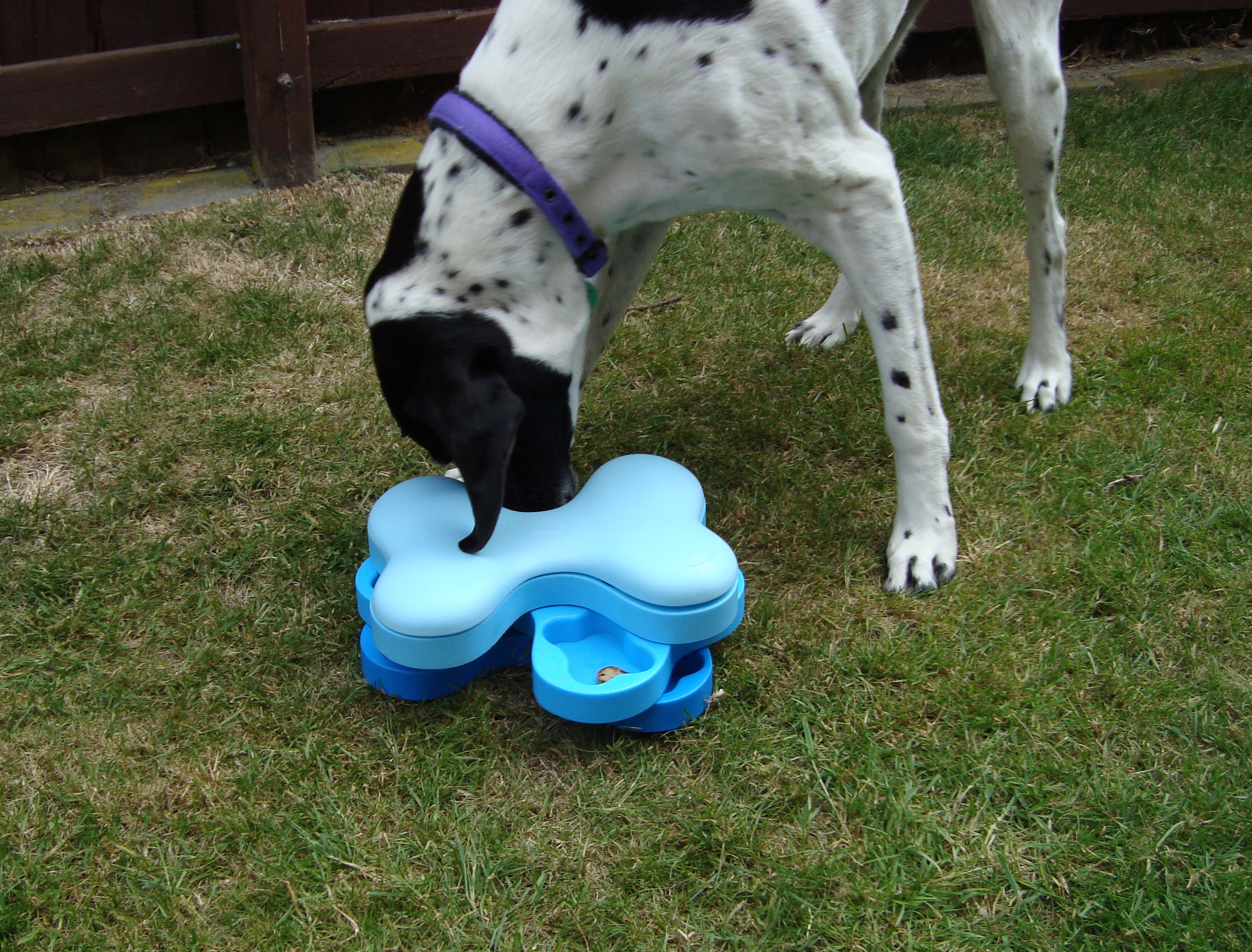
Even the dog toy market has recognised that dogs need mental stimulation.  The Nina Ottosson range, for example, offers a range of skill level toys designed to make your dog think about how to reveal their food reward.

Daisy demonstrates her intelligence with a Nina Ottosson toy

Despite all of this evidence, including videos of my Daisy using her interactive toys, many of the non-dog people in my life remain unconvinced about the intelligence of dogs.  I believe that persistence will pay off.  Over time we will see more and more research about the intellectual capacity of our dogs.  The non-believers will become believers.


[1] Science Daily, 10 August 2009

What is your dog thinking? Researchers are on the case!

Researchers at Emory University have published new research into canine cognition.  Entitled Functional MRI in Awake Unrestrained Dogs, the paper outlines findings of research that required two dogs to remain motionless in an MRI machine.

Yes – that’s right. Motionless.  The two dogs were outfitted with special ear muffs to protect them from the noise of the MRI and trained to rest their heads on a chin rest inside the machine.   As the MRI took scans of the dog’s brain activity,  hand signals were used to show the dogs whether there was or wasn’t a food reward.

This is a first-ever study on awake dogs, rather than those that have been sedated.  Importantly, part of the animal ethics of the study was to ensure the dogs were willing participants.

The findings show a definite brain activity response when the hand signals indicated a food reward.  Those dogs are paying attention!

The lead researcher, Professor Gregory Berns, says “We hope this opens up a whole new door for understanding canine cognition and inter-species communication. We want to understand the dog-human relationship, from the dog’s perspective.”

Professor Bern’s dog Callie in training in a mock-up of the MRI scanner (copyright Emory University)

Listen to Professor Berns talk about this project in the Emory University YouTube video:

Source:  Emory University press release 4 May 2012

Lessons from a Freethinking Dog

I have just finished reading Merle’s Door (Lessons from a Freethinking Dog) by Ted Kerasote.  This book was published in 2007 and became a national bestseller.  That’s not a surprise.

Mr Kerasote is an accomplished author.  He has written for publications including National Geographic, the New York Times, and Science.  And he has other books to his name.

Merle’s Door, however, has to be one of Mr Kerasote’s top literary accomplishments and something that will be remembered as a hallmark of his writing career.  Buy it (don’t just download it into your Kindle).

Merle’s Door is a biography of Merle, a dog adopted by Kerasote when they met totally by accident in 1991.  Merle was ‘living rough’ in the Utah desert and Ted was on one of his many trips with friends to enjoy nature.

“You need a dog, and  I’m it” says Merle.  And so begins a lifetime of 13 years together where Ted learns to translate Merle’s thoughts, to give him free reign to learn about life and his surroundings and, in turn, Ted learns many things from Merle.

Using his dog door and the freedom that Ted allowed him, Merle becomes the unofficial mayor of Kelly, Wyoming and makes many friends.  Along the way Ted establishes a ‘dedicated quadruped couch’ in his house and Merle leaves lasting footprints in the varnish of the balcony of the house they built together (and where Kerasote still lives).

Merle’s Door is Merle’s biography.  Lovingly written by Ted, we learn about Merle’s trademark “Ha ha ha” as he would converse with Ted in a language all his own.  He’d go hunting for elk, but was gun-shy when hunting birds  (and we find out why later in the book).  He has his scraps with other dogs and comes out learning valuable life lessons.

Later in life, Merle’s back end starts to deteriorate and Ted employs the use of acupuncture and massage to help his dog recover (no wonder why I like this book!).  With respect, he lets Merle define what will be a good day and a bad day and they enjoy one another’s company to the end.

Mr Kerasote does a wonderful job in depicting the human-dog bond that so many of us dog lovers have appreciated in our lives.  And he does it with the flair of an accomplished writer.

Like all true dog stories, be prepared for the end of Merle’s life in 2004 which is  obviously written by someone who has lived through the last days of their dog’s life.  Have a box of tissues handy – you’ll need it.  (I did)

This is a book I intend on keeping and adding to my dog book collection.  I’m grateful for Mr Kerasote’s writing talent because, not only is this Merle’s story, but it is well referenced with footnotes to key pieces of dog research (15 pages of references in total).

Through Mr Kerasote’s writing, Merle’s story lives on for all of us to share.  A wonderful dog that walked this earth for almost 14 years and left pawprints on many hearts….


