“Like many other much-loved humans, they believed that they owned their dogs, instead of realizing their dogs owned them.”
– Dodie Smith, English novelist and author of The Hundred and One Dalmatians


“Like many other much-loved humans, they believed that they owned their dogs, instead of realizing their dogs owned them.”
– Dodie Smith, English novelist and author of The Hundred and One Dalmatians

Teddy (right) with sister, Verdi
It’s been a good weekend for Teddy.
Jill says family life is getting back to normal, with Teddy and his sister enjoying some time together on the sofa – the first opportunity they’ve had for a long time.
Jill has re-arranged the furniture to ensure that any areas where Teddy might be interested in jumping onto or off of are fenced off. Her husband has built a ramp to the dog door which Teddy is handling beautifully (we will aim to get a photo of this up soon).
Jill says, “I read on the Tripawds site that if you were bonded to your special dog before, it’s nothing to the bond you have after amputation. This is so very, very true. When I took the two girl Beagles to the vet, Anneke and Alex (vet and vet nurse) wanted to come out to see Teddy. He wasn’t interested in them at all – he only had eyes for me!”
Kathleen Crisley, specialist in dog massage, rehabilitation and nutrition/food therapy, Canine Catering Ltd, Christchurch, New Zealand
Posted in Teddy's journey post-amputation
Tagged amputation, beagle, Teddy, tripawd, tripawds, tripod, Verdi
Feeding raw (or not) has to be one of the most controversial topics in dog ownership today. Consequently, the US Food & Drug Administration’s (FDA’s) recent warning to owners feeding raw is likely to generate some controversy.
The FDA’s Center for Veterinary Medicine (CVM) screened over 1,000 samples of pet food for bacteria that can cause foodborne illnesses. (The illnesses are called “foodborne” because the bacteria are carried, or “borne,” in or on contaminated food.) The study showed that, compared to other types of pet food tested, raw pet food was more likely to be contaminated with disease-causing bacteria.
Raw pet foods were included in the second year of a two-year study and the samples were from commercially available raw pet foods which were purchased online and sent to six different testing laboratories.
The participating laboratories analyzed the raw pet food for harmful bacteria, including Salmonella and Listeria monocytogenes.
Of the 196 raw pet food samples analyzed, 15 were positive for Salmonella and 32 were positive for L. monocytogenes (see Table 1).
| Type of Pet Food Sample | No. samples tested | No. positive for Salmonella | No. positive for L. monocytogenes |
|---|---|---|---|
| Raw pet food | 196 | 15 | 32 |
| Dry exotic pet fooda | 190 | 0 | 0 |
| Jerky-type treatsb | 190 | 0 | 0 |
| Semi-moist dog foodc | 120 | 0 | 0 |
| Semi-moist cat foodc | 120 | 0 | 0 |
| Dry dog foodd | 120 | 0 | 0 |
| Dry cat foodd | 120 | 1 | 0 |
| a Non-cat and non-dog food, such as dry pellets for hamsters, gerbils, rabbits, amphibians, and birds. b Included chicken jerky and pig ear-type products. c Typically packaged in pouches for retail sale, such as (1) pouched dog and cat food; and (2) food treats shaped like bacon, fish, pork chops, and burgers. d Included pellet- or kibble-type food typically packaged in bags for retail sale.Note: CVM did not collect or test canned and wet pet food samples in this study. |
|||
The FDA has gone as far as warning owners against raw feeding, but in an acknowledgement that this type of diet is the preference for many owners, they also provided these tips to prevent Salmonella and Listeria infections:
In my practice, I have clients that feed all types of diet (commercial, raw, homemade). I have seen raw food diets implemented successfully with some dogs, and others who fail to thrive on them for a variety of reasons. That’s why I am a proponent of the food therapy approach, which can successfully be implemented with all types of diet.
For my clients here in New Zealand, I’d like to emphasize that the food hygiene suggestions by the FDA do make sense. According to our Ministry of Primary Industries, Salmonella is the second most common bacterial cause of foodborne disease in this country (campylobacter is the first). Incidents of Listeria are rare, but some people like pregnant woman are particularly vulnerable to the disease.
Kathleen Crisley, specialist in dog massage, rehabilitation and nutrition/food therapy, Canine Catering Ltd, Christchurch, New Zealand
Source: US Food & Drug Administration
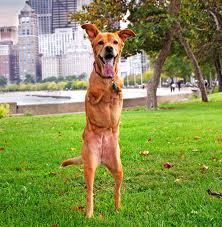
Faith, the biped dog who stole many hearts since being born in 2002, passed away on September 22, 2014. Her family says that she was increasingly uncomfortable with arthritic pain over the last few months and it was time to let her go.
I first wrote about Faith in 2011 when I was doing some research on special needs dogs. Faith’s adoptive family taught her to walk on her hind legs, rather than heeding advice from many ‘experts’ that she be put down. She went on to become a wonderful therapy dog and an ambassador for special needs in general.
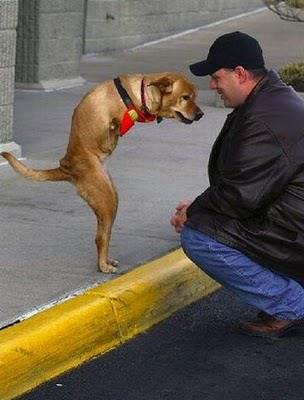
Faith with her manager, Mike Maguire
According to her family, Faith is probably running on all fours on the other side of the Rainbow Bridge. They are accepting messages of condolence on Faith’s Facebook page.
You can read more about Faith’s inspiring story in the book by Jude Stringfellow, Faith Walks, available through Amazon.

Kathleen Crisley, specialist in dog massage, rehabilitation and nutrition/food therapy, Canine Catering Ltd, Christchurch, New Zealand
Posted in special dogs and awards
Tagged biped, Faith, Faith Walks, Jude Stringfellow
Dogs suffering from certain types of blood cancers may have a new treatment alternative thanks to the collaborative work of cancer experts looking for options that can help both humans and their pets.
The drug, Verdinexor (KPT-335), works by preventing powerful tumor suppressing proteins from leaving the nucleus of cells, an exodus which allows cancer to grow unchecked. It’s the first new therapeutic option for dog lymphoma in more than two decades, potentially offering vets another alternative for treating the disease, which is the most common form of canine cancer.
“Verdinexor is a really different from chemotherapy, the current standard of care for lymphoma. It works by blocking a protein in the cells responsible for shuttling other proteins in and out of the nucleus, resulting in disruption of cell survival and eventual cell death ,” said veterinary oncologist Cheryl London, DVM, PhD, The Ohio State University College of Veterinary Medicine, who led preclinical, Phase I and Phase II studies of Verdinexor. “Verdinexor could give veterinarians another option if first-line chemotherapy fails or as a potent adjunctive therapy.”

Lead researcher Cheryl London with her dog, photo courtesy of The Ohio State University College of Veterinary Medicine
“A cancer diagnosis is tough on dogs and their owners. Dogs with lymphoma must go to a veterinary office weekly to receive chemotherapy infusions,” said London. “Since Verdinexor is a pill that can be given at home, it could help make treatment less traumatic for everyone.”
The similarities in the ways human and canine cancer drugs are researched and used are not coincidental. Many types of human and canine cancers are identical at both the cellular and molecular levels, making companion animal studies an ideal place to test drive experimental compounds that appear to have anti-cancer characteristics.
“When it comes to cancer, dogs and humans have so much in common,” said London. “I think as human medicine becomes more personalized through the use of genomics, I think we’ll see the same happening in vet medicine.”
Source: Newswise media release
Posted in research
Tagged cancer, canine cancer, Cheryl London, College of Veterinary Medicine, lymphoma, Ohio State University, Verdinexor
If you live in my local area of Christchurch (New Zealand), you are probably as worn out as I am about hearing about “The Rebuild” and “The New Central City.” It’s been especially frustrating for those of us who want to see a dog-friendly city because our needs are not being met.
So here’s one idea for the rebuilt Cathedral Square in central Christchurch.
A fountain for all to enjoy (but especially dogs!)
Kathleen Crisley, specialist in dog massage, rehabilitation and nutrition/food therapy, Canine Catering Ltd, Christchurch, New Zealand
An infectious dog cancer is continuing to lurk in the majority of dog populations around the world, particularly in areas with many free-roaming dogs. This is according to research published in the open access journal BMC Veterinary Research.
The survey of veterinarians across the world confirmed that Canine Transmissible Venereal Tumor (CTVT) has a global reach. Researchers from the University of Cambridge found that the countries and areas with the lowest rates of the disease also had strong dog control policies. These include managing the number of street dogs; spay and neuter practices; and quarantine procedures for imported dogs.
CTVT first originated as a tumor in a single dog that lived thousands of years ago. It has become the oldest, most widespread and prolific cancer known in nature. It causes tumors of the genitals, and is spread by the transfer of living cancer cells between dogs during sex. CTVT is one of only two known transmissible cancers.
To understand the global distribution and prevalence of the disease, the scientists sent a questionnaire to 645 veterinarians and animal health workers around the world. The replies showed that CTVT is endemic in dogs in at least 90 of 109 countries surveyed.
The researchers found that the only cases of CTVT reported in countries in Northern Europe, where free-roaming dogs are absent, were found in dogs that had been imported from abroad. There were no reports of CTVT in New Zealand, a fact attributed to this country’s quarantine rules. On the other hand, the disease was more likely to be present in countries or areas with free-roaming dog populations.
Andrea Strakova, from the University of Cambridge, said: “Although CTVT can usually be effectively treated, lack of awareness of the disease and poor access to veterinary care mean it can go untreated and impact the welfare of dogs. Research and monitoring of this disease may lead to improved methods for disease prevention, detection and treatment.”
Dr Elizabeth Murchison, also from the University of Cambridge, said: “Our study has suggested that free-roaming dogs are a reservoir for CTVT. Our review of the historical literature indicated that CTVT was eradicated in the UK during the twentieth century, probably as an unintentional result of the introduction of dog control policies. Careful management of free-roaming dog populations, as well as inclusion of CTVT in dog import/export quarantine policies, may help to control CTVT spread.”
Source: EurekAlert! media statement
For more information about this cancer, visit my earlier post A dog cancer that is 11,000 years old
Kathleen Crisley, specialist in dog massage, rehabilitation and nutrition/food therapy, Canine Catering Ltd, Christchurch, New Zealand
Posted in research
Tagged cancer, Canine Transmissible Venereal Tumor, CTVT, infectious cancer
Teddy is definitely feeling better these days. Jill was worried because Teddy, normally a vocal hound, hadn’t vocalized since his amputation surgery.
Not to worry – his voice is back!
Kathleen Crisley, specialist in dog massage, rehabilitation and nutrition/food therapy, Canine Catering Ltd, Christchurch, New Zealand
Posted in Teddy's journey post-amputation
Tagged amputation, amputation surgery, beagle, Canine Catering Ltd, hound, Teddy

Photo courtesy of Dany Wu

Powered by Linky Tools
Click here to enter your link and view this Linky Tools list…
There’s a new staff member at the Suffolk Country District Attorney’s office in Massachusetts. It’s Indy, a Golden Retriever/Yellow Labrador cross, who is the office’s new comfort dog.

Indy at her press conference (photo courtesy of Boston.com)
New Dog Comforts Victims in Suffolk DA’s Office – Massachusetts news – Boston.com.







 DoggyMom.com