Author Archives: DoggyMom.com

A unique photo series

Professional photographer Fred Levy of Maynard, Massachusetts heard about Black Dog Syndrome at the local dog park and decided to use his skills to help combat it.

As described here in my 2013 post, Black Dog Syndrome is a phenomenon reported by many shelters and rescues.  Black dogs are often depicted in movies and other media as mean, vicious and menacing.   And since many shelter don’t have lighting for ‘ambiance’ these dogs are often not seen in a flattering light.

“A dog shouldn’t be overlooked just because of its coat,” Levy said. “That’s a minor element when it comes to the dog.”

So he’s created a lovely photo series of black dogs using a black background to show off their beauty.

Here are a couple of examples:

Springer spaniel Aki

Aki, a Springer Spaniel

In this Oct. 2013 photo provided by Fred Levy, a black Labrador retriever named Denver poses in Levy's studio in Maynard, Mass. Levy, a pet photographer, first heard about “Black Dog Syndrome” in a 2013 conversation at a dog park. It’s a disputed theory that black dogs are the last to get adopted at shelters, perhaps because of superstition or a perception that they’re aggressive. The idea inspired Levy to take up a photo project on their behalf. (Fred Levy via AP)

A black Labrador retriever named Denver

And view more of the series on Fred’s website…

Great idea!

Source:  Yahoo news

The prescription for a soldier’s PTSD

I just found this very short item on the San Francisco Chronicle website.  A photo of a heavily tattooed man, his baby and his dog….

 Photo: Patty Snijders

Photo: Patty Snijders

The man is Ari Sonnenberg with his daughter, Nila Louise Sonnenberg, born April 1, 2015, and his Belgian Malinois dog, Sigmund Freud (also known as  Siggy).

Patty Snijders (Ari’s wife) says: “The dog has helped both Ari and me tremendously. He’s made our marriage stronger and prepared us for parenthood in many ways.”

A simple photograph and a lovely sentiment.  Siggy sounds very special and his presence has clearly been a help to the couple.

The body of knowledge about the value of dogs for our physical and mental health continues to grow, with research and study and stories like those of Siggy and his owners.

Kathleen Crisley, specialist in dog massage, rehabilitation and nutrition/food therapy, Canine Catering Ltd, Christchurch, New Zealand

Therapy dog helps woman testify at court hearing

This post is definitely filed under the heading of Special Dogs & Awards.  Another example of how our dogs can work with us and for us…. A courtroom therapy dog named Paz, a Labradoodle, has helped a woman testify in court about her multiple assaults and captivity, an ordeal endured with her 5-year old daughter. It is the first time a judge has allowed a therapy dog in court to support an adult (rather than a child).

 The appearance on Tuesday of Paz, a therapy dog, in a New York City courtroom to help an adult witness testify was said to be unprecedented. Credit Kevin Hagen for The New York Times

The appearance on Tuesday of Paz, a therapy dog, in a New York City courtroom to help an adult witness testify was said to be unprecedented. Credit Kevin Hagen for The New York Times

More details about this story in the New York Times link below. Well done, Paz, and may you continue to provide support to this woman – no one deserves that kind of treatment.  And kudos to the judge who recognized the value of the dog to the court’s proceedings. Source:  New York Times

Society Hound Barbie

Since I am now the proud Doggy Mom of Izzy the Greyhound, I’m naturally drawn to items with a greyhound theme.

So wow – I was blown away when I saw you can buy a Barbie® doll walking her greyhound.

It’s part of Barbie® – the Society Hound Collection:

  • Barbie® doll and her sleek greyhound step out into the cool day draped in their luxurious matching ensembles
  • Barbie® wears a charming 1920s-inspired blue grey faux fur trimmed dress with matching lined cape
  • Doll stand included
  • For the adult collector, age 14 and over

Society Hound BarbieI’m not going to buy this doll, as I have other priorities in my life right now.  But I’m impressed.

What unique dog items do you have in your home?

Kathleen Crisley, specialist in dog massage, rehabilitation and nutrition/food therapy, Canine Catering Ltd, Christchurch, New Zealand


50 Shades of Greyhound

I have a perfectly innocent explanation for the mussed up and torn sheets and the sound of the headboard banging against the wall…

Kathleen Crisley, specialist in dog massage, rehabilitation and nutrition/food therapy, Canine Catering Ltd, Christchurch, New Zealand


Dogs absorb lawn chemicals

Dogs exposed to garden and lawn chemicals may have a higher risk of bladder cancer. iStockPhoto

Dogs exposed to garden and lawn chemicals may have a higher risk of bladder cancer.
iStockPhoto


Dogs are ingesting, inhaling and otherwise being exposed to garden and lawn chemicals that have been associated with bladder cancer, according to a new study.

The paper, which will appear in the July issue of Science of the Total Environment, also found that wind could carry the chemicals to untreated properties. The researchers also found that dogs, once contaminated by the chemicals, can transfer them to their owners.

The chemicals are common herbicides containing the following: 2,4-dichlorophenoxyacetic acid (2,4-D), 4-chloro-2- methylphenoxypropionic acid (MCPP) and/or dicamba.

“The routes of exposure that have been documented in experimental settings include ingestion, inhalation and transdermal exposures,” lead author Deborah Knapp of Purdue University’s Department of Veterinary Clinical Sciences, told Discovery News.

“In the case of dogs,” she added, “they could directly ingest the chemicals from the plant, or they could lick their paws or fur and ingest chemicals that have been picked up on their feet, legs or body.”

Scottish terriers, West Highland white terriers, Shetland sheepdogs, beagles and wire hair fox terriers are all at particular risk, the researchers suggest, because these breeds have a high genetic propensity for bladder cancer.

Knapp and her colleagues first conducted an experimental grass plot study that involved spraying various defined patches with the chemicals under different conditions. These included spraying the herbicides on plots that were green, dry brown, wet or recently mowed. The researchers next measured how much of the chemicals remained on the grass up to 72 hours post treatment.

Co-author Angus Murphy, also from Purdue, explained that dead or dying plant material does not readily absorb the chemicals, “so the herbicide can remain longer on the surface of the plant.”

He continued, “If an excessive amount of herbicide is applied, then the capacity of the target plant to take up the compound may be overwhelmed.”

In a second experiment, the researchers analyzed urine samples of dogs from households that either used herbicides or didn’t. The majority of dogs from homes that used the chemicals were found to have these same herbicides in their urine. Some dogs from untreated homes also had the chemicals in their urine.

Knapp explained that wind could cause the herbicides to travel up to 50 feet away from the application site. Neighbors who use the chemicals might therefore impact other individuals in the area.

“There are industry guidelines for restricting lawn chemical application based on wind speed, although homeowners may not be aware of these,” Knapp said.

Once contaminated, dogs can pass the chemicals on to their owners and to others. The study only looked at dogs, but the researchers suspect that cats and other pets could also be affected.

“Dogs can pick up the chemicals on their paws and their fur,” Knapp said. “They can then track the chemicals inside the house, leaving chemicals on the floor or furniture. In addition, if the dog has chemicals on its fur, the pet owner could come in contact with the chemicals when they pet or hold the dog.”

John Reif, a professor emeritus of epidemiology at the Colorado School of Public Health, told Discovery News, “The paper presents important information since exposure to 2,-4-D, a widely used broad leaf herbicide, has been associated with increased risk of cancer in pet dogs and humans.”

Reif added, “This study has potentially important implications for human health since it demonstrates widespread exposure to pet dogs. The likelihood that children, who share the local environment with their pets, are similarly exposed to these chemicals is high and thus additional studies should be conducted to evaluate this possibility.”

The researchers suggest that if owners still must use herbicides, they should follow manufacturer guidelines, allow gardens and lawns to dry before allowing pets out, wash their dog’s feet each time the dog comes inside, and consider treating the back yard one week before the front (or vice versa) so that pets will have an area of less potential chemical exposure available to them.

Source:  Discovery.com


Love your dog? Restrain it when riding in the car!

This week has been a very rainy one in Christchurch.  Since I am a mobile practitioner, I spend a fair amount of time in the car.  When stopped at a traffic light, I snapped this photo with my phone:

Dog in car on rainy day

You can clearly see this little white dog sitting on the ledge at the rear window of the car.  I watched while the dog moved around on the ledge and onto the back seat of the car, then back again.

If this vehicle had to stop suddenly for any reason, this dog would go flying!  Just as the driving safely videos show things like drink bottles flying after a crash, so too would this little dog.  If it survived, it would likely need intensive medical care that would be both painful and expensive.

I don’t see enough dogs in Christchurch that are restrained properly using a car harness.  It’s very concerning.

I’ve even met and talked with vets about this subject, and many have admitted that although they know they should restrain their own dogs, they don’t!   Most vets don’t even ask as part of the annual check-up with their clients whether or not their dog travels in a vehicle and, if so, whether it is properly restrained.

We need more people leading from example….

…like the lovely lady who came yesterday to fit her Labrador puppy, Harley, with an auto harness.  She’s training him at a young age to accept being restrained in the car.

Please let me know if your vet encourages you to restrain your dog when traveling in the car.  I’d like to promote them via my Facebook page.  And send me photos of your dog safely restrained in the car!

Kathleen Crisley, specialist in dog massage, rehabilitation and nutrition/food therapy, Canine Catering Ltd, Christchurch, New Zealand

Barking characterizes dogs like voices characterize people

An international group of researchers has conducted a study on canine behavior showing that gender, age, context and individual recognition can be identified with a high percentage of success through statistical and computational methods of pattern recognition applied to their barking.

The results of the study have been published in the journal Animal Cognition.

This research aimed to understand the acoustic signals obtained from dog barking when the dog subjects are subjected to certain situations. The research was conducted through the development of a computational system based on statistic modeling that is able to recognize diverse characteristics of the dog (gender, age, individual, situation).

This diagram has been used to help ‘map’ the computing system behind the research:

Photo credit:   Universidad Politécnica de Madrid (UPM)

Photo credit:
Universidad Politécnica de Madrid (UPM)

The experiments were carried out in Budapest with eight Mudi breed dogs from Hungary, usually used as sheep-dogs—three males and five females. Each dog (aged between one and 10) registered 100 barks. A total of 800 barks was obtained by placing the dogs in seven different situations: (a) alone, after the owner tied the dog to a tree; (b) playing with a ball; (c) fighting, when a human pretended to attack the dog’s owner; (d) receiving their food ration; (f) in the company of a person who was foreign to the dog; and (g) preparing to go out with the owner. Each one of the 800 barks was characterized from 29 acoustic measurements.

By using the diverse computational models obtained from the collected data during the experiment, researchers successfully recognized the dog’s gender 85.13% of the time, while the age of the dog (recoded as young, adult and old) was classified without mistakes 80.25% of the time. The task of identifying the situation in which the dog was engaged was successful 55.50% of the time, while the recognition (among the eight dogs participating in the study) of the Mudi breed was successful the 67.63% of the time.

Whilst a highly technical bit of research, particularly for those of us who are challenged by computer programming and mathematics, there are applied uses for this research such as in assessing dog behavior.  Software programs using these models could help to identify fear, anxiety and levels of aggressiveness in a dog.

Source:  Phys.org

Chance gets a second chance

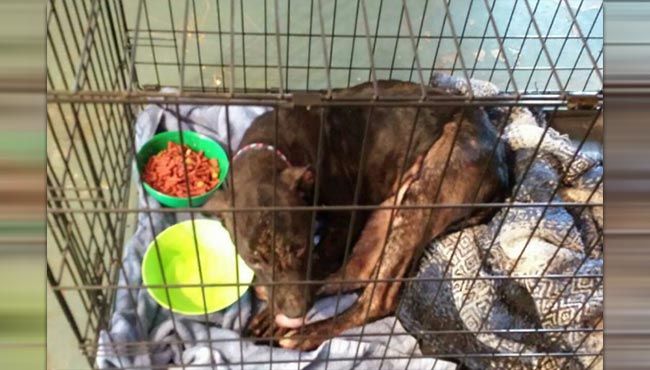
Who would have thought that a self-professed ‘every day working man employed at a scrap metal yard’ would be an animal adoption spokesman?  But that’s what’s happened in Alabama after a 5-month old puppy was found alive in a crushed batch of scrap metal.

Chance rests in a crate after his rescue

Chance rests in a crate after his rescue

“I couldn’t believe he was alive at first, then I couldn’t believe that someone would be that cruel,” Anthony Nicholson said.

Now named Chance, a veterinary check has revealed that the puppy has either a displaced or cracked hip.  Nicholson will pay the money for Chance’s surgery if he can’t raise it through fundraising.  His funding campaign is currently half-way to reaching its target.  Interested readers can donate to help Chance by going to Nicholson’s Go Fund Me site here.

“There are too many rescues and other foundations that will help re-home an animal. Don’t throw one away, and that’s basically what this is about,” Nicholson said.

Be sure to watch the interview about Chance on the Channel 12 website.

Source:  Channel 12, WSFA

Doggy quote of the month for June

‘Dogs are better than human beings because they know but do not tell.’

– Emily Dickinson, poet, 1830 – 1886