Author Archives: DoggyMom.com

Fresh and raw diets for dogs may have health benefits

Many dog owners think of their furry companions as part of the family, and now products are available to feed them that way, too. Some owners are moving away from traditional extruded kibble products, instead choosing ultra-premium fresh and raw diets found in the refrigerated aisle. The foods may look more similar to what we’d feed a member of the family, but many of the newer diets haven’t been rigorously tested for performance in dogs.

Beagle feeding study

“A lot of companies test for complete and balanced nutrition, but don’t go beyond that,” says Kelly Swanson, corresponding author on a new study published in the Journal of Animal Science and Kraft Heinz Company Endowed Professor in Human Nutrition in the Department of Animal Sciences and the Division of Nutritional Sciences at the University of Illinois. “The company we worked with – Freshpet – wanted to see how some of their unique diets would perform. Would dogs like them? Were they digestible? Would they increase activity?”

The researchers tested the palatability and digestibility of three commercially marketed fresh and raw diets for dogs, as well as a traditional extruded kibble diet. The diets included a lightly cooked roasted-refrigerated diet; a lightly cooked grain-free roasted-refrigerated diet; and a raw diet. The lightly cooked roasted diets were pasteurized, and the raw diet was treated with an acidifying bacteria that makes the food inhospitable to harmful microbes.

“The roasted diets come in a meatball form, and the raw diet was more like a big sausage roll that you cut up and feed to the dog. All diets were chicken-based, but some had added beef, salmon, or chicken liver. Each diet also contained a vitamin and mineral mix, and a dry mix of plant products like sweet potatoes, kale, spinach, cranberries, and carrots,” Swanson says. “People are familiar with those ingredients so they like to see them included in their pets’ diets. Although specific ingredients are not needed in the diet of dogs and cats, as many options can result in an acceptable nutrient profile, those ingredients are of high quality and are nutrient dense.”

Eight beagles were successively fed each diet for one month. After a 14-day transition period onto each new diet, they were monitored for voluntary physical activity, and then urine, stool, and blood samples were collected and analyzed.

The roasted diets turned out to be more digestible than the kibble, and both the grain-free roasted diet and the raw diet resulted in lower blood triglyceride levels than the kibble diet, even though they were higher in fat. Swanson isn’t able to pinpoint the cause of the surprising result, but points to it as a potential benefit of the non-traditional diets. Voluntary activity didn’t differ across the diets.

The researchers also found major shifts in the microbiota – the suite of microbes inhabiting the gut – in the roasted and raw diets, compared with kibble. Swanson says the changes in the microbiota were neither good nor bad, just different. He suggests that the results showcase the flexibility of gut microbiota, and how little scientists know about the effects of diet on host-microbe relationships as a whole.

It is important to point out that all dogs were healthy throughout the study period, and that all diets were palatable, highly digestible, and resulted in good stool quality. Even though some of the diets were statistically more digestible or led to lower triglycerides, those metrics were within the normal range for all dogs on all diets. Therefore, Swanson emphasizes, all the diet formats tested in the study, including kibble, would be healthy choices.

“As far as diet format and market segment is concerned, it ultimately comes down to consumer preference and philosophy. As long as a diet is shown to be safe and meets the nutritional needs of the pet in question, it is an acceptable option to me. If an owner is willing to pay more for premium ingredients and/or an improved processing method, I am fully supportive. To me, the most important thing is testing these new diet formats and products before they are commercially available,” Swanson says.

The article, “Apparent total-tract macronutrient digestibility, serum chemistry, urinalysis, and fecal characteristics, metabolites and microbiota of adult dogs fed extruded, mildly cooked, and raw diets,” is published in the Journal of Animal Science [DOI: 10.1093/jas/sky235]. Authors include Kiley Algya, Tzu-Wen Cross, Kristen Leuck, Megan Kastner, Toshiro Baba, Lynn Lye, Maria de Godoy, and Kelly Swanson. Lynn Lye is from Freshpet, and all other authors are from U of I. The research was funded by Freshpet.

Source:  University of Illinois press release

New type 1 diabetes therapy shows promise for long-term reversal in both humans, dogs

What if instead of daily insulin injections or wearing pumps, just getting a shot every few months could reverse Type 1 diabetes for you – or your dog?

It might take ushering in healthy pancreatic cells like a Trojan horse.

The Trojan horse, in this case, would be collagen, a protein that the body already makes for building muscles, bones, skin and blood vessels. A collagen formulation mixed with pancreatic cells, developed by Purdue University researchers in collaboration with the Indiana University School of Medicine, is the first minimally invasive therapy to successfully reverse Type 1 diabetes within 24 hours and maintain insulin independence for at least 90 days, a pre-clinical animal study shows.

For diabetic pets, the next step is a pilot clinical study in dogs with naturally occurring Type 1 diabetes, which will be conducted in collaboration with Purdue’s College of Veterinary Medicine.

“We plan to account for differences from mouse to human by helping dogs first. This way, the dogs can inform us on how well the treatment might work in humans,” said Clarissa Hernandez Stephens, first author on the work and a graduate researcher in Purdue’s Weldon School of Biomedical Engineering. Findings appear in early view for a forthcoming issue of the American Journal of Physiology – Endocrinology and Metabolism.

“With giving my dog shots twice a day, I have to constantly be thinking about where I am and when I need to be home. It greatly affects my work and my personal life,” said Jan Goetz, owner of a diabetic dog named Lexi. “Not having to give these shots would mean freedom.”

Type 1 diabetes affects about one in every 100 companion animals in the U.S., including dogs and cats, and approximately 1.25 million American children and adults.

David Taylor, an Indiana resident, has struggled with Type 1 diabetes for almost 50 years.

“A Type 1 diabetes diagnosis was my 18th birthday present, and since that first insulin injection, managing diabetes has been my ‘other’ full time job,” Taylor said. “Treatment methods have improved enormously over 50 years, but they still permit no time off for the patient. Receiving an injection every few months would restore the near-normal life to me that I haven’t had as an adult – and I could retire from that full-time diabetes management job.”

Because diabetes in dogs happens similarly in humans, treatment has so far been largely the same: Both need their glucose to be monitored throughout the day and insulin to be administered after meals.

This also means that dogs and humans could potentially benefit from the same cure: A new set of pancreatic cells to replace the clusters of cells, called islets, that aren’t releasing insulin to monitor blood glucose levels.

Still, 20 years of research and clinical trials hasn’t produced an effective islet transplantation therapy because multiple donors are needed, the current method of delivering islets through the portal vein of the liver is too invasive and the human immune system tends to destroy a large percentage of transplanted islets.

Purdue researchers simply changed how the islets were packaged – first, within a solution containing collagen, and second, as an injection through the skin instead of all the way at the liver, saving patients from a nasty procedure.

“Traditionally, we transplant islets in the liver of the animal and never do it under the skin, in large part because the skin doesn’t have the blood flow that the liver has for transporting insulin released by islets. And there are a lot of immune cells in the skin, so chances of rejection are high,” said Raghu Mirmira, professor of pediatrics and medicine and director of the Diabetes Research Center at the Indiana University School of Medicine.

The team removed the need for transplanting in the liver by thoroughly mixing mouse islets, provided by Mirmira’s lab, with the collagen solution. Upon injection just under the skin, the solution solidifies, the body recognizes the collagen and supplies it with blood flow to exchange insulin and glucose.

“It’s minimally invasive; you don’t have to go to the operating room and have this infusion into the portal vein. It’s as easy as it comes, just like getting a shot,” said Sherry Voytik Harbin, Purdue professor of biomedical engineering and basic medical sciences.

The researchers tested the effects of the solution between mouse twins and non-twins to check for discrepancies. Initial studies showed if the mouse donor were a twin to the recipient, the diabetic mouse could go at least 90 days without needing another shot. If not twins, the mouse would have normal blood sugar levels for at least 40 days. Nearly all transplanted islets survived either scenario, removing the need for multiple donors to compensate for those killed off by the immune system.

As they transition to testing the formulation in naturally diabetic dogs, the researchers will explore the feasibility of transplanting pig islets or stem cells programmed to produce insulin, in hopes that either method will further increase donor availability.

The islet transplantation therapy might also have implications for better treating severe pancreatitis.

Source:  Purdue University media statement

The Remler Radio Scottie Dog

On a recent layover in San Francisco International Airport, there was an exhibition on the history of radio and one of the companies featured was Remler Company Ltd, of San Francisco.  The company traded from 1918 to 1988.

A Scottie Dog (Scottish Terrier) featured as a brand motif on many of their radio models.

Here’s a selection of those I found on the internet:

Any of these radios, if you can afford them, would make an ideal ‘retro’ addition to a dog lover’s home.

Kathleen Crisley, Fear-Free certified professional and specialist in dog massage, rehabilitation and nutrition/food therapy, The Balanced Dog, Christchurch, New Zealand

Dogs to benefit from test to spot liver disease

Vets have developed a blood test that quickly spots early signs of liver disease in dogs, a study suggests.

Experts say that the test – based on insights gained from human patients – could help vets identify damage and start treatment early, saving the lives of many dogs.

The test – which is to be launched worldwide – means that fewer dogs will have to undergo invasive liver biopsies, findings by the University of Edinburgh suggest.

Diagnosis challenge

Diagnosing canine liver disease is challenging and catching early signs of damage is key to its treatment, vets say.

Current diagnosis is based on biopsies, which are expensive and can lead to complications.

Joining forces

Vets based at the University’s Royal (Dick) School of Veterinary Studies teamed up with medical doctors to look at blood levels of a molecule known as miR-122 in dogs. This molecule is found in high levels in people living with liver disease.

They worked with pets and their owners to test miR-122 levels in 250 dogs, including cocker-spaniels, labradoodles and Old English sheepdogs.

Testing kits

Dogs with liver disease were found to have significantly higher levels of a miR-122 compared with healthy dogs and dogs who had a different disease that did not affect the liver.

The team now plan to launch a testing kit to help vets worldwide quickly assess if their patient pooches have liver damage.

The study is published in the Journal of Veterinary Internal Medicine.

Lead vet researcher, Professor Richard Mellanby, Head of Companion Animal Sciences at The Hospital for Small Animals at the University of Edinburgh, said: “We have found a specific, sensitive and non-invasive way to detect liver damage in dogs. We hope that our test will greatly improve outcomes by allowing vets to make rapid and accurate diagnosis.”

Dr James Dear, Reader at the University of Edinburgh’s Centre for Cardiovascular Science and NHS doctor, who co-led the study, said: “‘I am delighted that the blood test we developed to improve the diagnosis of liver disease in humans can be used to help dogs too.”

Source:  University of Edinburgh

Flower essences – are they the same as Bach flowers?

Because I’m using an emotional nutrition range in my practice, which are mixtures of flower essences and homeopathics, I have been getting asked questions about them – which is great!

People refer to them as Bach flowers, and this isn’t entirely correct.

Dr Edward Bach worked in England in the years 1930 to 1935 on his flower remedies and when he died in 1936, his system of 38 remedies in total were fully documented.  These are the true Bach flower remedies.  The most notable combination is Rescue Remedy which is widely used today in both humans and animals.

He began collecting plants and flowers – the most highly-developed part of a plant – in the hope of replacing nosodes with a series of gentler remedies.  In his research, he matched a flower essence to a particular emotional state.  Here are a few examples:

  • Gentian – for discouragement after a setback
  • Mimulus – fear of known things
  • Vine – dominance and inflexibility

The Bach flower remedies should feature the Bach signature label  (made in England) which looks like this:

Bach flower logo

The remedies are made by infusing the flowers in spring water, either by the sun-steeped method or by boiling. The remedies contain a grape-based brandy as a preservative and there are alcohol free versions which are preserved in glycerin made from sunflowers

Following on from Dr Bach’s work on flower essences, there are other flower essences that have been developed from flowers growing in other parts of the world.  For example, there’s a whole range of essences extracted from Australian bush flowers.

So when people ask me about using flower essences, I remind them that there’s a difference between essential oils and flower essences and I also explain that not all flower essences are Bach flowers.

Kathleen Crisley, Fear-Free certified professional and specialist in dog massage, rehabilitation and nutrition/food therapy, The Balanced DogChristchurch, New Zealand

Scientists uncover new details in how sense of smell develops

Dogs, known for their extraordinarily keen senses of smell, can be trained to use their sensitive sniffers to find drugs, bombs, bed bugs, missing hikers and even cancer. Among dogs and other animals that rely on smell, at least one factor that may give them an advantage is a sheet of tissue in the nasal cavity.

In humans, this tissue — called the olfactory epithelium — is a single flat sheet lining the roof of the nasal cavity. In dogs, however, the olfactory epithelium forms a complex maze, folding and curling over a number of bony protrusions, called turbinates, that form in the nasal cavity. The olfactory epithelium contains specialized neurons that bind to odor molecules and send signals to the brain that are interpreted as smell. Dogs have hundreds of millions more of these neurons than people do. It is assumed this added structural complexity is responsible for dogs’ superior ability to smell. But, surprisingly, that has never been shown scientifically.

Now, researchers at Washington University School of Medicine in St. Louis have uncovered new details in how the olfactory epithelium develops. The new knowledge could help scientists prove that turbinates and the resulting larger surface area of the olfactory epithelium are one definitive reason dogs smell so well.

MouseOlfactoryEpithelium-700x467

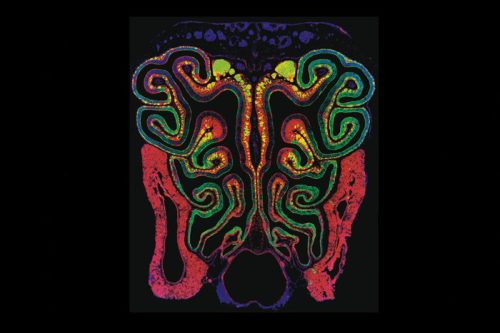
The olfactory epithelium — a mouse’s is pictured in green — is a sheet of tissue that develops in the nasal cavity. Researchers at Washington University School of Medicine in St. Louis have uncovered new details on how the olfactory epithelium develops and why it is that some animals have such great senses of smell, compared with others that lack such ability.

“We think the surface area of the sheet matters in how well animals smell and in the types of smells they can detect,” said David M. Ornitz, MD, PhD, the Alumni Endowed Professor of Developmental Biology. “One reason we think this stems from differences in the complexity of these turbinates. Animals that we think of as having a great sense of smell have really complex turbinate systems.”

The study, published Aug. 9 in the journal Developmental Cell, also could help answer a longstanding evolutionary question: How did animals’ senses of smell become so enormously variable? The way these abilities came to diverge over evolutionary history remains a mystery. Understanding these signals could help scientists tease out how dogs evolved an extraordinary olfactory system and humans wound up with a comparatively stunted one.

First author Lu M. Yang, a graduate student in Ornitz’s lab, found that a newly discovered stem cell the researchers dubbed FEP cells control the size of the surface area of the olfactory epithelium. These stem cells also send a specific signaling molecule to the underlying turbinates, telling them to grow. The evidence suggests that this signaling crosstalk between the epithelium and the turbinates regulates the scale of the olfactory system that ends up developing, sometimes resulting in olfactory epithelia with larger surface areas, such as in dogs.

When the stem cells can’t signal properly, turbinate growth and olfactory epithelium surface area experience an arrested development. To study this in the lab, mice with such olfactory stunting could, in theory, be compared with typical mice to learn more about how these signals govern the final complexity of an animal’s olfactory system.

“Before our study, we didn’t know how the epithelium expands from a tiny patch of cells to a large sheet that develops in conjunction with complex turbinates,” Yang said. “We can use this to help understand why dogs, for example, have such a good sense of smell. They have extremely complex turbinate structures, and now we know some of the details about how those structures develop.”

Source:  Washington School of Medicine in St Louis

Roles of emotional support animals examined

Airlines are not the only organizations grappling with the complexities surrounding emotional support animals. Colleges and courts are also questioning the need for these animals and the effects they may have on students and juries, respectively, according to research presented at the annual convention of the American Psychological Association.

The recent, rapid rise of emotional support animals has left colleges and universities struggling to understand the laws and how they can be applied to best support their communities, said Phyllis Erdman, PhD, professor at Washington State University, who chaired a symposium on emotional support animals and service dogs.

Emotional support animal photo by esadoctors

Emotional support animal on campus (photo by esadoctors.com)

College and university counseling centers are seeing an uptick in the number of students seeking mental health services, as students report anxiety, depression and stress about relationships and academic performance, she said.

“It’s not surprising that many schools are confronted with the growing phenomenon of emotional support animals. For many, the topic is a contentious one centered on whether students are taking advantage of the laws,” said Erdman. “This is further compounded by the fact that laws pertaining to emotional support animals are different from those governing disability service animals and therefore schools may need to develop new policies.”

A service animal falls under the Americans with Disabilities Act and is usually a dog that is trained to do work or perform tasks for the benefit of an individual with a physical, sensory, psychiatric or intellectual disability, Emotional support animals are not trained in specific tasks and are not recognized under the ADA. Although emotional support animals are allowed in campus housing, they may not necessarily be allowed in classrooms or elsewhere on campus, according to the study Erdman presented.

Erdman and her colleagues wanted to understand the state of emotional support animal requests on campuses and how colleges and universities are responding. They surveyed 248 university counseling centers about student requests for letters to allow them to have emotional support animals. The survey questions included how often the counseling centers received requests from students, how the schools handled those requests and how they handled requests to diagnose a disability in order to obtain an emotional support animal. It also asked counseling centers if they had emotional support animal policies in place.

Fifty-seven percent of the centers reported almost never receiving such requests. Thirty-one percent did several times a year and only 2 percent got requests more than once a week, according to the study.

Despite the lack of an overwhelming demand, a majority of university counseling centers reported concern about having policies in place to handle such requests, according to Erdman.

“Even a limited number of requests for emotional support animals can cause stress for student affairs offices, housing offices, counseling centers and disability offices,” she said. “Most schools wanted guidance and support for developing guidelines and navigating requests that come through.”

Erdman suggested that schools establish general definitions of the terms disability, service animal and emotional support animal when crafting a policy. The definition of a disability should adhere to ADA guidelines, she said. Any policy development must follow federal and state laws and should include the perspectives of various campus constituencies, including counseling centers, accessibility services, general counsel’s offices, campus safety departments and students themselves, according to Erdman.

“College students today are facing a great deal of stress and emotional support animals may help some students,” said Erdman. “We hope our study can serve as a guide for colleges and universities to develop policies that help students thrive.”

Uncertainty about emotional support animals is also occurring in courts, according to Dawn McQuiston, PhD, of Wofford College, who presented her research at the symposium. While objects such as dolls or teddy bears have been used for decades to calm vulnerable witnesses, courts began to include dogs in the mid-1990s to provide emotional support to alleged victims of child abuse. At least 144 courthouse facility dogs are now included in about three dozen states, she said. These dogs are provided by the court at the request of prosecutors to assist victims with the anxiety of testifying and reliving traumatic events.

Supporters say the dogs have made a huge difference in helping children and vulnerable adult witnesses open up on the stand, but some defense attorneys say having a friendly, sweet-looking canine in the witness box can prejudice a jury against a defendant by making the witness appear more believable and sympathetic, according to McQuiston.

“The concern is that the presence of a courthouse dog emphasizes that the witness is a victim, thereby playing to jurors’ sympathies. As a result, witnesses may be viewed as even more vulnerable or likeable, thus conflicting with a defendant’s right to a fair trial,” said McQuiston.

She cited two notable appeals cases involving courtroom dogs. In both cases, the victims had a support dog during testimony, the defendants were convicted and the convictions were subsequently appealed on the grounds that the presence of the dog led to undue sympathy for the victim and violated the defendant’s right to a fair trial. In both cases, the courts found no sign of prejudice due to the dogs’ presence.

McQuiston and her colleagues investigated whether courthouse dogs, compared to inanimate comfort items, resulted in more prejudice against defendants involved in two hypothetical crimes: A child sexual abuse case and a robbery of a child. They set up mock trials in which participants, in the role of jurors, read transcripts of the testimony and were shown several pictures depicting the child witness with a dog, with a teddy bear or with nothing.

They found that the presence of the dog had no significant effect on the juries’ outcomes, which McQuiston called surprising because the researchers had expected the dog to prejudice the jury against the defendant. Interestingly, their findings showed some biasing effects when the child clutched a teddy bear.

“Across two studies utilizing mock jury paradigms we found that, contrary to popular beliefs and our own predictions, courthouse dogs did not exert undue influence on juror decision-making regardless of the severity of the crimes tested, and did not differentially impact perceptions of child witnesses,” she said.

Source:  American Psychological Association

Muscle loss and wasting

I encounter dogs in my practice who are experiencing muscle loss and wasting fairly often.

Since owners must submit veterinary records to me for review as part of my intake process as well as update me on any subsequent vet visits, if there’s a diagnosis of chronic illness – such as kidney disease or cancer – then this muscle loss  is understandable and classified as cachexia.

In the absence of a diagnosis of disease, and working with an aging dog, then the muscle loss is classified as sarcopenia.

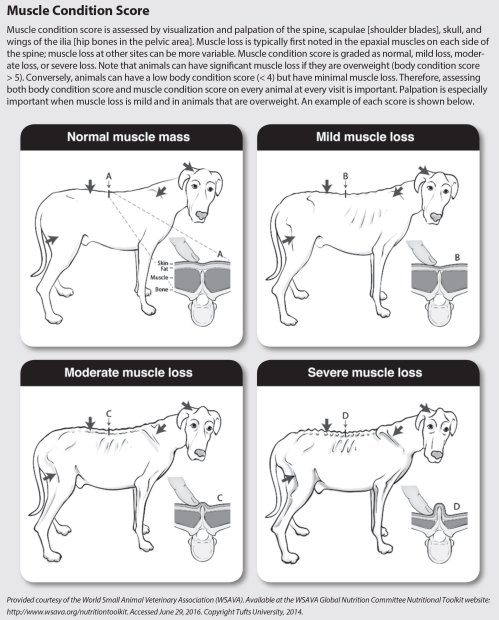
Muscle loss results in a change of appearance, which owners often notice first around the shoulder blades, top of the head, and around the pelvis.  Muscle wastage can be graded as noted below:

Muscle condition score

Exercise and good nutrition can be interventions with muscle loss.  Chronically ill dogs need a high quality diet that is appropriate for their disease, for example.  And aging dogs do need exercise that is targeted to their needs and abilities.

Owners should always be on the watch for signs of muscle loss – so early interventions that are medical and non-medical can be considered.

Kathleen Crisley, Fear-Free certified professional and specialist in dog massage, rehabilitation and nutrition/food therapy, The Balanced Dog, Christchurch, New Zealand

Labels

I’ve been thinking about labels a lot this week.

You already know my feelings about breed specific legislation (BSL) and the labeling of dogs as ‘dangerous’ simply because of their breed.  (In short, the labeling is unfair and unjustified – backed up by actual data.)

We also use labels for people and that is what has happened here recently with a greyhound group on Facebook.  From what I can tell, earlier this week one of the moderators of the group didn’t like a person sharing their views against greyhound racing – the moderator is involved in the greyhound racing industry.  So the moderator disconnected the person from the group.

This upset others in the group who expected the site to be an open forum for lovers of greyhounds.  (We need a lesson in Facebook groups, I think.  There are groups all over Facebook and posts get deleted and people disconnected from groups by moderators regularly.  There is no such thing as democracy in Facebook groups!)

And so a new group on Facebook has been formed and we have been encouraged to join that group to post about our greyhounds.

So if you are labeled ‘anti-racing’ by the first site, it seems another will gladly accept you.

We humans label all the time.   If you read the headline news over the last few years, what does the term ‘immigrant’ mean to you, for example?

So going back to the issue of dogs – which are both my passion and also my profession – what label applies to me?

Pro-Dog

Yup, if someone is mistreating a dog, hurting them, not taking responsibility for their care, treating them as disposable, using them for fighting…

…then please label me Pro-Dog.  I will be disagreeing with you.  And I will use this blog and my own company Facebook page for speaking about it.

Izzy the greyhound

Kathleen Crisley, Fear-Free certified professional and specialist in dog massage, rehabilitation and nutrition/food therapy, The Balanced Dog, Christchurch, New Zealand

Doggy quote of the month for August

“Dogs love their friends and bite their enemies, quite unlike people, who are incapable of pure love and always have to mix love and hate in their object-relations.”

– Sigmund Freud

Cute dog buddies