That freshly made bed feeling…

You know that feeling when you slide into bed after putting on a fresh set of clean sheets? Yeah. That. 🙂
Happy Friday everyone!

That freshly made bed feeling…
You know that feeling when you slide into bed after putting on a fresh set of clean sheets? Yeah. That. 🙂
Happy Friday everyone!
Posted in Dogs
Christchurch-based monthly magazine, Avenues, has a regular ‘hit & miss’ column to recognise things they like and don’t like which are happening around the city.
I’m pleased that dog-friendly workplaces have made the “Hit” list.
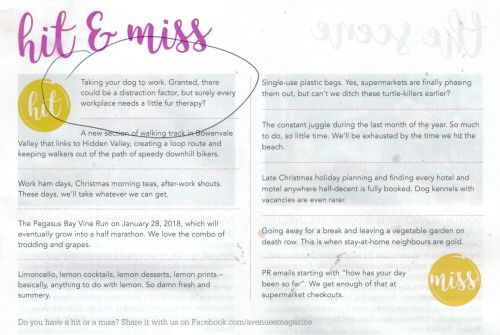
Of course, fur therapy is just one of the benefits of a dog-friendly workplaces.
Other benefits include:
Kathleen Crisley, specialist in dog massage, rehabilitation and nutrition/food therapy, The Balanced Dog, Christchurch, New Zealand
Researchers are creating a library of movement data from different dog breeds, to make animal animations in films and video games more realistic.

Motion data from the dogs will help create more realistic animal animations for games and films
Films such as the Planet of the Apes used motion capture techniques extensively to transform their human actors into apes, however this process doesn’t work well for true four-legged animals.
Now computer scientists from the Centre for Analysis of Motion, Entertainment Research & Applications (CAMERA), at the University of Bath, are looking to automate this process.
They are developing a new technique that will be able to use the movements of a two-legged human actor to drive a four-legged animal character, to make it move in a more realistic way.
The team has invited canine residents from local neighbours Bath Cats and Dogs Home to their studio to help collect the motion capture data.
Head of Studio at CAMERA, Martin Parsons, said: “At the moment, actors have to walk around on all fours, and the computer software changes them into an animal.
“What we want to do is to look at the movements of the human actor and then use a kind of translator to look at a library of real animal data to make the character on the screen move in a realistic way.
“It works a bit like a puppeteer, with the actor using their whole body to drive the animal avatar.
“We’re really grateful to the Bath Cats and Dogs Home for letting us work with their dogs.
“It is fantastic to be working with an important local charity just down the road from the University and we’re delighted to be making a donation to contribute towards the valuable work they do.”

Cameras in the studio detect light reflected from markers worn by the dogs, so researchers can capture the movement accurately
The dogs will be wearing coats with reflective markers fixed onto them. Infrared light hitting the reflective markers is sensed by special cameras that are placed around the edge of the studio, which can then record the 3D position of the marker. This information can be used to reconstruct the movement of the dogs on the computer screen.
The dogs will play on an agility course set up in the studio with their Animal Carers from the Home and an animal behavioural assistant on hand to help them interact, overcome any camera shyness and of course have fun.
Simon Lynn, Head of Animal Operations at Bath Cats and Dogs Home, said: “This is such an innovative project for our dogs and team to be a part of. It will be so beneficial for the dogs taking part as it is great socialisation for them – meeting new people and seeing different sights and sounds.
“Kennel life can become repetitive so we’re always looking at ways to add enrichment to our dog’s lives whilst they’re waiting to be adopted and a trip to the CAMERA team at the University of Bath definitely fits the bill.
“Their carers are with them at all times so we can check they’re relaxed and happy but we’re sure they are going to love it. Not only that but the donation towards Bath Cats and Dogs Home’s work will help these dogs find new homes and help us to save many other unwanted animals in our area.”
They will be using lots of different breeds to study the different gaits of the animals, and hope to expand the project to use cats next year.
As well as informing the research at CAMERA, the data collected during the shoots will be used as part of collaborative research and developments projects with industrial partners to drive the next generation of tools and processes across the visual effects and games industries.
CAMERA is a £5 million research centre funded by the Engineering and Physical Sciences Research Council (EPSRC) and the Arts and Humanities Research Council (AHRC) at the University of Bath. CAMERA will create advanced motion tracking technologies for use in the entertainment industry, to enhance training and athlete performance, and to help develop assistive technologies.
Source: University of Bath press release
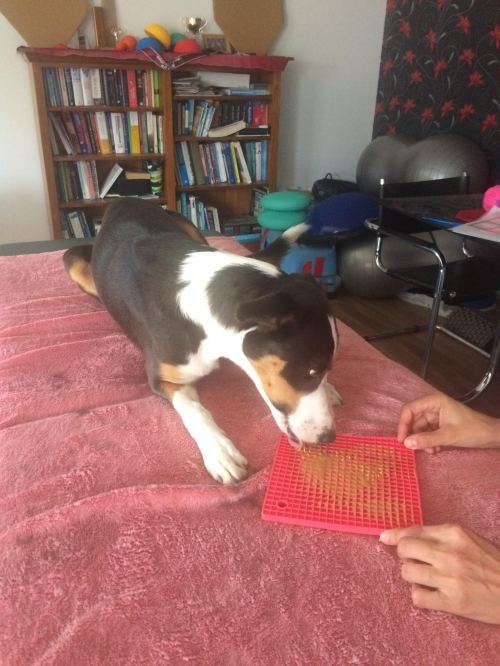
This is Bee, a young heading dog. Yesterday, she had her third massage and, with each session, she’s getting better.
There’s nothing physically wrong with Bee; her Mum is training her for competitive agility and wants to keep her in top condition. Since Bee is high-energy, the massage sessions are also to help her with focus and mindfulness.
During her first massage, Bee took a long time to settle. At her second massage, I suggested that we introduce a toy and we used a braided rope tug toy. Then I decided to try pushing some treats into the braids and we got almost instant results. Bee became more relaxed and allowed more touch. When I left, her Mum and I promised each other that next time, we’d use a food toy for the entire session.
So yesterday, her Mum was ready. And how clever is she??? She purchased a silicone pot holder for only $2 from Kmart and spread it with peanut butter. We had our best massage yet.
Low stress handling techniques are all about keeping the dog below threshold – no stress or anxiety. Food diversion toys can help with this – and they don’t have to be fancy or expensive.
Kathleen Crisley, specialist in dog massage, rehabilitation and nutrition/food therapy, The Balanced Dog, Christchurch, New Zealand
Tagged diversions, food toys, Kmart, low stress handling, peanut butter
“Thorns may hurt you, men desert you, sunlight turn to fog; but you’re never friendless ever, if you have a dog.”
– Douglas Malloch, poet

Read through my blog categories and you’ll notice that the research category is one of the largest. What can I say? I’m a bit of a science geek. I trained and worked in environmental science for over 20 years and so I understand the value of research – it creates new knowledge and underpins new developments that can help us and our dogs.
But research comes at a price – and that’s not just the cost of doing the research. Research quality is often judged on the basis of whether or not the research has been peer-reviewed. And like any system, the peer review and publishing system has become a money-maker for some journals. Academic staff are judged on their production of papers which show not only their name, but also the name of their employing institution. When I worked at the University of Canterbury in Christchurch, this system was commonly referred to as ‘publish or perish.’
There are journals that scam researchers into paying to be published when there is no real peer behind the peer review and the journal is one that may look reputable, but isn’t.

Professor Mike Daube of Curtin University in Australia thought it would be a good idea to challenge the system in a tongue-in-cheek way. He offered the services of his Staffordshire terrier, Olivia Doll, as a peer reviewer with expertise in subjects like “avian propinquity to canines in metropolitan suburbs” and “the benefits of abdominal massage for medium-sized canines.”
Olivia was approached to peer review at least one article. The Global Journal of Addiction & Rehabilitation Medicine appointed her as an Associate Editor (no job interview required) and a journal called Psychiatry and Mental Disorders listed her as a member of its editorial board. At last count, Olivia served on the editorial board of seven journals.
I hope I’m a bit more discerning in selecting the dog-related research that I share on this blog; and wherever possible I include a link to the original source to respect copyright.
Source: Science Magazine
Kathleen Crisley, specialist in dog massage, rehabilitation and nutrition/food therapy, The Balanced Dog, Christchurch, New Zealand
The first comparison of three common hydration methods for sniffer dogs shows that while all are effective, dogs drink more and are more hydrated when given a chicken-flavored electrolyte drink compared to plain water or when injected with electrolytes under the skin. The study, published in open-access journal Frontiers in Veterinary Science, also shows that the dogs did not suffer from a buildup of electrolytes from the drink, suggesting that electrolyte drinks are a safe hydration alternative for sniffer dogs, who are at risk of heat stroke in hot weather.
Working dogs, such as search and rescue dogs or police dogs, are crucial assistants when authorities respond to disasters or check for contraband at border crossings. These dogs often work in challenging environments, and can sometimes exert themselves to the point of exhaustion and heat stroke. In fact, hot weather can be dangerous for working dogs, as dogs don’t sweat much and rely on panting to cool themselves, meaning they can overheat easily.

The risk of heat stroke increases with dehydration, so one effective way to help working dogs stay safe is to keep them hydrated. However, there are different ways to do this. “People use different techniques to hydrate working dogs,” says Cynthia Otto of the University of Pennsylvania, who was involved in the study. “Dog handlers disagree about the most effective method, and since there was no data on the safety or effectiveness of each technique, we wanted to provide some clarity.”
The classic hydration technique is to provide free access to plain drinking water. A second technique involves delivering water and electrolytes through a needle under the skin, which is known as subcutaneous hydration. Drinks containing electrolytes, such as sodium and potassium, are a third option, but these are controversial. Such drinks make sense as a rehydration aid for humans, as we lose electrolytes when we sweat. However dogs sweat very little, leading critics to say that the drinks could cause an unhealthy buildup of electrolytes in dogs.
The research team investigated these three common hydration strategies in a group of Border Patrol sniffer dogs who inspect vehicles at the Texas border, during the hot summer months. The team took a variety of measurements for each dog, including their hydration levels, fluid intake and work performance.
Happily, all three hydration strategies appear to be effective, and the dogs showed similar behavior, body temperature, and work performance regardless of the way they were hydrated. “In this controlled setting, all the hydration techniques were safe and effective,” says Otto.
However, dogs receiving a chicken-flavored electrolyte drink drank significantly more fluid and had greater hydration levels. Interestingly, these dogs did not suffer from a buildup of sodium, a component of electrolyte drinks that could have negative effects in the body in large quantities. The dogs who drank electrolytes excreted the sodium in their urine, meaning their blood levels remained normal. Overall, the dogs handled the electrolytes well, suggesting they are a safe and effective hydration method.
These results surprised the researchers, as a previous study had reported that dogs who were offered a non-flavored electrolyte drink, drank very little of it. The chicken flavoring may have been key, making the dogs think they were having a tasty treat, but the team will need to investigate this further.
“If a dog is reluctant to drink, then a highly palatable flavored electrolyte solution may give them a boost,” says Otto. “However, these are healthy dogs in a controlled environment, and we don’t know if all electrolyte or flavoring approaches are created equal, so we will need to do further work.”
As the saying goes, “seeing is believing” and I have found that this holds true when educating people about the value of dog massage and complementary therapies. My profession is not well known (yet) and so it’s important to me to help spread the word in a positive and enjoyable way.
Yesterday, I had a massage tent at the ASB Summer Starter, an annual fun run and walk where dogs are encouraged to participate. This was my first year supporting the event (I tried last year but no one responded to my enquiry – so that’s progress!).
When people see how their dog responds to massage, even at a busy outdoor event like this one, it helps to open their eyes about complementary therapies. Fit dogs can still have trigger points and knots, just like humans. There was even a tripod on my table yesterday – healthy and happy – but a body that will need support going forward as the dog ages.
And I hate to think that people take exclusively the physio approach to their dog’s health – that is waiting until they are hurting or injured before seeking treatment. (Physiotherapy NZ’s definition of physio is ‘to help restore movement and function to anyone affected by an injury, disability or health condition’).
So yesterday was about showing people a taste of what massage and other therapies can do for their healthy dog.
Seeing is Believing.


Kathleen Crisley, specialist in dog massage, rehabilitation and nutrition/food therapy, The Balanced Dog, Christchurch, New Zealand
Today I took Izzy swimming. For only her third time, I think she did very well:
Looking at Izzy’s flotation vest, the Float Doggy made by D-Fa, you’d think I bought it for her, but in fact it’s a hand-me-down – and a testament to the quality of the item.
The D-Fa vest was purchased by a client for Ollie, who within the span of days became a quadriplegic in 2010. Swimming was part of his long-term care program (I won’t say rehab, since he never re-gained the use of his legs and on autopsy it was found that he had a brain tumor).
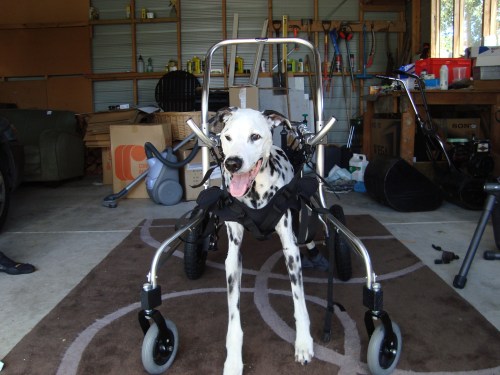
When Ollie died in September 2011, Ollie’s owner passed his life vest onto me for Daisy. By then, Daisy was also swimming at the Dog Swim Spa on a fortnightly basis.
Daisy wearing her Float Doggy flotation vest
Daisy passed away in July 2014 and so that vest saw a lot of use from September 2011 to July 2014.
And it came out of storage this year to support Izzy.
I wash out the vest after each use with liquid laundry detergent and cold water; chlorine from the pool can damage fibers of most garments.
Otherwise, that’s all I’ve done to maintain it.
I’d say that’s pretty well made!
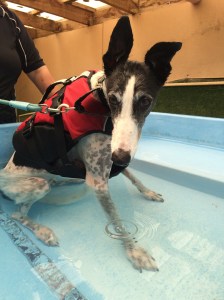
Izzy wearing the same Float Doggy, 22 November 2017
Kathleen Crisley, specialist in dog massage, rehabilitation and nutrition/food therapy, The Balanced Dog, Christchurch, New Zealand
Posted in dog care, Dogs, products for dogs
Tagged D-Fa, doggy life vest, Float Doggy, flotation vest, harness, life vest, secondhand goods, wheelchair
A team of Swedish scientists have used national registries of more than 3.4 million Swedes aged 40 to 80 to study the association between dog ownership and cardiovascular health. Their study shows that dog owners had a lower risk of death due to cardiovascular disease or to other causes during the 12-year follow-up.
A total of more than 3.4 million individuals without any prior cardiovascular disease in 2001 were included in the researchers’ study linking together seven different national data sources, including two dog ownership registers. The results are being published for the first time in Scientific Reports. The goal was to determine whether dog owners had a different risk of cardiovascular disease and death than non-dog owners.
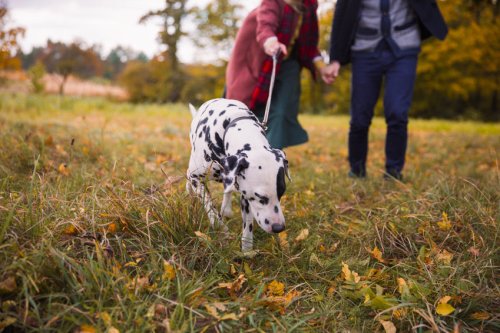
An elderly couple walks their dalmatian dog. Credit: © Myroslava / Fotolia
“A very interesting finding in our study was that dog ownership was especially prominent as a protective factor in persons living alone, which is a group reported previously to be at higher risk of cardiovascular disease and death than those living in a multi-person household. Perhaps a dog may stand in as an important family member in the single households. The results showed that single dog owners had a 33% reduction in risk of death and 11% reduction in risk of myocardial infarction during follow-up compared to single non-owners. Another interesting finding was that owners to dogs from breed groups originally bred for hunting were most protected,” says Mwenya Mubanga, lead junior author of the study and PhD student at the Department of Medical Sciences and the Science for Life Laboratory, Uppsala University.
In Sweden, every person carries a unique personal identity number. Every visit to a hospital is recorded in national databases, accessible to researchers after de-identification of data. Even dog ownership registration has been mandatory in Sweden since 2001. These scientists studied whether being registered as a dog-owner was associated with later diagnosis of cardiovascular disease or death from any cause.
“These kind of epidemiological studies look for associations in large populations but do not provide answers on whether and how dogs could protect from cardiovascular disease. We know that dog owners in general have a higher level of physical activity, which could be one explanation to the observed results. Other explanations include an increased well-being and social contacts or effects of the dog on the bacterial microbiome in the owner,” says Tove Fall, senior author of the study and Associate Professor in Epidemiology at the Department of Medical Sciences and the Science for Life Laboratory, Uppsala University.
“There might also be differences between owners and non-owners already before buying a dog, which could have influenced our results, such as those people choosing to get a dog tending to be more active and of better health. Thanks to the population-based design, our results are generalisable to the Swedish population, and probably also to other European populations with similar culture regarding dog ownership,” says Tove Fall.
The study was conducted by researchers at Uppsala University, Karolinska Institutet, Stanford University and the Swedish University of Agricultural Sciences.
Source: Uppsala University media release







 DoggyMom.com