Author Archives: DoggyMom.com

New hope for diagnosis of Chiari-malformation in toy dog breeds

Continuing to build on their specialist work in this area, researchers in collaboration with neurologists at Fitzpatrick Referrals and Helsinki University and a geneticist at the University of Montreal, have developed two separate studies, published the journal PLOS ONE last month, to learn more about these painful conditions affecting toy dogs.

Study one focused on how the Chiari malformation and Syringomyelia disorder affects the Cavalier King Charles Spaniel, a breed which is predisposed to the condition.

ckc-spaniels

Chiari malformation is the premature fusion of bones in the skull, which alters the flow of cerebrospinal fluid, resulting in a collection of fluid pockets within the spinal cord. These fluid pockets are commonly known as Syringomyelia and over time can cause irreversible damage to a dog’s spinal cord.

Using a novel MRI mapping technique, which can standardise images for different size dogs, researchers were able to examine a section of the dog’s skull, brain and vertebrae in greater detail and highlight via a movie clip how such disorders develop in the Cavalier King Charles Spaniel.

Examining the footage from the MRI movie clip, researchers were able to observe the compression of a dog’s brain caused by the premature fusion of bones in the skull. Such fusions also occur at the front of the head causing a dog’s face to become flatter, creating the often desirable doll like features common in this breed.

Study two examined characteristics that increased the risk of Syringomyelia in the Cavalier King Charles Spaniel, Chihuahua and the Affenpinscher dog breeds. Using a similar technique to study one, the study found that skull and neck conformation that increased the risk for Syringomyelia associated with Chiari-like malformation were subtly different between breeds.

Researchers found that Syringomyelia-affected Chihuahua’s tended to have a smaller angle between the base of the skull and the first and second neck vertebrae, whereas the Affenpinshers had a smaller distance between the first and second vertebrae. Cavalier King Charles Spaniels had reduced space between the joint on the skull base and the first cervical vertebrae. All breeds had a reduced hind skull which altered the angulation of the skull base with neighbouring bones in affected dogs and observed in the movie clips.

Dr Clare Rusbridge, from the University of Surrey, said: “Toy dogs are increasingly popular and as such demand for these breeds is unprecedented. Due to selection for rounded head shapes with short muzzles we are seeing more and more dogs with the painful Chiari malformation and Syringomyelia disorder.”

“The innovative mapping technique used in this study has the potential to provide a diagnostic tool for vets, helping them to quickly identify dogs suffering from these painful disorders.”

Source:  University of Surrey media release

My other posts on toy breeds and the Chiari malformation include:

A Dog’s Purpose – book review

I finished reading this New York Times bestseller yesterday – it’s been on my reading list for some time and I was lucky to have been given a copy as a Christmas present.

I have not been disappointed.  This story follows a dog who is reincarnated several times and, each time, he looks for his life’s purpose.  Starting his life as a stray born to a feral mother, this first life is a short one and gives insight into shelter life and euthanasia from the dog’s point of view.

a-dogs-purpose

The dog has a much longer life with his ‘boy’ Ethan as a Golden Retriever named Bailey, witnessing Ethan’s first love and encountering a psychotic neighbor with a penchant for animal cruelty (this part of the book is the darkest).

Reincarnated again, Bailey returns as a girl dog who becomes trained in search and rescue…

And then finally reincarnated again, during this final life of the book the dog is reunited with his Ethan, who is now a much older man…

There are many humorous scenes in this book, such as the dog’s observations about wearing the ‘cone of shame’ during several of his experiences when being neutered/spayed.

The book has been made into a movie that has only recently been released, and with controversy concerning the animal welfare standards on the film’s set, I’m not sure I will be interested in seeing the movie.  But I highly recommend the book – it’s a keeper in my dog book collection.

Kathleen Crisley, specialist in dog massage, rehabilitation and nutrition/food therapy, The Balanced Dog Ltd, Christchurch, New Zealand

Second hand treasures

Dogs of many breeds have been depicted in collectibles and decorative arts over the ages. Earlier this week, I was given this bronze of a greyhound…it was found in a load of scrap metal.

After a little elbow grease (polished first with toothpaste and a brush and then soaked overnight in Coca Cola), I have a second hand treasure.

Kathleen Crisley, specialist in dog massage, rehabilitation and nutrition/food therapy, The Balanced Dog Ltd, Christchurch, New Zealand

World Galgo Day

Izzy is a greyhound and we support all efforts to help the Galgos.

Doggy quote of the month for February

“What dogs?  These are my children, little people with fur who make my heart open a little wider.”

– Oprah Winfrey, actress, writer, talk show host, philanthropist

BarkCam

I am thoroughly happy with the BarkCam app.  It contains a range of sounds to attract your dog’s attention – a squeaky toy, keys jangling, a cat, and more.

I’ve been using the app for a couple of weeks now to snap photos of my massage clients.  They are turning out great!

BarkCam is a free app for Android and iphone.

Highly recommended (this is an unsolicited endorsement)

Kathleen Crisley, specialist in dog massage, rehabilitation and nutrition/food therapy, The Balanced Dog Ltd, Christchurch, New Zealand

Study Shows How a Dog’s Diet Shapes Its Gut Microbiome

Studies of the gut microbiome have gone to the dogs — and pets around the world could benefit as a result.

In a  paper published in the journal mBio, researchers from Nestle Purina PetCare Company report that the ratio of proteins and carbohydrates in a canine’s daily diet have a significant influence on the balance of microbes in its gut. Among other findings, they observed that dogs fed a high-protein, low-carbohydrate diet had decreases in the ratio of Bacteroidetes to Firmicutes bacteria, as well as enriched microbial gene networks associated with weight loss in humans. The microbial responses were more pronounced in obese and overweight dogs than in dogs of a healthy weight.

microbiome-dog

The researchers say their study may help identify new microbiology-inspired strategies for managing pet obesity, which is  a growing problem. More than half of pet dogs in the United States are overweight or obese, according to the most recent annual survey by the Association for Pet Obesity Prevention. A comparison of that data with previous surveys suggests that obesity in dogs, as in people, is getting worse.

“We do believe dogs have become heavier over the last decade, and that it’s an epidemic,” says Johnny Li, a computational biologist at Nestle Purina, in St. Louis, Missouri, who led the new study. Li says he launched the study because only a handful of previous studies have explored the gut microbiome of canines, and the effect of diet on gut microbes hasn’t been well documented.

Studies on animals are lacking, but human studies have connected microbial imbalance in the gut to a variety of conditions, including obesity, metabolic syndrome, cardiovascular disease, immune disorders, and liver and brain diseases.

Li and his team studied 32 Labrador Retrievers and 32 Beagles, with equal numbers of lean and overweight or obese dogs. During the first four weeks, all the dogs were fed the same baseline diet. During the second four weeks, half the dogs received a high-protein, low-carbohydrate diet; the other half received a high-carbohydrate, low-protein diet.

Fecal microbiome studies conducted after the first four weeks revealed few differences in the gut microbiomes of the dogs. Studies conducted after the second four weeks, after the dogs had eaten an experimental diet, showed dramatic changes in the microbiome. Dogs that ate a low-protein, high-carbohydrate diet had higher abundances of Bacteroides uniformis and Clostridium butyricum.

In dogs that ate a high-protein, low-carbohydrate diet, the researchers observed a decrease in the ratio of Bacteroidetes to Firmicutes bacteria. They also reported that abundances of Clostridium hiranonis, Clostridium perfringens, and Ruminococcus gnavus were more than double the abundances observed in the other experimental group.

Li says the effects of diet on the microbiome were more pronounced in obese and overweight dogs than in lean dogs. “That seems to suggest that obese dogs and overweight dogs are more susceptible to dietary intervention,” he says. A different diet for those animals may have a greater impact on the bacterial balance in their guts.

The study involved only two breeds, but Li says the findings are likely applicable to all dog breeds, “though we need more studies on other breeds in the future to be sure.”

Li says his team’s study provides a framework to explore the connection between diet and gut microbes in dogs. Although the findings are preliminary, he says he hopes to see the research eventually translate into real-world ways to modify pet food, perhaps through the strategic use of probiotics or prebiotics, and reduce the obesity epidemic.

View the paper Effects of the Dietary Protein and Carbohydrate Ratio on Gut Microbiomes in Dogs of Different Body Conditions

Source:  American Society of Microbiology press release


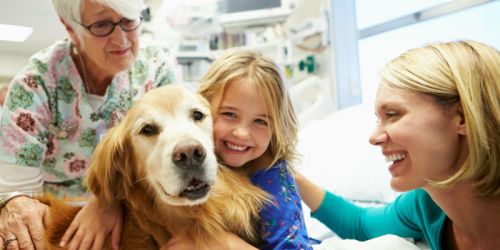
9 out of 10 nurses believe animals can improve patient health

Nine out of ten (90%) nurses believe animals can improve the health of patients with depression and other mental health problems, according to a survey of members of the Royal College of Nursing (RCN).

animal-therapy

The survey of more than 750 nursing staff also found that more than 80% think animals can improve communication difficulties such as for people with autism. In addition, 82% said that animals, dogs in particular, encouraged patients to be more physically active, while nearly 60% said just the presence of animals seemed to speed physical recovery.

Nearly half of those surveyed have worked with animals in their career, from dogs and cats to ponies and chipmunks, and of those 98% said it benefited the patient.

However, almost a quarter of staff questioned said no animals were allowed where they worked.

Amanda Cheesley, RCN Professional Lead for Long-term Conditions and End-of-life care, said: “I’ve seen patients with animals in hospitals and in their homes – the difference it makes is remarkable. I used to take my Great Dane with me when I was a district nurse and he could put a smile on any patient’s face.”

“The RCN is calling for better, more consistent access to animals for all patients who can benefit, as the evidence is clear that as well as bringing joyful moments to people when they are unwell, the clinical benefits are tangible. Nurses have told us of patients with reduced anxiety, better interaction and a whole reason to live – and we should listen to these experiences.”

Source:  Royal College of Nursing

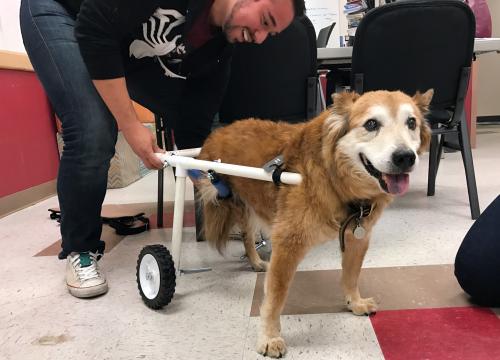
Building a dog wheelchair

During the fall semester, three College of Engineering students working as on-campus co-ops at New Mexico State University designed and built a wheelchair device to assist a dog who had his right hind leg amputated due to cancer.

“When I started to research mobility options to help Kita after his amputation to remove bone cancer, there were a lot of ideas online about using 3-D printers to create custom dog wheelchairs or walkers,” owner Michelle Lebsock said. “Even in his old age, Kita is the type of dog who absolutely loves walks, and although he healed well and adjusted to getting around on three legs, he would get tired very quickly and I could tell he really missed his long walks.”

After realizing regular pet wheelchairs wouldn’t work for Kita, Lebsock contacted the Aggie Innovation Space for advice on do-it-yourself dog wheelchair instructions she had found online.

“I first spoke to Natalia, and instead of just offering advice she took on the project as her own,” Lebsock said. “The talented engineering students at the AIS including Natalia, Abdiel and Arturo worked all semester to create a functional and ergonomic device that was custom-built for Kita. Even though the idea of 3-D printing brought me to the lab, the final product used traditional materials, and the students worked tirelessly to make sure each piece was exactly right. Their work has made one little three-legged dog and his owner very happy.”

Kita dog with wheelchair and students who designed it

New Mexico State University College of Engineering students and Aggie Innovation Space mentors (from left to right) Natalia Perez, Abdiel Jimenez and Arturo Dominguez designed and developed a wheelchair for Kita and his owner Michelle Lebsock. Kita’s right hind leg was amputated due to cancer in spring 2016.

“The AIS team became very passionate about this project sharing ideas, collaborating to assess specific constraints and requirements, and evaluating ideas for build-out materials. Collectively, we were able to design a device that was cost effective, functional, comfortable, strong enough to support the weight of the dog, and ultimately, easy to use,” Jimenez said. “We selected specific materials and specific design features to meet the unique needs of Kita. Michelle was kind enough to give us feedback, which allowed us to further refine the design.”

Throughout the fall, Perez, Jimenez and Dominguez met with Kita and Lebsock many times to determine the correct height, comfort, and restraint requirements of the device. Ease of assembly and disassembly were also important factors the Aggie Innovators had to consider to ensure the device was portable and easy to use.

“We were excited to have met a functional level of comfort for Kita with our first design, as he realized he could move around freely,” Dominguez said. “From there, we studied and evaluated Kita’s movement in the device, which allowed us to adjust the design to make it more comfortable and functional. With each iteration, Kita became more and more comfortable. During our final test, Kita was able to run for the first time since surgery and was able to move much more naturally. We then spent a week enhancing a few aesthetic features and branded it NMSU, including a specialized 3-D printed name plate.”

Kita dog in special wheelchair

Arturo Dominguez, a New Mexico State University College of Engineering student, fits nearly 17-year-old Kita with a wheelchair that was designed and built in the Aggie Innovation Space.

Dominguez said the group faced many design challenges throughout the duration of this project.

“Some of our initial design considerations required us to adjust the height of the device while ensuring that we provided adequate support of the shoulders and hips so as to minimize weight on pressure points,” Dominguez said. “As we adjusted the saddle mechanism in the device, we had to be sure not to pinch or irritate the underbelly and other sensitive areas of the dog.”

Perez said the challenges and hours spent working on this project was worth it when she and her fellow Aggie Innovators saw Kita run freely in the device and saw the happiness expressed in Lebsock’s reaction.

“This project reminded us how engineers can enhance quality of life, and made us realize that our duty as engineers is not just for people and the environment but for our furry friends that make our lives happier,” Perez said.

Source:  New Mexico State University media release

Favorite Video Friday – Doodad the Greyhound

Happy weekend, everyone. I hope you enjoy this greyhound video as much as we (Izzy and I) did.

Mel's avatarNo Dog About It Blog

I don’t know if I have ever shared this before, but in addition to being a lover of Shelties and Labs, I am a big lover of Greyhounds.

The first greyhound I ever met was Tater. He was owned by a couple I used to walk with at the dog park. He was elegant and graceful and so very funny. He played that deadpan look so well. (Is that a greyhound thing?)

Tater might have been an older greyhound, but he could still run like the wind. He and his sister, Nadya, who is a Borzoi, made running look like art. I loved watching them. Such beauty and grace.

There is just something about this breed that makes me smile.

I think that is why I fell in love with today’s Favorite Friday video featuring Doodad the Greyhound. If ever there was a dog who inspired smiles it is Doodad…

View original post 39 more words