I have been giving a lot of thought lately to the issue of fostering.
This time last year, Sox and I were fostering blind greyhound, Fred, who was adopted in mid-February and has settled well into a loving forever home. New Zealand has always had a homeless pet population – you don’t have to look far to find an adoption group (or two, three, or more) that operate in your area. And now, with a greyhound racing ban confirmed, our country has the responsibility to re-home the 2,900 hounds that the industry says it has it in its possession.
Fostering is the gift of life for dogs needing homes; it also has many benefits for the foster carer and the adoption agency.
Benefits of fostering
Fostering frees up space in shelters/kennels for another dog in need
For the fostered dog, it gives them a chance to de-compress (kennels keep dogs safe and fed, but they can also be noisy and negatively reinforcing – think of having roommates that you really wish would leave!)
For some dogs, they simply can’t cope in a shelter or kennel environment and these special dogs need to be cared for in a home before they are damaged from long-term kenneling
A fostered dog benefits from one-on-one attention and, if the foster carer/family own a dog (and/or other pets), then the fostered dog has the opportunity to learn the ‘house rules’ and how to interact with other companion animals
Fostered dogs often need to learn skills such as toilet training, walking on lead, and basic skills like wait, leave, and down (depending on the skills of the foster carer and the dog, of course) – a dog with life skills is less likely to have a failed adoption (returned to the adoption group)
Re-homing and adoption groups benefit from feedback from their foster carers; they learn about a dog’s likes and dislikes, behaviour, and areas for training – all of which enable them to give clearer information and support to adopters and to make a good and lasting match
Re-homing and adoption groups also benefit from the enthusiasm of their foster carers, who can help publicise the adoption group simply by taking the dog out for walks, promoting the dogs on their social media, and acting generally as a partner for the re-homing effort
An experienced foster carer is worth their weight in gold for the adoption groups they work with; some carers offer specialised skills that adoption groups often cannot afford to access on a commercial basis
For carers, fostering gives you the joy of companionship without necessarily the commitment of full-time ownership
There is huge satisfaction to be gained from giving a dog a second chance; the emotional reward is hard to describe
Setting expectations and standards
To be successful, fostering works best when the adoption agency and the foster carer are clear about expectations and standards. If the adoption agency isn’t clear about boundaries, it’s hard for the foster carer to know what a good job in fostering looks like.
Questions to ask if you are interested in fostering
Ask yourself why you want to foster – and be honest.
Most people I meet have the best of intentions to foster but can be emotionally unprepared for the experience. A foster dog is not your pet; some attachment to your foster dog is expected – it’s easy to bond with a dog in your care as you learn their personality. Some positive self-talk is a good idea – remind yourself that at some point you will need to farewell the dog, knowing that you gave them a head start for pet life.
What type of dog are you qualified to handle?
If you have breed-specific experience, it’s best to consider offering your skills to a breed-specific rescue group.
In more general terms, most previous dog owners will have experience with adult dogs; puppies are typically fostered only by those with puppy experience (and the availability to monitor them more closely throughout the day). If a dog has special needs such as behaviour issues or mobility or other physical impairments, then they will ideally need a special foster carer with some experience in these areas.
What support can you expect as a foster carer?
Most adoption groups will supply the basics for their foster carers: dog food, leash, collar, crate and bed.
Ask what process to follow if the dog is unwell and needs veterinary care, for example.
If you are experiencing behaviour problems and want to talk through training, what assistance is available? Some adoption groups have a dedicated person who will follow up with foster carers just to see how things are going – if this isn’t possible in your area, is there someone else you can bounce ideas off of?
All adoption agencies should be prepared to give you background on your foster dog. Some agencies will, of course, have very little information on the dogs that come into care. Others will have more information.
Foster agreements should be in writing
Agreements with a foster carer should be in writing and set out the responsibilities of each party; every adoption group should act as a business in this regard.
If foster carers are expected to be available for certain weekend adoption events, for example, then these should be clarified in the agreement.
Foster carers should be dealt with respect and, even if they are not being paid for their services, their in-kind time and efforts should be recognised as if the person was an employee. There should be no bullying, harassment or discrimination and the foster carer should have an avenue outlined in the agreement if a problem requires escalation. If the adoption agency has concerns about a foster carer’s competence or performance, then the agreement should outline how such situations will be handled.
What if you can’t manage it (for whatever reason)?
Life can throw us curve balls. Your situation may change. Perhaps the dog is higher needs than you anticipated and you are not coping; perhaps you are ill; perhaps there’s a family emergency. If you can’t manage to see your foster commitment through, then the foster agreement should outline the process to follow to return your foster dog. Depending on the circumstances, you should de-brief with your adoption agency, particularly if you’d like to foster again in the future.
Make a lifetime commitment only when it is right for you both
It’s natural to form a bond with your foster dog; affection for the dog is normal. After all, you are caring for a sentient creature who needs your help and who is living in your home…
While some dogs end up as ‘foster failures’, you must be sure that you can make the lifetime commitment to your foster dog if you are considering adopting them. Can you afford their care? Do you permanently have the time and space to give the dog its best pet life?
Note: If your intention is to add a dog to your home, ask your adoption agency about a ‘foster to adopt’ arrangement which means that you are providing foster care for the purpose of taking the dog on trial.
Fostering a dog in need can be one of the most rewarding experiences of your life.
If you are interested in fostering, please contact your local adoption groups for information on their needs – most will publish information on their website to get you started.
Kathleen Crisley, is Fear-Free certified dog massage therapist and canine fitness trainer. She has a particular passion for working with dogs and their families to ensure injury prevention and quality of life. She specialises in working with anxious and emotionally damaged dogs. Her mobile practice, The Balanced Dog, is based in Christchurch, New Zealand.
Subaru of America announced the return of Subaru Loves Pets Month, a time dedicated to supporting and celebrating shelter pets through the Subaru Loves Pets initiative. Together with its nationwide network of retailers, Subaru is doubling down on efforts to unite animals with loving homes, with a special focus on the older, physically challenged and “different” dogs Subaru lovingly calls “Underdogs,” often the last to be adopted.
According to the ASPCA(The American Society for the Prevention and Cruelty of Animals), nearly 6.3 million companion animals enter shelters nationwide annually. To help find loving homes for these animals, more than 600 Subaru retailers will partner with local shelters, rescues and animal welfare organizations throughout October to host in-person and virtual adoption events. Participating retailers will donate $100 to the organizations for every pet adopted in October, up to $3,100. In addition, Subaru will donate $20 to the ASPCA with every purchase of select pet-friendly accessories, including pet harnesses, seat protectors and travel bowls, through Subaru Parts Online and $1 for each “Animal” badge ordered through Subaru Badge of Ownership throughout October.
“We advocate for adopting from pet organizations year-round, but October is particularly special as we devote the entire month to uniting pets across the country with the loving homes they deserve,” said Alan Bethke, senior vice president of marketing, Subaru of America, Inc. “Our Subaru community is incredibly passionate about animal welfare, and together with our retailers, we’re proud to help make the world a better place for pets everywhere.”
Subaru Loves Pets Month will culminate in the fourth annual National Make A Dog’s Day on Oct. 22, a Subaru holiday that invites dog-lovers everywhere to go the extra mile for their pup. To celebrate, Subaru invites dog owners to do something special for the furry friends in their lives and share on social media using #MakeADogsDay. For those who are yet to be pet parents, Subaru invites Americans to consider adopting a shelter pet or “Underdog.”
Subaru has a long history of supporting pets in need and the Subaru Loves Pets initiative has helped support the adoption of nearly 60,000 animals from local animal welfare organizations. Since 2008, Subaru has donated more than $42 million to national and local organizations to support the rescue, transport, and adoption of nearly 350,000 pets.
“Well, you came here to stay as a foster dog last month.”
What’s foster?
“Foster means that I take care of you and teach you about being a pet, but you’re not mine.”
I’m not yours?
“No, but you did come to stay with me on a foster-to-adopt agreement.”
What’s adopt?
“Adopt is when I say that you should stay forever and become part of the family.”
I likes adopt
“Now, just checking. You want to be part of the family even though there are house rules?
Whaddya mean?
“So when I told you that you were naughty last night. Do you know why?”
Why?
“Because you were hiking your leg and peeing in the hallway”
Oh
“And peeing inside is not acceptable.”
Oh
“Unless you are sick. Are you sick?”
No, I’s not sick
“Then you have to agree to try harder about not peeing in the house.”
Okay. But you pee in the house.
“What? No I don’t.”
Yes you do. On the shiny white chair.
“Sox, that’s a toilet. I’m supposed to pee in it. That’s where people pee.”
I think the shiny white chair is scary.
“Scary? Is that why you come in every time I go to the toilet?”
Yes. I worries about you there and think you need cuddles.
“No need to worry, Sox. I can handle going to the toilet by myself. But I think we are getting off track with this conversation…Do you like it here?”
Yes, but I no likes when you call me naughty.
“I only call you naughty when you are doing something that is not allowed.”
So if I no do things that are not allowed then you no call me naughty?
“That’s right. I will call you A Good Boy.”
I is a Good Boy.
“Yes, Sox, I think you are a Good Boy. I think you should stay and be my Little Boy.”
I’s not little.
“That’s true. You’re a big Greyhound. But if I adopt you, you’ll become My Little Boy. Do you like the sound of that?”
Yup. I be your Good Little Boy.
“Okay. Then I’ll sign the adoption papers and we can begin our life together.”
I now make the official announcement that Sox has joined The Balanced Dog as my Little Boy and companion. He is in training to be a massage demo dog, a café dog, and to like the water and waves at the beach.
I look forward to sharing our adventures together.
Kathleen Crisley, Fear-Free certified professional and specialist in dog massage, rehabilitation and nutrition/food therapy, The Balanced Dog, Christchurch, New Zealand
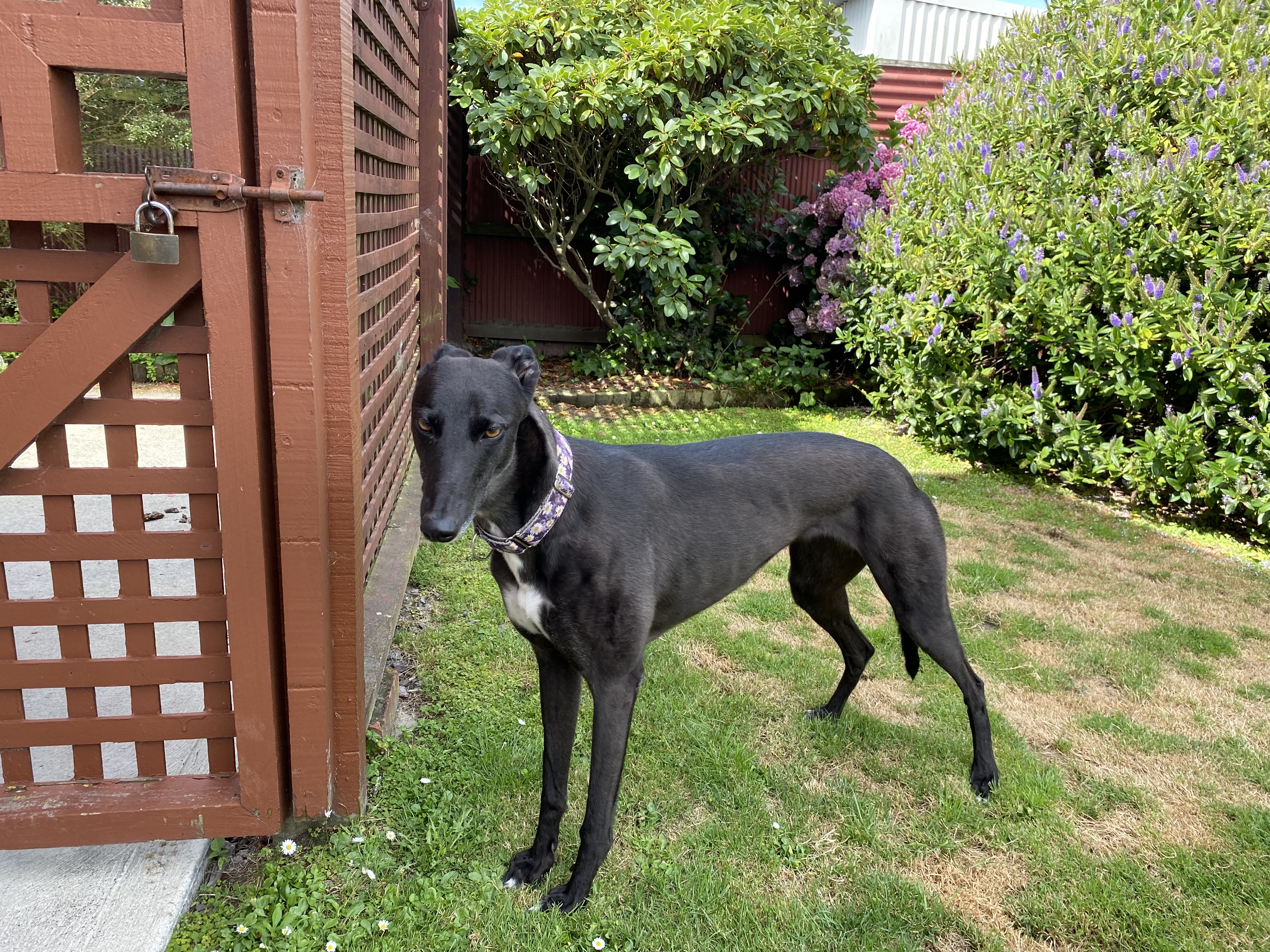
Rosie is my foster dog; she arrived one month ago exactly, on 17 December 2021.
Rosie is an affectionate black greyhound who has had three unsuccessful adoption placements. You see, Rosie is profoundly deaf.
She was not born deaf, but she became deaf through ear infections – and what appears to be lots of them, or at least ones that had unsuccessful or no treatment. Her ear canals are so severely scarred that about the only sound she has reacted to was the high-pitched loud squeal of my burglar alarm which I set off accidentally last month.
But there is a lot more you need to know about Rosie to understand her
Rosie doesn’t know she is special needs. She simply lives in a world where she sees people’s lips move but no sound comes out. She is reluctant to make eye contact with new people and so can easily misread their intentions. She responds to emotional energy very well; she seems to know when someone is smiling and wants to give her a pat; I always ask them to allow her to come to them which works well.
When Izzy died, she certainly knew I was upset and came in for lots of cuddles and reassurance.
She isn’t so sure of people wearing masks because masks cover faces and Rosie needs faces to read the situation. I have been deliberately taking her places where she meets people in masks and where I am wearing mine. She even came with me to the drive-thru vaccination clinic when it was time for me to have my Covid-19 booster shot; she barked anxiously at the face outside the window.
Mask-wearing will be part of our lives for a while and Rosie needs to live successfully in a masked up world so I will continue exposing her in a controlled manner to mask-wearing people so she can become more confident. Today, for example, we went to the local SPCA op shop which welcomes pets. The shop attendants and the customers were all wearing masks. We didn’t have any issues.
Rosie has lots of energy. When the sun is up, so is she. Forget the advice that a greyhound is so placid that two, 20-minute walks per day are sufficient exercise. Rosie has been having two walks of at least 30-40 minutes each and cracks a good pace for the entire time. An hour’s long walk on the beach with greyhound Misty was not problem for her, either.
I gave Rosie a massage over the weekend (her first) and I can assure you that she has great muscle tone. For a girl who is now 6 years, 9 months old, she is in great shape!
Rosie would benefit from being adopted by a household with another dog who is well-settled and playful. Rosie likes to play (she has had several play dates and is enthusiastic about engaging with other dogs who are both off-lead and on-lead). A dog that could be Rosie’s mentor will give her someone to follow around and mimic. In my opinion, a chilled out dog who can teach Rosie the house rules will see her settle into a new adoptive home pretty quickly.
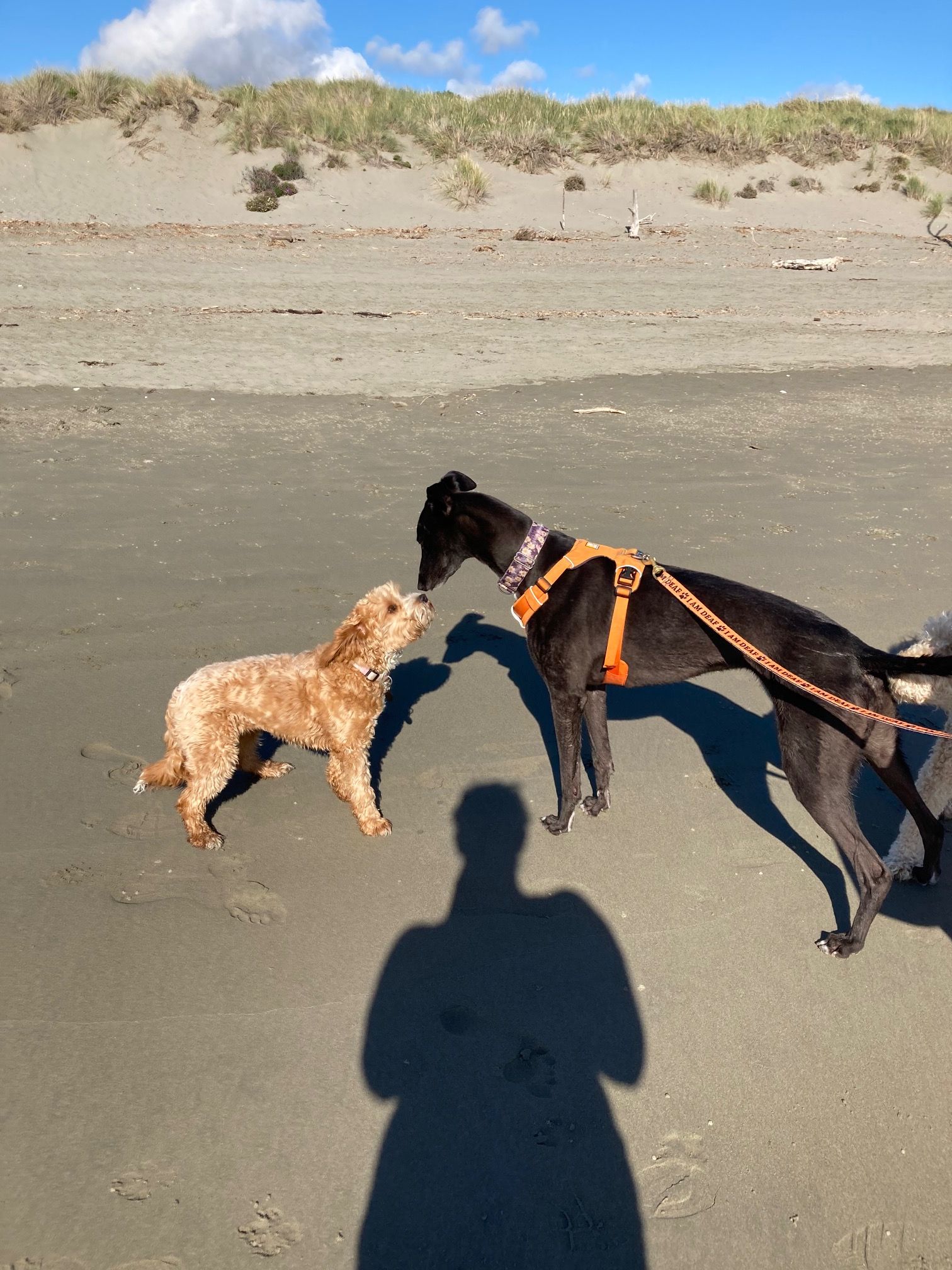
Meeting other dogs at the beach
Remember, though, that Rosie is deaf. She will always be deaf no matter how much training she receives. Rosie misses out on the low growls of dogs who are giving her a warning signal.
She doesn’t hear the children on the footpath who are coming from behind on scooters (startling her in the process). Whomever adopts Rosie needs to understand that they need to be her ears when they are out of the house – at all times. And when integrating into her new home, the dog:dog interactions will need to be supervised initially. Rosie doesn’t mean to be annoying, but she could be, in her enthusiasm to play.
Every greyhound needs a securely fenced section.
Rosie definitely needs one and always will. Off-lead exercise can only happen in securely fenced areas.
Rosie explores the section regularly throughout the day; the gate is always padlocked for added security
You may have heard that people who lose the their hearing seem to develop enhanced senses of touch, taste, smell, and sight. This is definitely the case with Rosie.
She is a sighthound. I can attest to the fact that Rosie triggers on all movement. So that is definitely cats, ducks, chickens, other birds, and rabbits. She also reacts to leaves, branches, pieces of rubbish and even my neighbour’s clothes on the line when they move in the breeze. Last week we were taking an afternoon walk along Papanui Road and the sunlight was reflecting off cars onto the ceiling of the shop walkway. Rosie startled at the reflections because it looked like something overhead was coming our way.
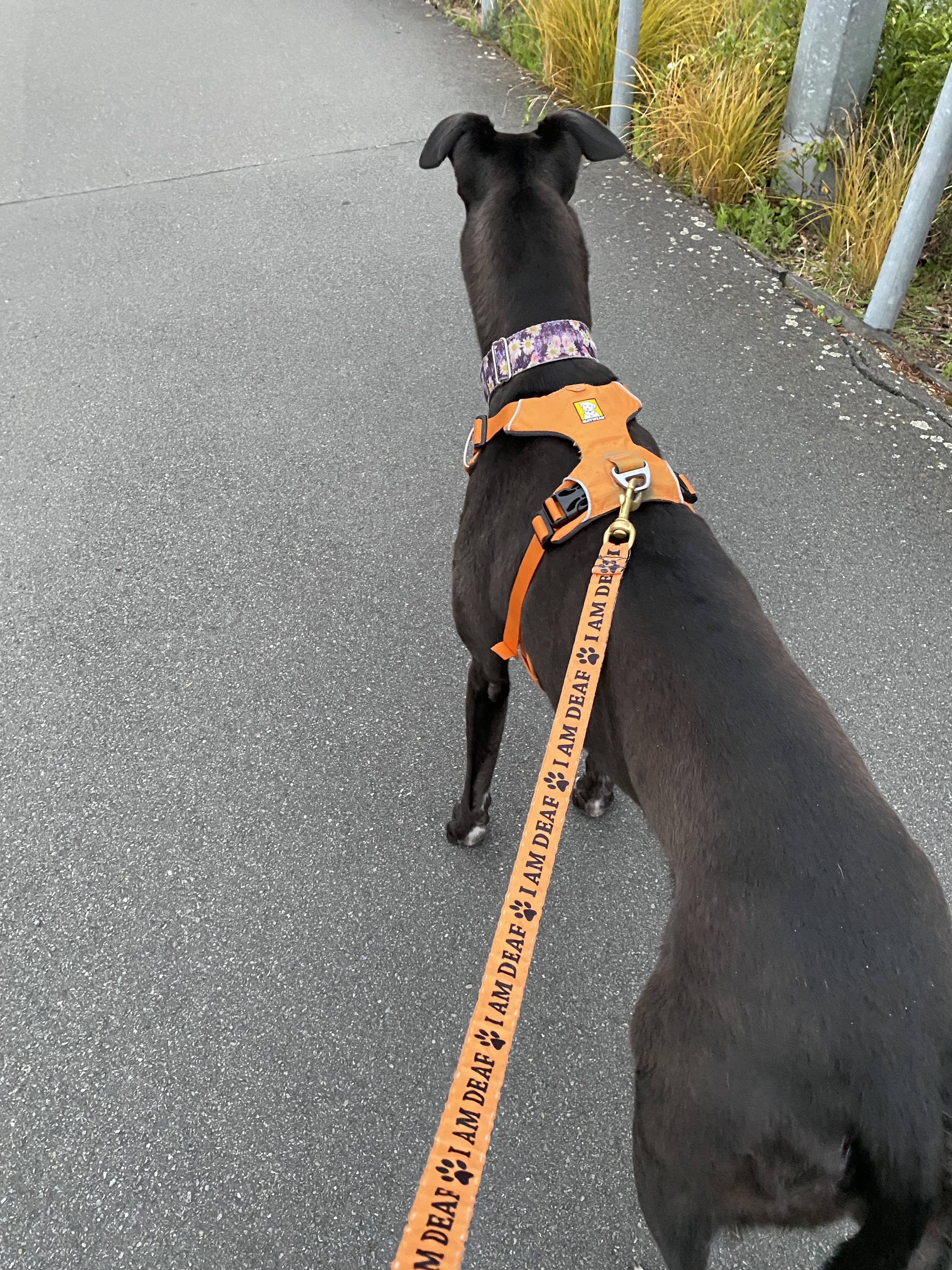
Consequently, it’s essential that anyone who walks Rosie does so with a firm grip of the leash and with it wrapped around their wrist. Always. And so that means that Rosie cannot be taken on walks by young members of an adoptive family. Adults only. Able-bodied ones, too. And please – a normal leash and not those horrible extension leads…
At my request, Rosie came with a lead that helps people know that she is a deaf dog. Her walking skills have improved considerably over the last month. She walks more calmly, mostly at my left side, although she will cross over the footpath when there is something interesting to investigate. Rosie is supposed to be a pet, not a competitive obedience dog and so I am happy to have her wander a bit. The important thing is that she has stopped tripping me up on walks with frantic zig-zagging in front of me.
If Rosie sees something of interest – like a neighbourhood cat – she will pull and rear up on her hind legs. Hold your ground and hold on tight. Rosie should always be walked in a harness for greater control and to avoid damage to her neck.
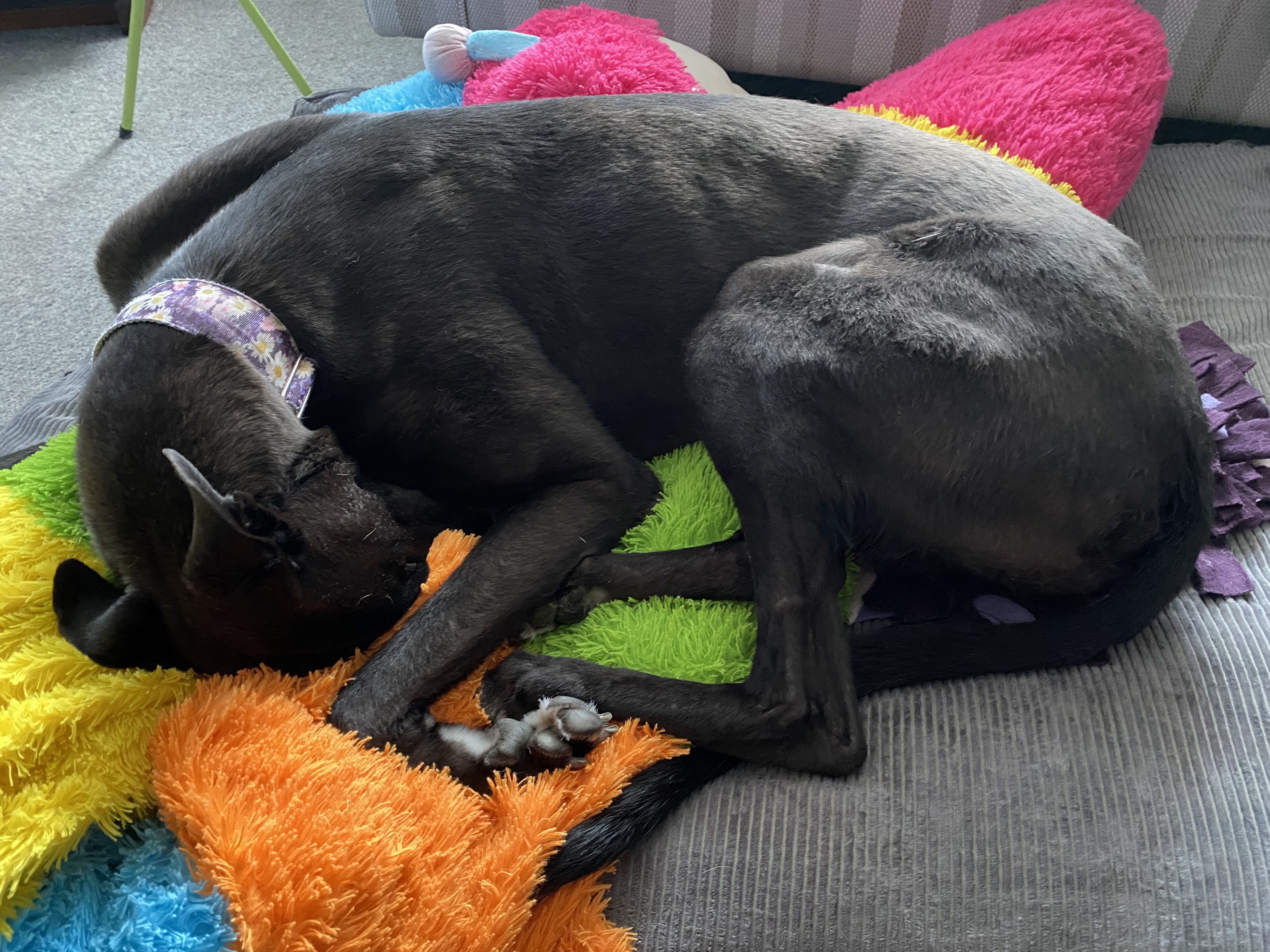
Rosie is a deep sleeper. All greyhounds sleep. Rosie sleeps more deeply than most. We know that dogs have a different sleep pattern than we do, but since Rosie cannot hear, it seems that she goes into a deep REM-like sleep more often. (This explains her energy levels when she’s awake – refreshed and ready to go!)
Greyhounds are known for their sleep startle – that sweet little greyhound can become a raving Cujo when wakened suddenly. In Rosie’s case, her risk of sleep startle is much greater. Therefore, I have developed a new habit of walking into a room with a good solid stomp of my foot. The vibrations will stir Rosie from her slumber.
The risk of sleep startle is another reason why Rosie cannot go to a home with small children, who are unlikely to remember the rules about engaging with a sleeping Rosie. Mature households only are needed as Rosie’s eventual adoptive family to keep everyone safe.
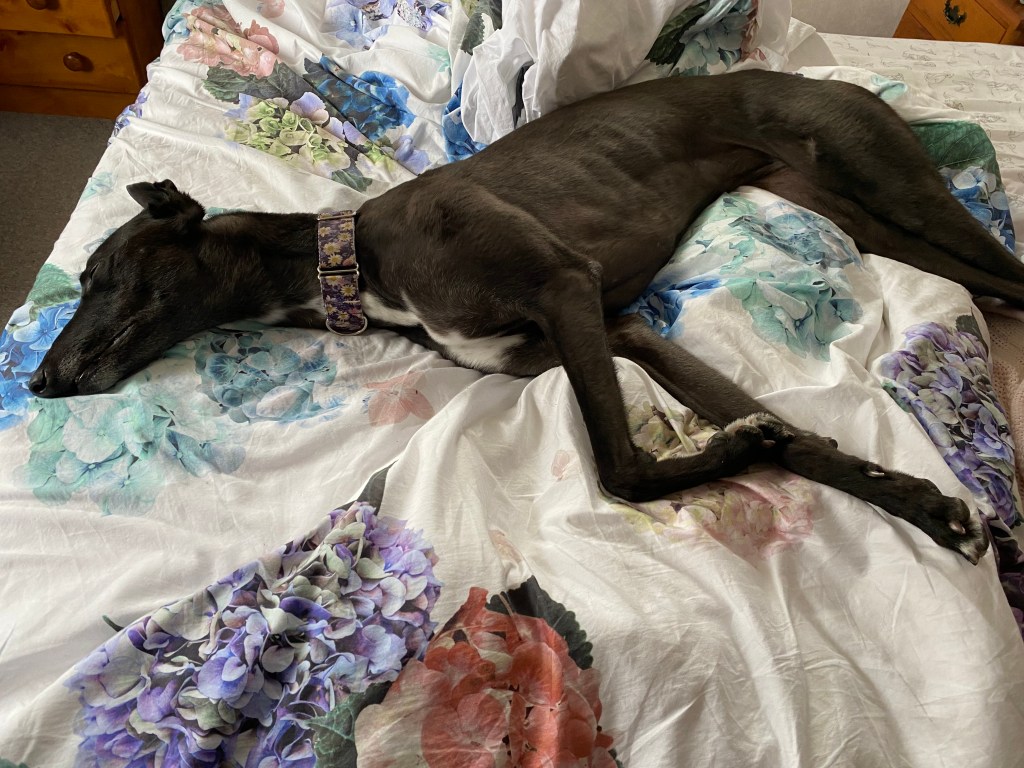
I mentioned earlier that Rosie is cuddly and affectionate. I have allowed her to sleep on my bed, particularly because she really wanted to snuggle and because she came one night to my bedroom at about 3 am when I was simply too tired to keep pushing her off the bed. Besides, I feel that since she has shown no interest in the sofa, she rightly deserves a chance to be a real pet greyhound and sleep on the bed.
Rosie is completely house-trained and she only barks when she is excited (such as when I am taking too much time to get dressed in the morning for our walk). I have had a pet cam running constantly for the last three weeks – she only whimpers a bit when I leave the house and then eventually settles on her bed for a deep sleep. She will sometimes go into the crate for a rest, but the crate is also strategically positioned so she can watch me in the kitchen from a safe distance.
In the interest of finding Rosie her forever home, I have begun working with Rosie on an essential cue – Look At Me. The Look At Me is the foundation for interacting with her handler so that she can then react to other visual cues which will be trained over time. I have already instituted her Come command, which is a vigourous tapping of my thigh.
We are perfecting her Look At Me and Come. Good things take time and I keep her training sessions short – only about 5-10 minutes each maximum. This ensures Rosie is set up for success. I am thoroughly happy to keep Rosie for as long as it takes until we find her the perfect match for her adoptive home and, in the meantime, we can continue our training and enjoy each other’s company.
Enquiries about adopting Rosie should be directed to Greyhounds as Pets.
Kathleen Crisley, Fear-Free certified professional and specialist in dog massage, rehabilitation and nutrition/food therapy, The Balanced Dog, Christchurch, New Zealand
Most small businesses like mine are approached on a regular basis to donate to fundraisers for animal welfare groups and charities. Sometimes, we have relationships with these groups and other times, they’ve never done business with us and we have to ascertain whether it is within our marketing budget to donate something and also whether that group shares our values.
There are many ways besides fundraisers that businesses can give back to their community.
In my business, I offer a loyalty card. After every five sessions of massage and physical therapy, the owner earns a free bag of our dog treats. Owners have the option, however, to donate the cost of their bag to a registered animal charity of their choice, although most leave the choice up to me. I rotate the donations.
Last week, I also offered to give massage to Liam, the assistance dog to young Sam Ward. Sam’s story appeared in the local paper because the little boy is in the final stages of aggressive Duchenne muscular dystrophy and his family are raising funds so they can fulfill his bucket list. Rather than giving back, I consider this my time to pay it forward, thanking those who have supported the business so I can give my time to others in need.
If you would like to donate to help Sam complete his bucket list, you can donate via Givealittle.
Kathleen Crisley, Fear-Free certified professional and specialist in dog massage, rehabilitation and nutrition/food therapy, The Balanced Dog, Christchurch, New Zealand
The paper’s abstract begins “The fate of experimental animals represents an ethical dilemma and a public concern.” I would say that this is an understatement. But, researchers in Finland decided to re-home their laboratory Beagles once their work was completed and documented the process of helping the dogs to adjust to pet life.
The re-homing of laboratory dogs was the first of its kind in Finland. The re-homing process was started with months of practising basic pet dog skills with the dogs and by familiarising them with the world outside the laboratory.
The practice period lasted from four to six months, depending on the dog.
“However, we found out that the socialisation time was not quite sufficient for all dogs; owners reported that some dogs continued to be timid and suffer from separation anxiety. The laboratory dog re-homing process would be smoother if in the future laboratory dog facilities separated out the defecation and rest areas, gave dogs access to an outside area and walked them outside on a leash,” says Docent Marianna Norring from the Faculty of Veterinary Medicine at the University of Helsinki.
The dogs had been living in packs of eight dogs for two to eight years in the University’s laboratory animal facilities, from where they had daily access to an enclosed outside space. They spent the nights in smaller groups of dogs.
At the University, the dogs had participated in both animal cognition and veterinary medical studies. The cognition research provided basic information on canine minds, and a new tranquilising agent suitable for dogs was developed in the veterinary medical study. The University of Helsinki does not currently have laboratory dogs.
The re-homing of laboratory dogs was implemented as a collaboration between SEY Animal Welfare Finland and the University of Helsinki. A large group of individuals participated in socialising the dogs and acquainting them with life outside the facility: animal caretakers, researchers, animal-rights campaigners and dog trainers. The aim was to take into account the individual characteristics of each dog when searching for a new home for them. Whenever possible, dogs were re-homed in pairs. Generally speaking, the new owners have been extremely happy about their new pets.
For the study, the dog re-homing process was monitored at the University for four years by interviewing the participants and collecting information from the new owners.
It is with almost unbearable sadness that I must share with you that we lost our beautiful soul Dumpling today. She took a bad turn the past few days which turned out to be the result of a large mass in her abdomen. At age 17+ we simply could not put her through any more testing and surgery.
When my wife first saw her picture on the Best Friends website, she fell in love immediately. It was our hope that we could give a 10-year-old dog that was missing most of her teeth, had eye problems and was going through a second heart worm regimen, a couple of years enjoying the life every dog deserves. It is our dream that she thrived for more than seven years because she was so happy here.
We know that the heartache will subside and are comforted in the knowledge that the joy and love she gave us will live with us forever. So please give all those close to you an extra hug today, be they human, canine, feline or all manner of G-d’s creations. Do it for you, do it for them, and today do it for Dumpling.
Kathleen thank you for always keeping her in your thoughts. Give Izzy a hug from us.
Stuart
In May 2012 during my first working visit to Best Friends Animal Sanctuary in Utah, I fell in love with Dumpling, a dog that had her fair share of health problems and hard times. Because I lived in New Zealand, I was unable to adopt her. I knew from the adoption website that Dumpling had been adopted and when I returned to the sanctuary the following year, I asked if the adoption staff would pass on my details to her new family so I could find out about her.
Thankfully, Stuart was happy to write to me with Dumpling updates; typically I would have an annual update each Christmas with a photo. The family vet estimated her to be 10 when adopted. During the course of her life with Stuart, she had to have an eye removed from a recurring infection but still loved to go for walks and take long naps during the day.
Yesterday, I got the email I knew was likely to come – Dumpling has passed. But she proved something that is very important – rescue dogs are not their history – they are what they become in a loving home. Dumpling recovered from heartworm and became a member of the family. She was no longer the down-and-out dog found in a Texas landfill next to the bodies of her dead puppies.
I am very grateful that Stuart and his family were able to give her a long and happy life post-adoption and for their kindness in keeping me updated about her.
Kathleen Crisley, Fear-Free certified professional and specialist in dog massage, rehabilitation and nutrition/food therapy, The Balanced Dog, Christchurch, New Zealand
“The choice to adopt a pet is a big decision that comes with much responsibility but infinite return on the investment. It will undoubtedly change your life.”
Meghan, Duchess of Sussex, Patron of Mayhew animal welfare charity




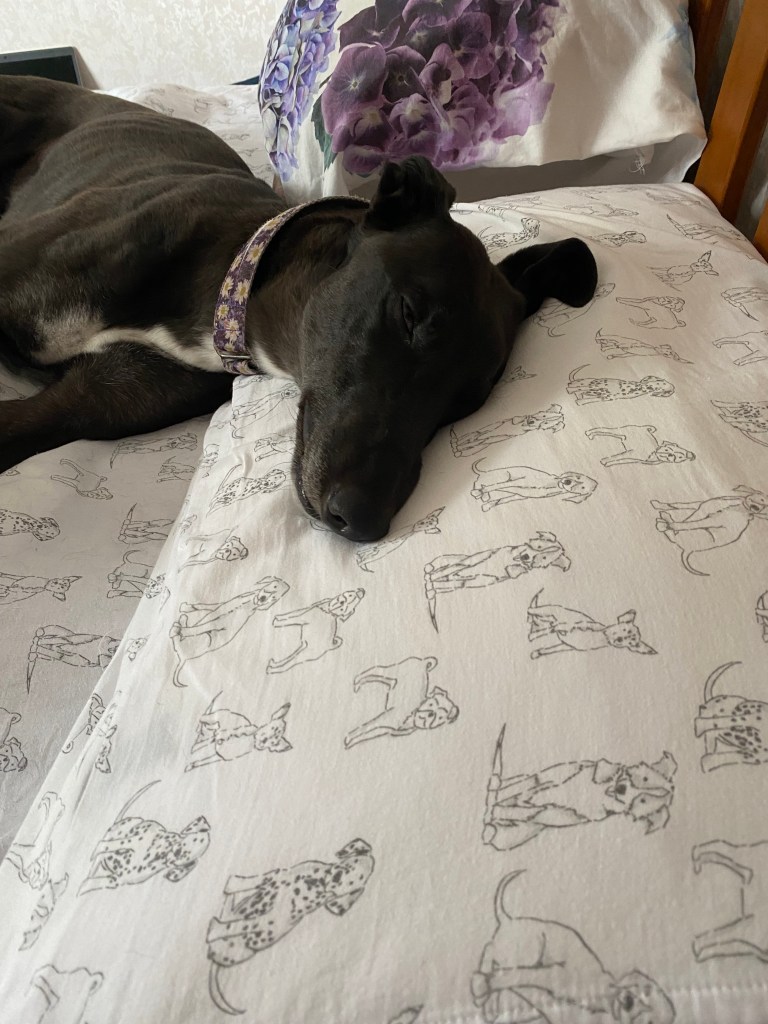
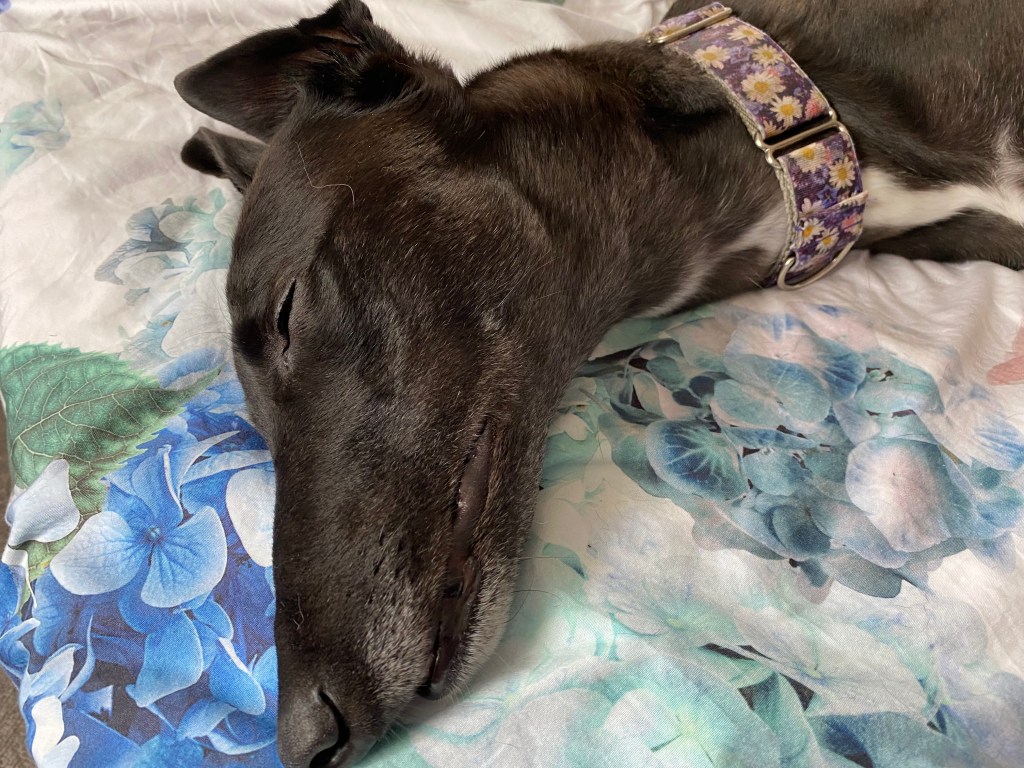


 It is with almost unbearable sadness that I must share with you that we lost our beautiful soul Dumpling today. She took a bad turn the past few days which turned out to be the result of a large mass in her abdomen. At age 17+ we simply could not put her through any more testing and surgery.








 DoggyMom.com