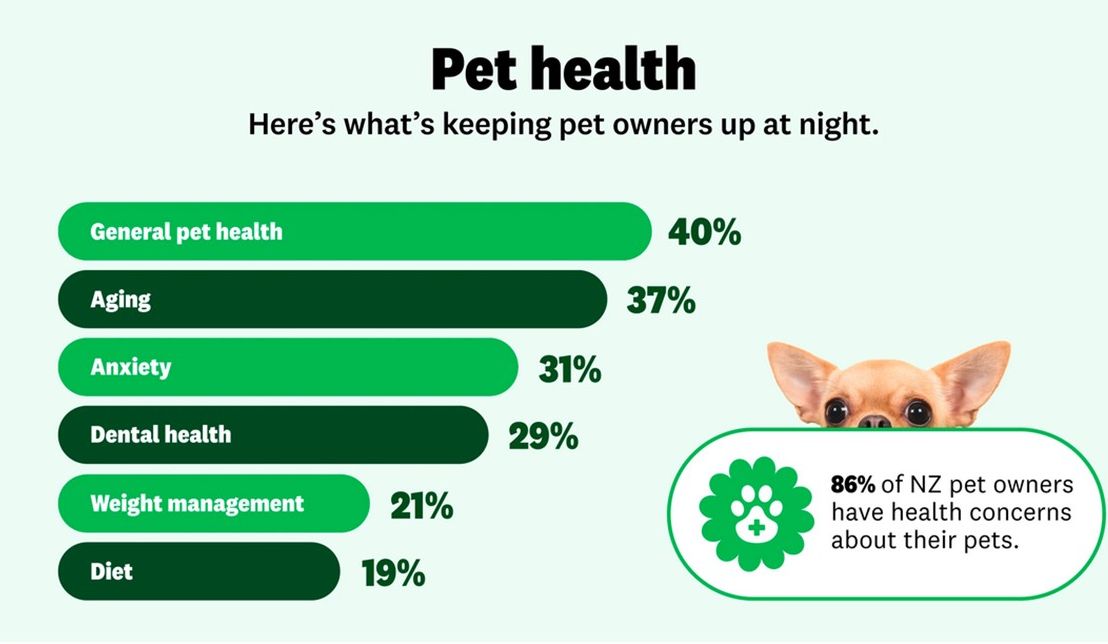
NZ-owned pet company Pet Direct released its pet survey recently and this infographic was the one I found most interesting and relevant.
The results align well with what my clients tell me. They seek out my services for support in their dog’s care – so of course general health features.
Arthritis is a major concern (no one likes to see there dog growing old) and there is a lot of confusion about what management options are available and that arthritis is actually a disease of the young dog. I still see too many pet parents who think a supplement is going to be their 100% solution which is the farthest from the truth. A multi-modal management strategy is needed.
And then comes anxiety. Thanks to my Fear Free certification, a lot of the clients I see have dogs with multiple issues and one of those is anxiety. Imagine living your life in a constant state of stress, unable to communicate in people language what is wrong! I really feel for these dogs. Massage, acupressure and lifestyle changes are all part of the picture for these dogs.
A friend of mine said she noticed that many of the posts on my Facebook page mention weight loss. Weight adds stress to the joints – so no surprises that weight management and diet are on my assessment list, too.
It’s certainly worth looking at the Pet Direct survey and thinking of what you can do for your dog and how you fit within the ‘norms’ of pet ownership in NZ. My full assessments include a review of your dog’s veterinary history, an in-home visit with gait analysis, massage and exercise game plan recommendations. Easy, convenient and cost effective.
Kathleen Crisley is Fear-Free certified dog massage therapist and canine fitness trainer. She has a particular passion for working with dogs and their families to ensure injury prevention and quality of life. She specialises in working with anxious and emotionally damaged dogs. Her mobile practice, The Balanced Dog, is based in Christchurch, New Zealand
Lost in the noise of the 2025 holiday season was a story that should have attracted more attention. A New York woman, Amanda Reynolds, is taking the Internal Revenue Service (USA) to court stating that her Golden Retriever, Finnegan, is a dependent for all intents and purposes and should be a tax deduction like any human child would be.
This case goes to the heart of how households and family life are changing. The nuclear family is long gone and more adults are opting to care for pets as opposed to human children. Dogs are sentient and entirely dependent upon us – so why aren’t they considered a dependent for taxes? They require feeding and medical care – much the same as any human child.
In New Zealand, for example, under 13 year old children receive free medical care. Not so for the under 13 canines..
There will be issues of traceability if this case – facing huge hurdles – succeeds. A child is given a Social Security Number and can be tracked through school records, for example. It’s harder to track the legitimate existence of a dog and one who is properly cared for.
I look forward to seeing how this case develops…
______________
Americans love their pets. Dogs sleep at the foot of the bed, cats rule entire households, and pet photos and videos draw millions of likes on social media. It’s no surprise, then, that nearly all U.S. pet owners (97%) say their pets are part of their family.
While millions of U.S. households (about 94 million families) own one or more pets, pets are not considered part of the family for tax purposes. A recently filed case in district court aims to change that. Amanda Reynolds, an attorney licensed in New York and Utah who focuses largely on civil litigation insurance defense, recently filed a complaint in the Eastern District of New York, together with Finnegan Mary Reynolds. The catch? Finnegan is Amanda’s dog.
Amanda Reynolds says that her dog, Finnegan, is more like a daughter—and wants the courts to agree. Amanda Reynolds
Background and Facts
Reynolds says that Finnegan, her eight-year-old golden retriever, is entirely dependent on her for food, shelter, medical care, training, transportation, and daily living. Finnegan has no independent income, resides exclusively with her, and has annual expenses exceeding $5,000. That means, Reynolds argues, that Finnegan satisfies every meaningful element of dependency recognized under section 152 of the Internal Revenue Code—except for being human. As a result, Reynolds has asked the court to determine whether pets can be recognized as non-human dependents under federal tax law.
According to the complaint, while dogs are legally classified as property, that does not fully reflect their role within families and households. Reynolds says that Finnegan’s care responsibilities mirror, and sometimes surpass, those of human dependents. Reynolds writes that “For all intents and purposes, Finnegan is like a daughter, and is definitely a ‘dependent’.”
Despite this, Reynolds notes, the tax code doesn’t allow relief for taxpayers who shoulder the financial burden of companion animals, even though it provides various credits and deductions—such as the Child Tax Credit, Dependent Care Credit, and Earned Income Tax Credit—for human dependents.
Reynolds claims this results in an arbitrary and unfair tax burden since taxpayers who provide financial support for human dependents get the benefit of tax breaks, while dog owners who provide similar levels of care receive none. This unequal treatment, she says, lacks a rational basis, especially considering the IRS’s own recognition that some animals—specifically, service dogs—may qualify for tax advantages. Reynolds argues that, from a financial standpoint, there is no real difference between service animals and companion animals.
The lawsuit alleges that the current tax law violates both the Equal Protection Clause and the Takings Clause. The Equal Protection Clause is part of the 14th Amendment of the Constitution and says that a government must apply its laws fairly and cannot treat people differently without a valid reason. The Takings Clause is part of the 5th Amendment and requires just compensation for private property.
Treating similarly situated taxpayers differently solely based on whether their dependents are human, Reynolds says, is discrimination. And, she claims that denying a tax break for the support of pets constitutes a wrongful taking because the lack of an available deduction results in a higher tax bill. Taking all of that into consideration, Reynolds says, justifies recognizing dogs as “quasi-citizens entitled to limited civil recognition, including dependency status for tax purposes.”
It may sound far-fetched, but Reynolds argues “this case is not frivolous or meritless” and warrants serious consideration by the court.
Procedural Issues
The court does not appear inclined to take up the matter. Magistrate Judge James M. Wicks granted a motion to stay discovery pending the IRS’s anticipated motion to dismiss. (Magistrate judges are appointed by the district judges of the court. In most districts, they handle pretrial motions and hearings in civil and criminal cases. While most civil cases are tried by district judges, magistrate judges may also preside over civil trials if all parties agree.)
A motion to stay discovery is a formal request to pause the discovery process in a lawsuit. Discovery happens early on in a lawsuit. As part of discovery, the parties exchange information and evidence, including document requests and depositions. It can be time-consuming and expensive, which is why a defendant may ask the court to stay discovery when a motion to dismiss is pending or anticipated (as here) and there are threshold legal issues that could end the case entirely (also as here).
The goal of a stay of discovery is to avoid unnecessary costs and effort while the court determines whether a case can or should move forward. It does not decide the case’s merits but simply pauses information gathering until the fundamental legal questions are resolved.
The Ruling So Far
Under the Federal Rule of Civil Procedure, discovery can be stayed for “good cause,” but simply filing—or planning to file—a motion to dismiss does not automatically qualify. Courts usually consider at least three factors: whether the defendant has shown that the claims are likely without merit, whether discovery would be extensive or burdensome, and whether a stay would unfairly prejudice the non-moving party.
Applying those principles here, Wicks concluded that a stay is warranted. Specifically, Wicks found that the IRS made a substantial showing that the original complaint is unlikely to survive a motion to dismiss. In a detailed pre-motion conference letter, the feds outlined several defects in the complaint, including lack of standing, improper service, and failure to state a claim as a matter of law. (Reynolds did not oppose or respond to that letter, according to court documents.)
Lack Of Standing
Standing is a legal term that refers to your right to bring a lawsuit or have a court hear your case—to be heard, you typically have to show that another party has harmed you and that the only fix for that harm can be found in court. The idea is to ensure that matters that end up in court aren’t frivolous and are raised by the right parties.
In her lawsuit, Reynolds does not allege that she actually attempted to claim her dog as a dependent or suffered an actual injury. That raises a standing problem. There are other issues with the complaint, Wick found, that impact standing, including that the Anti-Injunction Act and the Declaratory Judgment Act generally bar challenges to tax assessments and collections. Notably, the Anti-Injunction Act prevents courts from hearing suits brought “for the purpose of restraining the assessment or collection of any tax,” while the Declaratory Judgment Act bars federal courts from issuing any declaratory relief “with respect to federal taxes.”
Improper Service
The IRS also claims improper service. In a lawsuit, service (or service of process) refers to the formal delivery of legal documents, like the summons and complaint, to the defendant. The goal of proper service is to give the defendant notice that they are being sued and to allow them an opportunity to defend themselves. Lawsuits against federal agencies, like the IRS, require strict compliance with federal rules when it comes to service, which the IRS argues did not occur here.
No Constitutional Claims
Finally, complaints aren’t allowed to proceed when “the allegations in a complaint, however true, could not raise a claim of entitlement to relief.” While Wicks didn’t officially rule on the merits of the case, he did note that the Fourteenth Amendment does not apply to federal agencies and that the Fifth Amendment takings claim is unlikely to succeed (the mere payment of taxes does not constitute a compensable taking). And, he notes that the laws and tax court precedent make clear that animals cannot qualify as dependents under section 152 of the tax code.
What Are Dependents?
Under the federal tax code, dependents are persons that you can claim on your tax return. There are two kinds of dependents: a qualifying child and a qualifying relative.
A qualifying child must be related to you (typically, your child, stepchild, foster child, sibling, or descendant), live with you for more than half the year, meet age requirements (generally under 19, under 24 if a full-time student, or permanently and totally disabled at any age), and not provide more than half of their own financial support. The child also cannot file a joint tax return with someone else (except under very limited circumstances).
A qualifying relative, despite the name, need not be related by blood—they must be a person who is related to you or lives as a member of your household for the entire year. They must receive more than half of their support from you and have gross income below an annually adjusted threshold. There is no age limit, so your elderly parent could qualify. However, your spouse is never your dependent.
The statute specifically uses the term “individual” which courts and the IRS have consistently interpreted to mean human beings. As a result, pets—no matter how much they might feel like a member of your family—don’t meet the criteria.
As for those tax benefits? Reynolds is right that claiming a dependent can result in tax-favored credits and deductions. These include the Child Tax Credit (and Additional Child Tax Credit), the Credit for Other Dependents, and the Earned Income Tax Credit. Dependents may also qualify for a favorable head-of-household filing status, which offers lower tax rates and a higher standard deduction. But there isn’t any language in case law or statutes that would allow pet owners to claim those tax breaks.
(It’s worth noting that the definition of a dependent can narrow, especially as it relates to age, depending on the specific deduction or credit you’re claiming.)
The Care Of Animals Can Be Deducted In Limited Instances
While pets can’t be claimed as dependents, the tax code permits some limited deductions for animals. For instance, expenses for service animals may qualify as medical deductions, animals used in a trade or business may generate deductible expenses (such as guard dogs), and the care of foster animals may lead to a charitable deduction.
Outside of these narrow categories, however, pet-related costs for food, veterinary care, grooming, and housing are considered personal expenses, and therefore, not deductible.
Next Steps
The case has not yet been dismissed, although it appears from the recent ruling that it will be. (The Department of Justice declined to comment on the matter.)
Reynolds, however, remains optimistic. In a statement provided to Forbes, she noted, in part, “I commenced this case out of a labor-of-love as a dog owner and pup-mom to a golden retriever whom I esteem as my own daughter, having raised her by myself while my friends got married and had children. She has been in daycare while I am at work, I have paid for her medical visits, hospital visits, food, shelter and all other facets attendant to dog ownership.”
She added that she expects the litigation to be largely paper-oriented. She’s expecting the motion to dismiss shortly and says she “will address their arguments in opposition at that time.”
For now, however, don’t expect to see dogs like Finnegan listed on Form 1040.
In Christchurch, where I live and practice, we’re known for our flat landscape in most parts of the city and suburbs. However, we do have some hilly suburbs which are considered prime real estate for those wanting a view and a different level of privacy.
With those hilly sections come challenges.
Homes in these areas tend to require stairs or steep drives and a walk in the neighbourhood demands hill-walking; much different to the single story traditional housing on the flats. That said, new infill developments are building upwards. Usually, these take the form of multi-unit dwellings that are two or three stories high. All have staircases, most are steep to make the most of the available space.
As a mobile practitioner, I work with dogs in a range of settings. One fact that is universal, however, is that an aging dog is more likely to slip on floors and to have difficulty walking up/down stairs and hills. A dog of any age that has an injury is also going to have the same problems.
Owners of smaller breeds can carry them; for larger breeds, this is not an option.
So, if you are relocating to a new home, please think of your dog before signing on the dotted line. Your dog will age must faster than you do. A bit of planning can help you make a good choice so your dog can enjoy your home and neighbourhood for the rest of their life.
P.S. Not every family has the capacity to build a stair lift like Eddie’s family did. (RIP, Eddie)
Kathleen Crisley is Fear-Free certified dog massage therapist and canine fitness trainer. She has a particular passion for working with dogs and their families to ensure injury prevention and quality of life. She specialises in working with anxious and emotionally damaged dogs. Her mobile practice, The Balanced Dog, is based in Christchurch, New Zealand
I don’t mess around when it comes to new lumps and bumps. This small lump in the center of Sox’s head appeared in late August. After about one week, we made a trip to the vet for an exam and skin scraping.
It’s a benign histiocytoma, thankfully. This is an abnormal growth of histiocytes which are a cell that is part of the immune system. It should ‘self-resolve’ in 2-3 months; the head is a common location for this type of growth. It looks like a single, red, raised lump and it can be itchy which is why it has bled a couple of times.
To avoid infection, I have been treating it with colloidal silver. Avoiding secondary infection is particularly important for Sox because his inflammatory bowel disease is easily upset with antibiotics, which kill off the good gut bacteria.
No one, including a vet, can diagnose a lump with the naked eye. Sox’s lump could have been something more sinister such as a mast cell tumour. Keep a watch for lumps and bumps and get them checked out!
Kathleen Crisley is Fear-Free certified dog massage therapist and canine fitness trainer. She has a particular passion for working with dogs and their families to ensure injury prevention and quality of life. She specialises in working with anxious and emotionally damaged dogs. Her mobile practice, The Balanced Dog, is based in Christchurch, New Zealand
In my post Reading Labels, I shared the notification label from our bag of Purina Pro Plan Gastrointestinal dog food. The food we have relied on for over two years is changing!
The reply from Purina says: “Ensuring the safety and quality of our pet food remains our top priority. While the product is now manufactured in Thailand instead of Europe, the benefits of this diet remain unchanged. With a new manufacturing location, there will be new sourcing for raw ingredients and slight recipe variations. Please be assured the new formula continues to deliver the same efficacy and benefits. We recommend a gradual transition to the new formula to support digestive tolerance. If you have concerns, please consult your vet for tailored advice.“
Let’s compare ingredients…
ORIGINAL FORMULA
Rice, Corn, Pea protein, dried poultry protein, dried beet pulp, digest, soya protein, coconut oil, minerals, pork fat, monoglycerides, soya oil, fish oil; with nutritional additives Vit A, Vit D3, Vit E, Iron (II) sulphate monohydrate, calcium iodate anhydrous, copper (11) sulphate pentahydrate, manganese sulfphate monohydrate, zinc sulphate monohydrate, sodium selenite, antioxidants
I will follow my own advice to clients and transition to this food over a minimum of 10 days (and I’m planning longer than that). As a pet parent, however, I’m holding my breath that this new formula doesn’t upset Sox’s inflammatory bowel disease. Time will tell.
Kathleen Crisley is Fear-Free certified dog massage therapist and canine fitness trainer. She has a particular passion for working with dogs and their families to ensure injury prevention and quality of life. She specialises in working with anxious and emotionally damaged dogs. Her mobile practice, The Balanced Dog, is based in Christchurch, New Zealand
“To date, there are no specific disease modifying anti-osteoarthritic treatments. Current management of patients with osteoarthritis aims to improve patient and societal outcomes by reducing symptoms and improving function. Clinical guidelines broadly recommend the provision of effective and individualised information, combined with non-pharmacological and pharmacological interventions, and when these are insufficient, surgery.”
As you’ve probably read in this blog before, I’m a self-confessed Science Geek. I like the details. So, it should come as no surprise that label reading is part of my routine as a dedicated Dog Mum and pet professional.
This week has provided some good food for thought – the importance of reading labels.
First up is Sox’s Vitamin B supplement, Cobalazorb. When the latest box arrived, it was immediately noticeable that the packaging had changed:
There were differences that could be alarming for us. I have been managing Sox’s inflammatory bowel disease for years now and this supplement is vital since his malfunctioning gut does not digest all the goodness from food as it should. I emailed the company, ADM Australia PTY Ltd.
I have just received a new pack of Cobalazorb for my dog, who has chronic enteropathy. This pack prominently promotes that the product has a chicken flavour and also does not state that the capsule is a vegetable capsule – only “capsule.”
I’ve compared it to the previous pack, which states a flavouring but with no specific type and a vegetable capsule.
Given his sensitivities, I wanted to check that there have been no ingredient changes to the original product and that this is a change in packaging only.
Great news! The company responded the same day with this reply:
Thanks for reaching out.
I can confirm that only the packaging has changed for Cobalazorb, everything else remains the same as before. The flavouring is still artificial chicken (no actual chicken) and the capsules are vegetarian, so OK to use in dogs and cats with allergies and sensitivities.
Please reach out should you have any further questions.
At this point, I was winning. That was until the delivery the next day of our latest 12 kg bag of Purina Pro Plan Gastrointestinal kibble, our mainstay dog food. Only this time, the bag came with a prominent label announcing “Coming Soon, New Look and Formula.”
New formula…and when you turn over that label there’s a reminder that new foods should be transitioned over 10 days.
I emailed Purina to ask what the formula changes will be, explaining that I am using this food for Sox’s chronic enteropathy (IBD). It took them 2 days to reply, “We have reached out to our wider team regarding your questions about the formula changes and we’ll get back in touch with you as soon as possible.“
This reply doesn’t fill me with great confidence and history shows that whenever pet food companies change formulations, it is usually so they can reduce the cost of ingredients while improving profit margin. Decreasing cost of production often means decreasing the quality of the ingredients. Dog food is a big business.
Time will tell if I am going to need to find another food for Sox, and how long I will wait for a definitive reply from Purina.
I encourage all my clients to read labels – you’d be surprised how often products formulations are changed – a change in packaging is often a good reason to check the label.
P.S. A big shout out of thanks to ADM for such fabulous customer service (plus for not changing the formula of a valued supplement)
Kathleen Crisley is Fear-Free certified dog massage therapist and canine fitness trainer. She has a particular passion for working with dogs and their families to ensure injury prevention and quality of life. She specialises in working with anxious and emotionally damaged dogs. Her mobile practice, The Balanced Dog, is based in Christchurch, New Zealand
The ASPCA Poison Control Center has released its Top 10 list for reports of poisoning in pets during 2024. This list is a good guide for pet parents on safety.
The top items that are ingested are over-the-counter medications and supplements. Be careful when taking these items to ensure that any pills which are dropped on the floor are picked up immediately and that bottles are stored away from a dog’s reach.
Not all human foods are suitable for our dogs – notably things like grapes and raisins, xylitol-containing sweets and peanut butters are good examples. Be careful in the kitchen and pick up spills immediately. In my practice, I have seen a rise in incidents involving peanut butter that contains xylitol. It’s really important to read the label before giving your dog peanut butter and, if you share food, you must remember that not everyone bakes with xylitol-free peanut butter!
Chocolate is a well-known risk and ingestions of chocolate often occur over holidays like Christmas and Easter and during other family celebrations like birthdays. Your dog will follow its nose – so chocolates should not be kept in bags and jacket pockets.
Try to be gentle on the Earth and opt for more natural options instead of chemical pesticides; this will limit exposure risk in pets. And if using rodenticides, follow the instructions and use bait inside approved traps.
Let’s hope all my readers have a 2025 without incidents of poisoning!
There is a growing awareness of the link between overall health and a healthy gut. If gut health is poor, your dog will not thrive. Whilst diet is the first port of call for good health, dog owners are also seeking to augment diet with the ”right” additions to food.
Prebiotics and probiotics offer support for gut health, but I find that dog owners can often confuse the two terms.
A healthy gastrointestinal tract contains an abundance of beneficial bacteria that help digest food into nutrients which the body then absorbs. These bacteria are probiotics; the most common strains are the Lactobacillis and Bifidobacterium families of bacteria. Probiotics are available in supplement form – too many brands to mention in this column!
Prebiotics are fermentable fibres that support the growth of the good bacteria. When the fibre reaches the large intestine, the bacteria are able to ferment certain types of fibre which result in short-chain fatty acids. These fatty acids support and protect the intestinal lining, help reduce inflammation and prevent the overgrowth of unwanted bacteria. Examples of prebiotics are beet pulp which is an ingredient in many commercial foods and psyllium husk.
Psyllium husk is my prebiotic of choice for managing Sox’s inflammatory bowel disease
A healthy bowel is able to absorb more nutritional value from food.
When should you consider the addition of prebiotics and probiotics? Conditions that respond well include:
Inflammatory bowel disease
Stress-related diarrhoea
Antibiotic-associated diarrhoea
Dietary intolerances
When the intestinal tract is working well, faecal odours are less and stool consistency improves. You will notice the difference when picking up after your dog – particularly if you have been managing soft stools and diarrhoea for extended periods of time.
Kathleen Crisley is Fear-Free certified dog massage therapist and canine fitness trainer. She has a particular passion for working with dogs and their families to ensure injury prevention and quality of life. She specialises in working with anxious and emotionally damaged dogs. Her mobile practice, The Balanced Dog, is based in Christchurch, New Zealand
I have been giving a lot of thought lately to the issue of fostering.
This time last year, Sox and I were fostering blind greyhound, Fred, who was adopted in mid-February and has settled well into a loving forever home. New Zealand has always had a homeless pet population – you don’t have to look far to find an adoption group (or two, three, or more) that operate in your area. And now, with a greyhound racing ban confirmed, our country has the responsibility to re-home the 2,900 hounds that the industry says it has it in its possession.
Fostering is the gift of life for dogs needing homes; it also has many benefits for the foster carer and the adoption agency.
Benefits of fostering
Fostering frees up space in shelters/kennels for another dog in need
For the fostered dog, it gives them a chance to de-compress (kennels keep dogs safe and fed, but they can also be noisy and negatively reinforcing – think of having roommates that you really wish would leave!)
For some dogs, they simply can’t cope in a shelter or kennel environment and these special dogs need to be cared for in a home before they are damaged from long-term kenneling
A fostered dog benefits from one-on-one attention and, if the foster carer/family own a dog (and/or other pets), then the fostered dog has the opportunity to learn the ‘house rules’ and how to interact with other companion animals
Fostered dogs often need to learn skills such as toilet training, walking on lead, and basic skills like wait, leave, and down (depending on the skills of the foster carer and the dog, of course) – a dog with life skills is less likely to have a failed adoption (returned to the adoption group)
Re-homing and adoption groups benefit from feedback from their foster carers; they learn about a dog’s likes and dislikes, behaviour, and areas for training – all of which enable them to give clearer information and support to adopters and to make a good and lasting match
Re-homing and adoption groups also benefit from the enthusiasm of their foster carers, who can help publicise the adoption group simply by taking the dog out for walks, promoting the dogs on their social media, and acting generally as a partner for the re-homing effort
An experienced foster carer is worth their weight in gold for the adoption groups they work with; some carers offer specialised skills that adoption groups often cannot afford to access on a commercial basis
For carers, fostering gives you the joy of companionship without necessarily the commitment of full-time ownership
There is huge satisfaction to be gained from giving a dog a second chance; the emotional reward is hard to describe
Setting expectations and standards
To be successful, fostering works best when the adoption agency and the foster carer are clear about expectations and standards. If the adoption agency isn’t clear about boundaries, it’s hard for the foster carer to know what a good job in fostering looks like.
Questions to ask if you are interested in fostering
Ask yourself why you want to foster – and be honest.
Most people I meet have the best of intentions to foster but can be emotionally unprepared for the experience. A foster dog is not your pet; some attachment to your foster dog is expected – it’s easy to bond with a dog in your care as you learn their personality. Some positive self-talk is a good idea – remind yourself that at some point you will need to farewell the dog, knowing that you gave them a head start for pet life.
What type of dog are you qualified to handle?
If you have breed-specific experience, it’s best to consider offering your skills to a breed-specific rescue group.
In more general terms, most previous dog owners will have experience with adult dogs; puppies are typically fostered only by those with puppy experience (and the availability to monitor them more closely throughout the day). If a dog has special needs such as behaviour issues or mobility or other physical impairments, then they will ideally need a special foster carer with some experience in these areas.
What support can you expect as a foster carer?
Most adoption groups will supply the basics for their foster carers: dog food, leash, collar, crate and bed.
Ask what process to follow if the dog is unwell and needs veterinary care, for example.
If you are experiencing behaviour problems and want to talk through training, what assistance is available? Some adoption groups have a dedicated person who will follow up with foster carers just to see how things are going – if this isn’t possible in your area, is there someone else you can bounce ideas off of?
All adoption agencies should be prepared to give you background on your foster dog. Some agencies will, of course, have very little information on the dogs that come into care. Others will have more information.
Foster agreements should be in writing
Agreements with a foster carer should be in writing and set out the responsibilities of each party; every adoption group should act as a business in this regard.
If foster carers are expected to be available for certain weekend adoption events, for example, then these should be clarified in the agreement.
Foster carers should be dealt with respect and, even if they are not being paid for their services, their in-kind time and efforts should be recognised as if the person was an employee. There should be no bullying, harassment or discrimination and the foster carer should have an avenue outlined in the agreement if a problem requires escalation. If the adoption agency has concerns about a foster carer’s competence or performance, then the agreement should outline how such situations will be handled.
What if you can’t manage it (for whatever reason)?
Life can throw us curve balls. Your situation may change. Perhaps the dog is higher needs than you anticipated and you are not coping; perhaps you are ill; perhaps there’s a family emergency. If you can’t manage to see your foster commitment through, then the foster agreement should outline the process to follow to return your foster dog. Depending on the circumstances, you should de-brief with your adoption agency, particularly if you’d like to foster again in the future.
Make a lifetime commitment only when it is right for you both
It’s natural to form a bond with your foster dog; affection for the dog is normal. After all, you are caring for a sentient creature who needs your help and who is living in your home…
While some dogs end up as ‘foster failures’, you must be sure that you can make the lifetime commitment to your foster dog if you are considering adopting them. Can you afford their care? Do you permanently have the time and space to give the dog its best pet life?
Note: If your intention is to add a dog to your home, ask your adoption agency about a ‘foster to adopt’ arrangement which means that you are providing foster care for the purpose of taking the dog on trial.
Fostering a dog in need can be one of the most rewarding experiences of your life.
If you are interested in fostering, please contact your local adoption groups for information on their needs – most will publish information on their website to get you started.
Kathleen Crisley, is Fear-Free certified dog massage therapist and canine fitness trainer. She has a particular passion for working with dogs and their families to ensure injury prevention and quality of life. She specialises in working with anxious and emotionally damaged dogs. Her mobile practice, The Balanced Dog, is based in Christchurch, New Zealand.












 DoggyMom.com