Category Archives: dog care

My diary

I still use a paper diary despite having access to online calendars and tools. There’s a reason for that.

Diary photo

I successfully managed my time through the Auckland Power Crisis of 1998 without a hitch, thanks to my paper diary. My colleagues, who were already relying on electronic schedules, didn’t know where they were supposed to be for weeks.  Meetings had to be rescheduled; service delivery slowed.

My diary also helped me through the days and weeks following the Canterbury Earthquake of February 2011. During these trying times, I could still make and keep appointments, keep notes as reminders, and generally have something to hold onto that was part of ‘normal’ life.

Most pages include reminders of what I need to finish that day.

And reflecting on my diary over the weekend, I see that it includes Izzy’s social calendar.

Going forward over the next couple of months, Izzy has engagements for play dates, appearances at the Riccarton Market for Greyhounds as Pets, and dates for sleepovers when I have to travel for business.  She also has a birthday party date with her best mate (and boyfriend) Bergie.

I often say that the best thing we can give our dogs is quality time.  One way of ensuring you make time for your dog is to commit to them in writing.  I’m pretty confident that I’ve got the right priorities and tools to do just that.

Kathleen Crisley, specialist in dog massage, rehabilitation and nutrition/food therapy, The Balanced Dog Ltd, Christchurch, New Zealand


Tax implications for fostering

Americans resident in the United States have to file their taxes by 15th April each year – it’s a busy time for accountants and bookkeepers.

Second Hand Dogs

But I came across a tax decision,  VanDusen vs IRS Commissioner, which is very promising for volunteers who foster dogs for designated 501(c)(3) not-for-profit animal rescue organizations.  If the foster carer incurs unreimbursed expenses directly related to fostering, they can claim these on their tax returns as charitable deductions.  Things like food, veterinary care, and mileage are included; so too are utility costs for the portion of the home’s space that is used for care of the foster animal.

Careful record-keeping is important to ensure against audit troubles later on, of course.

Wish we had something like that in the tax code in New Zealand!

Kathleen Crisley, specialist in dog massage, rehabilitation and nutrition/food therapy, The Balanced Dog Ltd, Christchurch, New Zealand

Vaccination management

I meet owners who express concern about over-vaccination; more often than not, this has led them to the decision on not to vaccinate their dog. If they don’t send their dog to a boarding kennel or day care, there is little motivation for them to do so – other than any regular visits to their vet.

I can understand the concerns, but I also get concerned that these owners are relying on herd immunity – the odds that the majority of the herd (in this case, the dog population) are immunised and so their dog isn’t at risk because most animals are protected.

But then we have communities, like last year on the West Coast, who experience parvovirus infections across a range of puppies and dogs…

This blog is a re-print of an article I wrote for NZ Dog World magazine in 2014.  There is the option to titre test our dogs to test their levels of immunity and to give us more information on whether to vaccinate or not.


Titre testing is available in New Zealand but few dog owners appear to know about it, says Karen Cooper, Laboratory Manager with Gribbles Veterinary in Auckland.  “This testing option was not previously available here, but despite its recent introduction the uptake of the testing has not been huge.”

calming a cute puppy patient at the vet's

Vaccination time… or is it? (photo courtesy of Gribbles Veterinary)

A titre test measures the levels of antibodies in the blood.  Testing can be done for immunity to canine parvovirus and canine distemper virus.

Dr Jean Dodds, who is a leading holistic veterinarian and founder of Hemopet, a non-profit blood bank for dogs in the USA, says that research has found that an animal’s titre level remains constant for years.  Therefore, there is little risk that an animal will be misdiagnosed as having sufficient immunity.

A negative titre test would mean that the dog requires a booster vaccination, whereas a positive test would mean it does not.

Dr Dodd’s vaccination protocol calls for vaccine antibody titres to be undertaken every three years.  For most veterinary practices in New Zealand, three-yearly booster vaccination is routine.  Titre testing could be done in lieu of an automatic vaccination but in most cases the dog owner needs to ask for it.

The NZVA’s policy on vaccine use states:

Veterinarians should maintain a professional approach to all aspects of the use of vaccines. This includes encouraging widespread vaccination as an important means of preventing and controlling infectious diseases while ensuring that vaccines are not used unnecessarily.  Veterinarians should aim to maintain the profession as the source of informed knowledge on the use of vaccines and be responsible for the correct use of these agents.

Veterinarians should adhere to their ethical and legal obligations by informing their clients of the risks and benefits of vaccination of companion animals, keeping comprehensive patient records and vaccination certificates.

Why titre?

The most popular application is in puppies to check for an effective immune response; a titre test can be performed approximately two weeks following the final vaccination.

In older dogs, the main concern is avoiding the risks that are associated with vaccination.  These risks may involve localised swelling, lethargy, fever and allergic reactions ranging from mild to severe.   There may be no need to expose their bodies to the pressures associated with vaccination if they have sufficient immunity.  With rescue dogs, titre testing can provide insight into their immune status.

One issue for some owners is whether their boarding kennel will accept the tests.  The kennels I spoke to for this article varied in their position from “We require dogs to have a current vaccination certificate to “We would like to think of ourselves as educated and discerning and therefore we are happy to accept results of a titre test.” 

When boarding your dog, it is important to understand that there is no titre for kennel cough and so vaccination is likely to be needed.

Titre testing may not be suitable for every dog; re-vaccination may not be suitable for every dog.  It’s up to the owner to make an informed choice.

Kathleen Crisley, specialist in dog massage, rehabilitation and nutrition/food therapy, The Balanced Dog Ltd, Christchurch, New Zealand

Is dental care cultural?

Earlier this week, I went to the dentist.  There was nothing wrong – I just booked in for an annual check-up and a cleaning.  The lovely young dentist I saw said, “Oh, you’re an American.  Americans understand dental care.”

And, while I was flattered, it also got me thinking.

Here in New Zealand there are public service announcements on television with tooth fairies reminding parents they need to brush their kid’s teeth with fluoride toothpaste.  We never had anything like that when I was growing up and I don’t think it was needed because I remember that we even had health classes in school when we’d receive little complementary packs of a toothbrush and toothpaste to take home.

But if dental care varies across cultures, it would explain why I still meet many dog owners here in New Zealand who don’t brush their dog’s teeth.

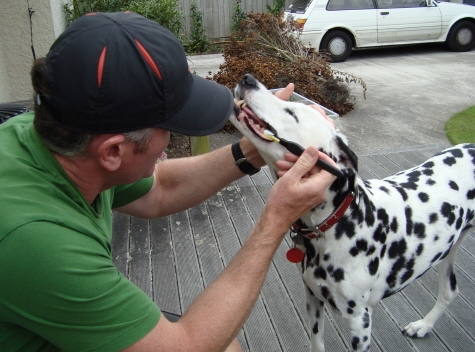
teeth-brushing

A client demonstrates teeth brushing

Most veterinarians will say that teeth brushing for our dogs is the best thing you can do – before dental diets, drinking water additives and chews – for your dog’s dental health.

Dental care, including teeth brushing, is a good habit for everyone in the family.  After I brush my teeth at night, Izzy gets her teeth brushed.

Greyhounds are known for their bad teeth – and yet more than 2 years after I adopted her, I am proud to say that Izzy has yet to need a dental cleaning at the vet.  And the vet comments that her teeth are in good condition.

Kathleen Crisley, specialist in dog massage, rehabilitation and nutrition/food therapy, The Balanced Dog Ltd, Christchurch, New Zealand

A balanced approach to fitness in dogs

The name of my canine massage practice is The Balanced Dog.  Balance is important to many aspects of our lives as well as the lives of our dogs.

When I interview owners who come into my practice for the first time, we discuss all aspects of their dog’s history and health before I massage their dog.  That’s because I want to see how the dog feels, but in context of what I know about their history.

For example, for an owner with a dog that competes in agility, they will think their dog is fit because it ‘runs around like a maniac’ with a ‘desire to win.’  But they aren’t winning and that is why they end up at my door.

This is when I explain that for dogs of any age, there are different components to fitness – described in the chart below.

The individual components of dog fitness

Their agility dog may be strong, but perhaps they are lacking in body awareness or balance – and so that’s where we will concentrate on exercises to improve these aspects of fitness.

For an elderly dog, we will want to ensure good flexibility (where massage and stretching come in) and exercise that is within the bounds of what the dog can tolerate.  ‘Stamina’ is age and breed dependent, for example.

By the way, these aspects are also useful when considering your own fitness.

Kathleen Crisley, specialist in dog massage, rehabilitation and nutrition/food therapy, The Balanced Dog Ltd, Christchurch, New Zealand

The 14th of February isn’t just Valentine’s Day

February 14 is also Pet Theft Awareness Day.

If you are like me, you find it pretty heart-wrenching to see posts on Facebook and to walk by posters hanging from telephone poles pleading for information about a missing dog.

Pet theft is a reality.  And there are things you can do to prevent it.

pet-theft-awareness-day-2

  • Keep your dog inside, this is particularly important for the long hours when you are at work and away from home
  • Padlock gates to your section
  • Never leave your dog tied outside of a shop such as a supermarket; thieves are opportunists and they can snatch a dog that is unattended very quickly
  • Do not let your dog roam in the neighbourhood
  • Spaying or neutering your dog will discourage them from the urge to roam
  • Make sure your dog has its licence tag and identification tag on its collar; in New Zealand micro-chipping of dogs is now mandatory
  • When returning a stray animal to an owner, request proof of ownership, including photos of the animal, vet records, etc (in practice, I have not always needed to be so vigilant of this step because the dog has been SOOO excited to see its family)
  • Be aware of strangers in the neighborhood and join your local neighbourhood watch group.  It pays to keep a close eye on what is happening in your community. If you see something suspicious, snap photos with your phone, report it to the police ASAP, and let your neighbours know, too.

pet-theft-awareness-day

Kathleen Crisley, specialist in dog massage, rehabilitation and nutrition/food therapy, The Balanced Dog Ltd, Christchurch, New Zealand

Building a dog wheelchair

During the fall semester, three College of Engineering students working as on-campus co-ops at New Mexico State University designed and built a wheelchair device to assist a dog who had his right hind leg amputated due to cancer.

“When I started to research mobility options to help Kita after his amputation to remove bone cancer, there were a lot of ideas online about using 3-D printers to create custom dog wheelchairs or walkers,” owner Michelle Lebsock said. “Even in his old age, Kita is the type of dog who absolutely loves walks, and although he healed well and adjusted to getting around on three legs, he would get tired very quickly and I could tell he really missed his long walks.”

After realizing regular pet wheelchairs wouldn’t work for Kita, Lebsock contacted the Aggie Innovation Space for advice on do-it-yourself dog wheelchair instructions she had found online.

“I first spoke to Natalia, and instead of just offering advice she took on the project as her own,” Lebsock said. “The talented engineering students at the AIS including Natalia, Abdiel and Arturo worked all semester to create a functional and ergonomic device that was custom-built for Kita. Even though the idea of 3-D printing brought me to the lab, the final product used traditional materials, and the students worked tirelessly to make sure each piece was exactly right. Their work has made one little three-legged dog and his owner very happy.”

Kita dog with wheelchair and students who designed it

New Mexico State University College of Engineering students and Aggie Innovation Space mentors (from left to right) Natalia Perez, Abdiel Jimenez and Arturo Dominguez designed and developed a wheelchair for Kita and his owner Michelle Lebsock. Kita’s right hind leg was amputated due to cancer in spring 2016.

“The AIS team became very passionate about this project sharing ideas, collaborating to assess specific constraints and requirements, and evaluating ideas for build-out materials. Collectively, we were able to design a device that was cost effective, functional, comfortable, strong enough to support the weight of the dog, and ultimately, easy to use,” Jimenez said. “We selected specific materials and specific design features to meet the unique needs of Kita. Michelle was kind enough to give us feedback, which allowed us to further refine the design.”

Throughout the fall, Perez, Jimenez and Dominguez met with Kita and Lebsock many times to determine the correct height, comfort, and restraint requirements of the device. Ease of assembly and disassembly were also important factors the Aggie Innovators had to consider to ensure the device was portable and easy to use.

“We were excited to have met a functional level of comfort for Kita with our first design, as he realized he could move around freely,” Dominguez said. “From there, we studied and evaluated Kita’s movement in the device, which allowed us to adjust the design to make it more comfortable and functional. With each iteration, Kita became more and more comfortable. During our final test, Kita was able to run for the first time since surgery and was able to move much more naturally. We then spent a week enhancing a few aesthetic features and branded it NMSU, including a specialized 3-D printed name plate.”

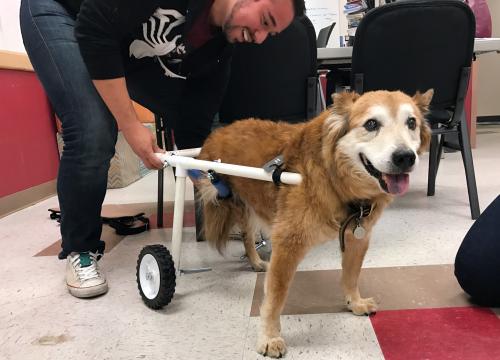
Kita dog in special wheelchair

Arturo Dominguez, a New Mexico State University College of Engineering student, fits nearly 17-year-old Kita with a wheelchair that was designed and built in the Aggie Innovation Space.

Dominguez said the group faced many design challenges throughout the duration of this project.

“Some of our initial design considerations required us to adjust the height of the device while ensuring that we provided adequate support of the shoulders and hips so as to minimize weight on pressure points,” Dominguez said. “As we adjusted the saddle mechanism in the device, we had to be sure not to pinch or irritate the underbelly and other sensitive areas of the dog.”

Perez said the challenges and hours spent working on this project was worth it when she and her fellow Aggie Innovators saw Kita run freely in the device and saw the happiness expressed in Lebsock’s reaction.

“This project reminded us how engineers can enhance quality of life, and made us realize that our duty as engineers is not just for people and the environment but for our furry friends that make our lives happier,” Perez said.

Source:  New Mexico State University media release

Spreading the word about dog massage

Dog massage??? What???!!!!

I get this fairly often; it doesn’t bother me.

One of the best ways I have found to give dog owners (and their d0gs) a bit of a taste for what I can do for them is to attend public events.  This weekend, I participated in the first annual Bark in the Park at Ferrymead Heritage Park.  The historic park was opened to dogs and their families to enjoy for the day.

Dogs rodethe trams, had posters printed for them on the authentic printing press, attended a blessing of the animals ceremony and were treated to frozen slushies made with chicken stock.  There was a series of guest speakers, including me.

I was consistently busy throughout the day at my stall as dog after dog came to see me for massage.  Dogs of all sizes, too!

Here are a few snaps from the day:

Every dog enjoyed their massage and owners were surprised at how quickly their dog relaxed and got into ‘the zone’ (as I call it).

Lesson for the day:  don’t knock it until you’ve tried it.  If you are a local Canterbury resident who missed out on Bark in the Park, the event is likely to become an annual one.  And you can always reach me here at The Balanced Dog to discuss your dog and how massage, laser, trigger point and food therapies can help your dog.

Kathleen Crisley, specialist in dog massage, rehabilitation and nutrition/food therapy, The Balanced Dog, Christchurch, New Zealand

Colloidal silver

colloidal-silver

I recommend keeping a bottle of colloidal silver at home for all minor skin scratches and wounds.  As it turns out, so does my vet!

Izzy is a greyhound and they are known for their thin skin which is easily damaged.  She had a run of wounds in November and December, thanks in part to doing zoomies in our yard and running into branches.

I cleaned these wounds twice a day using colloidal silver solution. I took her to the vet about 3 days in to ensure that she was happy with the healing.  She was and told me that vets (like human doctors) are starting to be more cautious when prescribing antibiotics because of the proven problems associated with over-use (in particular, the development of antibiotic-resistant superbugs).

Colloidal silver is a natural antibacterial and also has antiviral and anti-inflammatory properties.  This makes it a great addition to your pet first aid kit.  And, your dog thinks that you are simply using water on their sore spots!

Kathleen Crisley, specialist in dog massage, rehabilitation and nutrition/food therapy, The Balanced Dog, Christchurch, New Zealand


Prescription diets – what’s the truth?

Prescription diet foods, both canned and dry, are often recommended to match a specific health condition in an animal.  Most owners know how expensive these foods can be, and yet they want to feed something that will help their pet’s health.

There is lots of information written by holistic veterinarians about the quality of ingredients in these foods and whether they are truly biologically appropriate for animals.  In my massage workshops for owners, we go through a module on label reading as an introduction to understanding what is in commercially-made pet foods and what makes one food ‘better’ than another…

Recently, a class action lawsuit was filed in the U.S. District Court of Northern California listing these companies as defendants:

  • Mars PetCare
  • Hill’s Pet Nutrition
  • Nestlé Purina Petcare
  • Banfield Pet Hospital
  • Blue Pearl Pet Hospital
  • PetSmart
The plaintiffs are pet owners who had purchased prescription diets from one or more of the above companies and they argue that the companies conspired with each other to falsely promote prescription pet foods and, more importantly, that none of the ingredients in the foods are drugs or medications that would be subject to a prescription under the food and drug regulations.  The plaintiffs argue that this is false marketing; some of the plaintiffs appear to say that veterinarians in some of the pet hospitals ‘prescribed’ the foods without even examining their animal.

The main brands involved in the case are:
  • Hill’s Prescription Diet hills-prescription-diets
  • Purina Pro Plan Veterinary Diets
  • Royal Canin Veterinary Diet
  • Iams Veterinary Formula
pro-plan-veterinary-dietsAs pet parents are a large group of consumers, it’s important that we understand nutrition and ask questions of professionals that recommend diets.  This is everyone who tries to sell you pet food – not just vets, may I add.  In our local market in New Zealand, there are dog trainers and pet shops that sell food and have a vested interest in recommending certain products to owners.
royal-canin-veterinary-dietiams-veterinary-formula

For me, the question to ask is how any food or supplement may help to nutritionally support your pet’s health condition.  It’s also worth asking what feeding or clinical trials were done on foods professing to be specifically for treatment of a health condition.

The grounds for the lawsuit make very interesting reading You can read a copy of the lawsuit filed in the court here.

And if you are based in the USA, have purchased prescription diet foods within the last four years,  and may wish to consider joining the class action, this is the website of the law firm representing the plaintiffs.

There will be more to come on this case; the plaintiffs are seeking a trial by jury.  I can’t even say at this point that the jury is out…
Kathleen Crisley, specialist in dog massage, rehabilitation and nutrition/food therapy, The Balanced Dog, Christchurch, New Zealand