Category Archives: dog care

Building a dog wheelchair

During the fall semester, three College of Engineering students working as on-campus co-ops at New Mexico State University designed and built a wheelchair device to assist a dog who had his right hind leg amputated due to cancer.

“When I started to research mobility options to help Kita after his amputation to remove bone cancer, there were a lot of ideas online about using 3-D printers to create custom dog wheelchairs or walkers,” owner Michelle Lebsock said. “Even in his old age, Kita is the type of dog who absolutely loves walks, and although he healed well and adjusted to getting around on three legs, he would get tired very quickly and I could tell he really missed his long walks.”

After realizing regular pet wheelchairs wouldn’t work for Kita, Lebsock contacted the Aggie Innovation Space for advice on do-it-yourself dog wheelchair instructions she had found online.

“I first spoke to Natalia, and instead of just offering advice she took on the project as her own,” Lebsock said. “The talented engineering students at the AIS including Natalia, Abdiel and Arturo worked all semester to create a functional and ergonomic device that was custom-built for Kita. Even though the idea of 3-D printing brought me to the lab, the final product used traditional materials, and the students worked tirelessly to make sure each piece was exactly right. Their work has made one little three-legged dog and his owner very happy.”

Kita dog with wheelchair and students who designed it

New Mexico State University College of Engineering students and Aggie Innovation Space mentors (from left to right) Natalia Perez, Abdiel Jimenez and Arturo Dominguez designed and developed a wheelchair for Kita and his owner Michelle Lebsock. Kita’s right hind leg was amputated due to cancer in spring 2016.

“The AIS team became very passionate about this project sharing ideas, collaborating to assess specific constraints and requirements, and evaluating ideas for build-out materials. Collectively, we were able to design a device that was cost effective, functional, comfortable, strong enough to support the weight of the dog, and ultimately, easy to use,” Jimenez said. “We selected specific materials and specific design features to meet the unique needs of Kita. Michelle was kind enough to give us feedback, which allowed us to further refine the design.”

Throughout the fall, Perez, Jimenez and Dominguez met with Kita and Lebsock many times to determine the correct height, comfort, and restraint requirements of the device. Ease of assembly and disassembly were also important factors the Aggie Innovators had to consider to ensure the device was portable and easy to use.

“We were excited to have met a functional level of comfort for Kita with our first design, as he realized he could move around freely,” Dominguez said. “From there, we studied and evaluated Kita’s movement in the device, which allowed us to adjust the design to make it more comfortable and functional. With each iteration, Kita became more and more comfortable. During our final test, Kita was able to run for the first time since surgery and was able to move much more naturally. We then spent a week enhancing a few aesthetic features and branded it NMSU, including a specialized 3-D printed name plate.”

Kita dog in special wheelchair

Arturo Dominguez, a New Mexico State University College of Engineering student, fits nearly 17-year-old Kita with a wheelchair that was designed and built in the Aggie Innovation Space.

Dominguez said the group faced many design challenges throughout the duration of this project.

“Some of our initial design considerations required us to adjust the height of the device while ensuring that we provided adequate support of the shoulders and hips so as to minimize weight on pressure points,” Dominguez said. “As we adjusted the saddle mechanism in the device, we had to be sure not to pinch or irritate the underbelly and other sensitive areas of the dog.”

Perez said the challenges and hours spent working on this project was worth it when she and her fellow Aggie Innovators saw Kita run freely in the device and saw the happiness expressed in Lebsock’s reaction.

“This project reminded us how engineers can enhance quality of life, and made us realize that our duty as engineers is not just for people and the environment but for our furry friends that make our lives happier,” Perez said.

Source:  New Mexico State University media release

Spreading the word about dog massage

Dog massage??? What???!!!!

I get this fairly often; it doesn’t bother me.

One of the best ways I have found to give dog owners (and their d0gs) a bit of a taste for what I can do for them is to attend public events.  This weekend, I participated in the first annual Bark in the Park at Ferrymead Heritage Park.  The historic park was opened to dogs and their families to enjoy for the day.

Dogs rodethe trams, had posters printed for them on the authentic printing press, attended a blessing of the animals ceremony and were treated to frozen slushies made with chicken stock.  There was a series of guest speakers, including me.

I was consistently busy throughout the day at my stall as dog after dog came to see me for massage.  Dogs of all sizes, too!

Here are a few snaps from the day:

Every dog enjoyed their massage and owners were surprised at how quickly their dog relaxed and got into ‘the zone’ (as I call it).

Lesson for the day:  don’t knock it until you’ve tried it.  If you are a local Canterbury resident who missed out on Bark in the Park, the event is likely to become an annual one.  And you can always reach me here at The Balanced Dog to discuss your dog and how massage, laser, trigger point and food therapies can help your dog.

Kathleen Crisley, specialist in dog massage, rehabilitation and nutrition/food therapy, The Balanced Dog, Christchurch, New Zealand

Colloidal silver

colloidal-silver

I recommend keeping a bottle of colloidal silver at home for all minor skin scratches and wounds.  As it turns out, so does my vet!

Izzy is a greyhound and they are known for their thin skin which is easily damaged.  She had a run of wounds in November and December, thanks in part to doing zoomies in our yard and running into branches.

I cleaned these wounds twice a day using colloidal silver solution. I took her to the vet about 3 days in to ensure that she was happy with the healing.  She was and told me that vets (like human doctors) are starting to be more cautious when prescribing antibiotics because of the proven problems associated with over-use (in particular, the development of antibiotic-resistant superbugs).

Colloidal silver is a natural antibacterial and also has antiviral and anti-inflammatory properties.  This makes it a great addition to your pet first aid kit.  And, your dog thinks that you are simply using water on their sore spots!

Kathleen Crisley, specialist in dog massage, rehabilitation and nutrition/food therapy, The Balanced Dog, Christchurch, New Zealand


Prescription diets – what’s the truth?

Prescription diet foods, both canned and dry, are often recommended to match a specific health condition in an animal.  Most owners know how expensive these foods can be, and yet they want to feed something that will help their pet’s health.

There is lots of information written by holistic veterinarians about the quality of ingredients in these foods and whether they are truly biologically appropriate for animals.  In my massage workshops for owners, we go through a module on label reading as an introduction to understanding what is in commercially-made pet foods and what makes one food ‘better’ than another…

Recently, a class action lawsuit was filed in the U.S. District Court of Northern California listing these companies as defendants:

  • Mars PetCare
  • Hill’s Pet Nutrition
  • Nestlé Purina Petcare
  • Banfield Pet Hospital
  • Blue Pearl Pet Hospital
  • PetSmart
The plaintiffs are pet owners who had purchased prescription diets from one or more of the above companies and they argue that the companies conspired with each other to falsely promote prescription pet foods and, more importantly, that none of the ingredients in the foods are drugs or medications that would be subject to a prescription under the food and drug regulations.  The plaintiffs argue that this is false marketing; some of the plaintiffs appear to say that veterinarians in some of the pet hospitals ‘prescribed’ the foods without even examining their animal.

The main brands involved in the case are:
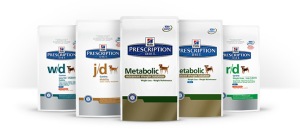
  • Hill’s Prescription Diet hills-prescription-diets
  • Purina Pro Plan Veterinary Diets
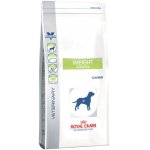
  • Royal Canin Veterinary Diet
  • Iams Veterinary Formula
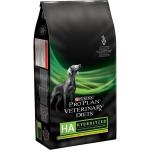
pro-plan-veterinary-dietsAs pet parents are a large group of consumers, it’s important that we understand nutrition and ask questions of professionals that recommend diets.  This is everyone who tries to sell you pet food – not just vets, may I add.  In our local market in New Zealand, there are dog trainers and pet shops that sell food and have a vested interest in recommending certain products to owners.
royal-canin-veterinary-dietiams-veterinary-formula

For me, the question to ask is how any food or supplement may help to nutritionally support your pet’s health condition.  It’s also worth asking what feeding or clinical trials were done on foods professing to be specifically for treatment of a health condition.

The grounds for the lawsuit make very interesting reading You can read a copy of the lawsuit filed in the court here.

And if you are based in the USA, have purchased prescription diet foods within the last four years,  and may wish to consider joining the class action, this is the website of the law firm representing the plaintiffs.

There will be more to come on this case; the plaintiffs are seeking a trial by jury.  I can’t even say at this point that the jury is out…
Kathleen Crisley, specialist in dog massage, rehabilitation and nutrition/food therapy, The Balanced Dog, Christchurch, New Zealand

How to Deal with a Crotch Hound

We all know the type…but are probably afraid to classify our own dogs as Crotch Hounds since it sounds so rude.  The dog trainer is this video calls the behavior ‘checking the oil’ when visitors arrive!

Here’s a new video with some advice on how to re-train your dog so your visitors are greeted in a more socially acceptable way.

Kathleen Crisley, specialist in dog massage, rehabilitation and nutrition/food therapy, The Balanced Dog, Christchurch, New Zealand

BPA (Bisphenol A) in Canned Dog Foods

Note from DoggyMom:

When buying plastic containers for temporary food storage, drink bottles, etc, I always look for “BPA free” labeling.  BPA is an endocrine disruptor and many consumers don’t know to look for this – most of the plastic containers being sold in the ‘$2 shops’ in New Zealand are not BPA free, for example.   In this study, the researchers fed dogs only canned (tinned) food and found significant increases in the levels of the BPA in the dogs – even in tins that were supposedly BPA free.

Very concerning if you are feeding only canned food!


Bisphenol A (BPA) is a widely used industrial chemical found in many household items, including resins used to line metal storage containers, such as food cans. Now, researchers at the University of Missouri have found that short-term feeding of canned dog food resulted in a significant increase of BPA in dogs. Scientists believe that because of shared environments, dog exposure to BPA through canned foods could have human health implications.  tinned-dog-food

“Bisphenol A is a prevalent endocrine-disrupting chemical found in canned foods and beverages,” said Cheryl Rosenfeld, an associate professor of biomedical sciences in the MU College of Veterinary Medicine and an investigator in the Bond Life Sciences Center. “We wanted to determine if short-term feeding of widely available commercial canned food could alter BPA concentrations in dogs. Thus, we assessed BPA contained within pet food cans. We also analyzed whether disturbances in bacteria found in the gut and metabolic changes could be associated with exposure to BPA from the canned food.”

Dog owners volunteered their healthy pets for the study. Blood and fecal samples were collected prior to the dogs being placed on one of two commonly used, commercial canned food diets for two weeks; one diet was presumed to be BPA-free. Robert Backus, an associate professor in the Department of Veterinary Medicine and Surgery in the MU College of Veterinary Medicine, and other researchers on the team then analyzed the cans and the food contained in the cans for BPA levels and performed gut microbiome assessments.

“The dogs in the study did have minimal circulating BPA in their blood when it was drawn for the baseline,” Rosenfeld said. “However, BPA increased nearly three-fold after being on the either of the two canned diets for two weeks. We also found that increased serum BPA concentrations were correlated with gut microbiome and metabolic changes in the dogs analyzed. Increased BPA may also reduce one bacterium that has the ability to metabolize BPA and related environmental chemicals.”

Dogs who share internal and external environments with their owners are likely excellent indicators of the effects of BPA and other industrial chemicals on human health.

“We share our homes with our dogs,” Rosenfeld said. “Thus, these findings could have implications and relevance to humans. Indeed, our canine companions may be the best bio-sentinels for human health concerns.”

Source: University of Missouri press statement

Prepared for emergencies

We (New Zealand) has been in the news this week for all of the wrong reasons.  A 7.8 magnitude quake in the South Island with rural communities like Waiau and Kaikoura hit the hardest.  Being only 2 1/2 hours south of the epicenter of the quake, those of us in Christchurch felt it strongly – shaking and rolling for almost a full 2 minutes.  We’ve been through this in 2010 and again in 2011 – and our city is still rebuilding.

I decided that the item on my TO DO list to refresh my emergency supplies had better go to the top.  We know that we have many fault lines in the country and shaking on one can trigger activity in another.  Basically all New Zealanders should be ready for quake activity at all times.

Emergency supplies

I have refilled my drinking water supplies (40 litres), for example.  I aim to do this every 6 months and so I have marked my calendar for when 6 months is up.  I bought new resealable containers this weekend and filled them with Izzy’s dry food., and I’ve taken the time to put more of my supplies in one place – the large plastic container is also new.

First aid kits for humans and dogs are in there.  Also a dog bowl, extra leash and collar.  Copies of Izzy’s vaccination record, microchip number and pet insurance are inside a zipped plastic bag and saved electronically in the cloud. We forget sometimes how much we rely on electronic records.  If the Big One hits, our power supplies will be down for some time.  Good old hard copies are worth keeping and updating.

I even realised that my email address on the NZ Companion Animal Register for Izzy’s microchip is outdated and so I’ll be phoning them in the morning to change it.

My water purification tablets have expired.  So a trip to the pharmacy this week is planned.

Izzy has a spare dog coat packed, along with a towel and temporary bed.  A new tennis ball for fun is also packed.  I’ve also ordered some more dehydrated dog food.

And one of the things that many emergency lists forget is a stake and chain – which I have had for years.  In a severe earthquake, fences will come down.  Your dog will need to be restrained safely wherever you are and you cannot rely on rope to tie them up.  A stressed dog can chew through that in minutes and be gone.

I also have an old dog tag that I’ve covered with a label.  A pen and paper are also in my kit.  I can leave notes if I need to but also write our temporary address on the dog tag because who knows where we may end up as temporary shelter…

From personal experience, I can tell you that during the first earthquake of 2010, I was much more calm knowing that I had supplies and was prepared.  I set about checking the safety of my house and setting up things like an emergency toilet…I was ready!

If you don’t prepare for yourself, then do it for your dog.  They rely on us for the care and safety.

Kathleen Crisley, specialist in dog massage, rehabilitation and nutrition/food therapy, The Balanced Dog, Christchurch, New Zealand
Eggshells – a natural source of calcium

I like using wholefoods and avoiding waste – reasons why I make my own dog treats and why I feed my dog a hybrid diet (incorporating raw, homemade and commercial foods).

In the case of egg shells, I used to put them in my compost pile.  But, they always seemed to the source of attraction for rats (yuck!). I could throw them in my  green organics bin that is collected each week; this is taken away to a commercial composting operation – but of course from a sustainability point of view, we’re using trucks and diesel to cart waste away.

There’s another option – making some natural calcium supplement for my dog.

And it’s very easy to do!

First, after I use eggs for baking or cooking, I gather the shells and leave them out on my kitchen bench to to dry for 24 hours.  After that, I store them in refrigerator to keep them from growing bacteria.

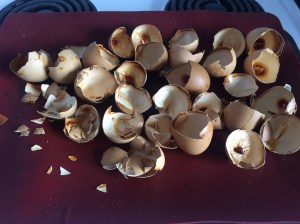
Then I arrange them on a baking tray and bake them for 5 minutes at 180 degrees C (roughly 350 degrees F).  Then I turn the oven off and let the shells cool in the oven.

This is what the look like when they are finished:

eggshells-after-baking

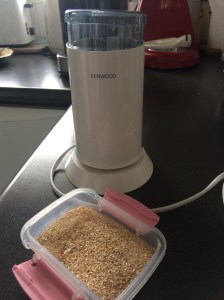
Final step:  into the coffee grinder.  After just a few pulses, I have a fine calcium powder.

grind

I keep the calcium powder in the refrigerator for up to 2 weeks; using 1/2 teaspoon mixed into raw food per meal.

Dogs need calcium in their diet and I am confident in feeding this to Izzy, who is a large-breed dog with no health problems.  For all dogs, we need to be confident in their health status before deciding to feed certain foods and supplements.

Kathleen Crisley, specialist in dog massage, rehabilitation and nutrition/food therapy, The Balanced Dog, Christchurch, New Zealand
Time to budget

It’s a holiday weekend in New Zealand  – for Labour Day.  And every year this holiday also marks the start of the pre-Christmas season.  christmas_dog_highdefinition_picture_168935

As many of you understand, Christmas falls in the summer school holiday period in New Zealand. Many companies shut down during this time and require their workers to take some of their annual leave, since trading can be minimal or non-existent.    If workers don’t have enough paid days, then it can mean time off without pay.

And every year, for a range of reasons including more money being spent on holidays, entertaining and gifts, I see owners who can’t fund the full costs of their dog’s care.

This blog post is a reminder about the items you need to set money aside for in your end of year budget. And the time to budget is NOW.

dog-budgeting

  • Food
  • Treats
  • Medications
  • Supplements
  • Costs for vet care, such as visits for required vaccinations if you are boarding your dog
  • Boarding and care costs, if you are heading away

Just as in people, medications and supplements are only effective if their dosage is kept up.  And dogs on things like pain medication will suffer with break-through pain as medications wear off.  In other cases – let’s say heart medication – stopping this medication could be life-threatening.

Because of their stoic nature, dogs often hide their pain and/or owners miss the signals – such as withdrawing from activity – which are indicators of a dog in pain.  For this reason, some owners think they can get away with a ‘short break’ from medication.

With supplements, once the loading doses are given and the effective dose is reached, there is a level of stability with the coverage given by the supplement.  Stop giving it and you are faced with starting a loading dose all over again.  Many owners miss this step and go back to regular dosages, further compromising the value to the dog of giving the supplement in the first place!

When we take on a dog into our family, we’re responsible for lifetime care as with any other family member.  When there is only so much money to go around, sometimes the silent member of the family – the dog – is the one to miss out.

Please remember health care is a basic right for all animals and plan your holiday budget accordingly.  If that means less money for Christmas festivities – so be it.

Kathleen Crisley, specialist in dog massage, rehabilitation and nutrition/food therapy, The Balanced Dog, Christchurch, New Zealand

Intestinal health can impact dog behavior

intestinal-health-can-impact

Photo credit: University of Helsinki

General fearfulness, sensitivity to noise as well as hyperactivity and impulsiveness are the most common behavioural problems in dogs. At their worst, they can have a very negative impact on the wellbeing of the dog and owner alike.

“Behaviour and behavioural disorders often develop as a combination of hereditary and environmental factors, which makes studying them challenging. Metabolomics, or the study of the metabolism, provides us with new clues on the biological issues underpinning behavioural disorders while promoting genetic research. At the moment, metabolomics research in dogs is rare, and the purpose of this pilot study was to examine new approaches and attain information on any metabolic abnormalities associated with hyperactivity in dogs,” explains Professor Hannes Lohi of the University of Helsinki  and the  Folkhälsan Research Centre.

Ab­nor­mal meta­bolic blood test res­ults in hy­per­act­ive dogs

Determining the blood metabolites in hyperactive and normally behaved German Shepherds revealed a significant link between hyperactivity and lower blood phospholipid levels.

“We knew to expect this discovery from research on the human side, as several studies have recorded lower blood lipid and fatty acid levels in ADHD patients than in control groups. However, the causal relationship is not clear and requires further studies, particularly ones with more extensive research data. Our discovery supports the existing belief that human and canine diseases are similar, which suggests dogs can serve as excellent models for human illnesses,” states doctoral student Jenni Puurunen.

“It is significant that the dog’s age, sex or fasting had little impact on the link between behaviour and metabolites. We also controlled for dietary changes by feeding all dogs the same food for two weeks before testing,” explains Puurunen.

In­test­inal health can im­pact can­ine be­ha­viour

One of the most interesting discoveries in the study was the negative correlation between hyperactive behaviour and the levels of the metabolites of tryptophan, a vital amino acid. This metabolite is only produced when intestinal bacteria process the tryptophan received in food. The discovery suggests differences in the gut bacteria of hyperactive and normally behaved dogs, which is very significant in light of the discovery made a few years ago about the connection between the brain and the intestines.

“We know that the composition of the gut microbiota significantly influences the creation of neurotransmitters, for example, those which regulate mood and behaviour. The effect also works vice-versa, so that a stress reaction in the brain can have an adverse effect on the gut microbiota. Consequently, we cannot tell whether our discovery is the cause of canine hyperactivity or its consequence,” Puurunen says.

A glob­ally unique meta­bolo­m­ics pro­ject is un­der­way

Earlier this year, Lohi’s research group released an article on a study of the metabolomics of fearful dogs, which revealed differences between the blood counts of fearful and fearless dogs. However, more extensive research is required to confirm these pilot-stage findings. The research group has launched an extensive collection of samples to test new metabolomics technology together with the company Genoscoper. If successful, the new system could become a significant tool to speed up genetic research, particularly as it relates to behavioural studies.

The study is part of a more extensive canine behaviour project underway at the research group. The project seeks to determine the environmental and hereditary factors as well as metabolic changes relating to behaviour and behavioural disorders, and map their similarities with corresponding illnesses in humans.

Source:  University of Helsinki media release