Category Archives: dog ownership

Saving the whole family

As the Northern Hemisphere enters its hurricane season, it’s a useful time to review your plans for disaster preparedness regardless of your location in the world.

In New Zealand, as our seismic activity continues to make the news, it’s important to be ready regardless of season.  Things like refreshing your stored water supply, for example.  And if you don’t have a bottled water supply, get one!  This includes storing enough water for 3 days for you and your animals.

The American Veterinary Medical Association (AVMA) distributed this video last year.  It outlines the things you need as a pet parent and not just things for dogs.  I have clients on lifestyle blocks with horses, for example.  Although I don’t know much about horse care, I can certainly understand the need to have harnesses and a trailer ready for evacuation.

The video mentions how to make a temporary dog tag out of a luggage tag. This may work for larger dogs, but is impractical for small breed dogs.

What I prefer is to have an old dog registration tag in my emergency kit.    It’s been covered with a blank label and I have a pen in the kit.

If we had to evacuate to a temporary location, I will write our contact details on this temporary tag.

I’m also a supporter of micro chipping, which is compulsory for dogs in New Zealand.

Kathleen Crisley, specialist in dog massage, rehabilitation and nutrition/food therapy, The Balanced Dog, Christchurch, New Zealand

Burials with your pet

No one gets out of life alive – not us and not our pets.

But it can be problematic when one wants to be buried with their pet’s remains.  In many locations, this isn’t allowed.

A state Senate bill in New York is making its way through the legislative process that would allow cremated pet remains to be buried in human cemeteries.  In 2014, another regulation allowed pet cemeteries to accept human remains.

Cemetery

Assemblyman James Brennan of Brooklyn, sponsored the measure saying that with increased rates of pet ownership “has come a significant shift in the desire of New Yorkers to have their pets interred in their grave, crypt or niche.”

Source:  New York Post


Senior adults see benefits from dog ownership

The Centers for Disease Control and Prevention (USA) recommends that adults of all ages should engage in 150 or more minutes of moderate physical activity per week. Among adults 60 years of age or more, walking is the most common form of leisure-time physical activity because it is self-paced, low impact and does not require equipment.

Johnson and Dog - senior dogs

Rebecca Johnson and her team determined that older adults who also are pet owners benefit from the bonds they form with their canine companions. Photo by University of Missouri

Researchers at the University of Missouri have determined that older adults who also are pet owners benefit from the bonds they form with their canine companions. Dog walking is associated with lower body mass index, fewer doctor visits, more frequent exercise and an increase in social benefits for seniors.

“Our study explored the associations between dog ownership and pet bonding with walking behavior and health outcomes in older adults,” said Rebecca Johnson, a professor at the MU College of Veterinary Medicine, and the Millsap Professor of Gerontological Nursing in the Sinclair School of Nursing. “This study provides evidence for the association between dog walking and physical health using a large, nationally representative sample.”

The study analyzed 2012 data from the Health and Retirement study sponsored by the National Institute on Aging and the Social Security Administration. The study included data about human-animal interactions, physical activity, frequency of doctor visits and health outcomes of the participants.

“Our results showed that dog ownership and walking were related to increases in physical health among older adults,” said Johnson, who also serves as director of the Research Center for Human-Animal Interaction at MU. “These results can provide the basis for medical professionals to recommend pet ownership for older adults and can be translated into reduced health care expenditures for the aging population.”

Results from the study also indicated that people with higher degrees of pet bonding were more likely to walk their dogs and to spend more time walking their dogs each time than those who reported weaker bonds. Additionally, the study showed that pet walking offers a means to socialize with pet owners and others.

Retirement communities also could be encouraged to incorporate more pet-friendly policies such as including dog walking trails and dog exercise areas so that their residents could have access to the health benefits, Johnson said.

Source:  University of Missouri media release

Pet friendly senior living

TigerPlace is a retirement community that helps residents care for their pets as both age.

Located in Colombia, Missouri, this retirement community offers one-floor living to make it easy for owners and pets to enjoy the outdoors.  And there’s on-site veterinary care!Senior gentleman and dog sitting on ground and posing in a park

Described as “pet encouraging” as opposed to “pet tolerating”, this facility even offers dog walkers for older residents who are finding it difficult to give their dog the exercise it needs.

This article in the Missourian gives greater insight into the facility and its value to its residents.  This includes following 90-year old Elizabeth Kennedy who lives at TigerPlace with her 12-year old Boston Terrier, Dolly.

The article mentions a growing trend for retirement communities to offer pet care and the  recognition and evidence that pets keep us living longer, more active, and happier lives.

Kathleen Crisley, specialist in dog massage, rehabilitation and nutrition/food therapy, The Balanced Dog, Christchurch, New Zealand


Responsibility

I’ve been to the supermarket today and, although I don’t have human babies, I purchased something from the baby aisle:

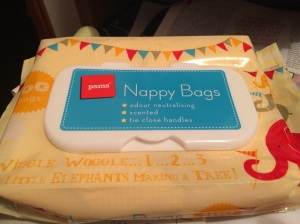
Nappy bags

I consider this purchase a badge of honour.  Nappy bags (diaper bags for those of you who live in the USA/Canada) are an excellent tool for picking up dog poo.  I just got 100 bags for only $2.15 (a much better price than purchasing special doggy doo bags from the pet store).

Sadly, I think I am in the minority when it comes to dog owners.  Or, at least that’s the way I feel.  Today, I took Izzy for a walk in a local park after going to the supermarket and I counted 4 piles of poo that owners had not picked up.

One of them was in a field used for cricket on the weekends.

It’s a sign that we have too many irresponsible dog owners in Christchurch.  And in today’s paper – Mike Yardley – a local commentator, agrees.  He laments the pitiful rate of enforcement by our Council and calls upon members of the public to name and shame.

If you see a dog owner blithely pretend their animal hasn’t just crapped all over the footpath – have a crack at them. Shame them into behaviour change, because the council probably won’t police it.

That’s fine – to a point.  When you feel safe to do so.  But we also need greater enforcement so people take dog-owning responsibilities seriously.  And we shouldn’t let the Council, which uses our taxes (rates and dog registration fees) to fund its activities, off the hook when it comes to its responsibility.

Kathleen Crisley, specialist in dog massage, rehabilitation and nutrition/food therapy, The Balanced Dog, Christchurch, New Zealand
Patience

Patience

Some people find it hard to believe that a dog professional like myself has never raised a dog from a puppy.  That’s because my family raised me with the idea that you adopt, rather than buy, a dog.  And by default that has steered me into a life with re-homed dogs – both mixed breeds and purebreds – who have entered my life at different ages.

My first dog came from a shelter; my second came from a supermarket ‘free to a good home’ ad; my third was a private adoption facilitated by a local rescue group (but she had never lived in their shelter); my fourth was a word-of-mouth adoption of Daisy, a purebred Pointer, who had bounced back to her breeder through no fault of her own.  And now, I have Izzy who is a retired racing greyhound.

It’s a myth that ‘rescue’ dogs are all mixed breeds; many pure bred dogs also find themselves in need of re-homing.  Responsible breeders will take back a dog for any reason during the lifetime of the dog.  So, for example, in cases of divorce or an owner’s death, these dogs come up for adoption – and that’s only a couple of examples.  There are also breed specific rescue groups who are passionate supporters of a breed and work to re-home dogs who have fallen on bad times.

What my life of adopting dogs has taught me is patience.  It’s great to go out and buy the dog a bed, food and toys and envisage a perfect life together.  And it will be good- but there are usually teething problems.

For example, when I adopted Izzy , she was suffering from re-homing stress.  She was overwhelmed by her surroundings in my home – it was totally foreign territory.  She was off her food and made herself a bed on a blanket by the front door.  She remained there for almost 2 weeks (only moving to eat or drink or go out for walks) until she got her confidence to explore more of the house.

It took her 2 months to venture confidently into my bedroom (where large windows looking out onto the garden seemed to overwhelm her).  She did not get on my bed for almost 4 months.

We had a few toileting incidents but that was also because she was getting used to new food and was already stressed from her change of circumstances.  Whose tummy wouldn’t cause them problems?

But we got there and that takes patience.  When I do home-checking for Greyhounds as Pets, I get an idea about how well the family is prepared to be patient with their new dog.

A prospective owner with a very strict timeline for getting their dog settled is unlikely to be successful – the dog doesn’t know about the timeline.

The best advice I can give is – be patient.  If anything, give your new dog some space.  Let them decide when they are comfortable in trying new things and don’t overwhelm them with affection too soon.

It’s worth the wait.

Kathleen Crisley, specialist in dog massage, rehabilitation and nutrition/food therapy, The Balanced Dog, Christchurch, New Zealand


Firefighters rescue dog from burning home

A Sacramento homeowner’s smoke alarms did their job this week by waking the family so they could evacuate and raise the alarm with fire crews.

Unfortunately, it looks like their dog was left inside (dogs may run and hide during these situations; there is commotion and stress and people do not always think clearly – in terms of being able to get their dog out of the house with them).

Fire video screen shot

The Sacramento Fire Department did a great job in finding the dog, and his rescue was caught on ‘helmet cam’

You can view the video by following this link to a CBS news report.  The video is also available on the Fire Department’s Facebook page.

Smoke alarms save lives.  Tomorrow is Valentine’s Day – show your dog that you love them by checking that your smoke alarms are working.

Kathleen Crisley, specialist in dog massage, rehabilitation and nutrition/food therapy, The Balanced Dog, Christchurch, New Zealand

Image

A dog’s prayer

A dog's prayer

What a veterinarian and a dog massage therapist have in common

I came across an article recently which was a sort of a “Vets Tell You What They Really Think” piece.  It listed 50 things that the veterinarian would love to say, but can’t, because it would be either too forward or too unprofessional (or both).

One of these really stood out for me:

“Here’s a pet peeve: owners who don’t want to pay for diagnostic tests but then cop an attitude because you don’t know what’s wrong with the animal. Since you wouldn’t let me do the blood work or X-rays, how the heck do you expect me to know?”A vet in South Carolina.

I’m in total agreement with this vet.  If we don’t have a diagnosis how are we able to help?

Believe it or not, I get contacted fairly regularly from people who want me to come and work on their dog because they don’t want to pay for x-rays or other tests.  In such cases, I tell them politely that I need a diagnosis to be able to confidently work with their animal.  The risk is too high that, for example, if the dog has spinal injury I can make it worse rather than better.

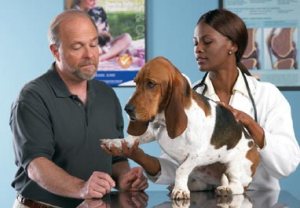
Costs for veterinary care can be high, but you pay for the skills and the tools that are available to a veterinarian.  The vet is your dog’s equivalent of the Family Doctor/General Practitioner and sometimes the Emergency Room Doctor combined.  Your dog needs them!

dog and vet

There are times I’ve been caught.  Such as the case where the owners said x-rays had been taken and we worked for quite a few weeks on the dog only to suffer setbacks.  The owners were getting frustrated.   I suggested other things within my scope of practice and I recommended they go back to the vet.

That’s when I found out that the owner had only allowed the vet to take a single x-ray to save money.  The x-ray didn’t reveal anything in the lower spine and so the vet  assumed a partial tear of the cruciate based solely on symptoms.  And that’s the diagnosis I was working with, too.

When the owners returned to the vet, they were persuaded to do more scans and that’s when the problem (and a totally different diagnosis) was determined.

In the end, these owners probably spent more money than they saved.  And  their dog walked around with an injury that was even more difficult to address.

My advice to owners is to only bring a dog into your life when you are confident that you can pay for their care (and that’s means more than just vaccinations, food and flea treatments).  And if you have concerns about your ability to pay for injuries and illness – get pet insurance.  Some policies even cover costs of complementary care such as dog massage when these treatments are recommended by your vet.

I know that some owners like the idea of setting aside money regularly; my concern is that you would have to be setting fairly large amounts aside regularly for a bank balance with compounding interest to reach into the thousands.  And that’s what some of my clients face when surgeries and special procedures are needed.

Your vet is an essential part of your health care team.  We all need a solid diagnosis to help your dog feel better.

Kathleen Crisley, specialist in dog massage, rehabilitation and nutrition/food therapy, The Balanced Dog, Christchurch, New Zealand

Life after Buddy

This article (Hounded by Grief), courtesy of the WBUR, Boston’s National Public Radio station, starts with the haunting words:

I am dogless.  Again.

Boston journalist Anita Diamant pictured with Buddy at Good Harbor Beach in Gloucester, Mass., winter 2013. (photo by Ms Diamant)

Boston journalist Anita Diamant pictured with Buddy at Good Harbor Beach in Gloucester, Mass., winter 2013. (photo by Ms Diamant)

For all of us who have loved a series of dogs, including a special ‘heart dog,’ I think some of the words will resonate with you.

Kathleen Crisley, specialist in dog massage, rehabilitation and nutrition/food therapy, The Balanced Dog Ltd, Christchurch, New Zealand