Tag Archives: patience

Co-operative care – it can be done!

There’s a chap who regularly turns up at pet events in the area, like the recent Selwyn Pet Expo. He seems to take great pleasure in coming into my stall, picking up a dog toothbrush, and loudly exclaiming that it would never work.

I say that you can’t expect most dogs to accept teeth brushing immediately but it is the Gold Standard for good dental health. I explain the process of de-sensitisation and counter-conditioning to achieve co-operative care.

Make it a positive experience and be patient.

  • let the dog see the brush every day in the living environment, such as on a table
  • play and handle the brush with the dog looking
  • introduce toothpaste on it and allow the dog to lick it off, if it chooses (remember that pet toothpaste is formulated to taste good). Use praise and additional treats to reinforce that licking the toothbrush is a wanted behaviour.
  • after the dog is regularly accepting the toothpaste, gently raise a lip and touch the brush to the teeth and withdraw – with treats/praise all the way.
  • progress slowly to introducing the brush into the mouth and then withdraw treats (but always praise)

“Nope. Nope” he says. “Won’t work” as he walks away…

I wish him well in spending lots of money at the vet for routine professional cleanings under general anaesthetic (and silently send good thoughts to his poor dog).

In the meantime, I hope he sees this post and video. The keepers at London Zoo use the same principles with the wild animals in their care. Co-operative care strategies enable each animal to actively take part in their weigh-in – without fear, anxiety or stress.

Kathleen Crisley is Fear-Free certified dog massage therapist and canine fitness trainer. She has a particular passion for working with dogs and their families to ensure injury prevention and quality of life. She specialises in working with anxious and emotionally damaged dogs. Her mobile practice, The Balanced Dog, is based in Christchurch, New Zealand

Patience

Patience

Some people find it hard to believe that a dog professional like myself has never raised a dog from a puppy.  That’s because my family raised me with the idea that you adopt, rather than buy, a dog.  And by default that has steered me into a life with re-homed dogs – both mixed breeds and purebreds – who have entered my life at different ages.

My first dog came from a shelter; my second came from a supermarket ‘free to a good home’ ad; my third was a private adoption facilitated by a local rescue group (but she had never lived in their shelter); my fourth was a word-of-mouth adoption of Daisy, a purebred Pointer, who had bounced back to her breeder through no fault of her own.  And now, I have Izzy who is a retired racing greyhound.

It’s a myth that ‘rescue’ dogs are all mixed breeds; many pure bred dogs also find themselves in need of re-homing.  Responsible breeders will take back a dog for any reason during the lifetime of the dog.  So, for example, in cases of divorce or an owner’s death, these dogs come up for adoption – and that’s only a couple of examples.  There are also breed specific rescue groups who are passionate supporters of a breed and work to re-home dogs who have fallen on bad times.

What my life of adopting dogs has taught me is patience.  It’s great to go out and buy the dog a bed, food and toys and envisage a perfect life together.  And it will be good- but there are usually teething problems.

For example, when I adopted Izzy , she was suffering from re-homing stress.  She was overwhelmed by her surroundings in my home – it was totally foreign territory.  She was off her food and made herself a bed on a blanket by the front door.  She remained there for almost 2 weeks (only moving to eat or drink or go out for walks) until she got her confidence to explore more of the house.

It took her 2 months to venture confidently into my bedroom (where large windows looking out onto the garden seemed to overwhelm her).  She did not get on my bed for almost 4 months.

We had a few toileting incidents but that was also because she was getting used to new food and was already stressed from her change of circumstances.  Whose tummy wouldn’t cause them problems?

But we got there and that takes patience.  When I do home-checking for Greyhounds as Pets, I get an idea about how well the family is prepared to be patient with their new dog.

A prospective owner with a very strict timeline for getting their dog settled is unlikely to be successful – the dog doesn’t know about the timeline.

The best advice I can give is – be patient.  If anything, give your new dog some space.  Let them decide when they are comfortable in trying new things and don’t overwhelm them with affection too soon.

It’s worth the wait.

Kathleen Crisley, specialist in dog massage, rehabilitation and nutrition/food therapy, The Balanced Dog, Christchurch, New Zealand


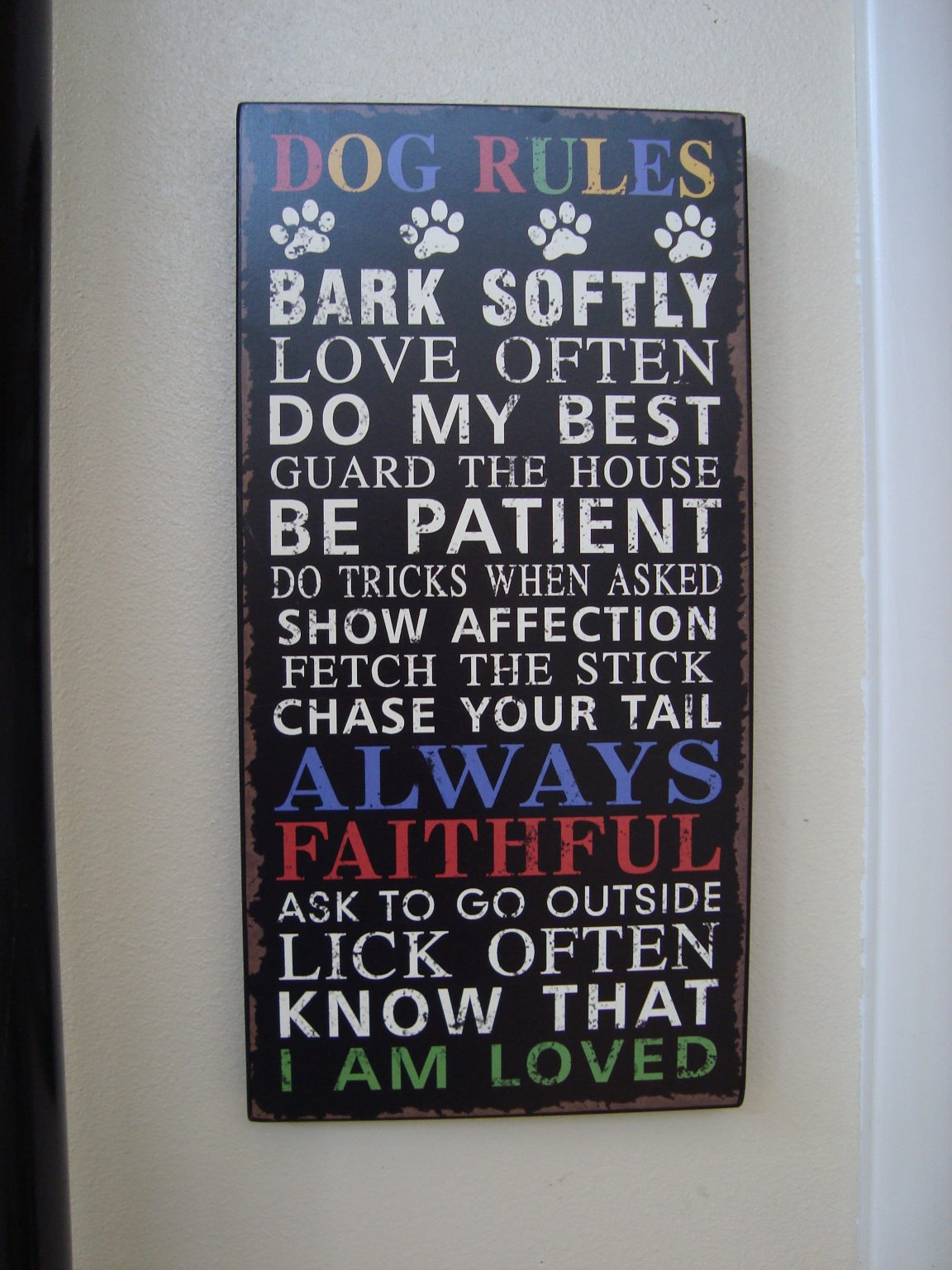
Dog Rules

Dog Rules

Kathleen Crisley, specialist in dog massage, rehabilitation and nutrition/food therapy, Canine Catering Ltd, Christchurch, New Zealand

Patience

I love it when dogs are used in advertising. Some ads are better than others. My current favorite is from appliance manufacturer Fisher & Paykel.

I love the use of black & white and the dog theme. What do you think?


