Category Archives: Dogs

Label reading

There is a lot of information on the web about reading the food ingredient label on your dog’s food.  Some of the advice I agree with, some of it is purely marketing.

But I have a much simpler test for you.  If you feed a commercially prepared food (whether raw, cooked or processed), take a look at the label.

What is the country of origin?

Here’s the label on the commercial kibble that I am currently feeding Izzy (she is on a diet of home-cooked mixed with this food).  It is made in New Zealand (where we live).

pet food label

Where is yours made?

Country of origin labeling can offer an insight into quality, particularly in terms of things like food safety, security of the supply chain, and length of time the product has been on the shelf.

Kathleen Crisley, specialist in dog massage, rehabilitation and nutrition/food therapy, Canine Catering Ltd, Christchurch, New Zealand

In Memory of Denali (a fitting 1000th post)

****Warning****   For anyone who has loved and lost a dog, this video will bring you to tears.  It certainly did for me.  But I couldn’t think of a more fitting 1000th post for this blog – a tribute to the human/dog bond.

This short film is about Denali, photographer/cinematographer Ben Moon’s dog, and their life story together.

Kathleen Crisley, specialist in dog massage, rehabilitation and nutrition/food therapy, Canine Catering Ltd, Christchurch, New Zealand


What are you looking at? (Dogs follow the human gaze)

Dogs are known to be excellent readers of human body language in multiple situations. Surprisingly, however, scientists have so far found that dogs do not follow human gaze into distant space. Scientists at the Messerli Research Institute at the Vetmeduni Vienna investigated how this skill of dogs is influenced by aging, habituation and formal training. The outcome: Gaze following to human gaze cues did not differ over the dogs’ lifespan, however, formal training was found to directly influence gaze following in dogs.


Gaze following to distant space has been documented in many species and is considered a basic response found in many taxa. Dogs may present a special case as the researchers found evidence that they are able to follow human gaze to objects such as food or toys, but not for the comparatively simpler task of following gaze into distant space.

Two possible reasons were offered to explain this phenomenon: One reason could be habituation. Dogs lose their innate gaze following response as they age, as they are frequently exposed to human gaze cues over their lifespan and slowly stop responding to them. Another reason could be formal training such as obedience, agility, and trick training may interfere with the dogs’ response to gaze cues, since dogs are usually trained to look at the owner, to wait for commands and ignore distractions.

What influences dogs’ gaze following response to human gaze cues?

Lead author Lisa Wallis and her colleagues at the Vetmeduni Vienna investigated 145 Border Collies aged 6 months to 14 years in the Clever Dog Lab in order to address the question of whether habituation, and/or training influences dogs’ gaze following response, and to determine, for the first time, how this ability changes over the course of a dog’s life by comparing groups of dogs of different ages. 

Dogs of all ages are able to follow human gaze

The scientists tested two groups of dogs with differing amounts of formal training over their lifespan. Both groups participated firstly in a test and control condition, where their initial gaze following performance was measured. The experimenter obtained the dogs’ attention using its name and the command “watch” after which the experimenter turned her head swiftly to look at the door of the testing room in the test condition, or looked down to the floor next to her feet in the control condition. If the dogs responded by looking at the door within two seconds in the test condition but did not look at the door in the control condition, a gaze following response was recorded.

Dogs’ tendency to follow human gaze is influenced by training for eye contact
Lisa Wallis with a Border Collie in the test room. (Photo: Clever Dog Lab / Vetmeduni Vienna)

Lisa Wallis with a Border Collie in the test room. (Photo: Clever Dog Lab / Vetmeduni Vienna)

The dog follows Wallis' gaze to the door. (Photo: Clever Dog Lab / Vetmeduni Vienna)

The dog follows Wallis’ gaze to the door. (Photo: Clever Dog Lab / Vetmeduni Vienna)


Dogs which had a higher amount of formal training over their lifespan showed a lower gaze following response compared to dogs with little or no training. Similarly, short-term training also decreased dogs’ gaze following response and increased gaze to the human face.

The authors conclude that formal training had a stronger influence than aging or habituation on dogs’ gaze following response. This may explain why previous studies have failed to find a gaze following response when cues to distant space are used, and why in comparison to other species dogs perform relatively poorly in this task. The fact that the experimenter used strong attention-getting cues and provided contextual relevance by looking at a door may have also contributed to the positive results found in this study.

“From a very young age dogs have experience with doors when they live in human homes. The dogs develop an understanding that at any time an individual may enter the room, and therefore doors hold special social relevance to dogs”. – says Lisa Wallis.

In her current project, together with her colleague Durga Chapagain, Wallis is investigating the effects of diet on cognitive aging in older dogs. The scientists are still looking for dog owners who would like to participate in that long-term study (food is provided for free).

This research has been published in the journal Animal Behaviour.

Source:  Vedmeduni Vienna media release

A therapy dog to help mourners

Say ‘therapy dog’ and most people will think of hospitals, rest homes, and mental health services.  Some may also think about dogs supporting witnesses when they have their day in court….but now there’s a growing use of therapy dogs in funeral homes.

This video, from the Ballard-Durand funeral home in New York, promotes Lulu, a Goldendoodle, who can be booked on request for funeral services.

The loss of a loved one and funerals, in general, are times of great emotional stress.  How nice it is that dogs are offering comfort in these situations and that they are being accepted by professional funeral directors.

Kathleen Crisley, specialist in dog massage, rehabilitation and nutrition/food therapy, Canine Catering Ltd, Christchurch, New Zealand

A unique photo series

Professional photographer Fred Levy of Maynard, Massachusetts heard about Black Dog Syndrome at the local dog park and decided to use his skills to help combat it.

As described here in my 2013 post, Black Dog Syndrome is a phenomenon reported by many shelters and rescues.  Black dogs are often depicted in movies and other media as mean, vicious and menacing.   And since many shelter don’t have lighting for ‘ambiance’ these dogs are often not seen in a flattering light.

“A dog shouldn’t be overlooked just because of its coat,” Levy said. “That’s a minor element when it comes to the dog.”

So he’s created a lovely photo series of black dogs using a black background to show off their beauty.

Here are a couple of examples:

Springer spaniel Aki

Aki, a Springer Spaniel

In this Oct. 2013 photo provided by Fred Levy, a black Labrador retriever named Denver poses in Levy's studio in Maynard, Mass. Levy, a pet photographer, first heard about “Black Dog Syndrome” in a 2013 conversation at a dog park. It’s a disputed theory that black dogs are the last to get adopted at shelters, perhaps because of superstition or a perception that they’re aggressive. The idea inspired Levy to take up a photo project on their behalf. (Fred Levy via AP)

A black Labrador retriever named Denver

And view more of the series on Fred’s website…

Great idea!

Source:  Yahoo news

The prescription for a soldier’s PTSD

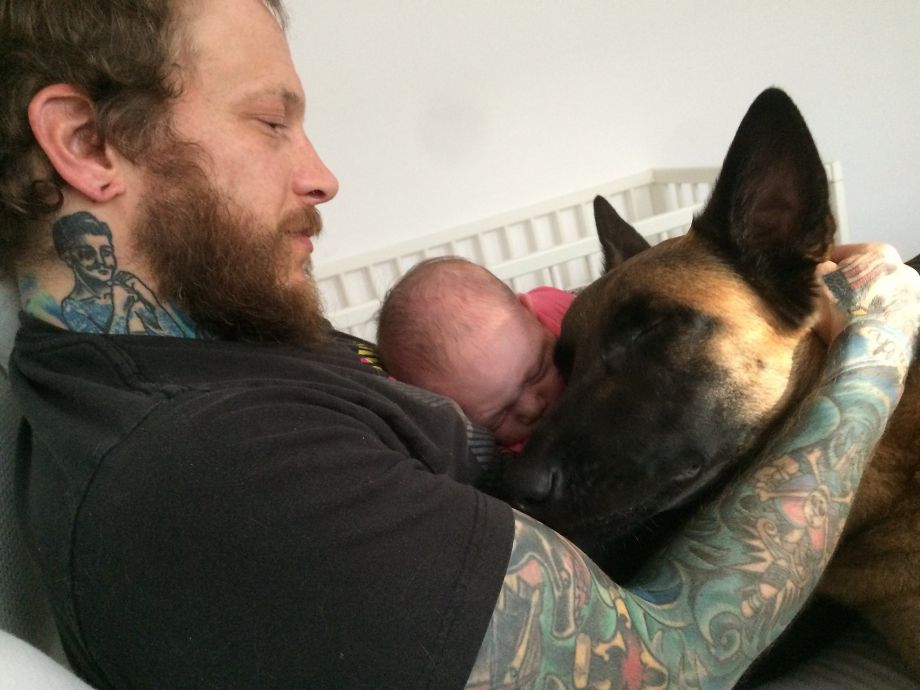
I just found this very short item on the San Francisco Chronicle website.  A photo of a heavily tattooed man, his baby and his dog….

 Photo: Patty Snijders

Photo: Patty Snijders

The man is Ari Sonnenberg with his daughter, Nila Louise Sonnenberg, born April 1, 2015, and his Belgian Malinois dog, Sigmund Freud (also known as  Siggy).

Patty Snijders (Ari’s wife) says: “The dog has helped both Ari and me tremendously. He’s made our marriage stronger and prepared us for parenthood in many ways.”

A simple photograph and a lovely sentiment.  Siggy sounds very special and his presence has clearly been a help to the couple.

The body of knowledge about the value of dogs for our physical and mental health continues to grow, with research and study and stories like those of Siggy and his owners.

Kathleen Crisley, specialist in dog massage, rehabilitation and nutrition/food therapy, Canine Catering Ltd, Christchurch, New Zealand

Therapy dog helps woman testify at court hearing

This post is definitely filed under the heading of Special Dogs & Awards.  Another example of how our dogs can work with us and for us…. A courtroom therapy dog named Paz, a Labradoodle, has helped a woman testify in court about her multiple assaults and captivity, an ordeal endured with her 5-year old daughter. It is the first time a judge has allowed a therapy dog in court to support an adult (rather than a child).

 The appearance on Tuesday of Paz, a therapy dog, in a New York City courtroom to help an adult witness testify was said to be unprecedented. Credit Kevin Hagen for The New York Times

The appearance on Tuesday of Paz, a therapy dog, in a New York City courtroom to help an adult witness testify was said to be unprecedented. Credit Kevin Hagen for The New York Times

More details about this story in the New York Times link below. Well done, Paz, and may you continue to provide support to this woman – no one deserves that kind of treatment.  And kudos to the judge who recognized the value of the dog to the court’s proceedings. Source:  New York Times

Society Hound Barbie

Since I am now the proud Doggy Mom of Izzy the Greyhound, I’m naturally drawn to items with a greyhound theme.

So wow – I was blown away when I saw you can buy a Barbie® doll walking her greyhound.

It’s part of Barbie® – the Society Hound Collection:

  • Barbie® doll and her sleek greyhound step out into the cool day draped in their luxurious matching ensembles
  • Barbie® wears a charming 1920s-inspired blue grey faux fur trimmed dress with matching lined cape
  • Doll stand included
  • For the adult collector, age 14 and over

Society Hound BarbieI’m not going to buy this doll, as I have other priorities in my life right now.  But I’m impressed.

What unique dog items do you have in your home?

Kathleen Crisley, specialist in dog massage, rehabilitation and nutrition/food therapy, Canine Catering Ltd, Christchurch, New Zealand


50 Shades of Greyhound

I have a perfectly innocent explanation for the mussed up and torn sheets and the sound of the headboard banging against the wall…

Kathleen Crisley, specialist in dog massage, rehabilitation and nutrition/food therapy, Canine Catering Ltd, Christchurch, New Zealand


Dogs absorb lawn chemicals

Dogs exposed to garden and lawn chemicals may have a higher risk of bladder cancer. iStockPhoto

Dogs exposed to garden and lawn chemicals may have a higher risk of bladder cancer.
iStockPhoto


Dogs are ingesting, inhaling and otherwise being exposed to garden and lawn chemicals that have been associated with bladder cancer, according to a new study.

The paper, which will appear in the July issue of Science of the Total Environment, also found that wind could carry the chemicals to untreated properties. The researchers also found that dogs, once contaminated by the chemicals, can transfer them to their owners.

The chemicals are common herbicides containing the following: 2,4-dichlorophenoxyacetic acid (2,4-D), 4-chloro-2- methylphenoxypropionic acid (MCPP) and/or dicamba.

“The routes of exposure that have been documented in experimental settings include ingestion, inhalation and transdermal exposures,” lead author Deborah Knapp of Purdue University’s Department of Veterinary Clinical Sciences, told Discovery News.

“In the case of dogs,” she added, “they could directly ingest the chemicals from the plant, or they could lick their paws or fur and ingest chemicals that have been picked up on their feet, legs or body.”

Scottish terriers, West Highland white terriers, Shetland sheepdogs, beagles and wire hair fox terriers are all at particular risk, the researchers suggest, because these breeds have a high genetic propensity for bladder cancer.

Knapp and her colleagues first conducted an experimental grass plot study that involved spraying various defined patches with the chemicals under different conditions. These included spraying the herbicides on plots that were green, dry brown, wet or recently mowed. The researchers next measured how much of the chemicals remained on the grass up to 72 hours post treatment.

Co-author Angus Murphy, also from Purdue, explained that dead or dying plant material does not readily absorb the chemicals, “so the herbicide can remain longer on the surface of the plant.”

He continued, “If an excessive amount of herbicide is applied, then the capacity of the target plant to take up the compound may be overwhelmed.”

In a second experiment, the researchers analyzed urine samples of dogs from households that either used herbicides or didn’t. The majority of dogs from homes that used the chemicals were found to have these same herbicides in their urine. Some dogs from untreated homes also had the chemicals in their urine.

Knapp explained that wind could cause the herbicides to travel up to 50 feet away from the application site. Neighbors who use the chemicals might therefore impact other individuals in the area.

“There are industry guidelines for restricting lawn chemical application based on wind speed, although homeowners may not be aware of these,” Knapp said.

Once contaminated, dogs can pass the chemicals on to their owners and to others. The study only looked at dogs, but the researchers suspect that cats and other pets could also be affected.

“Dogs can pick up the chemicals on their paws and their fur,” Knapp said. “They can then track the chemicals inside the house, leaving chemicals on the floor or furniture. In addition, if the dog has chemicals on its fur, the pet owner could come in contact with the chemicals when they pet or hold the dog.”

John Reif, a professor emeritus of epidemiology at the Colorado School of Public Health, told Discovery News, “The paper presents important information since exposure to 2,-4-D, a widely used broad leaf herbicide, has been associated with increased risk of cancer in pet dogs and humans.”

Reif added, “This study has potentially important implications for human health since it demonstrates widespread exposure to pet dogs. The likelihood that children, who share the local environment with their pets, are similarly exposed to these chemicals is high and thus additional studies should be conducted to evaluate this possibility.”

The researchers suggest that if owners still must use herbicides, they should follow manufacturer guidelines, allow gardens and lawns to dry before allowing pets out, wash their dog’s feet each time the dog comes inside, and consider treating the back yard one week before the front (or vice versa) so that pets will have an area of less potential chemical exposure available to them.

Source:  Discovery.com