Category Archives: Dogs

The ultimate in pet-friendly homes

  • Building a new house?
  • Does your family include at least one pet?

Well then, Standard Pacific Homes in Irvine, California has the answer for you.  For an additional $35,000, your new home can include a pet suite.

Pet suites are all about convenience and include dual purpose cabinets for owner/dog and dedicated laundry facilities so the dog hair stays with your dog’s bedding and coats.  There’s even a camera to keep an eye on your dog when you are not at home.

More in this news item:

If I were building in Christchurch right now, I’d be seriously thinking of adding a pet suite to my new home.  It would be another way of including dogs in the rebuild!

Kathleen Crisley, specialist in dog massage, rehabilitation and nutrition/food therapy, Canine Catering Ltd, Christchurch, New Zealand

Is your dog an optimist or a pessimist?

Dogs can have either an optimistic or a pessimistic view of the world, new research shows.  The approach used in the research will have uses in assessing animal welfare generally, but also in assessing suitability of dogs for various working roles.

“This research is exciting because it measures positive and negative emotional states in dogs objectively and non-invasively (important for those concerned about animal welfare in research),” said Dr Melissa Starling, from the University of Sydney’s Faculty of Veterinary Science.

Dr Starling has been working with Assistance Dogs Australia to investigate whether measuring optimism would assist in selecting dogs for training.

Dogs were taught to associate two different sounds (two octaves apart) with whether they would get the preferred reward of milk or instead get the same amount of water. Once the dogs learned the discrimination task, they were presented with ‘ambiguous’ tones.

If dogs responded after ambiguous tones, it showed that they expect good things will happen to them, and they are called ‘optimistic.’ They can show how optimistic they are by which tones they respond to. A very optimistic dog may even respond to tones that sound more like those played before water was offered.

“Of the dogs we tested we found more were optimistic than pessimistic but it is too early to say if that is true of the general dog population,” said Dr Starling.

“This research could help working dog trainers select dogs best suited to working roles. If we knew how optimistic or pessimistic the best candidates for a working role are, we could test dogs’ optimism early and identify good candidates for training for that role. A pessimistic dog that avoids risks would be better as a guide dog while an optimistic, persistent dog would be more suited to detecting drugs or explosives.”

Dr Starling talks more about her research in this video:

Source:  University of Sydney media release

Pet products and the environment – a survey for US and Canadian owners

Scientists have long been aware of the potential environment impacts that stem from the use and disposal of the array of products people use to keep themselves healthy, clean and smelling nice. Now a new concern is emerging – improper disposal of pet care products and pills.

Dog shampoos, heartworm medicine, flea and tick sprays, and prescription and over-the-counter medicines increasingly are finding their way into landfills and waterways, posing a water quality and environmental health risk. Researchers at Oregon State University say that, with an estimated 68 percent of American households owning at least one pet, the scope of the potential problem is large.

Sam Chan, a watershed health expert with the Oregon Sea Grant program at Oregon State University, has launched a survey of veterinary professionals and pet owners to to get a better idea of the scope of the issue. If you live in the United States or Canada, you can contribute to his survey here.

The purpose of the survey is to determine how aware people are about the disposal of “pharmaceutical and personal care products” (PPCPs) for both themselves and their pets plus their general awareness of the environmental issues.

“You can count on one hand the number of studies that have been done on what people actively do with the disposal of these products,” Chan said. “PPCPs are used by almost everyone and most wastewater treatment plants are not able to completely deactivate many of the compounds they include.”

Increasingly, Chan said, a suite of PPCPs used by pets and people are being detected at low levels in surface water and groundwater. Examples include anti-inflammatory medicines such as ibuprofen, antidepressants, antibiotics, estrogens, the insect repellent DEET, and ultraviolet (UV) sunblock compounds.

For example, coal tar which is used in pet medicines and shampoos for skin treatment is an endocrine disruptor.

When medicines are no longer needed, the research team encourages owners to take the drugs and medications back to their pharmacy or veterinarian for proper disposal in a drug collection program. Placing unwanted medications in the rubbish means that they are an uncontrolled source in landfills, where leaching and runoff are mechanisms to enter the environment.

Source: Phys.org

Diagnosing lymphoma in dogs

Nearly one out of four dogs will develop cancer in their lifetime and 20 per cent of those will be lymphoma cases.

A team of researchers from the University of Leicester has helped Avacta Animal Health Ltd to develop a new user-friendly electronic system for diagnosing lymphoma in dogs in the early stages, and for remission monitoring.

Marketed as cLBT (canine lymphoma blood test), this is the first test of its kind to track the remission monitoring status of a dog after undergoing chemotherapy.

Photo by Avacta Animal Health Ltd

Photo by Avacta Animal Health Ltd

Led by Professor Alexander Gorban from the University’s Department of Mathematics, the University team together with experts from Avacta elaborated technology for differential diagnosis of canine lymphoma and for remission monitoring.

This technology is based on the cLBT, which detects the levels of two biomarkers, the acute phase proteins C-Reactive Protein and Haptoglobin.

The paper ‘Computational diagnosis and risk evaluation for canine Lymphoma’ by E.M. Mirkes, I. Alexandrakis, K. Slater, R. Tuli and A.N. Gorban has been published in the academic journal Computers for Biology and Medicine and is available at the following location: http://dx.doi.org/10.1016/j.compbiomed.2014.08.006

Source:  University of Leicester media release

Doggy quote of the month for October

“Like many other much-loved humans, they believed that they owned their dogs, instead of realizing their dogs owned them.”

– Dodie Smith, English novelist and author of The Hundred and One Dalmatians

101 Dalmatians

Teddy’s journey: family life returns

Teddy (right) with sister, Verdi

Teddy (right) with sister, Verdi

It’s been a good weekend for Teddy.

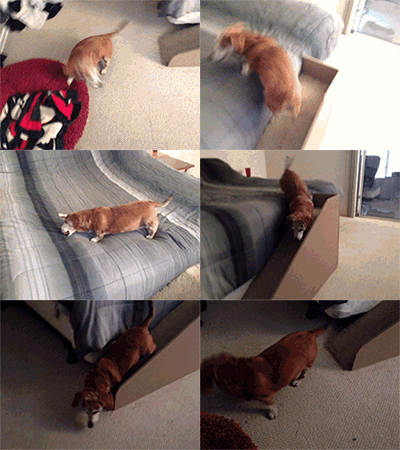
Jill says family life is getting back to normal, with Teddy and his sister enjoying some time together on the sofa – the first opportunity they’ve had for a long time.

Jill has re-arranged the furniture to ensure that any areas where Teddy might be interested in jumping onto or off of are fenced off.  Her husband has built a ramp to the dog door which Teddy is handling beautifully (we will aim to get a photo of this up soon).

Jill says, “I read on the Tripawds site that if you were bonded to your special dog before, it’s nothing to the bond you have after amputation.  This is so very, very true.  When I took the two girl Beagles to the vet, Anneke and Alex (vet and vet nurse) wanted to come out to see Teddy.  He wasn’t interested in them at all – he only had eyes for me!”

Kathleen Crisley, specialist in dog massage, rehabilitation and nutrition/food therapy, Canine Catering Ltd, Christchurch, New Zealand

US FDA issues warning about raw pet foods

Feeding raw (or not) has to be one of the most controversial topics in dog ownership today.  Consequently, the US Food & Drug Administration’s (FDA’s) recent warning to owners feeding raw is likely to generate some controversy.

The FDA’s Center for Veterinary Medicine (CVM) screened over 1,000 samples of pet food for bacteria that can cause foodborne illnesses. (The illnesses are called “foodborne” because the bacteria are carried, or “borne,” in or on contaminated food.) The study showed that, compared to other types of pet food tested, raw pet food was more likely to be contaminated with disease-causing bacteria.

Raw pet foods were included in the second year of a two-year study and the samples were from commercially available raw pet foods which were purchased online and sent to six different testing laboratories.

The participating laboratories analyzed the raw pet food for harmful bacteria, including Salmonella and Listeria monocytogenes.

Of the 196 raw pet food samples analyzed, 15 were positive for Salmonella and 32 were positive for L. monocytogenes (see Table 1).

Table 1: Number and type of pet food samples that tested positive for Salmonella and Listeria monocytogenes (Years 1 & 2)
Type of Pet Food Sample No. samples tested No. positive for Salmonella No. positive for L. monocytogenes
 Raw pet food  196  15  32
 Dry exotic pet fooda  190  0  0
 Jerky-type treatsb  190  0  0
 Semi-moist dog foodc  120  0  0
 Semi-moist cat foodc  120  0  0
 Dry dog foodd  120  0  0
 Dry cat foodd  120  1  0
a Non-cat and non-dog food, such as dry pellets for hamsters, gerbils, rabbits, amphibians, and birds.
b Included chicken jerky and pig ear-type products.
c Typically packaged in pouches for retail sale, such as (1) pouched dog and cat food; and
(2) food treats shaped like bacon, fish, pork chops, and burgers.
d Included pellet- or kibble-type food typically packaged in bags for retail sale.Note: CVM did not collect or test canned and wet pet food samples in this study.

The FDA has gone as far as warning owners against raw feeding, but in an acknowledgement that this type of diet is the preference for many owners, they also provided these tips to prevent Salmonella and Listeria infections:

  • Thoroughly wash your hands with soap and water (for at least 20 seconds) after handling raw pet food, and after touching surfaces or objects that have come in contact with the raw food. Potential contaminated surfaces include countertops and the inside of refrigerators and microwaves. Potential contaminated objects include kitchen utensils, feeding bowls, and cutting boards.
  • Thoroughly clean and disinfect all surfaces and objects that come in contact with raw pet food. First wash with hot soapy water and then follow with a disinfectant. A solution of 1 tablespoon bleach to 1 quart (4 cups) water is an effective disinfectant. For a larger supply of the disinfectant solution, add ¼ cup bleach to 1 gallon (16 cups) water. You can also run items through the dishwasher after each use to clean and disinfect them.
  • Freeze raw meat and poultry products until you are ready to use them, and thaw them in your refrigerator or microwave, not on your countertop or in your sink.
  • Carefully handle raw and frozen meat and poultry products. Don’t rinse raw meat, poultry, fish, and seafood. Bacteria in the raw juices can splash and spread to other food and surfaces.
  • Keep raw food separate from other food.
  • Immediately cover and refrigerate what your pet doesn’t eat, or throw the leftovers out safely.
  • If you’re using raw ingredients to make your own cooked pet food, be sure to cook all food to a proper internal temperature as measured by a food thermometer. Thorough cooking kills Salmonella, L. monocytogenes, and other harmful foodborne bacteria.
  • Don’t kiss your pet around its mouth, and don’t let your pet lick your face. This is especially important after your pet has just finished eating raw food.
  • Thoroughly wash your hands after touching or being licked by your pet. If your pet gives you a “kiss,” be sure to also wash your face.

In my practice, I have clients that feed all types of diet (commercial, raw, homemade).  I have seen raw food diets implemented successfully with some dogs, and others who fail to thrive on them for a variety of reasons.  That’s why I am a proponent of the food therapy approach, which can successfully be implemented with all types of diet.

For my clients here in New Zealand, I’d like to emphasize that the food hygiene suggestions by the FDA do make sense.  According to our Ministry of Primary Industries, Salmonella is the second most common bacterial cause of foodborne disease in this country (campylobacter is the first).  Incidents of Listeria are rare, but some people like pregnant woman are particularly vulnerable to the disease.

Kathleen Crisley, specialist in dog massage, rehabilitation and nutrition/food therapy, Canine Catering Ltd, Christchurch, New Zealand

Source:  US Food & Drug Administration

Saying goodbye to Faith

Faith the dog 1

Faith, the biped dog who stole many hearts since being born in 2002, passed away on September 22, 2014.  Her family says that she was increasingly uncomfortable with arthritic pain over the last few months and it was time to let her go.

I first wrote about Faith in 2011 when I was doing some research on special needs dogs.  Faith’s adoptive family taught her to walk on her hind legs, rather than heeding advice from many ‘experts’ that she be put down.  She went on to become a wonderful therapy dog and an ambassador for special needs in general.

Faith with her manager, Mike Maguire

Faith with her manager, Mike Maguire

According to her family, Faith is probably running on all fours on the other side of the Rainbow Bridge.  They are accepting messages of condolence on Faith’s Facebook page.

You can read more about Faith’s inspiring story in the book by Jude Stringfellow, Faith Walks, available through Amazon.

Faith Walks

Kathleen Crisley, specialist in dog massage, rehabilitation and nutrition/food therapy, Canine Catering Ltd, Christchurch, New Zealand

New Cancer Drug for Dogs Also Helps Humans

Dogs suffering from certain types of blood cancers may have a new treatment alternative thanks to the collaborative work of cancer experts looking for options that can help both humans and their pets.

The drug, Verdinexor (KPT-335), works by preventing powerful tumor suppressing proteins from leaving the nucleus of cells, an exodus which allows cancer to grow unchecked. It’s the first new therapeutic option for dog lymphoma in more than two decades, potentially offering vets another alternative for treating the disease, which is the most common form of canine cancer.

“Verdinexor is a really different from chemotherapy, the current standard of care for lymphoma. It works by blocking a protein in the cells responsible for shuttling other proteins in and out of the nucleus, resulting in disruption of cell survival and eventual cell death ,” said veterinary oncologist Cheryl London, DVM, PhD, The Ohio State University College of Veterinary Medicine, who led preclinical, Phase I and Phase II studies of Verdinexor. “Verdinexor could give veterinarians another option if first-line chemotherapy fails or as a potent adjunctive therapy.”

Lead researcher Cheryl London with her dog, photo courtesy of The Ohio State University College of Veterinary Medicine

Lead researcher Cheryl London with her dog, photo courtesy of The Ohio State University College of Veterinary Medicine

“A cancer diagnosis is tough on dogs and their owners. Dogs with lymphoma must go to a veterinary office weekly to receive chemotherapy infusions,” said London. “Since Verdinexor is a pill that can be given at home, it could help make treatment less traumatic for everyone.”

The similarities in the ways human and canine cancer drugs are researched and used are not coincidental. Many types of human and canine cancers are identical at both the cellular and molecular levels, making companion animal studies an ideal place to test drive experimental compounds that appear to have anti-cancer characteristics.

When it comes to cancer, dogs and humans have so much in common,” said London. “I think as human medicine becomes more personalized through the use of genomics, I think we’ll see the same happening in vet medicine.”

Source:  Newswise media release

My idea for the Christchurch rebuild

If you live in my local area of Christchurch (New Zealand), you are probably as worn out as I am about hearing about “The Rebuild” and “The New Central City.”  It’s been especially frustrating for those of us who want to see a dog-friendly city because our needs are not being met.

So here’s one idea for the rebuilt Cathedral Square in central Christchurch.

A fountain for all to enjoy (but especially dogs!)

Kathleen Crisley, specialist in dog massage, rehabilitation and nutrition/food therapy, Canine Catering Ltd, Christchurch, New Zealand