Category Archives: Dogs

The Kaptin of Tips Hair

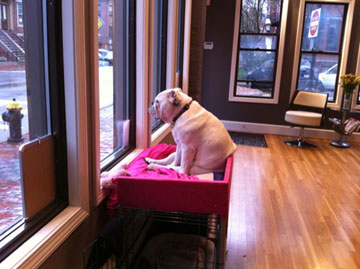
If you’re in Boston and need a hair cut, then the place to go is Tips Hair salon, located on Dartmouth Street in the South End.  There you will find Kaptin, an English Bulldog who is the salon’s mascot:

Photo copyright Tips Hair Boston

Photo copyright Tips Hair Boston

Kaptin is a girl and she spends her day sitting in the window watching all of the activity on Dartmouth Street!

Image

Wordless Wednesday, part 35

Wordless Wednesday, part 35

Oakley, by Army First Lieutenant Brandon Harker

BP_Wordless_wed_Hop_Logo_2014

A lifesaving dog

Gabriel Campbell is a little boy with such severe dairy and peanut allergies that his family has been unable to go to restaurants and even playgrounds for fear of exposure.

Through fundraising, they’ve been able to welcome Sheba, a trained allergy alert dog, into their family.  Sheba was trained by Angel Service Dogs in Colorado.

This is their story:

Just another example of how special our dogs are, and what special work they can do when properly trained.

A vaccine for canine osteosarcoma?

Osteosarcoma is a highly aggressive bone tumor that affects at least 10,000 dogs annually in the United States, alone.

Photo by osteosarcomaindogs.org

Photo by osteosarcomaindogs.org

It is estimated that 90-95 percent of canine osteosarcoma subjects have microscopic metastatic disease (spread of cancer cells to other parts of the body at the time of diagnosis). Standard of care includes removal of the primary tumor—usually by amputation—followed by chemotherapy. Systemic chemotherapy given after amputation delays the development of metastatic disease; however, despite treatment, most dogs die of the disease within one year of diagnosis.

A new option may be available in the future if Dr. Nicola Mason’s research at the University of Pennsylvania School of Veterinary Medicine produces satisfactory results. Mason, an assistant professor of medicine and a Board-certified ACVIM Diplomate in Small Animal Internal Medicine, is evaluating the first vaccine for canine osteosarcoma.

The approach harnesses the power of the dog’s immune system, “training” it to seek out and destroy cancer cells that remain after amputation and chemotherapy.

Over a century ago, an orthopedic surgeon named William Coley recognized that human sarcoma patients with concurrent bacterial infections that caused high fevers had improved overall survival times compared to those sarcoma patients without infection. This led him to develop a therapeutic concoction of live bacteria that he injected into patients with bone sarcomas. He documented improved survival and in some cases, complete remission in individuals with the aggressive disease by using this early form of “immune therapy.”

Mason’s team is employing similar immune therapeutic strategy to treat dogs with osteosarcoma that have undergone the standard of care treatment (amputation and chemotherapy) to prevent metastatic disease. “The concept is that administration of the Listeria-based (genetically modified bacteria) vaccine will activate the patient’s immune system and educate it to recognize cells that express the target molecule,” says Mason.

Dogs are given the live bacterial vaccine intravenously, Mason explains, and it induces a mild transient fever on the day of vaccination. The dogs are usually treated as outpatients and return home the same day. “We have found highly encouraging results when the vaccine is given to patients that have no evidence of metastatic disease at the time of the study enrollment, which is three weeks after the last chemotherapy is administered. Four out of the first five dogs vaccinated are alive at least two years after their initial diagnosis, which is more than twice their expected survival duration. The vaccine has not yet shown any serious short- or long-term side effects, either.”

Mason says the results have led researchers to evaluate whether this vaccine may be able to directly target and kill the bone tumor itself, perhaps eliminating the need for amputation in the future.

Source:  American College of Veterinary Internal Medicine media release

I’m a Liebster award winner

Liebster AwardI’ve been given a Liebster Award by Corso Mama, another doggy mom with a blog.  This award goes to blogs with less than 300 followers. and it’s my job to keep the ball rolling.

In receiving this award, I’ve been asked to answer these questions:

1.  Has your vision for your blog changed since you started it?

Not really.  This blog started as my customer newsletter which I sent via email and I realized that I could be more efficient by writing blog posts as I thought of them rather than holding back until the beginning of each month.  I aim to share all sorts of news involving dogs for other dog parents to enjoy.

2.  What have you learned from other bloggers since starting your blog adventure?

I’ve learned about things like Wordless Wednesdays – which I adopted last year – to share interesting graphics or photographs without the need for captions or accompanying stories.  And as I have connected to other bloggers, I’ve been able to share their interesting content, too.

3.  What do you hope to accomplish with your blog?

To educate and raise awareness about “all things dog”

4.  Do you feel you are able to coexist with other bloggers even if they might express opinions that are different from yours?

Yes, absolutely.  The world would be a difficult place to live if we were all the same.  Bloggers should be able to have professional debate without getting nasty.

5.  What is your favorite blog (other than your own) and why?

I like Doggerel because Pyrrha is a rescue with unique issues.  Her mom is doing a great job with her.

6.  If you could live anywhere in the world, where would it be?

I’d probably split my time equally between the northern and southern hemispheres (Christchurch, where I live now and Massachusetts, where I grew up) so that I could miss winter weather year-round.  Of course, I would only do this if I was a) rich and able to own a jet that would allow Daisy to travel as a passenger rather than luggage and b) that border controls would mean that Daisy would not be quarantined upon re-entering the country. Sigh.  I don’t think this will happen.

7.  If you could drop everything right now and do anything you wanted, what would you do?

I’d go for a short nap cuddled up under the covers with Daisy.

8.  What is your favorite animal?

The dog, of course!

9.  What are your passions in life?

Well, I love everything to do with dogs.  Beyond that, I believe in professionalism and honesty in everything I do.

10.  Which do you prefer–rainy days or sunny days?

I kind of like rainy days because I’m more likely to stay at home and do some creative thinking.

11.  Which do you prefer–city or country life?

Actually, I’m a suburban girl.  Not quite the city, but definitely not the country.

And now my nominees for a Liebster:

  1. Nikitaland
  2. Bailey Unleashed
  3. Lapdog Creations
  4. My Pawsitively Pets
  5. A Bowl of Noodles
  6. Ruby the Airedale
  7. My Rotten Dogs
  8. The Elka Almanac
  9. Dobermann Daze
  10. The Five Dog Blog
  11. Dogdaz

And for these nominees, please answer these questions:

  1. Why did you establish your blog?
  2. When did you start blogging?
  3. Approximately how many hours per week do you blog?
  4. If you had one thing to do differently with your blog, what would it be?
  5. What’s one of your favourite blogs (other than your own)?
  6. What makes that blog one of your favourites?
  7. Since we can’t spend all of our time online, what book are you currently reading?
  8. Which do you prefer – pure bred or mixed breed?
  9. Do you consider yourself a dog parent or dog owner?
  10. Would you rather do a Crossword or a Suduku?
  11. When the weather turns cold, does your dog wear a coat?

A new use for Border Collies

Researchers from Central Michigan University presented their research at the annual meeting of the American Society for Microbiology this week.

They’ve found that Border Collies are effective at reducing seagull congregation on recreational beaches, resulting in lower E. coli abundance in the sand

A Border Collie on beach patrol, photo by Elizabeth Alm

A Border Collie on beach patrol, photo by Elizabeth Alm

Gull droppings may be one source of the indicator bacterium Escherichia coli to beach water, which can lead to swim advisories and beach closings. In addition, gull droppings may contain bacteria with the potential to cause human disease, according to Elizabeth Alm, one of the researchers on the study.

At the beginning of the summer, 200-meter sections of beach were arbitrarily assigned to be dog-treated beaches or control beaches. Half way through the summer, the beach sections were swapped, so that dogs were moved to the control beaches and the dog-treated beaches were then left to be untreated controls.

During the summers of 2012 and 2013, researchers recorded the number of gulls at each beach section. Once each week samples of beach water and beach sand were collected and the numbers of E. coli in the samples counted. In early summer, samples from beaches where dogs had excluded gulls had significantly lower E. coli counts compared to control beaches.

“Border collies are intelligent dogs that love to work and could be used by beach managers as part of a comprehensive management strategy to reduce bacterial contamination at public beaches,” said Alm.

Source:  American Society for Microbiology media release


Amtrak’s pet-friendly travel trial

Amtrak pets on boardFrom 5 May through 2 November 2014, Amtrak is conducting a trial program for owners traveling with their pets.  The Carry-on Pet Pilot Program will allow passengers to bring cats and small dogs, up to 20 pounds including the carrier, on selected train services in the Chicago region.

Amtrak petsThe carriers are considered a piece of carry-on baggage and the fee per pet is $25.00.  No more than four pets will be allowed  per train.

To qualify for the Amtrak scheme, your  dog will need to be harmless, odorless and at least eight weeks old.

In an Amtrak press release, Joe Boardman, president and CEO of Amtrak said, “Amtrak is supportive of accommodating pets on trains, and through direct collaboration with the Illinois Department of Transportation and a working group led by U.S. Rep. Jeff Denham of California we are optimistic a plan can be reached to address the needs and concerns of all our passengers.”

It’s a start…let’s hope the trial goes well.  All aboard!


Image

Wordless Wednesday, part 34

Daisy in sunshine 2014BP_Wordless_wed_Hop_Logo_2014

Support for a healthy dog

Preventive healthcare is essential both for you and your dog.  In the USA, the Partners for Healthy Pets website aims to help pet owners understand the value of preventive healthcare.  You can even register your dog to receive reminders that it is time for their annual checkup.

The site contains useful information about annual checkups, weight management, and other issues.  Here’s just one example to encourage good weight management.

If you have a 20 pound dog,

A treat of one hot dog....

a treat of one hot dog….

...is the human equivalent of eating 2 1/2 hamburgers!

…is the human equivalent of eating 2 1/2 hamburgers!

The site also contains a searchable database for veterinarians and veterinary hospitals.  Worth bookmarking if you are one of my USA readers.

Kathleen Crisley, specialist in dog massage, rehabilitation and nutrition/food therapy, Canine Catering Ltd, Christchurch, New Zealand


Pets quake victims, too

It is estimated that in the September 2010 Canterbury earthquake, 3000 animals died. This included one dog, who suffered a heart attack.

In today’s news, comes this story reporting that New Zealanders would put their animals before their own safety (no surprise to me – if Daisy couldn’t be evacuated with me, I’d be staying put).

Pets quake victims, too – national | Stuff.co.nz

Kathleen Crisley, specialist in dog massage, rehabilitation and nutrition/food therapy, The Balanced Dog, Christchurch, New Zealand