Category Archives: Dogs

The power of rest and relaxation

Best Friends Animal Sanctuary allows sleepovers with selected sanctuary dogs.  These dogs have been assessed for behaviours and deemed ready to go out to the public so they can experience environments that are more like a private home.

These experiences make the dogs more suitable for adoption and they give the dog a much-needed rest from the kennel environment.

Brigit, a Staffordshire Bull Terrier x Cattle Dog, is my sleepover dog as I study dog handling skills here.  She’s very sociable with people, but is reactive to other dogs which we are working on…

Today, I took Brigit for an enrichment visit to the Landing, an area of the sanctuary that is grassed and is in shade.  She had a wonderful time, followed by an hour-long walk in the evening when we met many people and successfully encouraged her to look at me rather than focusing on dogs that were passing on the other side of the street.

DSC03057DSC03064 DSC03066

Kathleen Crisley, specialist in dog massage, rehabilitation and nutrition/food therapy, Canine Catering Ltd, Christchurch, New Zealand

Office Dog

Best Friends Animal Sanctuary is one of those special places that allow dogs in offices.  It’s the ultimate dog-friendly workplace; dogs are not only welcomed in the offices of workers, they are encouraged.

Many office staff take dogs from the sanctuary to give them socialization experience as they prepare to be adopted.

Office Dog

Kathleen Crisley, specialist in dog massage, rehabilitation and nutrition/food therapy, Canine Catering Ltd, Christchurch, New Zealand

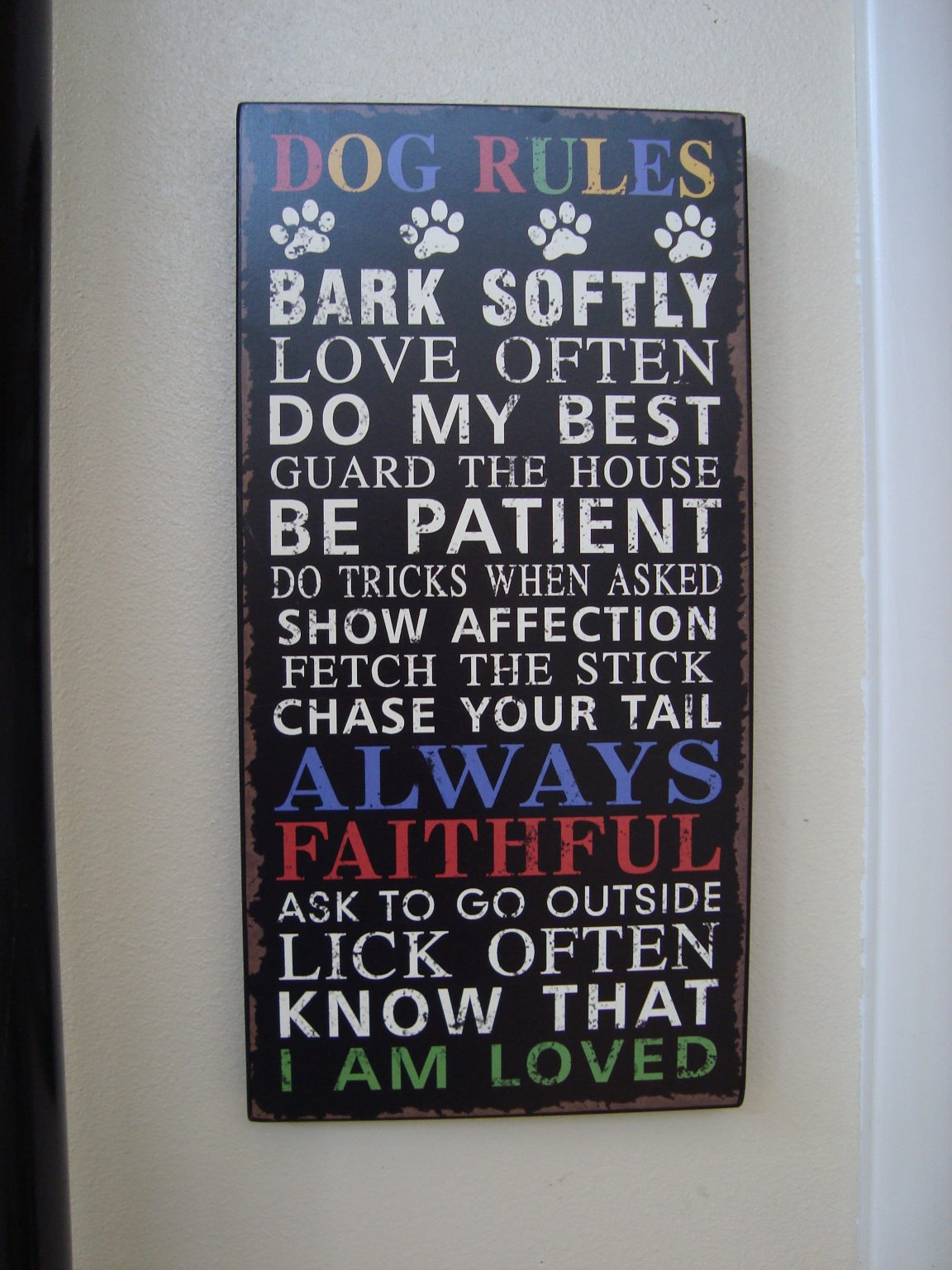
Dog Rules

Dog Rules

Kathleen Crisley, specialist in dog massage, rehabilitation and nutrition/food therapy, Canine Catering Ltd, Christchurch, New Zealand

Re-visiting Old Friends

Old Friends

Today, I worked at Old Friends.  This is the ‘old people’s home’ of the Best Friends Animal Sanctuary.  Besides helping to take dogs for walks in the cooler morning hours, I also got to use my massage skills on some special needs dogs.

Google

Google

Google was rescued from Kanab, Utah.  He spent most of his life chained; and as a result he has neck problems.  Because of his neck problems, his back, mid-thoracic, is also tight.  Google thoroughly enjoyed his massage.

Google has been at Best Friends for some time; he's over the age of 12 and still looking for a home. He's also been a blood donor for other dogs. Some nice person is sponsoring him so he can receive a free flight anywhere in the USA if adopted.

Google has been at Best Friends for some time; he’s over the age of 12 and still looking for a home. He’s also been a blood donor for other dogs. Some nice person is sponsoring him so he can receive a free flight anywhere in the USA if adopted.

Wrangler, who is suffering from heartworm

Wrangler, who is suffering from heartworm

Wrangler had just had his second injection as part of heartworm treatment.  Dogs undergoing this treatment have a series of injections and are restricted in exercise to ensure that the worms don’t dislodge from the heart causing respiratory arrest.

Wrangler needed very light massage (so not to stress his system) and few acupressure points for relaxation.

By the end of his massage, Wrangler rewarded me with a smile

By the end of his massage, Wrangler rewarded me with a smile

I am convinced that there is a role for massage therapy in the shelter environment, particularly for long-term residents and those with special health needs.

I am grateful to the caregivers at Old Friends who allowed me to work with these animals.

Kathleen Crisley, specialist in dog massage, rehabilitation and nutrition/food therapy, The Balanced Dog Ltd, Christchurch, New Zealand

Bretagne, the 9/11 dog, celebrates her 16th birthday

Bretagne is the last known surviving search and rescue dog from 9/11.  That’s special.  Here is how she celebrated her day…

Norbert: the little therapy dog with a series of books

Norbert

Norbert shows his High Five (photo courtesy of Norberthood.com)

Norbert is a special therapy dog.  He’s a very tiny (3-pound) cross-breed who was the only puppy born to his dog mother in California.  His owners believe he is a Chihuahua, Cairn Terrier  and Lhasa Apso cross.  Adopted in 2009 from PetFinder.com, Norbert was his human mother’s first-ever dog and he traveled to Boston to live with her.

At the age of one, he passed his therapy dog tests and began working with children and the elderly. Along the way he learned new tricks like High Five, Namaste (stay) and Zen (lie down).

Then his mom decided to write a book, and then another, and (soon) another….

Book 1: Norbert - What can little me do?

Book 1: Norbert – What can little me do?

Book 2: Norbert - What can little you do?

Book 2: Norbert – What can little you do?

Book 3 (due out in November 2015): Norbert & Lil Bub - What can little we do?

Book 3 (due out in November 2015): Norbert & Lil Bub – What can little we do?

Therapy dogs are special dogs providing important emotional support services to those in need.  I like the fact that there are children’s books featuring Norbert – if we tell children about dogs and their personalities, and teach them lessons along the way, we set them up to be compassionate adults who are prepared to be responsible pet owners.

Kathleen Crisley, specialist in dog massage, rehabilitation and nutrition/food therapy, Canine Catering Ltd, Christchurch, New Zealand

Enrichment for the special needs dog

In my massage practice, I see quite a few special needs dogs.  These can be senior dogs who are slowing down for a variety of reasons, dogs who have been injured, and dogs who are terminally ill.  Some also have behavioral difficulties which exacerbate any physical limitations they may have.

One of the things I address with my clients is enrichment.

The dog may be physically limited in its abilities but is not impaired cognitively.  Like older people who have entered rest homes/nursing homes, or who are being cared for at home, these dogs need stimulation and variety.

Visitors, including other dogs, is just one example of an enrichment activity.

Another issue for owners in this situation is introducing variety by getting their dog out of the house.  If a dog enjoys car rides, for example, they may be happy just to take a drive to a new location with the windows down to experience new scenery and smells.

Kenny, a 13+ year old Bull Terrier/Blue Heeler cross, was taken to the beach recently - his smile says it all!

Kenny, a 13+ year old Bull Terrier/Blue Heeler cross, was taken to the beach recently.  He needed to be carried from the car to the beach but his smile says it all!

I know some owners who take their dogs for a take-out meal so they can sit in the car and enjoy it together – with snacks included.

Once owners have tried enrichment activities with their dog, they have universally reported to me an improvement in the dog’s disposition and general engagement.

Kathleen Crisley, specialist in dog massage, rehabilitation and nutrition/food therapy, Canine Catering Ltd, Christchurch, New Zealand


Dominance research

The hierarchy in a group of dogs is not based on aggression but on submissiveness, says newly published research.

A dog ranked lower in the hierarchy displays signals of submissive behaviour towards dogs ranked higher. These findings have for the first time been substantiated by means of measurements by dog researcher Joanne van der Borg of Wageningen University and colleagues based in Utrecht.

wo beagles from the group of dogs studied. Communication by means of postures plays a central role in identifying dominance relationships between two dogs. The display of a lowered posture during an interaction by Zwart (the beagle on the right) is an acknowledgement of the higher status of Witband (left), who adopts a higher posture. Both dogs display mutual aggression (Witband by staring fixedly and Zwart by baring his teeth), which was found not to be a suitable measure of dominance. Photo: Joanne van der Borg.

Two beagles from the group of dogs studied. Communication by means of postures plays a central role in identifying dominance relationships between two dogs. The display of a lowered posture during an interaction by Zwart (the beagle on the right) is an acknowledgement of the higher status of Witband (left), who adopts a higher posture. Both dogs display mutual aggression (Witband by staring fixedly and Zwart by baring his teeth), which was found not to be a suitable measure of dominance. Photo: Joanne van der Borg.

In the study into dominance, a group of dogs was placed together on working days, and stable relationships formed between them after a few months. By closely observing and analysing the exchange of seven postures and 24 behaviours by the dogs, the researchers were able to establish a hierarchy. This proved to be linear.

The suitability of signals as a measure of dominance was determined using the exchange of signals between two animals. Suitable signals are postures or behaviours which are only displayed within a relationship from animal A to animal B and not in the opposite direction. Based on the receipt of submissive signals, the dogs were ranked from high to low.

The study supports the view that the dominance in a group of dogs is not determined by aggression, as many dog owners and dog trainers believe. Aggression is found to be exhibited by higher-ranked dogs towards lower-ranked dogs but also in the opposite direction, from lower-ranked dogs towards higher-ranked dogs. For this reason, signals of aggression are not suitable as a measure of dominance.

Not natural born fighters

The idea of dominance in dogs is popular among some dog trainers in various countries. They believe that dogs, like wolves, are natural born fighters with only one aim: to reach the top of the hierarchy. By contrast, a different school of thought among dog trainers holds that dominance is an outdated and obsolete notion which is not applicable to our domestic dogs. There has been much misunderstanding about the interpretation of this view, because until now there was a lack of substantiation by means of hard figures.

Signals from the dog

The signals of submissiveness from a dog meeting another member of its species can best be read from the lowering of the posture compared to the other dog. Another expression of acknowledgement of the higher status of the other individual is body-tail-wagging. This behaviour, often seen in young dogs when greeting other dogs, involves the tail moving in quite broad strokes, often with the hindquarters (the hind part of the body) moving with it. Both forms of submissiveness are an expression of ‘formal dominance’, because the context (aggression, greeting, play) does not matter. The findings are in line with previous results into dominance among wolves in captivity and Italian feral dogs.
The study contributes to our knowledge about the ways in which dogs communicate their status towards other dogs. This is important for correctly classifying the hierarchical relationship between two dogs, and probably also between human and dog. This in turn helps establish the correct diagnosis in the event of problem behaviour and will therefore improve the welfare of dogs.

Source:  Wageningen University media release

Friday Funny: Benny the Bulldog plays peek-a-boo

A short video to say ‘Yeah, it’s Friday!’

The Pergo dog party

I guess you could say that the Great Dane in this commercial is a ‘party animal’

Another great dog-themed commercial, this time by Pergo Flooring…


