Category Archives: Dogs

Enrichment for the special needs dog

In my massage practice, I see quite a few special needs dogs.  These can be senior dogs who are slowing down for a variety of reasons, dogs who have been injured, and dogs who are terminally ill.  Some also have behavioral difficulties which exacerbate any physical limitations they may have.

One of the things I address with my clients is enrichment.

The dog may be physically limited in its abilities but is not impaired cognitively.  Like older people who have entered rest homes/nursing homes, or who are being cared for at home, these dogs need stimulation and variety.

Visitors, including other dogs, is just one example of an enrichment activity.

Another issue for owners in this situation is introducing variety by getting their dog out of the house.  If a dog enjoys car rides, for example, they may be happy just to take a drive to a new location with the windows down to experience new scenery and smells.

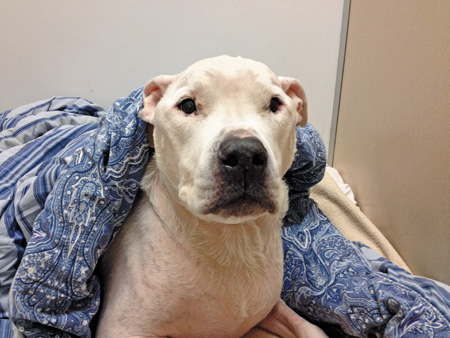
Kenny, a 13+ year old Bull Terrier/Blue Heeler cross, was taken to the beach recently - his smile says it all!

Kenny, a 13+ year old Bull Terrier/Blue Heeler cross, was taken to the beach recently.  He needed to be carried from the car to the beach but his smile says it all!

I know some owners who take their dogs for a take-out meal so they can sit in the car and enjoy it together – with snacks included.

Once owners have tried enrichment activities with their dog, they have universally reported to me an improvement in the dog’s disposition and general engagement.

Kathleen Crisley, specialist in dog massage, rehabilitation and nutrition/food therapy, Canine Catering Ltd, Christchurch, New Zealand


Dominance research

The hierarchy in a group of dogs is not based on aggression but on submissiveness, says newly published research.

A dog ranked lower in the hierarchy displays signals of submissive behaviour towards dogs ranked higher. These findings have for the first time been substantiated by means of measurements by dog researcher Joanne van der Borg of Wageningen University and colleagues based in Utrecht.

wo beagles from the group of dogs studied. Communication by means of postures plays a central role in identifying dominance relationships between two dogs. The display of a lowered posture during an interaction by Zwart (the beagle on the right) is an acknowledgement of the higher status of Witband (left), who adopts a higher posture. Both dogs display mutual aggression (Witband by staring fixedly and Zwart by baring his teeth), which was found not to be a suitable measure of dominance. Photo: Joanne van der Borg.

Two beagles from the group of dogs studied. Communication by means of postures plays a central role in identifying dominance relationships between two dogs. The display of a lowered posture during an interaction by Zwart (the beagle on the right) is an acknowledgement of the higher status of Witband (left), who adopts a higher posture. Both dogs display mutual aggression (Witband by staring fixedly and Zwart by baring his teeth), which was found not to be a suitable measure of dominance. Photo: Joanne van der Borg.

In the study into dominance, a group of dogs was placed together on working days, and stable relationships formed between them after a few months. By closely observing and analysing the exchange of seven postures and 24 behaviours by the dogs, the researchers were able to establish a hierarchy. This proved to be linear.

The suitability of signals as a measure of dominance was determined using the exchange of signals between two animals. Suitable signals are postures or behaviours which are only displayed within a relationship from animal A to animal B and not in the opposite direction. Based on the receipt of submissive signals, the dogs were ranked from high to low.

The study supports the view that the dominance in a group of dogs is not determined by aggression, as many dog owners and dog trainers believe. Aggression is found to be exhibited by higher-ranked dogs towards lower-ranked dogs but also in the opposite direction, from lower-ranked dogs towards higher-ranked dogs. For this reason, signals of aggression are not suitable as a measure of dominance.

Not natural born fighters

The idea of dominance in dogs is popular among some dog trainers in various countries. They believe that dogs, like wolves, are natural born fighters with only one aim: to reach the top of the hierarchy. By contrast, a different school of thought among dog trainers holds that dominance is an outdated and obsolete notion which is not applicable to our domestic dogs. There has been much misunderstanding about the interpretation of this view, because until now there was a lack of substantiation by means of hard figures.

Signals from the dog

The signals of submissiveness from a dog meeting another member of its species can best be read from the lowering of the posture compared to the other dog. Another expression of acknowledgement of the higher status of the other individual is body-tail-wagging. This behaviour, often seen in young dogs when greeting other dogs, involves the tail moving in quite broad strokes, often with the hindquarters (the hind part of the body) moving with it. Both forms of submissiveness are an expression of ‘formal dominance’, because the context (aggression, greeting, play) does not matter. The findings are in line with previous results into dominance among wolves in captivity and Italian feral dogs.
The study contributes to our knowledge about the ways in which dogs communicate their status towards other dogs. This is important for correctly classifying the hierarchical relationship between two dogs, and probably also between human and dog. This in turn helps establish the correct diagnosis in the event of problem behaviour and will therefore improve the welfare of dogs.

Source:  Wageningen University media release

Friday Funny: Benny the Bulldog plays peek-a-boo

A short video to say ‘Yeah, it’s Friday!’

The Pergo dog party

I guess you could say that the Great Dane in this commercial is a ‘party animal’

Another great dog-themed commercial, this time by Pergo Flooring…


Doggy quote of the month for September

“Once you have had a wonderful dog, a life without one is a life diminished.”

 – Dean Koontz, author

Teaching others the benefits of dog massage

Last weekend, I held my first dog massage workshops in five years.  These half-day workshops cover my own 12-step relaxation massage sequence for dogs along with the basics of gait analysis, senior dog care and keeping records on lumps and bumps.

Today, I received this text:

“Hi, Coffee and I came to your massage class last weekend and, when we were doing hands on, I noticed a golf-ball sized lump on her.  I took her to the vet and they have operated and removed it, so just wanted to say thanks as would not have come across it if it wasn’t for your class.”

I can’t wait to do more workshops on a variety of holistic dog care topics…and I am so happy that Coffee’s lump was found in time – all because of massage.

And here are some photos from the weekend:

DSC03033DSC03030


DSC03038DSC03029


Kathleen Crisley, specialist in dog massage, rehabilitation and nutrition/food therapy, Canine Catering Ltd, Christchurch, New Zealand

10 years ago…

This week marks the 10th anniversary of the Hurricane Katrina disaster.

The Hurricane Katrina Memorial at Angel's Rest, Kanab, Utah

The Hurricane Katrina Memorial at Angel’s Rest, Kanab, Utah


Lest we forget….

Kathleen Crisley, specialist in dog massage, rehabilitation and nutrition/food therapy, Canine Catering Ltd, Christchurch, New Zealand

Proud Mum

It has been a great week for Izzy (and it’s only Wednesday!).

Over the weekend, she was my ‘demo dog’ at workshops to teach owners how to give their own dogs a relaxation massage.   Izzy is very comfortable on  my massage table and chose to remain there during the last half of the workshop rather than getting down on the floor…

Izzy relaxes on my massage table during my "Learn Dog Massage" workshop

Izzy relaxes on my massage table during my “Learn Dog Massage” workshop

And then on Monday night, she visited a local scout group so our local coordinator for Greyhounds as Pets could talk about the re-homing of retired greyhounds.  Izzy loves children, and soaked up all their love and affection.

Izzy at ScoutsIMG_0380


I’m so proud!

Kathleen Crisley, specialist in dog massage, rehabilitation and nutrition/food therapy, Canine Catering Ltd, Christchurch, New Zealand

How dogs see with their noses

This post isn’t some reference to a scientific journal – it’s a YouTube video.

I hope you enjoy it and learn a little something about your dog’s gift of smell…

Kathleen Crisley, specialist in dog massage, rehabilitation and nutrition/food therapy, Canine Catering Ltd, Christchurch, New Zealand

Best dogs for apartment living

Did you know that the American Kennel Club has published a list of the best dogs for apartment living?

With cities growing and land prices escalating, most metropolitan areas around the globe are looking to establish neighborhoods characterized by apartments rather than single-family homes.  This move can create challenges for people wanting to ensure that dogs remain part of their lives.

Years ago for example, in New  Zealand, the main telecommunications company here used a Jack Russell Terrier named Spot in its commercials.  The breeding and demand for these dogs soared.  People thought that the dog, being small, would be good for the suburbs (let alone, apartments).  But terriers need wide-open spaces and are bred for hunting down prey like rabbits and ferrets.  The result:  lots of ill-behaved dogs and owners who were out of their depth.

I would say that this list is a starting point, many mixed-breed dogs can acclimate to apartment living with the right routine and devotion.  And small dog breeds need to be managed carefully around stairs – because a lifetime of walking up and down stairs puts a lot of strain on the back and shoulders….

The best dog breeds for apartment living are:

The Cavalier King Charles Spaniel

The Cavalier King Charles Spaniel

The Pug

The Pug

The Shih Tzu

The Shih Tzu

The Bulldog

The Bulldog

The Bichon Frise

The Bichon Frise

The French Bulldog

The French Bulldog

IMG_0265

The Greyhound

The Chinese Crested

The Chinese Crested

The Havanese

The Havanese

The Maltese

The Maltese

Kathleen Crisley, specialist in dog massage, rehabilitation and nutrition/food therapy, Canine Catering Ltd, Christchurch, New Zealand