Category Archives: research

Hip dysplasia – it’s not just genetics

Doctoral research by Randi I. Krontveit at the Norwegian School of Veterinary Science has revealed that environmental factors play a larger role in the development of hip dysplasia than previously thought.

The critical period is from birth to the age of three months.  Activities such as walking up steps on a daily basis during this critical period increased the risk of developing hip dyplasia.

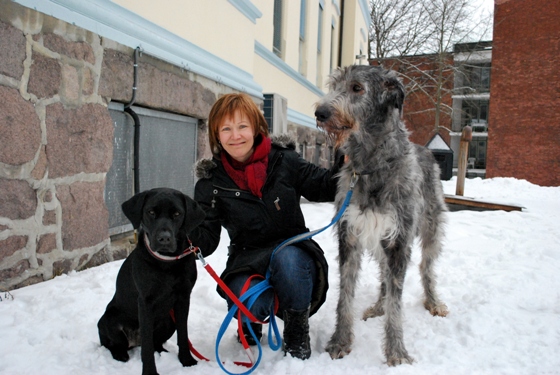
The study group consisted of 500 dogs in four breeds:  the Labrador Retriever, the Newfoundland, the Leonberger and the Irish Wolfhound.

Randi I. Krontveit with two of her study subjects. Photo courtesy of the Norwegian School of Veterinary Medicine

Environmental factors were assessed by questionnaires filled out by breeders and owners alongside examinations by veterinarians.  Dogs were followed for a period of ten years, making the findings of the study particularly robust.

Puppies born in the spring or summer and at breeders’ who lived on a farm or small holding had a lower risk of developing hip dysplasia.  After about eight weeks, the puppies began to live with their new owners. The opportunity to exercise daily in parks up until the age of three months reduced the risk of hip dysplasia.

Overall, it would appear that daily exercise out in gently undulating terrain up until the age of three months has a positive impact when it comes to preventing the disease.

For more information about this research, you can email Dr Krontveit via this page at the Norwegian School of Veterinary Medicine.

Epilepsy gene discovery in dogs

The journal PLoS ONE has published research this week by Professor Hannes Lohi of the University of Helsinki.  Professor Lohi and his research team have isolated a gene linked to epilepsy in Belgian Shepherds.

The gene is found on canine chromosome 37.  The research team isolated the gene by comparing the genome of dogs with epilepsy against those of dogs that were in a healthy control group.  The gene could increase the risk of epilepsy by a factor of 7.

Genetic epilepsy is also referred to as ‘idiopathic epilepsy.’  A co-author on the article has said that as many as 20% of the Belgian Shepherd breed is estimated to have epilepsy and so the research could underpin the development of a genetic test for the disease.

Seizures can result in abnormal movements, usually on one side of the body, followed by cramping in the limbs.  Drooling and vomiting are other symptoms.

This research group is responsible for other genetic discoveries in dogs.  Through their research, the group has developed a canine DNA bank in Finland containing 40,000 samples from 250 different breeds of dogs.  They have previously identified the epilepsy gene EPM2B in Miniature Wirehaired Dachshunds and a gene LGI2 in Lagotto Romagnolos and collaborated with other researchers in the discovery of an epilepsy gene in Tibetan Terriers.

Source:  Helsingin yliopisto (University of Helsinki) (2012, March 23).   New epilepsy gene located in dogs. ScienceDaily. Retrieved March 25, 2012, from http://www.sciencedaily.com­ /releases/2012/03/120323205337.htm?utm_source=feedburner&utm_medium=email&utm_campaign=Feed%3A+sciencedaily%2Fplants_animals%2Fdogs
+%28ScienceDaily%3A+Plants+%26+Animals+News+–+Dogs%29

New research into virus infection in dogs

Researchers at the University of Pennsylvania School of Veterinary Medicine and the Perelman School of Medicine have published new research into an Epstein Barr-like virus that can infect and may cause lymphomas in dogs.

The findings means that humans and dogs share a similar biology – at least when it comes to the infection by the virus.  (Epstein Barr is the cause of diseases such as mononucleosis and is linked to the development of more serious diseases including non-Hodgkins and Hodgkins lymphomas.)

How does infection occur?

In humans, the Epstein Barr virus infects B cells.  After an acute phase of infection, which passes in many people without them even being aware of it,  the virus goes into a latent phase.  Most people show no symptoms during this phase.  In some, however the virus promotes unnatural growth of B cells and this contributes to the development of lymphoma.

Dogs develop lymphomas that share some characteristics with human lymphomas.  These conditions are relatively common in certain breeds such as the golden retriever.

Researchers think this line of enquiry is promising because they may be able to study the rates of infection and responses to treatment in dogs and this may have spinoffs for human treatment.

You can read the entire University of Pennsylvania media statement here.

Quality of life improves when obese dogs shed excess weight

Researchers at the University of Liverpool have published the results of a study into the quality of life of obese dogs in The Veterinary Journal.

The researchers tracked various quality of life indicators with the owners of 50 dogs who were classified as obese.  These dogs were of various breeds and a mixture of males and females.   The same questionnaire was repeated once the dogs went through a weight loss programme (for the dogs that were successful in losing weight, and those that were not).

Photo courtesy of University of Liverpool

The vitality scores for the dogs that lost weight increased and their scores for emotional disturbance and pain decreased. The more body fat that the dogs lost, the greater their improvement in vitality.

Some people may think ‘these results are a no-brainer’ but in veterinary and other clinical medicine fields, the norm is ‘evidence-based medicine.’  That is, practitioners like veterinarians want results from research that is measurable and defensible when applying or recommending treatments.

Since obesity is linked to problems with the heart, arthritis and other conditions, research likes this helps to underpin the importance of the healthy weight message.

The same basic principles for weight loss in dogs apply to humans:  use portion control, increase exercise and activity, and eat healthy foods.

Furry friends with benefits

Research conducted at Case Western Reserve University has revealed the positive impact that pet ownership has on women who are managing HIV/AIDS.

Dr Allison Webel set out to understand how women manage their HIV/AIDS and stay on track to take their medications, follow doctors’ orders and live healthy lifestyles.  She found that “Pets—primarily dogs—gave these women a sense of support and pleasure.”

The human and animal bond in healing and therapy is being recognized, Webel said, as more animals are visiting nursing homes to connect to people with dementia or hospitals to visit children with long hospital stays.

Dr Webel talks about her research in this YouTube video:

Spinal cord research benefits dogs

Last week, the University of California San Francisco issued a press release about the promising research of Dr Linda J Noble-Haeusslein and her collaborators at Texas A&M  University.

The US Department of Defense has granted $750,000 over three years to develop a drug that helps to mitigate the secondary damage associated with spinal cord injury.  When an injury occurs, there is a cascading chemical reaction that damages nearby cells and that means – essentially – that more damage happens than that caused by the immediate injury.

It is thought that the drug, a protein-blocking agent, will successfully interfere with that cascading process and preserve sensitive neurological pathways.

Other neurological researchers have shown that movement in the spine can be preserved if as little as 18-20 percent of nerve fibre tracts remain intact.

Dogs such as Dachshunds, Corgis and Beagles (dogs with a long torso) are known to be susceptible to disc ruptures.   When a dog presents with a disc rupture at the Small Animal Hospital at Texas A&M University, their owner will be asked to consent to the experimental treatment.

And why is the funding coming from the Department of Defence?  Well, sadly, there are many wounded soldiers returning from overseas war zones with spinal injuries.

Source:  University of California, San Francisco (UCSF) (2012, January 18). Saving dogs with spinal cord injuries. ScienceDaily. Retrieved January 25, 2012, from http://www.sciencedaily.com­ /releases/2012/01/120118155338.htm

Dogs as workers – not such a bad idea according to NZ researcher

“Some people think that is cruel to use dogs as workers,” says Dr William “Deak” Helton, “but what these people don’t seem to understand is that from the dog’s perspective it is actually crueller if they are not allowed to work.”  Dr Helton, who is based at the Department of Psychology at the University of Canterbury in Christchurch, New Zealand, is describing for me his experience with working dogs in Alaska.  I wrote about his research in my Canine Corner column this month (NZ Dog World), and here’s some more information about Deak and his research.

This slideshow requires JavaScript.

(Photos copyright Eve Welch, University of Canterbury)

Deak has been studying dogs for over 12 years and, from those early days growing up in Alaska, he observed that sledding and racing dogs wanted to pull immediately when they were placed in harness.  Many people don’t realise, when watching coverage of competitions like the Iditarod, that a large metal snow anchor is used to keep the sled in place as the dogs are secured in their harnesses.  A handler that forgets to do this will quickly find his/her sled taken out for an unguided run!

Deak has a keen interest in seeing working dogs reach top performance.  He described one of his research projects, looking for a way to help screen dogs being considered for a working career:A recent study we did was one in which we measured dogs’ right and left ear temperatures and their ability (based on owners’ reports) to pay attention. The tympanic membrane’s (ear drum’s) temperature is highly correlated with the temperature of the brain on the same side. So differences between the ear’s temperatures may tell you if the dog is more strongly cerebrally lateralized than another. Dogs (like people) have two cerebral hemispheres, one right and one left. Most people are aware that they have a dominate hemisphere (are lateralized). Dogs also differ in their degree of lateralization (how strong one side is compared to the other). Neuroscientists have hypothesized that being strongly lateralized (having a dominate cerebral hemisphere) is actually helpful to the animal in coordinating its behaviour. Imagine having two brain hemispheres both trying to tell your body what to do, without having one as the “leader,” the system may be prone to confusion. Hence, dogs with stronger cerebral lateralization may be better able to pay attention. The less lateralized dogs may be more prone to conflicting cues (distraction). Difference in right and left ear temperature may be an objective measure of cerebral lateralization.

One area where dogs show promise is in the field of medical diagnostics, says Deak.  He goes into some detail about the role of the dog, its accuracy in detecting rates of disease, and his opinion that dogs would be used more widely than they currently are:

There have now been several studies showing that dogs can be used to detect various medical conditions, for example, cancers. When you compare detection capability across tests/technologies you have to look at both the correct detection rate and the false alarm rate of the different tests.

Dogs have been trained to detect the presence of breast cancer by smelling the patient’s exhaled breath. The principle is essentially the same as breath analysis to detect alcohol consumption. The patient breathes into a tube that traps the chemicals exhaled in their breath. The dog then is presented with these breath samples and has been trained to signal when one of them has cancer related chemical compounds (it might not be that the dog is smelling cancer per se, but some related chemical excreted by the body as a reaction to cancer). McCulloch and colleagues (2006) have trained dogs to do this task (detect breast cancer via breath samples), and the dogs after training demonstrated a correct detection rate around 88.0% and a false alarm rate around 2.3%. This is not perfect, but for comparative purposes, in the medical literature, mammography screening by professional radiologists for breast cancer typically has a correct detection rate around 86.6% and a false alarm rate around 3.2% (Banks et al., 2004).

A higher correct detection rate and lower false alarm rate means an overall better detector.

The dog definitely looks promising. Keep in mind mammography is also considered by many to be uncomfortable and some people are concerned that the procedure itself may have side effects. This may put off people from doing the test. The key with cancer is probably early detection. If people are afraid of the test, they aren’t going to do it until they feel so bad they have to and by that time it might be too late. Dog detection (since the dog doesn’t have to even be in contact with the patient) is generally non-invasive.

For detecting intestinal cancer the difference in screening may be between a stool sample and having a colonoscopy. The latter is much more uncomfortable than the former. Considering the preliminary evidence and the long track-record of dogs being used in other detection contexts (explosives, narcotics, invasive pests, etc.), I think the lack of using dogs in medical diagnostic work is mysterious. While dogs will not be a perfect system, people have to realize there are no tests that are perfect. Dogs (or other biological detectors) could be used in conjunction with other tests. There are companies trying to figure out what the dogs are detecting so that they can make technological tests for detecting cancer based on the dog’s ability to detect it, but that is not helping anyone now.

Dogs can probably do the job and if the track record in other contexts is informative (for example, explosives) then dogs will probably be able to do the job better than technology for the foreseeable future.  Of course we should develop other technologies, but if we want to save lives now, dogs could be used more in this context.

The Editor of Canine Ergonomics:  The Science of Working Dogs, a compilation of research from disciplines ranging from biology and veterinary medicine, to psychology and forensic medicine, Deak says “For me, this book filled a gap when you consider how extensive dogs are employed.”  The book, published in 2009 has had great reviews.

The cover of Deak's book

Deak describes his research as the field of engineering psychology, more popularly known as ergonomics.  His work in the field of human factors psychology has earned him the 2011 Earl Alluisi Award for Early Career Achievement by the American Psychological Association (APA).

Is your dog right-pawed or left-pawed?

Research shows that dogs can have a paw preference and it is fairly easy for you to test your own dog.

In 2006, a researcher, Dr Nick  Branson, found that the way a dog uses its paws was an indicator of how it reacted to noise.  Dogs without a clear paw preference were more likely to be reactive to noises such as thunderstorms and fireworks.  He presented his findings at the annual conference of the Australian Veterinary Association in 2007.

Dr Branson was quoted as saying,:

“It seems possible that dogs that do not favour one side or the other may be prone to experience intense emotional responses to a broad range of stimuli. Animals with lateralised functions may be able to transfer attention from disturbing stimulus more successfully.”  (Source:  News Nine)

Now, if you want to know how to test your dog for their dominant paw,  here’s how – just follow these tests as demonstrated by Ellie Mae on YouTube:

How kindness built civilization by Gareth Cook

Any columnist who begins an article with “It’s about time the dog got a little more respect” is bound to get my attention.

In this article  Gareth Cook, a columnist with The Boston Globe, discusses the research of Brian Hare who compared the intelligence of dogs with chimpanzees and found that the dogs are more intelligent in many aspects.

The lesson:  “To be smart, first play nice.”

Read his story here.

Kathleen Crisley, Fear-Free certified professional and specialist in dog massage, rehabilitation and nutrition/food therapy, The Balanced DogChristchurch, New Zealand

Rescuing beagles from the lab

The Foundation for Biomedical Research, located in Washington DC, estimates that there are 60,000 dogs in research facilities in the United States.  (The Foundation advocates for ethical treatment of animals used in research.)

The beagle is commonly chosen as a research subject because of its size and temperament.

Unfortunately for the dogs involved in research, most facilities do not re-home the dogs after their ‘useful’ period has passed.  Most are euthanised.  One reason for this is that the facilities who conduct research involving dogs do not wish to be identified, for fear that they are targeted by activists who publicise their use of the dogs.  In extreme cases, activists have been known to break into the facilities to release the dogs.

Some animal welfare agencies work behind the scenes to find ways to receive these dogs and find them new homes, also protecting the anonymity of the laboratories so they are encouraged to re-home more dogs in the future.   The San Francisco Chronicle ran a story last week of one such re-homing effort involving nine beagles.

Re-homing an ex-laboratory dog is not always easy.  Most of these dogs have never been outside and have never been housebroken because they spend their lives in a crate or cage.  In the cases of these beagles, they were also de-barked (vocal chords were intentionally cut) to reduce noise in the laboratory.

The June re-homing exercise was the second for the Beagle Freedom Project, which mounted this wonderful video on YouTube of the rescue:

In future blog postings, I will provide some more information about dogs used in research and the points of view about whether or not the experimentation on them is essential.  This is a major animal welfare issue and one that will not go away quickly as the world seeks to develop new treatments for human diseases and disorders.

Kathleen Crisley, Fear-Free certified professional and specialist in dog massage, rehabilitation and nutrition/food therapy, The Balanced DogChristchurch, New Zealand