Finding Pets After the Storm, Joplin Missouri

Animals have also been caught up in the destruction of Sunday’s tornado in Joplin, Missouri.  Listen to this radio programme from KSMU radio to hear about the rescue and recovery efforts at the Joplin Humane Society.

Kathleen Crisley, specialist in dog massage, rehabilitation and nutrition/food therapy, The Balanced Dog, Christchurch, New Zealand


Importing veterinary medicines and supplements into New Zealand

In my NZ Dog World column this month, I promised to include more information about the importing requirements if you are considering buying a supplement or medicine from overseas.  Here’s that information…

I’ll caution you again – this is not an easy area to work in or understand!  (Although the NZ Food Safety Authority recommends using a consultant for importing applications, I tried to contact two consultants from the consultants list to clarify a few points for my research.  Neither have replied.)

Until this month, the NZFSA used something called the Register of Allowable Nutrients with Known Therapeutic Uses in Exempt Oral Nutritional Compounds.  Glucosamine, for example, was included on the register.  The NZFSA website has recently announced:

“The register of allowable nutrients with known therapeutic uses in exempt oral nutritional compounds is no longer in use. Nutrients formerly listed on that register will now be evaluated solely on safety and pharmacological thresholds as applicable. Products with expressly stated or obviously implied therapeutic and/or pharmacological claims will still require registration. The limitations on species uses or pure supplements will no longer be applied.

I asked NZFSA what this means for the average pet owner who many want to buy a glucosamine supplement from an overseas supplier that was previously allowed into the country.  I got a very prompt reply from Linley Thorburn, an Advisor at the NZFSA (which was much appreciated).

She says:

There must be a clear nutritional claim made on the label for the product to be considered exempt.  If the product is making a claim to treat arthritis, then the product would require registration and be supported by efficacy data. Also, safety thresholds will be established for oral nutritional compounds that contain ingredients like, glucosamine, chondroitin etc.

Products currently registered containing these ingredients that have a clear nutritional claim will no longer require registration.

It sounds like the work to establish the safety thresholds hasn’t happened yet, but the fact that products that are currently registered that contain the ingredients will no longer require registration means that direct importing should become easier.

As I mentioned in my article, the best thing to check before considering purchasing a product from overseas is the ACVM register.  Look for the product by name and if it is registered, chances are you won’t be able to import it directly unless it falls under the new requirements.

In addition, this month MAF announced new rules for “Registration by Reference”   In some circumstances, the NZFSA will allow determinations made by the Australian Pesticides and Veterinary Medicines Authority (APVMA) to carry weight in New Zealand – reducing the time and costs for the registration process.   This change only pertains to products for non-food producing animals (i.e., pets).

MAF says that this move could encourage a greater range of products to be registered in the New Zealand market, particularly for products with a limited demand.  If this open doors to more product selection, dog owners and veterinary professionals will have a wider range of choices for animal care.

My fingers are crossed that suppliers and veterinary medicine companies will take advantage of this change!

Kathleen Crisley, specialist in dog massage, rehabilitation and nutrition/food therapy, The Balanced Dog, Christchurch, New Zealand

Pet relief areas in US airports

In 2009, the US Government passed legislation requiring service animals that are flying to have indoor and outdoor relief facilities.

Here’s what the facility at Maui’s Kahului Airport looks like:

This slideshow requires JavaScript.

Kathleen Crisley, specialist in dog massage, rehabilitation and nutrition/food therapy, The Balanced Dog, Christchurch, New Zealand

Homeless dogs in paradise – a visit to the Maui Humane Society

Whenever I travel, I like to do research on dogs and dog welfare issues.  I was on Maui last week and took a trip out to visit the Maui Humane Society.  I’m very glad I did.

The Humane Society is a very busy place  set on beautiful grounds adorned by tropical flowers.    In the reception area is a notice board complete with photos and details of animals that have successfully found their forever homes after a stay at the shelter.

Jocelyn Bouchard, who  is the Chief Executive Officer of the Society, told me that the Society employs two full time adoption counselors who promote adoptions, provide counseling and support to potential adopters before, during and after adoption, and coordinate transfers.

The Society transports pets off island, out of state and internationally and works with adopters and transport agencies to make this happen.   For the ten months of this financial year (July through to end of April), 832 dogs have been adopted and another 63 have been transferred. In the fiscal year the ended June 30 2010, the Society adopted a total of 911 dogs, transferring a total of 33.

Holiday makers often visit the Society’s shelter, and adoptions to California and other west coast (USA) locations are fairly common.   The most common international designation for pets is Canada.  Pets have been transferred as far as Indonesia and Germany, too!

This slideshow requires JavaScript.

The Society spends an average of $255 on every animal in its care.

The kennel area was full on the day of my visit.   Dogs are photographed with flower leis around their neck to add a unique Hawaiian touch.

The Society is a no-kill shelter and has no time limit for keeping animals.  Adoption information on the kennel signs tell you how long the animal has been in the Society’s care.  Adoption fees range from a high of $125 for puppies under the age of 6 months, $100 for dogs over the age of 6 months, and $55 for dogs over the age of 7 years.
You can find the Society’s headquarters at 1350 Mehameha Loop in Pu’unene.  Visiting hours are 10 am -4 pm, Monday through Saturday,  and 12 to 4 on Sundays.

The Maui Humane Society is committed to building lifelong bonds between people and animals through education, community outreach and the prevention of cruelty.

Kathleen Crisley, specialist in dog massage, rehabilitation and nutrition/food therapy, The Balanced Dog, Christchurch, New Zealand

A bit more about the surfing dogs of Hawaii

Sava and Billy Hamilton have featured in a Eukanuba commercial.  Sava is 11 years old and still surfs:

Malu and Erik Lillmars are often seen on the beach at Waikiki (Oahu).  Malu was homeless before she met Erik, and now they are best buddies in the surf:

And I hope you enjoy this Hawaii Surf Session report, focusing exclusively on the surfing dogs of Hawaii:

Interested in learning to surf with your dog?  Then check out The Dog’s Guide to Surfing:  Hanging Ten with Man’s Best Friend by Kevin Reed.

Kathleen Crisley, specialist in dog massage, rehabilitation and nutrition/food therapy, The Balanced Dog, Christchurch, New Zealand

The surfing dogs of Hawaii

I have just returned from a short holiday in Maui to celebrate my mother’s 80th birthday.   I hadn’t even arrived on Maui when I knew this trip was ‘meant to be’.  The cover story of Hana Hou, the magazine of Hawaiian Airlines, was about dogs who surf!

Read the story, with pictures,  about Buddy Surfing today.

Kathleen Crisley, specialist in dog massage, rehabilitation and nutrition/food therapy, The Balanced Dog, Christchurch, New Zealand

The Museum of the Dog

Heading to St Louis for a vacation with your dog?

Don’t miss the American Kennel Club’s Museum of the Dog.  The museum offers a range of exhibits all about our favourite topic:  dogs!

The museum also has a Fido Friendly Visitation Policy.  The museum actively encourages owners to bring their dogs for a visit, providing fresh water and treats as well as a place to exercise.  Dogs must be obedience trained and on leash to visit.

Dogs visiting at the Museum of the Dog

The Museum of the Dog is located at 1721 South Mason Road in St Louis and is open Tuesday through Saturday from 10 am to 4 pm.   On Sundays, you can visit between 1 and 5 pm.

Admission:  $5.00 adults, $2.50 seniors and $1.00 for children from the ages of 5 – 14.

Kathleen Crisley, specialist in dog massage, rehabilitation and nutrition/food therapy, The Balanced Dog, Christchurch, New Zealand

Sydney’s dog restaurant

Did you know that Sydney has its very own dog restaurant?  This isn’t just a restaurant that allows dogs – this is a restaurant catering for dogs only (owners are not even served here!)

Called Chew Chew, the restaurant is located at Woolstonecraft Station and is open from Wednesday to Sunday.  Meals are prepared on site using organic meats and are formulated using a basic recipe of 50% meat, 25% grain and 25% vegetables.  Owners can ask for an adjusted recipe that meets their dog’s dietary restrictions.

At Chew Chew, dogs can indulge in a number of dishes including chicken risotto, salmon pasta and beef steak.   A three-course set menu consists of an soup entree, followed by salad with beef, chicken or fish, and a cup cake or doggie cappuccino for dessert.

The interior of the Chew Chew Restaurant

Chew Chew also sells takeaway meals for dogs in two sizes:  200 g and 400 g.

Not surprisingly, the opening of the restaurant in 2010 captured a fair bit of media attention.

Sydney dog owners:  take your dog for a special day out at Chew Chew.

Kathleen Crisley, specialist in dog massage, rehabilitation and nutrition/food therapy, The Balanced Dog, Christchurch, New Zealand

Dog imports to New Zealand

Did you know that approximately 3,100 dogs are imported into New Zealand per year?

New immigrants bring their dogs into the country; breeders also import dogs to add to their bloodlines, and individuals import dogs as pets or show dogs.

MAF had to put changes to dog importation rules on hold last month because there was an application for an independent review.   Proposed changes that are now on hold include introduction of a quarantine for dogs coming from Britain and the Irish Republic  (currently these dogs are allowed into the country without quarantine as long as they have lived 6 months in these areas).

Read about the conflict over MAF’s intention to change the rules in this Otago Daily Times article.

Kathleen Crisley, specialist in dog massage, rehabilitation and nutrition/food therapy, The Balanced Dog, Christchurch, New Zealand

Pointer vs Dalmatian

When I am out walking with Daisy, many people stop us to ask, “She’s a Dalmatian crossed with what?”  And I reply politely, “She’s a pure bred English Pointer, actually.  But it is the spots that throw people off.”

With the help of our friend, Olliver (Ollie for short), I am going to explain the differences between a Pointer and a Dalmatian.  

To start off, let’s look at Daisy and Ollie side by side:  they are different!
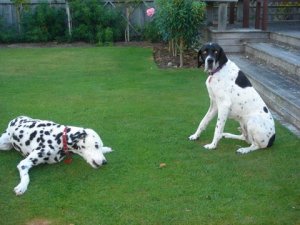
Maybe a side by side comparison will help:

Both dogs are black & white, but Ollie has only small spots whereas Daisy has large and small ones.  Daisy’s head is almost solid black; Olliver’s head has spots all over!

Perhaps the best way to tell the dogs apart is to read Daisy’s lips.  Our friends call these saggy doggy lips.  Ollie’s lips are clearly not the same!

Both dogs shed on a regular basis and are single-coated.  This means that they feel the cold and so their favourite place in winter is in front of the fire.  They also benefit from wearing a coat on colder days.

 Some basic Dalmatian facts:

The Dalmatian is a non-sporting dog and the breed is recognised by the American Kennel Club and the New Zealand Kennel Club, as well as many other clubs worldwide.   Dalmatians are either bi-coloured or tri-coloured. Bi-coloured dogs are black and white and tri-coloured dogs have brown, liver and black spots.  Puppies are born white and their spots develop over time.

The breed has a long history, with some people suggesting that Dalmatians were featured on the walls of the Egyptian pyramids. Gypsies that travelled Europe used Dalmatians to calm horses and provide companionship to travellers.  The word ‘Dalmatian’ is derived from the area of Croatia that was known as Dalmatia.  Dogs were traded for goods to the British, who were the first to breed the dogs.

During the late 1700s, Dalmatians were known to be riding under the axles or alongside the carriages of their noblemen owners for the sole purpose of being a status symbol.  The dogs could run or trot for over a hundred miles in a single day. In the evening, the dogs were placed alongside the horses in the stables to guard and to calm the horses.

When Dalmatians came to America in 1870, they arrived as the mascot to the fire truck and this association with firehouses continues to this day.

Dalmatians are known for their spots, energy, devotion, protective nature and intelligence.

Some basic Pointer facts:

The English Pointer, also known as the Pointer, is a gun dog that is recognised by major kennel clubs worldwide.  Pointers may be liver and white, black and white, lemon and white or orange and white.  The dogs can be tri-coloured and also come as solids.  (Solids are more rare and are much sought after.)

Like the Dalmatian, the Pointer has a long history.  It was bred to be a gentleman’s hunting dog and so they are known for being gentle and well-mannered once they are trained.  History records Pointers as far back as the 1600s, with Pointers being used to locate hares and greyhounds being used to chase them.  The breed is thought to be a cross of Foxhound, Bloodhound, Greyhound, Newfoundland, and Setter.  Other records say that there was a Spanish Pointer that was bred in 17th and 18th century to form the basis of today’s breed.

Pointers are often shown ‘on point’ when they are standing still and pointing at the location of birds.  Pointers are not naturally known for their retrieving skills but they can be trained to find dead or wounded game.

Pointers are known for their strength, cleverness, dependability, hardworking nature, loyalty and congeniality.

Famous dogs

Sensation was one of the most famous Pointers.  He was imported to the United States in 1876 and is the mascot for the Westminster Kennel Club, appearing on their emblem.

The Pointer ‘on point’ is also the official registered trademark of the Rodd & Gunn clothing company and the image of the Pointer is found on all of their menswear garments. 

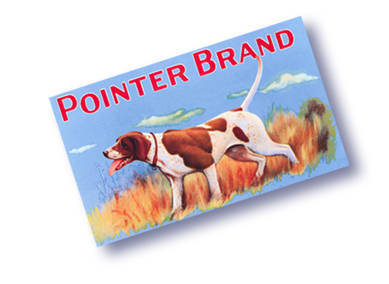
Pointer Brand clothing has also been manufactured in the United States since 1913.  The company’s logo features Carolina Bill, the dog of Landon Clayton King who founded the company, L. C. King Manufacturing Company, in Tennessee. 

Sparky® the Fire Dog is one famous Dalmatian.

He is the mascot and logo for the National Fire Protection Association.  Perhaps the best known Dalmatians are Pongo, Perdita, Prince and the puppies made famous by 101 Dalmatians.  The One Hundred and One Dalmatians was a novel published in 1956 by Dodie Smith that was made into animated films by Walt Disney Productions.

I hope that this article gives you some better information about why Pointers are different from Dalmatians.   Despite their differences, the dogs get along just fine!

Sources:

 www.allsands.com

www.dogbreedinfo.com

www.dogster.com

www.trademarkia.com

www.wikipedia.org

Kathleen Crisley, specialist in dog massage, rehabilitation and nutrition/food therapy, The Balanced Dog, Christchurch, New Zealand