
Stress.
People experience it and so do our dogs. Trigger stacking is something I discuss with many of clients.
Trigger stacking occurs when multiple stressors (triggers) accumulate. The stress hormone cortisol builds up and after a time the dog’s natural coping threshold is exceeded. Sudden fear, panic or pain reactions can result – such as when a dog snaps at a member of the family out of character.
Trigger stacking can also occur in people; something I’ve recently experienced on my trip to the USA. So I thought I would put the concept of trigger stacking into perspective using my human experience.
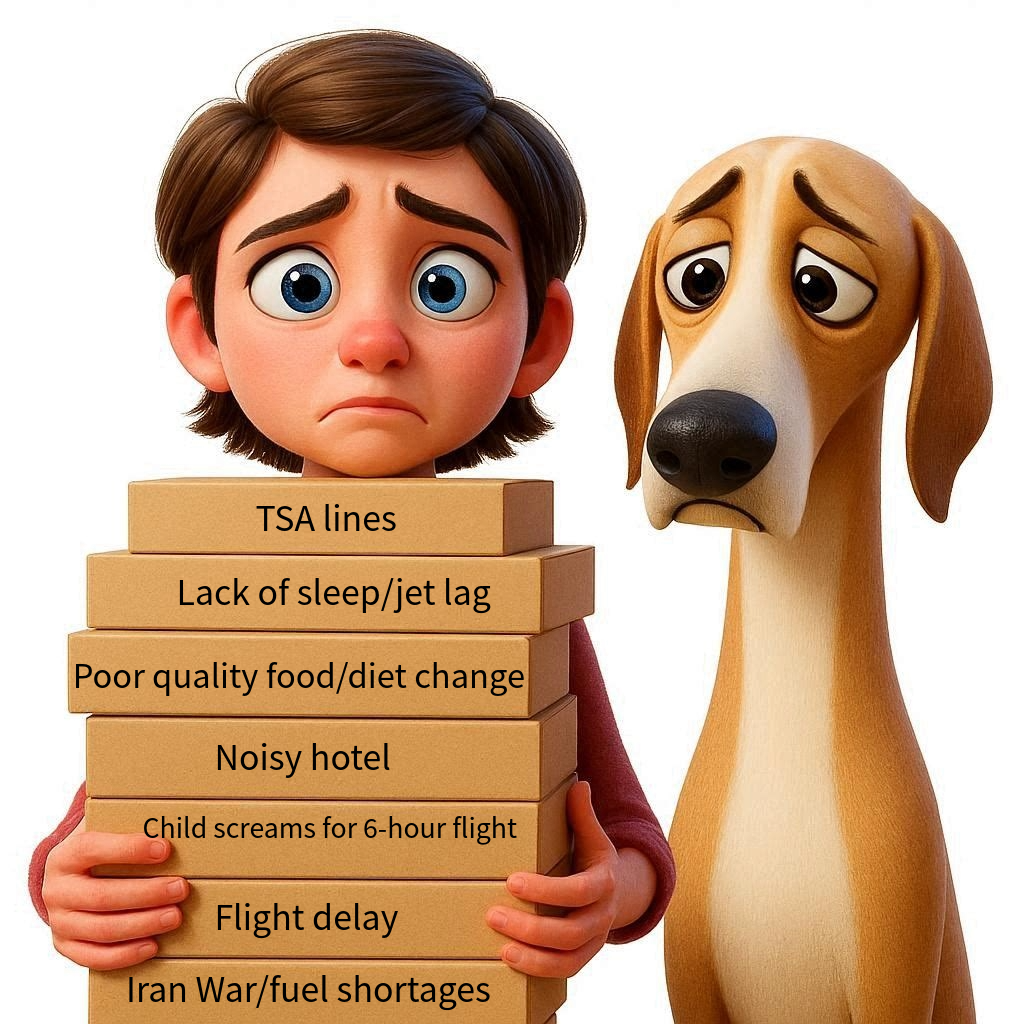
I’d like to start by saying that I am an experienced traveler and typically handle the stress of travel with no issues. This year has been different.
In the days prior to my departure, the US decided to wage war on Iran. Fuel uncertainties seemed to be the only topic in the news and at the time I didn’t honestly know if World War III would break out before I managed to get home. Or, fuel shortages would mean that I couldn’t get back.
So my stressors were already high before a number of things got added:
- Christchurch Airport was fogged in and my outgoing flight was severely delayed; I would miss the first day of my conference
- I learned that my flight was not operated by Air New Zealand, but rather was a codeshare with United Airlines. United’s services are typically poor, but especially so on this international flight with a surly flight crew, a cabin that alternated from severely cold to very hot, and terrible food. It’s my opinion, but Air New Zealand on its worst day is still better than a typical day flying United.
- And then welcome to America, where my connecting flight on United means that I am in the last boarding group. This is typical of United. Passengers from its Star Alliance partners are considered lower than basically any other ticketed passenger. By the time I board, the overhead bins are stuffed with rolling suitcases that in this country would have to be checked. It’s very typical that American passengers don’t want to check bags and virtually every flight has an announcement at the gate “We have a full flight today and so are now checking bags for free at the gate.” (Such announcements are meant to encourage people to check their bags before a long boarding process because everyone is competing for bin space.)
- Takeoff for the East Coast. A child in the middle of the airplane starts to cry and scream. He screams for the entire 6-hour flight with his parents walking him up and down the cabin in an attempt to calm him. No rest on this flight for me or anyone else. Noise cancelling headphones don’t help much given the decibel level of this kid – who will, no doubt, audition for opera school when he is older and have PTSD from his traumatic cross-country flight.
- Hot and humid on arrival. I check into my hotel and discover that its air conditioning unit is doing its best impression of a jet plane on take off. It’s too hot and stuffy not to have air conditioning and, besides, the air conditioning unit helps to drown out the sounds of the local interstate highway. I can hear the traffic noise clearly because the walls in this rather aged hotel (which I booked at a premium through the conference organiser) are paper thin.
- By morning, I am working not only with jet lag but also a bare 3-4 hours of sleep.
- One of the things that I always notice when traveling in the USA is that its obesity problem is no accident. Finding fresh fruit and vegetables is harder than you think. The conference food is a breakfast sandwich of bacon and egg with hot drinks but no fruit; lunch is provided by food trucks and the salad I order comes drenched in oily dressing and is mostly cheese. By night, I find a steak house because you can usually order a salad (and I remember to ask for dressing on the side and skip the chemically-preserved croutons, too, please).
- Return to the hotel, still not sleeping and this time someone appears to be doing late night maintenance with rubbish being stuffed in the bins outside for most of the night. 4 hours of sleep again, by which time I am well and truly operating on adrenaline.
- My meetings finish early and I would love to leave for my destination of New Orleans where I am meeting my sister. There are flights available with space however Southwest Airlines insists that I need to pay another US$350 to take that flight (like literally, who else is going to take that seat in the next 6 hours?). My trip is already costing a bomb with the NZ dollar trading at 58 cents US. I decide to stick it out for a final night at the hotel, but ask to have a different room to escape the interstate.
- Meanwhile, the top news story is the TSA (security) lines at airports across the country. Officers haven’t been paid for 5 weeks thanks to a stalled Homeland Security funding bill. Most are not turning up at work on the promise of back pay. Some have no money to afford the cost of travel to work, or they have sought other jobs to feed their families. “Please arrive at your airport 5 hours before your flight to ensure you have enough time to clear security.”
- Another largely sleepless night, the upgraded hotel room offers only a minor improvement since the air conditioning is just as loud (obviously a hotel standard) and, besides, I am now worried about getting to the airport at the crack of dawn.
- Thankfully, my driver shows up early and I get through TSA fairly easily only to find that all the food outlets at the airport are overrun thanks to more passengers arriving early. The terminal is shoulder-to-shoulder. I spend almost an hour in line at Starbucks for a breakfast sandwich and coffee. I then hope/pray for an on-time flight. Southwest’s boarding procedures are much more streamlined by seat number (as opposed to a class-driven boarding group) and I arrive in New Orleans on time.
And this is where my trigger stacking finally reveals itself. I am short-tempered with my sister, still worried about getting home (possibly irrationally so, but I can’t switch it off) and not sleeping. New Orleans creole cooking doesn’t agree with me at our first meal together and I spend the rest of the evening chewing antacids and visiting the toilet. My poor sister is recovering from a cold and coughs sporadically during the night. I am wide awake, reading and checking emails at 2 am. Another night of about 4 hours of sleep and I’m annoyed when my sister wakes me up moving around in our room in the morning. I feel guilty; it is her holiday, too.
Things start to improve; we stick to more ‘normal’ food where possible and make a point of eating fruit and vege at the dinner buffet at our hotel. We seek out a restaurant that serves fish to avoid heavy, fat-laden meals. And we enjoy each other’s company. Still short-tempered, but not quite as pronounced as earlier in the trip.
I decide to ask my travel agent to change my outgoing flight to earlier because the weather prediction is for thunderstorms later in the day. The benefit is that my sister and I are now leaving around the same time and so can travel to the airport together and hang out since New Orleans has a single, connected terminal for all airlines. We have a simple lunch. The new flight time also ensures that I arrive in Houston in plenty of time to make my connecting Air New Zealand flight which greatly reduces my stress.
And my Houston flight to New Zealand is genuinely Air New Zealand, so things are looking up. I sleep most of the trip to Auckland and enjoy a very nice on-board dinner and breakfast, too. (With real fruit and vege).
I’ve been home for a number of days now. I’m sleeping in my own bed, eating my own food, and Sox and I are enjoying our twice-daily outings.
Although the Iran War is still the top news story and I’m worried about what this is going to do to our economy both in the short and long terms, I am home. My USA-induced trigger stack is largely gone and I am back to my normal self.
Trigger stacking increases reactivity in both people and dogs. The inability to settle and irritability are symptoms. In dogs and people, shutting down is often at the extreme end when the nervous system can no longer deal with the stress – luckily I didn’t get to that stage.
We must identify and reduce triggers, managing the environment for better results. I knew how I was feeling, switching hotel rooms and flights were environmental management options for me, as was managing my food choices.
The same holds true for our dogs. It’s just that they have little ability to make changes – it is up to us as their guardians to do it for them.
I hope this post has helped to explain trigger stacking in a somewhat humorous way (it’s a lot more funny now that I am back to normal). Best wishes to all as we navigate a world that has changed over the last eight weeks; may things improve for all in the days to come.
Kathleen Crisley is Fear-Free certified dog massage therapist and canine fitness trainer. She has a particular passion for working with dogs and their families to ensure injury prevention and quality of life. She specialises in working with anxious and emotionally damaged dogs. Her mobile practice, The Balanced Dog, is based in Christchurch, New Zealand








