
“Dogs and philosophers do the greatest good and get the fewest rewards”
-Diogenes, Greek philosopher

“Dogs and philosophers do the greatest good and get the fewest rewards”
-Diogenes, Greek philosopher
Ed, a Bull Terrier, loves his regular massage sessions. Ed responds to massage much like a person does, so we decided to cover him in a blanket and take a video.
I have launched this video on social media as a promotion for gift vouchers for Christmas 2021. Dog massage is the calorie-free gift which supports wellness, relaxation, and can provide an early warning for sinister lumps and bumps. It helps arthritic dogs like Ed with pain relief and mobility and should be an essential part of any rehab program following an injury or surgery.
Kathleen Crisley, Fear-Free certified professional and specialist in dog massage, rehabilitation and nutrition/food therapy, The Balanced Dog, Christchurch, New Zealand
Researchers at the University of California, Davis, have found that people may not recognize that their dog is stressed when exposed to common household noises. While it’s well established that sudden loud noises, such as fireworks or thunderstorms, commonly trigger a dog’s anxiety, a new study finds even common noises, such as a vacuum or microwave, can be a trigger.

The study was published in Frontiers in Veterinary Science.
The research found that high-frequency, intermittent noises such as the battery warning of a smoke detector are more likely to cause a dog anxiety, rather than low-frequency, continuous noise.
“We know that there are a lot of dogs that have noise sensitivities, but we underestimate their fearfulness to noise we consider normal because many dog owners can’t read body language,” said lead author Emma Grigg, a research associate and lecturer at the UC Davis School of Veterinary Medicine.
Some common signs of a dog’s anxiety include cringing, trembling or retreating, but owners may be less able to identify signs of fear or anxiety when behaviors are more subtle. For example, stressed dogs could pant, lick their lips, turn their head away or even stiffen their body. Sometimes their ears will turn back, and their head will lower below their shoulders. Grigg suggests owners better educate themselves on anxiety-related behavior.
Researchers conducted a survey of 386 dog owners about their dogs’ responses to household sounds and examined recorded dog behaviors and human reactions from 62 videos available online. The study found that owners not only underestimated their dogs’ fearfulness, but the majority of people in videos responded with amusement rather than concern over their dog’s welfare.
“There is a mismatch between owners’ perceptions of the fearfulness and the amount of fearful behavior actually present. Some react with amusement rather than concern,” Grigg said. “We hope this study gets people to think about the sources of sound that might be causing their dog stress, so they can take steps to minimize their dog’s exposure to it.”
Grigg said because dogs have a wider range of hearing, some noises could also be potentially painful to a dog’s ears, such as very loud or high-frequency sounds. She said minimizing exposure may be as simple as changing batteries more frequently in smoke detectors or removing a dog from a room where loud noises might occur.
“Dogs use body language much more than vocalizing and we need to be aware of that,” said Grigg. “We feed them, house them, love them and we have a caretaker obligation to respond better to their anxiety.”
Source: UC Davis

Each year in New Zealand, there is an annual renewal process for our dog’s registrations, which is the responsibility of the local town or city council. Typically, this consists of a round disc with the dog’s registration number on it, the registration number changes each year as the new plastic tag is issued on renewal.
But in an effort to reduce plastic waste, a number of councils including Christchurch and Wellington have announced that dogs will be issued with a more durable metal tag starting in 2022. The Selwyn District instituted the tags in 2021.
This means that the dog’s registration number will remain the same with the registration renewing after each year’s fee is paid; the metal tag is designed to last the dog’s lifetime.
In Christchurch, where I live, the council issues 40,000 tags each year which would normally go to landfill. Instead, the metal tags will be recyclable when the tag is no longer required.
In managing our environment, it is nice to think that our dogs are doing their part and I, for one, will happily polish Izzy’s tag to keep it looking brand new while foregoing the annual change of the plastic tag.
Kathleen Crisley, Fear-Free certified professional and specialist in dog massage, rehabilitation and nutrition/food therapy, The Balanced Dog, Christchurch, New Zealand
Pets are not the only ones who experience separation anxiety; their people do too.
Washington State University researchers surveyed a sample of new first-year college students leaving pets at home and found that 75% experienced some level of pet separation anxiety—with one in four reporting moderate to severe symptoms.
“Students who are struggling with missing their pets should know that they’re not alone,” said Alexa Carr, the lead author of the study which is part of her WSU doctoral dissertation. “There’s nothing necessarily wrong with them if they are experiencing a lot of distress from leaving their pets. It can be an isolating experience to lose that coping resource.”
The students who had higher anxiety tended to be those who treated their pets more like people, identifying them as friends, sleeping in the same room and generally spending a lot of time with them. Interestingly, students who had dogs at home also tended to report more attachment to their pets—and more separation anxiety—than those with cats and other types of pets.
While there are many anecdotal accounts of students missing their pets, the study published in Anthrozoos, is the first known research investigating this kind of pet separation anxiety in humans.
Carr and co-author Patricia Pendry, a WSU associate professor of human development, surveyed a sample of about 150 incoming first-year students who had pets at home. The vast majority of respondents, 81%, were women—which is a limitation of the study but also consistent with trends in college enrollment. In 2020, 60% of enrolled college students were women, according to National Center for Education Statistics.

The researchers surveyed the group before they arrived on campus and after their first two weeks of the semester in fall 2019 before the pandemic forced many universities online. The students answered questions related to their mental health, attachment to their pets and feelings about leaving them behind.
Even after controlling for pre-existing mental health issues, the researchers found that pet-related separation anxiety was very strong in the group during the transition to college, especially among students who were closely attached to their pets.
The findings indicate this is an issue for many students and should be taken seriously by campus counselors, Carr said. It also has implications for pet visitation programs now popular at many U.S. universities which bring animals to campus to help stressed students. A previous WSU study found that petting dogs or cats for just 10 minutes lowers levels of the stress hormone cortisol.
The authors said more research is needed to understand the implications of pet separation anxiety. For example, whether students’ symptoms are stable or become less severe over the course of the semester; or whether pet visitation programs might have some unintended effects, such as potentially exacerbating separation anxiety for students missing their specific pets back home.
The researchers also cautioned that this study should not be used as justification for students to bring their pets with them when they go to college, particularly if they would be their sole caregivers.
“It’s a big responsibility to take care of an animal and would a student then able to balance their school responsibilities, social lives and jobs?” Carr said. “There are more things to take into consideration and explore before we could advocate for more pets on campus.”
Source: WSU Insider
Would you risk your life for your fur baby? A new survey reveals that three in five Americans would willingly run into a burning building to save their pet.
The poll of 2,000 cat and dog owners also shows that 81 percent wouldn’t think twice before saving their pet from immediate danger. Six in 10 (59%) would willingly fight another person to save their four-legged friend.
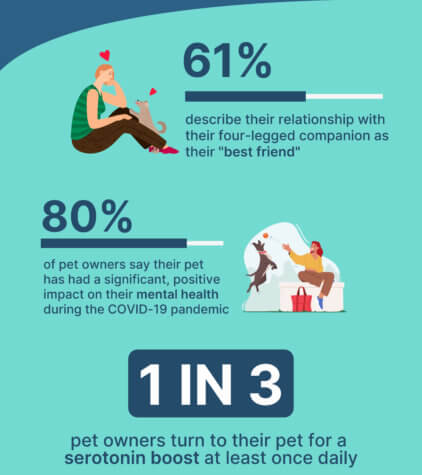
Sixty-two percent would even describe their pet as their “best friend,” while three in five agree that their pet is their “soulmate.”
Conducted by OnePoll on behalf of Figo Pet Insurance, the survey also reveals that pet owners often search for similar affirmations of love from their pets as they do from their partners. That includes their pet “following them around” (63%), “giving them kisses” (59%) and sleeping in their bed (53%) as the top signs of endearment.
Research also showed that 84 percent of Gen Z (ages 18-24) are likely to include their pet in their wedding or a milestone event. More than three-fourths of Gen Zers are likely to get a tattoo inspired by them as well. Of those who own multiple species of pets, 48 percent admit they’ve bonded to one in particular — including 80 percent who feel more tied to their dog than their cat.
Regardless of which pet they bond more with, two-thirds (67%) believe that because they are so connected, they can read each other’s minds. Four in five pet owners believe that their pet significantly impacts their mental health in a positive way.
Furthermore, more than one-third of the survey admit turning to their pet for a boost of serotonin at least once every single day of the week.
“The connection we have with our pets goes much further than just owner and companion. Our pets comfort us when we’re sad, stick by us through ups and downs and provide unconditional love like no other relationship can. Our pets are family, and while they may not be able to verbalize their affection for us, any pet parent can attest to the strength and depth of their devotion,” says Lizbeth Bastidas, claim supervisor and certified vet technician in a statement.
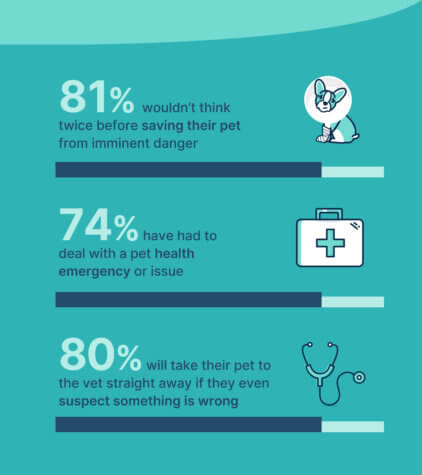
Because of being the most loyal companion, more than two-thirds of pet owners feel obligated in some way to repay their pet for all they do for them. Eight in 10 say it is likely that they will take their pet to the vet straight away if they even suspect something is wrong.
Almost one in five add they would pay more than $7,000 to save their pet’s life, and 53 percent would willingly go into debt or spend any amount necessary to save them from immediate danger. Although only one-third have pet insurance, 54 percent of pet owners agree that it is a good way to repay their pet.
Of those who have pet insurance, one in three say it has come in handy three to four times. Of those who don’t, two in five believe it is too expensive.
“With the growing cost of vet care in the U.S., the sad reality is that many pet parents will at some point face an expensive vet bill that could put them in a terrible position – having to choose between their beloved companion and their financial health. Our pets are there for us through thick and thin, and many pet parents would do anything to return the favor. This is especially true today, when pet medical care has advanced so drastically; sophisticated cancer treatments, alternative therapies, pain management and the list goes on. Pet insurance lightens the financial, mental and emotional load for pet owners, ensuring that cost does not dictate their pet’s care,” Bastidas adds.
Source: Studyfinds.org
A study involving some 11,000 dogs carried out at the University of Helsinki demonstrated that the gender, age and breed of the dog, as well as any behavioural problems and certain environmental factors, are connected to hyperactive and impulsive behaviour and inattention (ADHD).

“Our findings can help to better identify, understand and treat canine hyperactivity, impulsivity and inattention. Moreover, they indicated similarity with human ADHD, consolidating the role of dogs in ADHD-related research,” says Professor Hannes Lohi, head of a canine gene research group at the University of Helsinki.
“Dogs share many similarities with humans, including physiological traits and the same environment. In addition, ADHD-like behaviour naturally occurs in dogs. This makes dogs an interesting model for investigating ADHD in humans,” says doctoral researcher Sini Sulkama.
Professor Lohi’s research group collected data on more than 11,000 dogs by conducting an extensive behavioural survey. Hyperactivity, impulsivity and inattention were examined using questions based on a survey utilised in human ADHD research. The goal of the study was to identify environmental factors underlying canine ADHD-like behaviour and potential links to other behavioural traits.
“We found that hyperactivity, impulsivity and inattention were more common in young dogs and male dogs. Corresponding observations relating to age and gender in connection with ADHD have been made in humans too,” says Jenni Puurunen, PhD.
Dogs who spent more time alone at home daily were more hyperactive, impulsive and inattentive than dogs who spent less time on their own.
“As social animals, dogs can get frustrated and stressed when they are alone, which can be released as hyperactivity, impulsivity and inattention. It may be that dogs who spend longer periods in solitude also get less exercise and attention from their owners,” Sulkama muses.
The researchers discovered a new link between hyperactivity and impulsivity, and the owner’s experience with dogs, as the two traits were more common in dogs who were not their owners’ first dogs. The causality of this phenomenon remains unclear.
“People may pick as their first dog a less active individual that better matches the idea of a pet dog, whereas more active and challenging dogs can be chosen after gaining more experience with dogs,” explains Sulkama.
Breeding has had a significant effect on the breed-specific behaviour of different dog breeds. Differences between breeds can also indicate genes underlying the relevant traits.
“Hyperactivity and impulsivity on the one hand, and good concentration on the other, are common in breeds bred for work, such as the German Shepherd and Border Collie. In contrast, a more calm disposition is considered a benefit in breeds that are popular as pets or show dogs, such as the Chihuahua, Long-Haired Collie and Poodle, making them easier companions in everyday life. Then again, the ability to concentrate has not been considered as important a trait in these breeds as in working breeds, which is why inattention can be more common among pet dogs,” Professor Lohi says.
The study confirmed previously observed interesting links between hyperactivity, impulsivity and inattention, and obsessive-compulsive behaviour, aggressiveness and fearfulness. ADHD is also often associated with other mental disorders and illnesses. For example, obsessive-compulsive disorder (OCD) often occurs in conjunction with ADHD. In dogs, OCD-like obsessive-compulsive behaviour can appear as, among other things, tail chasing, continuous licking of surfaces or themselves, or staring at ‘nothing’.
“The findings suggest that the same brain regions and neurobiological pathways regulate activity, impulsivity and concentration in both humans and dogs. This strengthens the promise that dogs show as a model species in the study of ADHD. In other words, the results can both make it easier to identify and treat canine impulsivity and inattention as well as promote ADHD research,” Sulkama sums up.
This study was part of the Academy of Finland project investigating the epidemiology of canine behaviour and related environmental and genetic factors and metabolic changes. This study was also supported by the European Research Council (Starting Grant), the ERA-NET NEURON funding platform and the Jane and Aatos Erkko Foundation.
Sulkama S, Puurunen J, Salonen M, Mikkola S, Hakanen E, Araujo C, Lohi H. Canine hyperactivity, impulsivity, and inattention share similar demographic risk factors and behavioural comorbidities with human ADHD. Transl Psychiatry. 2021 Oct 1;11(1):501. doi: 10.1038/s41398-021-01626-x.
Source: University of Helsinki
It’s hard to heal in your hospital bed if you’re concerned about your pets at home.
Tiffany Braley, M.D., M.S., an associate professor of neurology at University of Michigan Health, was surprised when a patient she was caring for explained why they needed to go home from the hospital as soon as possible: their pets.
After she heard several more patients voice concern for their cats, dogs and other animals at home as they sat in the hospital, she soon realized that this occurrence was not uncommon. In many cases, it involved patients who were the sole caregivers for their pets.
“I’ve had patients with acute strokes explain to me that they needed to get home to their pets, even though it was in their best medical interest to be admitted or remain in the hospital,” Braley said. “Through these interactions, it became evident to me that we needed to learn more about the scope of this problem and how we could find better ways to address it.”
Braley, who also loves animals, then reached out to fellow animal lover colleagues in neurology, social work, nursing, and U-M’s Office of Patient Experience to investigate this question. The first step: learning about pet owner experiences from Michigan Medicine’s own patient advisors.
In partnership with U-M’s Office of Patient Experience, Braley and colleagues sent a survey to patient and family advisors who previously offered to help share their experiences to improve the patient experience. The purpose of the survey was to understand how a need to care for animals at home might affect how hospitalized patients follow their doctors’ recommendations.
Researchers published their findings in the Journal of Patient Experience.
More than half of the 113 people who responded to the survey (63%) reported difficulty figuring out pet care during their own hospitalization and/or that of a loved one.
Nearly a third reported that pet care needs impacted their decision, the decision of someone they knew, or both, about whether to stay at the hospital when the medical team recommended it.
And 16% of respondents said they know someone who has left the hospital against medical advice to go care for their pets.
“These patients are stressed already; how do you heal or accept staying in the hospital for treatment when you’re also worried about the welfare of your beloved pets?” said first author Carri Polick, R.N., a doctoral student at the U-M School of Nursing. “It can be hard if a patient doesn’t have a lot of social contacts or family members.” “I’ve had patients with acute strokes explain to me that they needed to get home to their pets, even though it was in their best medical interest to be admitted or remain in the hospital.” Tiffany Braley, M.D., M.S.
Although social work is typically brought in to help patients come up with care plans for their pets, they may not be notified until several days into the hospitalization, typically when the situation is urgent, and are usually forced to turn to the patient’s social circle for help. Unfortunately, some patients do not have available social support, and there are limitations in what is available for assistance.
“We see a rising need for a formalized services to identify patients early in their course who need assistance with pet care, and a need to provide better resources, before it becomes a crisis and impacts their care or the welfare of their pets,” said Braley, the senior author and principal investigator.
The study team notes that, while this study is an important first step, the survey was small and included mostly women and white participants who live in nearby Washtenaw, Wayne and Oakland counties, which could indicate low estimations of the issue at large. To learn more about the overall scope and impact of pet care needs in a larger, more diverse group, the team is now studying people currently hospitalized or in the Emergency Department at Michigan Medicine to explore how pet care needs affect their hospital outcomes.
They’ve also started talking with potential local partners, including the Michigan Humane Society, to brainstorm what a future foster care collaboration could look like.
“This research is further evidence that pets are truly a part of the family and an important part of how and why we make decisions,” said Matt Pepper, the organization’s president and CEO. “Here at Michigan Humane, our work has taught us that people will forego their own health and safety for that of their pet. This study reinforces the need for communities to support families inclusive of the pet.”
Braley said a pilot program might start by focusing on a specific unit or patient population first – perhaps people needing inpatient rehabilitation, or parents of a child in the hospital who have an animal back at home. That way, the team could start helping people and their pets while they continue learning about the needs.
“Given the importance of pets to human health, follow-on studies are needed to explore how pet ownership impacts patients’ healthcare decision-making and outcomes,” Braley said. “If there is a link between pet ownership and adherence to medical treatments, I hope that early assessment of pet care needs and implementation of patient-centered methods to meet these needs will become standard of care for hospitalized patients.”
Additional authors include Jennifer W. Applebaum, M.S., Caitlin Hanna, Darnysus Jackson, II, M.S., Sophia Tsaras-Schumacher, LMSW, Rachel Hawkins, LMSW, Alan Conceicao, Louise M. O’Brien, Ph.D., M.S. and Ronald D. Chervin, M.D., M.S.
Paper cited: “The impact of pet care needs on medical decision-making among hospitalized patients: A cross-sectional analysis of patient experience,” Journal of Patient Experience. DOI: 10.1177/23743735211046089.
Source: University of Michigan Health

A textile-based implant containing cartilage derived from stem cells reduced pain and restored hip joint function to baseline levels in a study of dogs with symptoms of moderate osteoarthritis. The study, led by researchers at North Carolina State University, Washington University in St. Louis and Cytex Therapeutics Inc., could be a significant first step toward preventative, less invasive joint resurfacing in dogs and humans.
In humans – and in dogs – a single, millimeter-thick layer of cartilage can mean the difference between an active lifestyle or painful osteoarthritis. That tiny cap of cartilage is what protects joint surfaces and allows the bones to glide over one another smoothly. Age or joint injury can cause the cartilage to degrade, leading to osteoarthritis and progressive joint pain.
“One of the holy grails of orthopedics is to replace cartilage, but there hasn’t been an effective way to do it,” says Duncan Lascelles, professor of surgery and translational pain research and management at NC State and co-corresponding author of the research. “Most of the focus is on replacing or restoring the cartilage surface with artificial materials, but regenerating cartilage isn’t possible right now. And many of the artificial products in use don’t integrate with the body.”
Farshid Guilak, the Mildred B. Simon Professor of Orthopedic Surgery at Washington University and Shriners Hospitals for Children, along with Bradley Estes and Frank Moutos, founded Cytex Therapeutics to develop an implant that could replace damaged or missing cartilage. The implant is made using a unique combination of manufacturing techniques that result in a part textile, part 3D-printed structure, which can be seeded with the patient’s own stem cells.
“Combining 3D printing with advanced textiles enabled us to engineer an implant that mimics the function of native, healthy tissues in the joint from day one after implantation,” Estes says. “We also designed it to dissolve over time so that, ultimately, joint function is transferred back to the patient’s own tissues during the healing process.”
The researchers designed a study to test the implant for resurfacing joints in dogs, a critical step in translating this technology into use for both canine and human patients.
In the study, cartilage was allowed to grow on the implant for several weeks before surgery. Then the implant was placed into the damaged area of the hip’s ball joint. Over time, the implant dissolved, ultimately leaving only the patient’s own natural tissue in the repaired hip joint.
The dogs in the study were divided into two groups – one which received the implant, and a control group which did not. Lascelles, NC State research associate Masataka Enomoto and their NC State colleagues performed the surgeries and measured subsequent joint pain and function in both groups.
Four months post-surgery, the group that received the cartilage implant had returned to baseline levels for both function and pain, while the control group never improved. The researchers also saw evidence that the implant had successfully integrated into the hip joints, effectively resurfacing them.
“What we saw is that with the implant these dogs were doing as well as or better than they would be after a total joint replacement,” Lascelles says.
“We were thrilled that the implant was so effective at restoring the activity levels of the animals,” Estes says. “After all, this is why patients go see their physicians – they want to be able to play tennis, play with their kids, and, in general, re-engage in a pain-free active lifestyle that had been taken away by arthritis.”
Lascelles hopes that the implant will address some of the issues involved with total joint replacements in young and active patients.
“There are significant drawbacks to total joint replacements in the young patient,” Lascelles says. “The surgery is more complicated, and the artificial joints are only good for a particular number of years until they must be replaced, often with poorer results each time.
“This procedure is less invasive, and the implant uses the body’s own cells and integrates into the damaged area with little danger of rejection. We believe that it is an early intervention that could be a major advance in postponing joint replacements for dogs and hopefully one day for humans.”
The work appears in Science Advances and was supported by Shriners Hospitals for Children, the Arthritis Foundation, the Nancy Taylor Foundation for Chronic Diseases, and the National Institutes of Health under grant numbers AR055042, AG46927, AG15768, AR74240, AR073752, and AR074992. Cytex Therapeutics has licensed the implant technology. Enomoto and Estes are co-first authors of the paper. Researchers from the Medical College of Wisconsin and Purdue University also contributed to the work.
Source: North Carolina State News









 DoggyMom.com