In 1859, Florence Nightingale wrote, “A small pet is an excellent companion for the sick, the long chronic cases especially.”

Florence Nightingale, founder of modern nursing, 1820 – 1910

In 1859, Florence Nightingale wrote, “A small pet is an excellent companion for the sick, the long chronic cases especially.”
Florence Nightingale, founder of modern nursing, 1820 – 1910
Posted in dog quotes, Dogs
Tagged companion animals, elderly, Florence Nightingale, nursing
Yesterday, I led another Cooking for Dogs workshop which is a workshop I designed about four years ago to encourage owners to add fresh ingredients into their dog’s diet. We also discuss the latest research into dog diets (such as the July 2018 announcement by the US FDA about a possible link between grain-free foods and heart disease) and what makes a ‘good’ ingredient for a recipe – things like choosing meat ingredients and the use of spices such as ginger and turmeric.
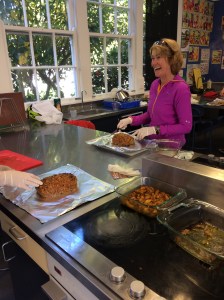
Cooking for Dogs – happy dog owners make recipes like doggy meatloaf and chewy chicken strips
I’m a supporter of the hybrid diet – where dogs are fed commercial food, raw food and also homemade food for variety and nutritional support and to mitigate the risks of long-term nutritional deficits.
It’s been a month or so now of food-themed interactions with clients and colleagues. For example, during my visit to Kindness Ranch, I was given a tour. They make their own ‘sow chow’ of fresh ingredients for their pigs because they found that commercial pig food is designed to fatten up the pigs for slaughter. (Whereas the pigs at the Ranch have been rescued and will live out their lives naturally.)
Look at the colors in the bowl – fresh foods like watermelon! What pig wouldn’t want to chow down on food that that was this fresh?


And I’ve had a few interactions with clients this week which were also food related. For example, the well-meaning owner of a Labrador puppy. I had to tell her that I felt her dog was overweight and that she needed to reduce the amount of food being fed daily (adjusted also for treats used in training).
She was worried because the bag of her commercial puppy food recommended that she feed even more. I explained that we should feed our dogs according to body condition and that many commercial foods often overstate the feeding rates for their foods. After all, if owners feed more food, then they have to buy more food. (I’m sure there are some dogs that may need the recommended feeding volumes – but these would be the exception and not the rule from my experience.)
And then there was the dog that had been losing weight and urinating in the house. I strongly advised that the dog be taken to the vet for a health check and the results were in – a pancreatic problem brought on by feeding raw. In this case, I suspect that the raw food mix being fed to this dog was way too high in fat and also contained consistently too much liver instead of a mixture of other organ meats such as heart and kidney. Regardless, the dog was not thriving on its diet and, worse, was being hurt by it. A change in diet to a commercial kibble has seen a return to health and no more urinating in the house which is a positive for both dog and owner.
Every dog is different when it comes to diet. There is no one right or wrong answer, but there are tools and techniques we can use to match them to a diet that works.
Kathleen Crisley, Fear-Free certified professional and specialist in dog massage, rehabilitation and nutrition/food therapy, The Balanced Dog, Christchurch, New Zealand
Posted in dog care, dog nutrition and labelling, Dogs
Tagged dog food, food, homemade dog treats, raw diet
I have started a new campaign that will run through to the end of the year to help me promote the benefits of canine massage. The Love Me, Massage Me campaign is fairly straightforward: each of my customers will receive a printed bandana like this one:
![IMG_2834[1]](https://doggymom.com/wp-content/uploads/2018/09/img_28341.jpg?w=500)
Tamzin the Pug models her Love Me Massage Me bandana
The winner will receive a massage every 3 months during 2019; there’s also a second and third prize.
Since I teach owners to massage their dogs using a relaxation massage sequence incorporating acupressure points, I’m happy if the dogs are being massaged by their owners and not just me.
I think every dog should be massaged regularly to support health and wellness.
Wish me luck! #lovememassageme
Kathleen Crisley, Fear-Free certified professional and specialist in dog massage, rehabilitation and nutrition/food therapy, The Balanced Dog, Christchurch, New Zealand
Our friend Ben, a greyhound, had an accident on Saturday, 15th September 2018.
From what we can tell, he was chasing a cat who must have taken a hard right turn. When Ben tried to follow (he was under cover of a line of bushes and trees at the time of the incident), his momentum carried him sideways into a tree. He emitted a huge cry of pain but was luckily able to walk home slowly before being taken to the vet within 15 minutes of the crash.
His bruising wasn’t immediately apparent because bruising takes time to come up; the vet suggested that he might also have cracked a rib during the impact.

Ben the greyhound shortly after the incident
But within a few hours, here’s what he looked like:

Ben the greyhound on 15 September 2018
I visited with him on Saturday afternoon and again on Monday (17th September) to laser him thoroughly with specific acupressure and trigger points addressed. To some extent, the laser helped to bring out the bruising and speed healing. His mum was also giving him regular rubdowns with Sore No More lotion (which I use and sell in my practice) and also dosing him Traumeel drops which I also recommend to my clients as a ‘must have’ for their First Aid kits.
And today (Wednesday, 19th September 2018), I got these lovely photos of Ben who is happily out running again in the sunshine:


It is very rewarding to be able to help dogs using my scope of practice of massage, acupressure, and laser therapies. It’s even more rewarding when the dog is also a close friend.
Kathleen Crisley, Fear-Free certified professional and specialist in dog massage, rehabilitation and nutrition/food therapy, The Balanced Dog, Christchurch, New Zealand
A new study in the journal Scientific Reports gets to the bottom of it: Why do dogs that are trained to locate poop sometimes find the wrong kind of poop?
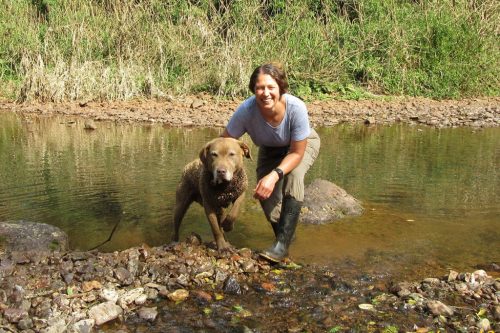
Washington University researcher Karen DeMatteo and her scat-sniffing dog Train are on a mission to preserve jaguars, pumas, bush dogs and other carnivores in the forests of Northeastern Argentina. (Photo: courtesy of Karen DeMatteo/Washington University)
It happens anywhere from 4 percent to 45 percent of the time, said Karen DeMatteo, a biologist in Arts & Sciences at Washington University in St. Louis. Her new research confirms that there are three viable, alternative explanations beyond errors in handler or dog training that can explain the collection of non-target scats with detection dogs in some ecosystems.
Detection dogs are trained to use scent, not their eyes, to locate specific kinds of scat. They’re useful partners in conservation projects as an alternative to camera photo traps or other more invasive means of identifying which individual animals are present in an area.
And while finding the wrong kind of poop doesn’t ultimately muck up research results — researchers who use scat to track animals usually use DNA tests to confirm the identity of target and non-target evacuators — collecting and testing false positives costs a project time and resources.
“To date, when non-target samples are found in detection dog studies, it is assumed it may be due to errors in detection dog or handler training; however, our study determined that this is not always the case,” DeMatteo said. “Instead, the complexity of ecosystems where a study is conducted can affect the perceived accuracy of detection dog studies because the natural behaviors of non-target species, like coyotes in our study, can alter the genetic profile of target scat, like that from a puma.”
In her own work, DeMatteo has successfully used scat-detection dogs to identify the routes traveled by endangered pumas and other reclusive carnivores along a biologically important corridor in Argentina.
Detection dogs are great at determining the presence of specific animals because they can find droppings hidden in grass, droppings that have been rained on and disintegrated into the mud — or even droppings that have been eaten and then recycled.
Yes, that’s right, and it’s a normal part of life for many animals, DeMatteo said.
“Humans have a natural aversion to coprophagy, which is reflected in the visual horror on an owner’s face when they see their dog gobble down their own scat or the scat of another dog or cat,” DeMatteo said. “Once this shock subsides, the owner typically worries that the scat will cause health problems or there is something psychologically wrong with their four-legged friend.”
“While the reasons underlying coprophagy in domestic dogs are still fuzzy, it is known in wild canids that coprophagy is natural and is often associated with territoriality or nutritional benefits,” she said. “So while the finding that coyotes will consume puma scat is novel and has various ecological implications, coprophagy occurs naturally under a variety of circumstances.”
The tendency of one animal to eat another’s scat is one of three behaviors that might alter the type of scat, or the state of the scat, that a detector dog might encounter, and thus affect the perceived accuracy of the technique.
Researchers also considered how urine-marking by non-target species might affect a detector dog’s ability to locate scat from a species of interest, and also what happens if one animal picks up another’s scat and moves it using its mouth, potentially bringing it into contact with saliva. Field trials were conducted in the St. Louis area and in northwest Nebraska.
The researchers found that each of the proposed behaviors alters the genetic profile of the scat in question, and all were confirmed to play a role in the detection dog indicating on non-target scats.
The pool of conservation-trained detection dogs is constantly growing in number, as are the types of target species and the areas where they are being used, DeMatteo said. One of the continuing questions surrounding their use for these types of projects is how to maintain a high quality standard for training detection dogs and their handlers.
“In reality, the dog is easier to train than the handler, with the latter having a higher chance of introducing error,” DeMatteo said. “Even with these variables, these results are extendable to other dog-handler teams with less experience, as long as consistency is used.”
While this study, “How behavior of nontarget species affects perceived accuracy of scat detection dog surveys,” demonstrates that there are alternative explanations for why dogs sometimes collect non-target samples, it also shines a light on behaviors that humans may not understand — but that could play a role in ecosystem functioning.
“Genetic testing can eliminate these samples and maintain accuracy in the [detection dog-assisted] studies,” DeMatteo said. “However, this non-target interaction with target scat potentially has important implications for other ecological questions, including parasite/disease transmission, zoonotic diseases and general health of wild populations.”
Source: Washington University in St Louis media statement
Posted in Dogs, research, special dogs and awards
Tagged ecosystems, poop, sniffing dogs
Chicken necks are a common treat for dogs, but pet owners are being warned they have been linked with a potentially fatal form of paralysis
As pet ownership increases across the world, our furry (as well as feathered and scaly) friends have become firmly established members of the family.
Wanting the best for our pets, we often offer special treats, and chicken necks are a favourite in many families – often considered a ‘healthy’ option.
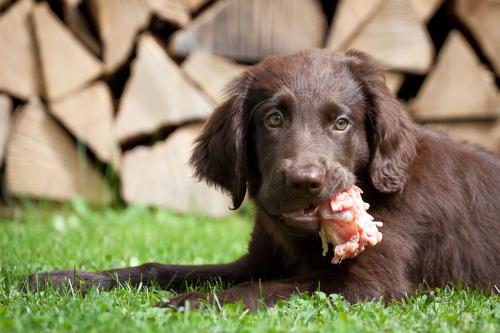
Vets are warning raw chicken could be dangerous and owners should stick with regular dog food. Picture: iStock
But vets are warning raw chicken, particularly chicken necks, can lead to a debilitating and potentially fatal form of paralysis in dogs.
A new study, led by the University of Melbourne’s U-Vet Werribee Animal Hospital, found the consumption of raw chicken meat increases the risk of dogs developing a paralysing condition called acute polyradiculoneuritis (APN) by more than 70 times.
Dr Matthias le Chevoir, chief investigator on the project, says the cause of APN in dogs has baffled the veterinary community for a long time.
“It is a rare but very debilitating condition where the dog’s hind legs first become weak. It can then progress to affect the front legs, neck, head and face. Some dogs may die from the disease if their chest becomes paralysed,” he says.
“Most dogs eventually recover without treatment but it may take up to six months or more in some cases.
“In our clinic alone we see around 30 cases per year and around three in ten cases would not recover. Watching your pet suffer is obviously very distressing and it can be difficult for owners to nurse their pet if the condition can gradually improve.”
Paralysis results from the dog’s immune system becoming unregulated and attacking its own nerve roots, progressively worsening over several days.
APN is the canine counterpart of Guillain-Barré syndrome (GBS) in humans, a condition that also causes muscle weakness and may require ventilation if chest muscles are affected.
Dr le Chevoir says the bacteria Campylobacter is now considered a triggering agent in up to 40 per cent of GBS patients. It may be present in undercooked chicken, unpasteurised milk products and contaminated water.
“Our team at U-Vet Animal Hospital wanted to understand if consuming raw chicken could also be triggering APN in dogs. Many of us have previously worked overseas and know that a raw meat diet is less common there, so we were intrigued by this potential connection,” Dr le Chevoir says.
The team studied 27 dogs with symptoms of APN and 47 dogs without, examining physical symptoms and interviewing the owners about recent behaviours and diet; focusing on the consumption of raw chicken meat.
Faecal samples collected within seven days of the presentation of clinical signs (such as changes in voice, hind limb weakness or a choppy gait) showed the dogs with APN were 9.4 times more likely to have had a Campylobacter infection than the control group without the disease.
“The microbe Campylobacter is likely to be the reason for the dysregulation of the dogs’ immunity and the symptoms of paralysis,” lead author Dr Lorena Martinez-Antòn says.
“These bacteriological results were consistent with the hypothesis that the uncooked chicken meat was the source of the Campylobacter and as a result, triggered APN.”
In humans, scientists think Campylobacter, which is most commonly found in commercial poultry products, contains molecules similar in structure to part of the nerve cell. This similarity confuses the immune system, which attacks the body’s own nerves, resulting in paralysis.
Dr Martinez-Antòn and Dr le Chevoir say there appears to be a growing trend for feeding dogs raw meat diets, which is concerning given the risks.
“A significant association is also found between APN and smaller dog breeds. Based on our clinical experience this seems to be because smaller dogs are more likely to be fed smaller bones like chicken necks,” the doctors say in the research paper.
“We recommend owners choose regular dog food rather than chicken necks until we know more about this debilitating condition.”
Kathleen Crisley, Fear-Free certified professional and specialist in dog massage, rehabilitation and nutrition/food therapy, The Balanced Dog, Christchurch, New Zealand
How many of you feel this way about your dog’s bed preferences?
When Ray invited himself to become part of our lives, I had no problems with him sharing our home. I had no problems if he chose to sleep on my bed but …
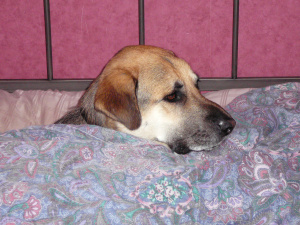
… when he lays there basically waiting for his breakfast ,,,
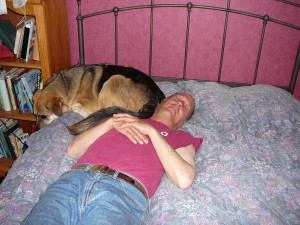
… or when he clearly expects the pillows-end of the bed, regardless of how accessible it is …
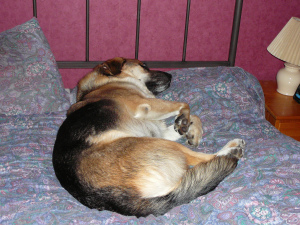 … or when he sees an opportunity to take over more than half the bed …
… I really have to question whether I have been perhaps a little too generous with my hospitality?
Posted in Dogs
Remember being a kid? Then you probably played with Crayons.
Today, I found Herb Williams Art, and his collection called Call of Couture. All of these pieces have been made from Crayons.
Very creative!


Kathleen Crisley, Fear-Free certified professional and specialist in dog massage, rehabilitation and nutrition/food therapy, The Balanced Dog, Christchurch, New Zealand
Earlier today, I paid a visit to the Pine Ridge Pet Cemetery to visit the grave of my dog Porky. It’s something I do every time I’m in the area.
Because it was a warm evening, I decided to walk around taking in the various names and memorials made to beloved pets. I walked up a hill of raised markers and on the way down, I noticed that one had an inscription on the reverse.
This was Iko’s stone.

The front of Iko’s gravestone

The inscription on the reverse of the stone
Kathleen Crisley, Fear-Free certified professional and specialist in dog massage, rehabilitation and nutrition/food therapy, The Balanced Dog, Christchurch, New Zealand







 DoggyMom.com