Scientists uncover new details in how sense of smell develops

Dogs, known for their extraordinarily keen senses of smell, can be trained to use their sensitive sniffers to find drugs, bombs, bed bugs, missing hikers and even cancer. Among dogs and other animals that rely on smell, at least one factor that may give them an advantage is a sheet of tissue in the nasal cavity.

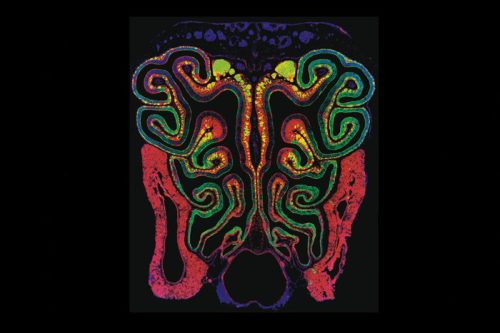
In humans, this tissue — called the olfactory epithelium — is a single flat sheet lining the roof of the nasal cavity. In dogs, however, the olfactory epithelium forms a complex maze, folding and curling over a number of bony protrusions, called turbinates, that form in the nasal cavity. The olfactory epithelium contains specialized neurons that bind to odor molecules and send signals to the brain that are interpreted as smell. Dogs have hundreds of millions more of these neurons than people do. It is assumed this added structural complexity is responsible for dogs’ superior ability to smell. But, surprisingly, that has never been shown scientifically.

Now, researchers at Washington University School of Medicine in St. Louis have uncovered new details in how the olfactory epithelium develops. The new knowledge could help scientists prove that turbinates and the resulting larger surface area of the olfactory epithelium are one definitive reason dogs smell so well.
MouseOlfactoryEpithelium-700x467

The olfactory epithelium — a mouse’s is pictured in green — is a sheet of tissue that develops in the nasal cavity. Researchers at Washington University School of Medicine in St. Louis have uncovered new details on how the olfactory epithelium develops and why it is that some animals have such great senses of smell, compared with others that lack such ability.

“We think the surface area of the sheet matters in how well animals smell and in the types of smells they can detect,” said David M. Ornitz, MD, PhD, the Alumni Endowed Professor of Developmental Biology. “One reason we think this stems from differences in the complexity of these turbinates. Animals that we think of as having a great sense of smell have really complex turbinate systems.”

The study, published Aug. 9 in the journal Developmental Cell, also could help answer a longstanding evolutionary question: How did animals’ senses of smell become so enormously variable? The way these abilities came to diverge over evolutionary history remains a mystery. Understanding these signals could help scientists tease out how dogs evolved an extraordinary olfactory system and humans wound up with a comparatively stunted one.

First author Lu M. Yang, a graduate student in Ornitz’s lab, found that a newly discovered stem cell the researchers dubbed FEP cells control the size of the surface area of the olfactory epithelium. These stem cells also send a specific signaling molecule to the underlying turbinates, telling them to grow. The evidence suggests that this signaling crosstalk between the epithelium and the turbinates regulates the scale of the olfactory system that ends up developing, sometimes resulting in olfactory epithelia with larger surface areas, such as in dogs.

When the stem cells can’t signal properly, turbinate growth and olfactory epithelium surface area experience an arrested development. To study this in the lab, mice with such olfactory stunting could, in theory, be compared with typical mice to learn more about how these signals govern the final complexity of an animal’s olfactory system.

“Before our study, we didn’t know how the epithelium expands from a tiny patch of cells to a large sheet that develops in conjunction with complex turbinates,” Yang said. “We can use this to help understand why dogs, for example, have such a good sense of smell. They have extremely complex turbinate structures, and now we know some of the details about how those structures develop.”

Source:  Washington School of Medicine in St Louis

Roles of emotional support animals examined

Airlines are not the only organizations grappling with the complexities surrounding emotional support animals. Colleges and courts are also questioning the need for these animals and the effects they may have on students and juries, respectively, according to research presented at the annual convention of the American Psychological Association.

The recent, rapid rise of emotional support animals has left colleges and universities struggling to understand the laws and how they can be applied to best support their communities, said Phyllis Erdman, PhD, professor at Washington State University, who chaired a symposium on emotional support animals and service dogs.

Emotional support animal photo by esadoctors

Emotional support animal on campus (photo by esadoctors.com)

College and university counseling centers are seeing an uptick in the number of students seeking mental health services, as students report anxiety, depression and stress about relationships and academic performance, she said.

“It’s not surprising that many schools are confronted with the growing phenomenon of emotional support animals. For many, the topic is a contentious one centered on whether students are taking advantage of the laws,” said Erdman. “This is further compounded by the fact that laws pertaining to emotional support animals are different from those governing disability service animals and therefore schools may need to develop new policies.”

A service animal falls under the Americans with Disabilities Act and is usually a dog that is trained to do work or perform tasks for the benefit of an individual with a physical, sensory, psychiatric or intellectual disability, Emotional support animals are not trained in specific tasks and are not recognized under the ADA. Although emotional support animals are allowed in campus housing, they may not necessarily be allowed in classrooms or elsewhere on campus, according to the study Erdman presented.

Erdman and her colleagues wanted to understand the state of emotional support animal requests on campuses and how colleges and universities are responding. They surveyed 248 university counseling centers about student requests for letters to allow them to have emotional support animals. The survey questions included how often the counseling centers received requests from students, how the schools handled those requests and how they handled requests to diagnose a disability in order to obtain an emotional support animal. It also asked counseling centers if they had emotional support animal policies in place.

Fifty-seven percent of the centers reported almost never receiving such requests. Thirty-one percent did several times a year and only 2 percent got requests more than once a week, according to the study.

Despite the lack of an overwhelming demand, a majority of university counseling centers reported concern about having policies in place to handle such requests, according to Erdman.

“Even a limited number of requests for emotional support animals can cause stress for student affairs offices, housing offices, counseling centers and disability offices,” she said. “Most schools wanted guidance and support for developing guidelines and navigating requests that come through.”

Erdman suggested that schools establish general definitions of the terms disability, service animal and emotional support animal when crafting a policy. The definition of a disability should adhere to ADA guidelines, she said. Any policy development must follow federal and state laws and should include the perspectives of various campus constituencies, including counseling centers, accessibility services, general counsel’s offices, campus safety departments and students themselves, according to Erdman.

“College students today are facing a great deal of stress and emotional support animals may help some students,” said Erdman. “We hope our study can serve as a guide for colleges and universities to develop policies that help students thrive.”

Uncertainty about emotional support animals is also occurring in courts, according to Dawn McQuiston, PhD, of Wofford College, who presented her research at the symposium. While objects such as dolls or teddy bears have been used for decades to calm vulnerable witnesses, courts began to include dogs in the mid-1990s to provide emotional support to alleged victims of child abuse. At least 144 courthouse facility dogs are now included in about three dozen states, she said. These dogs are provided by the court at the request of prosecutors to assist victims with the anxiety of testifying and reliving traumatic events.

Supporters say the dogs have made a huge difference in helping children and vulnerable adult witnesses open up on the stand, but some defense attorneys say having a friendly, sweet-looking canine in the witness box can prejudice a jury against a defendant by making the witness appear more believable and sympathetic, according to McQuiston.

“The concern is that the presence of a courthouse dog emphasizes that the witness is a victim, thereby playing to jurors’ sympathies. As a result, witnesses may be viewed as even more vulnerable or likeable, thus conflicting with a defendant’s right to a fair trial,” said McQuiston.

She cited two notable appeals cases involving courtroom dogs. In both cases, the victims had a support dog during testimony, the defendants were convicted and the convictions were subsequently appealed on the grounds that the presence of the dog led to undue sympathy for the victim and violated the defendant’s right to a fair trial. In both cases, the courts found no sign of prejudice due to the dogs’ presence.

McQuiston and her colleagues investigated whether courthouse dogs, compared to inanimate comfort items, resulted in more prejudice against defendants involved in two hypothetical crimes: A child sexual abuse case and a robbery of a child. They set up mock trials in which participants, in the role of jurors, read transcripts of the testimony and were shown several pictures depicting the child witness with a dog, with a teddy bear or with nothing.

They found that the presence of the dog had no significant effect on the juries’ outcomes, which McQuiston called surprising because the researchers had expected the dog to prejudice the jury against the defendant. Interestingly, their findings showed some biasing effects when the child clutched a teddy bear.

“Across two studies utilizing mock jury paradigms we found that, contrary to popular beliefs and our own predictions, courthouse dogs did not exert undue influence on juror decision-making regardless of the severity of the crimes tested, and did not differentially impact perceptions of child witnesses,” she said.

Source:  American Psychological Association

Muscle loss and wasting

I encounter dogs in my practice who are experiencing muscle loss and wasting fairly often.

Since owners must submit veterinary records to me for review as part of my intake process as well as update me on any subsequent vet visits, if there’s a diagnosis of chronic illness – such as kidney disease or cancer – then this muscle loss  is understandable and classified as cachexia.

In the absence of a diagnosis of disease, and working with an aging dog, then the muscle loss is classified as sarcopenia.

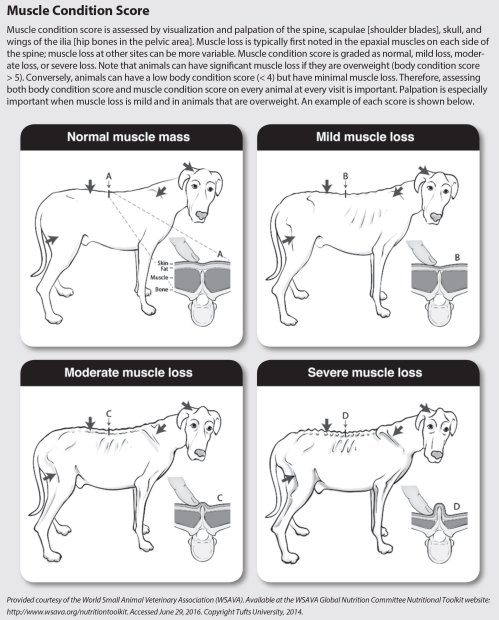
Muscle loss results in a change of appearance, which owners often notice first around the shoulder blades, top of the head, and around the pelvis.  Muscle wastage can be graded as noted below:

Muscle condition score

Exercise and good nutrition can be interventions with muscle loss.  Chronically ill dogs need a high quality diet that is appropriate for their disease, for example.  And aging dogs do need exercise that is targeted to their needs and abilities.

Owners should always be on the watch for signs of muscle loss – so early interventions that are medical and non-medical can be considered.

Kathleen Crisley, Fear-Free certified professional and specialist in dog massage, rehabilitation and nutrition/food therapy, The Balanced Dog, Christchurch, New Zealand

Labels

I’ve been thinking about labels a lot this week.

You already know my feelings about breed specific legislation (BSL) and the labeling of dogs as ‘dangerous’ simply because of their breed.  (In short, the labeling is unfair and unjustified – backed up by actual data.)

We also use labels for people and that is what has happened here recently with a greyhound group on Facebook.  From what I can tell, earlier this week one of the moderators of the group didn’t like a person sharing their views against greyhound racing – the moderator is involved in the greyhound racing industry.  So the moderator disconnected the person from the group.

This upset others in the group who expected the site to be an open forum for lovers of greyhounds.  (We need a lesson in Facebook groups, I think.  There are groups all over Facebook and posts get deleted and people disconnected from groups by moderators regularly.  There is no such thing as democracy in Facebook groups!)

And so a new group on Facebook has been formed and we have been encouraged to join that group to post about our greyhounds.

So if you are labeled ‘anti-racing’ by the first site, it seems another will gladly accept you.

We humans label all the time.   If you read the headline news over the last few years, what does the term ‘immigrant’ mean to you, for example?

So going back to the issue of dogs – which are both my passion and also my profession – what label applies to me?

Pro-Dog

Yup, if someone is mistreating a dog, hurting them, not taking responsibility for their care, treating them as disposable, using them for fighting…

…then please label me Pro-Dog.  I will be disagreeing with you.  And I will use this blog and my own company Facebook page for speaking about it.

Izzy the greyhound

Kathleen Crisley, Fear-Free certified professional and specialist in dog massage, rehabilitation and nutrition/food therapy, The Balanced Dog, Christchurch, New Zealand

Doggy quote of the month for August

“Dogs love their friends and bite their enemies, quite unlike people, who are incapable of pure love and always have to mix love and hate in their object-relations.”

– Sigmund Freud

Cute dog buddies

Empathetic dogs lend a helping paw

Many dogs show empathy if their owner is in distress and will also try to help rescue them. This is according to Emily M. Sanford, formerly of Macalester College and now at Johns Hopkins University in the US. She is the lead author of a study in Springer’s journal Learning and Behavior that tested whether there is truth in the notion that dogs have a prosocial and empathetic nature. Interesting to note, the study found that dogs specially trained for visitations as therapy dogs are just as likely to help as other dogs.

Helping paw

Many dogs are ready to lend a helping paw if needed. Credit: © Mat Hayward / Fotolia

In one of their experiments, Sanford and her colleagues instructed the owners of 34 dogs to either give distressed cries or to hum while sitting behind a see-through closed door. Sixteen of these dogs were registered therapy dogs. The researchers watched what the dogs did, and also measured their heart rate variability to see how they physically reacted to the situation. In another part of the experiment, the researchers examined how these same dogs gazed at their owners to measure the strength of their relationship.

Dogs that heard distress calls were no more likely to open a door than dogs that heard someone humming. However, they opened the door much faster if their owner was crying. Based on their physiological and behavioural responses, dogs who opened the door were, in fact, less stressed than they were during baseline measurements, indicating that those who could suppress their own distress were the ones who could jump into action.

The study therefore provides evidence that dogs not only feel empathy towards people, but in some cases also act on this empathy. This happens especially when they are able to suppress their own feelings of distress and can focus on those of the human involved. According to Sanford, this is similar to what is seen when children need to help others. They are only able to do so when they can suppress their own feelings of personal distress.

“It appears that adopting another’s emotional state through emotional contagion alone is not sufficient to motivate an empathetic helping response; otherwise, the most stressed dogs could have also opened the door,” explains co-author Julia Meyers-Manor of Ripon College in the US. “The extent of this empathetic response and under what conditions it can be elicited deserve further investigation, especially as it can improve our understanding of the shared evolutionary history of humans and dogs.”

Contrary to expectation, the sixteen therapy dogs in the study performed as well as the other dogs when tested on opening the door. According to Meyers-Manor this may be because registered therapy dogs, despite what people may think, do not possess traits that make them more attentive or responsive to human emotional states. She says that therapy dog certification tests involve skills based more on obedience rather than on human-animal bonding.

“It might be beneficial for therapy organizations to consider more traits important for therapeutic improvement, such as empathy, in their testing protocols,” adds Meyers-Manor. “It would also be interesting to determine whether service dogs show a different pattern of results given their extensive training in attentiveness to their human companions.”

Reference: Sanford, E.M. et al (2018). Timmy’s in the well: Empathy and prosocial helping in dogs, Learning & Behavior DOI: 10.3758/s13420-018-0332-3

Source:  Springer media release

Anxiety and the Fear-Free Approach

When the makers of the famous  ThunderShirt conducted a survey of dog owners back in 2011, the results showed that anxiety problems of various types are very common in dogs.    Although this survey was based in the USA, the results are likely to be comparable in other English-speaking countries.  From what I can see, there are plenty of anxious dogs in New Zealand.

Their survey found that:

  • Over 29% of all dogs suffer from at least one anxiety or fear issue…Nearly 23 million dogs in the United States alone.1 16% of all dogs are suffering from multiple anxiety and/or fear issues
  • Over 12 million dogs are left to just suffer with their anxiety problems without their owners trying any remedies…over half of all dogs with anxieties. Why? 71% of dog owners do not feel that treating the problem was necessary; 29% do not feel that there is a viable solution for the problems; 13% feel that solutions are too expensive.
  • Over 41% of dog-owning households had at least one dog with an anxiety or fear issue. That translates into over 18.6 million households in the United States that are dealing with anxiety and fear issues.
  • Dog owners are spending over $1 billion each year dealing with anxiety problems. Over $240 million on damaged property alone. (Average household cost of $246 x 18.6 million households owning at least one dog with anxiety issues / 4.5 years average time with dog)
  • The most common anxiety or fear issues among dogs in the US are the following:
    o Fear of Noise or Noise Anxiety – 17% of all dogs or over 13 million dogs.
    o Separation Anxiety – 13% of all dogs or 10 million dogs.
    o Reactivity towards people and/or dogs – 12% or nearly 9 million dogs.
    o General Anxiety – 5% or 3.5 million dogs.
    o Travel Anxiety – 5% or 3.5 million dogs.
  • The most common NOISE fears or anxieties among the 13 million dogs are:
    o Fear of Thunderstorms – 86%
    o Fear of Fireworks – 74%
    o Fear of Vacuum Cleaners – 41%

It’s for this reason that I’m so glad I chose to become Fear-Free certified because I see dogs in my massage and rehab practice that are anxious and for a variety of reasons.

Sometimes my new (dog) clients are anxious because they don’t know me.  So our first session is about getting them to relax and realize that I am not a threat.   I bring yummy treats, for example, and play relaxing music.  And I specialize in in-home care, so the dog is in their own environment from the start – and their owner is there for comfort and reassurance.

I’m using more and more flower essence blends, too, which are proving to have dramatic results with anxious dogs.  In the last month alone, I’ve had three clients come to me because their dogs are anxious at their training grounds and/or at dog shows.  These dogs have had untrained dogs rush at them, or worse, and they’ve become anxious whenever a strange dog is nearby.  It’s a real shame, but there are things we can do to alleviate their stress.

Massage, of course, by its very nature can be calming.  Just as with vets and vet techs who are taught about touch gradient, touch gradient is important to the work I do.  Keeping a connection with the dog during massage, stretching and other exercises is important to ensure we have a trusting bond and I don’t startle them.

FF Certified Professional Logo jpg

Fear free is also about working at the dog’s pace; all bookings are taken with an hour allotted to each client to ensure we have plenty of time and aren’t rushed.

If you have an anxious dog and think you have run out of options, I hope you will reconsider by finding a Fear-Free certified professional near you.

Kathleen Crisley, specialist in dog massage, rehabilitation and nutrition/food therapy, The Balanced Dog, Christchurch, New Zealand


Therapy Dogs Effective in Reducing Symptoms of ADHD

In a first of its kind randomized trial, researchers from the University of California Irvine School of Medicine found therapy dogs to be effective in reducing the symptoms of attention deficit/hyperactivity disorder (ADHD) in children.  The study’s main outcomes were recently published by the American Psychological Association in the Society of Counseling Psychology’s Human-Animal Interaction Bulletin (HAIB).  Additional new findings were presented at the International Society for Anthrozoology 2018 Conference held July 2-5 in Sydney, Australia.

Titled, “A Randomized Controlled Trial of Traditional Psychosocial and Canine-Assisted Interventions for Children with ADHD,” the research involved children aged 7 to 9 who had been diagnosed with ADHD and who had never taken medicines for their condition.  The study randomized participants to compare benefits from evidenced-based, “best practice” psychosocial interventions with the same intervention augmented by the assistance of certified therapy dogs.  The research was led by Sabrina E. B. Schuck, PhD, MA, executive director of the UCI Child Development Center and assistant professor in residence in the Department of Pediatrics at UCI School of Medicine.

UCI study

New study led by Sabrina E. B. Schuck, PhD, MA, executive director of the UCI Child Development Center and assistant professor in residence in the Department of Pediatrics at UCI School of Medicine, finds therapy dogs to be effective in reducing the symptoms of attention deficit/hyperactivity disorder (ADHD) in children. Photo by UCI

Results from Schuck’s research indicate children with ADHD who received canine assisted intervention (CAI) experienced a reduction in inattention and an improvement in social skills.  And, while both CAI and non-CAI interventions were ultimately found to be effective for reducing overall ADHD symptom severity after 12 weeks, the group assisted by therapy dogs fared significantly better with improved attention and social skills at only eight weeks and demonstrated fewer behavioral problems. No significant group differences, however, were reported for hyperactivity and impulsivity.

“Our finding that dogs can hasten the treatment response is very meaningful,” said Schuck.  “In addition, the fact that parents of the children who were in the CAI group reported significantly fewer problem behaviors over time than those treated without therapy dogs is further evidence of the importance of this research.”

Guidelines from the American Academy of Pediatrics for the management of ADHD underscore the importance of both psychopharmacological and psychosocial therapies.  Patients who receive psychosocial therapy prior to medications have shown to fare better.  Additionally, many families prefer not to use medications in young children.

“The take away from this is that families now have a viable option when seeking alternative or adjunct therapies to medication treatments for ADHD, especially when it comes to impaired attention,” said Schuck. “Inattention is perhaps the most salient problem experienced across the life span for individuals with this disorder.”

This study is the first known randomized controlled trial of CAI for children with ADHD. It illustrates that the presence of therapy dogs enhances traditional psychosocial intervention and is feasible and safe to implement.

Animal assisted intervention (AAI) has been used for decades, however, only recently has empirical evidence begun to support these practices reporting benefits including reduced stress, improved cognitive function, reduced problem behaviors and improved attention.

The study was supported by the Eunice Kennedy Shriver National Institute of Child Health and Human Development (NICHD) and Mars-WALTHAM® grant R01H066593.

Source:  University of California Irvine media release

Purina’s pets and people survey

It turns out dogs are more than just man and woman’s best friend. They are also counselors, confidants, bunk mates, stress relievers, and overwhelmingly viewed as part of the family, according to the 2018 Pets and People Survey by Just Right® by Purina®.

The brand’s survey of more than 1,000 dog owners revealed fascinating details about the unique relationship and unbreakable bond people share with their dogs.

Purina owner survey

Among the key findings:

  • 95 percent view their dog as part of the family,
  • 62 percent said their dog helps them de-stress after a long day at work, and
  • 55 percent believe their dog provides emotional comfort after receiving bad news.

The survey also found dogs have helped 15 percent of men gain the attention of the opposite sex, while half of all women surveyed said they preferred time with their dog over time with their partner and/or other family members. Among Millennials age 18 to 34 years old, 56 percent said they have purchased birthday cakes for their dogs, and 77 percent said they feed their dogs before they feed themselves.

“Having dogs myself, I know firsthand that the emotional connection between dog owners and their pets runs deep,” said Julia Pitlyk, brand manager for Just Right by Purina. “We conducted this survey to learn more about what exactly the owner-dog relationship looks like and while each relationship provides that deep connection, the results really support our belief that every dog is unique – some may be confidants while others are effective wingmen.”

About the Survey

Research Now SSI conducted an online survey on behalf of Just Right by Purina among adults ages 18+ who are dog owners and have some responsibility over the well-being of their pet. A total of 1,010 responses were collected between March 26 and March 29, 2018. The online surveys are not based on a probability sample and therefore no estimate of theoretical sampling error can be calculated.

Source:  PR newswire

Do grain-free diets really cause canine heart disease?

You may have heard that on July 12th, the US Food and Drug Administration issued a statement that it was investigating a potential connection between grain-free diets and canine heart disease:

The U.S. Food and Drug Administration is alerting pet owners and veterinary professionals about reports of canine dilated cardiomyopathy (DCM) in dogs eating certain pet foods containing peas, lentils, other legume seeds, or potatoes as main ingredients. These reports are unusual because DCM is occurring in breeds not typically genetically prone to the disease. The FDA’s Center for Veterinary Medicine and the Veterinary Laboratory Investigation and Response Network, a collaboration of government and veterinary diagnostic laboratories, are investigating this potential association.

Canine DCM is a disease of a dog’s heart muscle and results in an enlarged heart. As the heart and its chambers become dilated, it becomes harder for the heart to pump, and heart valves may leak, leading to a buildup of fluids in the chest and abdomen. DCM often results in congestive heart failure. Heart function may improve in cases that are not linked to genetics with appropriate veterinary treatment and dietary modification, if caught early.

The underlying cause of DCM is not truly known, but is thought to have a genetic component. Breeds that are typically more frequently affected by DCM include large and giant breed dogs, such as Great Danes, Boxers, Newfoundlands, Irish Wolfhounds, Saint Bernards and Doberman Pinschers. It is less common in small and medium breed dogs, except American and English Cocker Spaniels. However, the cases that have been reported to the FDA have included Golden and Labrador Retrievers, Whippets, a Shih Tzu, a Bulldog and Miniature Schnauzers, as well as mixed breeds.

Full text of the FDA statement here.

Investigating possible links is always a good thing; but equally concerning is understanding what data backs up any claim.

Pet Business magazine points out that the data backing up the link is very thin – at this point unlikely to pass the rigor of a peer-reviewed journal.  Obviously an industry body has concerns about the impact of consumer choices  and the impact on sales, but it is right that they point out that the data set so far is quite limited.

I follow research regularly, and I’m always open to findings that may cause us to re-think our choices of food and other healthcare strategies for our dogs.

But let’s be sure about evidence.

The availability and variety of grain-free foods has increased dramatically in recent years, as cases of itchy dogs and dietary intolerances caused by corn and wheat have been documented.  Who’s to say that grain-free carbohydrates like peas, lentils and potatoes might not also come with side effects?

And all of this debate reinforces my belief in the hybrid diet.  Sometimes raw, sometimes kibble, and sometimes homemade.  Diversification is a strength!

Kathleen Crisley, specialist in dog massage, rehabilitation and nutrition/food therapy, The Balanced Dog, Christchurch, New Zealand