Fundraising

I haven’t been posting as frequently as I would like.  Forgive me.

Over the last two months, I have been pulling together the prizes and other arrangements for my third annual fundraising event.  While I always walk away feeling good that I’ve invested my time in giving back to the community, these events take time and effort.

I haven’t had much time to do my usual research and writing – but we are in countdown mode with less than 2 days to go.  And then it will be over for another year.

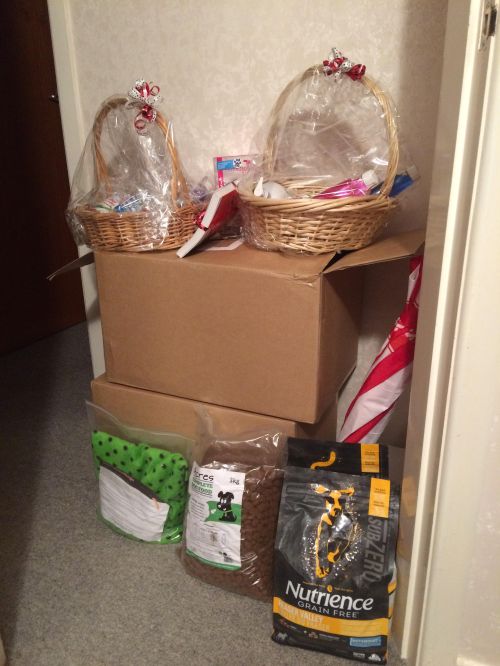
Tonight, I am wrapping prizes.  This photo shows my progress – but thankfully there is still a long way to go thanks to many generous donors/sponsors.

Prizes

Back soon with doggy news.

Kathleen Crisley, specialist in dog massage, rehabilitation and nutrition/food therapy, The Balanced Dog, Christchurch, New Zealand

Pet dogs help kids feel less stressed

Pet dogs provide valuable social support for kids when they’re stressed, according to a study by researchers from the University of Florida, who were among the first to document stress-buffering effects of pets for children.

boy-and-dog

Darlene Kertes and colleagues tested the commonly held belief that pet dogs provide social support for kids using a randomized controlled study – the gold standard in research.

“Many people think pet dogs are great for kids but scientists aren’t sure if that’s true or how it happens,” Kertes said. Kertes reasoned that one way this might occur is by helping children cope with stress. “How we learn to deal with stress as children has lifelong consequences for how we cope with stress as adults.” 

For their study, recently published in the journal Social Development, the researchers recruited approximately 100 pet-owning families, who came to their university laboratory with their dogs. To tap children’s stress, the children completed a public speaking task and mental arithmetic task, which are known to evoke feelings of stress and raise the stress hormone cortisol, and simulates real-life stress in children’s lives. The children were randomly assigned to experience the stressor with their dog present for social support, with their parent present, or with no social support.

“Our research shows that having a pet dog present when a child is undergoing a stressful experience lowers how much children feel stressed out,” Kertes said . “Children who had their pet dog with them reported feeling less stressed compared to having a parent for social support or having no social support.”

Samples of saliva was also collected before and after the stressor to check children’s cortisol levels, a biological marker of the body’s stress response. Results showed that for kids who underwent the stressful experience with their pet dogs, children’s cortisol level varied depending on the nature of the interaction of children and their pets.

“Children who actively solicited their dogs to come and be pet or stroked had lower cortisol levels compared to children who engaged their dogs less,” said Kertes, an assistant professor in the psychology department of UF’s College of Liberal Arts and Sciences. “When dogs hovered around or approached children on their own, however, children’s cortisol tended to be higher.”

The children in the study were between 7 to 12 years old.

“Middle childhood is a time when children’s social support figures are expanding beyond their parents, but their emotional and biological capacities to deal with stress are still maturing,” Kertes explained. “Because we know that learning to deal with stress in childhood has lifelong consequences for emotional health and well-being, we need to better understand what works to buffer those stress responses early in life.”

Source:  University of Florida News

Downward Dog

A new tv series is coming this week (in the USA).  I just saw the trailer.  It sounds really good – life told from the perspective of Martin the dog!

If you live in the USA and watch it, let me know what you think.

And maybe this will come to New Zealand’s screens later in the year?

Kathleen Crisley, specialist in dog massage, rehabilitation and nutrition/food therapy, The Balanced Dog, Christchurch, New Zealand

A death at doggy day care

News broke this week about a dog being mauled to death at a doggy day care operation, Valley Dog Daycare, in West Auckland.

Wilson,  a Huntaway/Doberman cross, was found dead by his owner, lying in a pond at the day care’s property.

Winston

A photo of Winston, supplied by his owners to the media

Auckland Council’s animal management team is investigating and this is a good thing  because such a vicious death – apparently Winston was mauled and suffered many wounds – means something went majorly wrong at this property.

It has also been reported that the day care operator didn’t notice Winston’s absence, and that’s why his owner ended up searching for him on the rural property, a shock that most of us can only imagine.

It’s important that we look carefully at the investigation’s findings.  There are already calls for the doggy day care industry to be regulated and it’s hard to argue against that in these circumstances.

I’ve said it many times when it comes to hiring anyone who is going to work with your dog in any capacity –  find out their qualifications and experience and commitment to ongoing developments in their industry.

In larger operations, it’s possible that the ‘lead’ employee or proprietor has qualifications but the staff have only had in-house training (at best).   Find out if the dogs on the property are ever left alone or unsupervised.  Be sure that there are staff to supervise dog-to-dog interactions at all times.

Sadly, accidents do happen because animals can be unpredictable.  Every facility should have a standard operating procedure to investigate and de-brief on findings of any near-miss or accident.  This is what is expected under the workplace health and safety regulations when humans are involved and in my opinion it would be a practice easily adapted for facilities working and caring for animals.

Kathleen Crisley, specialist in dog massage, rehabilitation and nutrition/food therapy, The Balanced Dog, Christchurch, New Zealand

Walking the talk

For some of my clients, I recommend that they take their dogs to hydrotherapy.  Sometimes I recommend a water treadmill and, other times, a swimming pool is better.

And with some owners, it seems they are reluctant to give it a try.  I think it is because they question whether hydrotherapy for dogs is a ‘real’ thing or they just can’t imagine their dog doing it.

Today, I took Izzy swimming for the first time.  (My previous dog, Daisy, who passed away in 2014, was a regular at the pool for almost the last two years of her life).

Here is Izzy at the Dog Swim Spa.  The lifejacket gave her support and confidence and she did very well.

We are going to make it to the pool at least 3-4 times per year and will increase the frequency of visits as she ages and depending on her physical condition.  It is good variety for her fitness regime at the moment plus these visits will serve as added enrichment.

Kathleen Crisley, specialist in dog massage, rehabilitation and nutrition/food therapy, The Balanced Dog, Christchurch, New Zealand

Is love enough? Some thoughts on the five freedoms

It’s been a while since I blogged about the Five Freedoms.

For a number of reasons over the last week, I have been reflecting again on these basic rights of animals in context of whether an owner’s love blinds them to their dog’s actual quality of life.

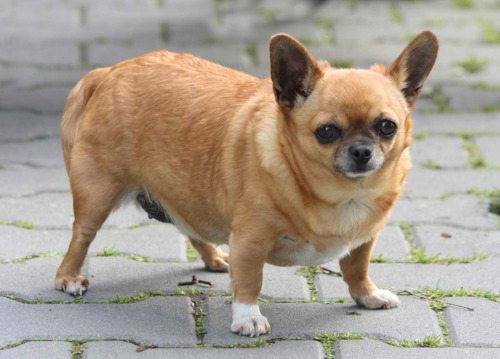
A good example will be an obese dog.  Yes, the owner is feeding it (more likely over-feeding it or perhaps not feeding the right diet), but the dog’s body condition means that the animal is not healthy.

For example, the Chihuahua I wrote about that had heart problems.  It was then revealed upon discussion that the dog was grossly overweight.  Thankfully, in that case, the owner accepted advice that their dog needed to go on a weight loss program and they stuck to it so the dog dropped the weight and the heart problems disappeared.

fat-chihuahua

What an obese Chihuahua looks like

A dog with a diagnosed orthopedic problem like hip dysplasia, elbow dysplasia, or arthritis (as examples) needs to be kept trim, with a fitness regime that is appropriate to their condition.  It’s rather disheartening to see a dog yo-yo with its weight.  They are going good and then drop off my calendar only to be booked in weeks and months later because they are limping.  More often than not, the dog has re-gained all of its weight (if not more) due to improper diet and exercise.

Another circumstance is when an owner has a very elderly dog who is showing signs of pain and discomfort – even with medication.   This situation is one reason why I developed my Quality of Life checklist to help clients understand what their dog is telling them.  We have to look at behavior and health and ask ourselves if the dog has quality of life and make changes wherever we can.

Is love enough?  It’s a big part of caring for our dogs.  But, it isn’t everything.  And it can be an excuse – consciously or subconsciously – for neglect.

Kathleen Crisley, specialist in dog massage, rehabilitation and nutrition/food therapy, The Balanced Dog, Christchurch, New Zealand

How Dogs Interact with Others Plays a Role in Decision-Making

Researchers at Canisius College found that the relationship between two dogs living in the same household may impact how much influence they have on each other’s behavior.

Dogs who showed little to no aggression towards their housemates were more likely to automatically follow each other than dogs who viewed their canine housemates as rivals. The study results are reported in the latest issue of Animal Cognition.

Familiar dogs

Dogs were tested in their own homes because a laboratory setting would have introduced other influences into how the dogs reacted

To conduct this study, Christy Hoffman, Ph.D., and Malini Suchak, Ph.D., assistant professors of Animal Behavior, Ecology, and Conservation, traveled to 37 multi-dog households to test the dogs in their own homes. This was an unusual approach, since most studies test dogs in the laboratory and often pair them with other dogs they don’t know. “We really wanted to look at the impact of the relationship between the dogs on their behavior, and doing that in a setting natural to the dogs, with dogs they already know, is really important,” Suchak says.

To classify how competitive household dogs were with each other, the owners were asked to fill out a survey known as the Canine Behavioral Assessment and Research Questionnaire (C-BARQ).

Dogs that were low in rivalry never or rarely displayed aggressive behavior toward the other dog. Dogs that were high in rivalry displayed some degree of aggression around valuable resources, suggesting they have a more competitive nature.

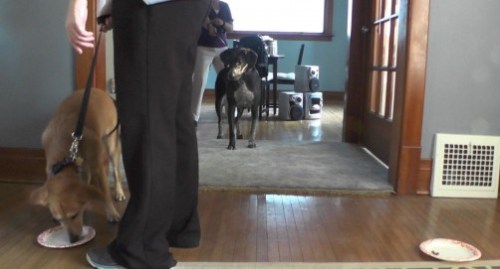
After their owners completed the C-BARQ, the dogs participated in a simple task. A research assistant placed two plates containing food in front of both dogs. One dog was allowed to approach the plates and eat the food from one plate before being walked out of the room. At that point, the second dog was allowed to make a choice. If the second dog followed the first dog, he arrived at an empty plate. If he didn’t follow the first dog, he went straight to the plate that still contained food.

Dogs that were low in rivalry were more likely to follow the first dog and frequently ended up at the empty plate. What surprised the researchers was that low rivalry dogs only blindly followed the demonstrator when allowed to make their choice immediately. “Low and high rivalry dogs only differed in the choices they made when there was no delay,” Hoffman says. “When they had to wait 5 seconds before making their choice, all dogs tended to go directly to the full plate.” 

Suchak adds, “This suggests that the low rivalry dogs may have been automatically following their housemates. When we forced the dogs to wait, it was as if the low rivalry dogs actually took the time to think about the situation, and they went straight for the food.”

The researchers also tested the dogs in a condition where a human removed the food from one plate before the dog made a choice. Interestingly, low rivalry dogs were more likely to follow the human demonstrator when there was no delay, a finding that paralleled what happened with dog demonstrators. Hoffman suggests this may have to do with the personality of low rivalry dogs, “Since the tendency of the low rivalry dogs to follow was seen when the demonstrator was both another dog and a human, competitiveness may be a characteristic of the individual that extends beyond their relationship with other dogs.” 

This means that if owners have a high rivalry dog “that dog may be more likely to think for himself, and less likely to blindly follow, than a dog that is less competitive,” says Hoffman. “On the whole, our findings show there is variation in the ways dogs make decisions and that how dogs interact with others plays a big role in how they respond under conditions that require quick thinking.”

Source:  Newswise

The evolution of dog breeds

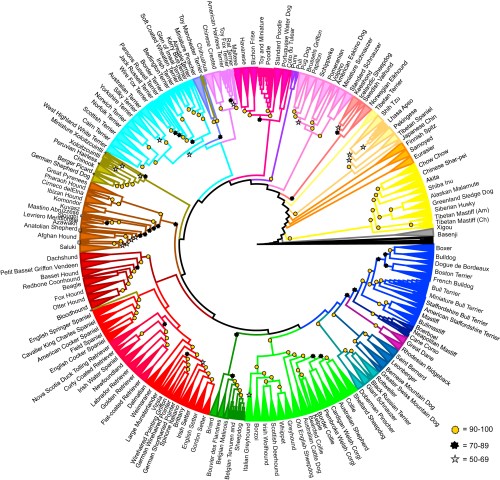
When people migrate, Canis familiaris travels with them. Piecing together the details of those migrations has proved difficult because the clues are scattered across the genomes of hundreds of dog breeds. However, in a study published April 25, 2017 in Cell Reports, researchers have used gene sequences from 161 modern breeds to assemble an evolutionary tree of dogs.

The map of dog breeds, which is the largest to date, unearths new evidence that dogs traveled with humans across the Bering land bridge, and will likely help researchers identify disease-causing genes in both dogs and humans.

Cladogram of 161 Domestic Dog Breeds

Cladogram of 161 Domestic Dog Breeds

The study highlights how the oldest dog breeds evolved or were bred to fill certain roles. “First, there was selection for a type, like herders or pointers, and then there was admixture to get certain physical traits,” says study co-author and dog geneticist Heidi Parker of the National Institutes of Health (NIH). “I think that understanding that types go back a lot longer than breeds or just physical appearances do is something to really think about.”

Most popular breeds in America are of European descent, but in the study, researchers found evidence that some breeds from Central and South America — such as the Peruvian Hairless Dog and the Xoloitzcuintli– are likely descended from the “New World Dog,” an ancient canine sub-species that migrated across the Bering Strait with the ancestors of Native Americans. Scientists have previously reported archaeological evidence that the New World Dog existed, but this study marks the first living evidence of them in modern breeds.

“What we noticed is that there are groups of American dogs that separated somewhat from the European breeds,” says study co-author Heidi Parker of the NIH. “We’ve been looking for some kind of signature of the New World Dog, and these dogs have New World Dogs hidden in their genome.” It’s unclear precisely which genes in modern hairless dogs are from Europe and which are from their New World ancestors, but the researchers hope to explore that in future studies.

Other results were more expected. For instance, many breeds of “gun dogs,” such as Golden Retrievers and Irish Setters, can trace their origins to Victorian England, when new technologies, such as guns, opened up new roles on hunting expeditions. Those dogs clustered closely together on the phylogenetic tree, as did the spaniel breeds. Breeds from the Middle East, such as the Saluki, and from Asia, such as Chow Chows and Akitas, seem to have diverged well before the “Victorian Explosion” in Europe and the United States.

Herding breeds, though largely European in origin, proved to be surprisingly diverse. “When we were looking at herding breeds, we saw much more diversity, where there was a particular group of herding breeds that seemed to come out of the United Kingdom, a particular group that came out of northern Europe, and a different group that came out of southern Europe,” says Parker, “which shows herding is not a recent thing. People were using dogs as workers thousands of years ago, not just hundreds of years ago.”

Different herding dogs use very different strategies to bring their flocks to heel, so in some ways, the phylogenetic data confirmed what many dog experts had previously suspected, the researchers noted. “What that also tells us is that herding dogs were developed not from a singular founder but in several different places and probably different times,” says the study’s senior co-author and dog geneticist Elaine Ostrander, also of the NIH.

Ostrander and her colleagues have spent years sequencing dog genomes but can also frequently be found out in the field at dog shows, recruiting dog owners to participate in the study. “If we see a breed that we haven’t had a good sample of to sequence, we definitely make a beeline for that owner,” says Ostrander. “And say, ‘Gosh, we don’t have the sequence of the Otterhound yet, and your dog is a beautiful Otterhound. Wouldn’t you like it to represent your breed in the dog genome sequence database?’ And of course, people are always very flattered to say, “Yes. I want my dog to represent Otterhound-ness.” All of the dog sequences in the study are from dogs whose owners volunteered, Ostrander says. Over half the dog breeds in the world today still have not been sequenced and the researchers intend to keep collecting dog genomes to fill in the gaps.

Understanding dogs’ genetic backstory also has practical applications. Our canine compatriots fall victim to many of the same diseases that humans do — including epilepsy, diabetes, kidney disease, and cancer — but disease prevalence varies widely and predictably between breeds, while it is more difficult to compartmentalize at-risk human populations. “Using all this data, you can follow the migration of disease alleles and predict where they are likely to pop up next, and that’s just so empowering for our field because a dog is such a great model for many human diseases,” says Ostrander. “Every time there’s a disease gene found in dogs it turns out to be important in people, too.”

Source:  ScienceDaily

Full journal article available here

Doggy quote of the month for May

“One of the most enduring friendships in history – dogs and their people, people and their dogs.”

– Terry Kay, author

A tale of 2 dog foods

Clients of my practice know that I feed a hybrid diet, that is a diet that is part commercial dog food (dry food – ‘kibble’ as well as dehydrated raw food), raw (real meat) and homemade food using both real meat, vegetables, eggs and fruit.

We are preparing for our third annual fundraiser and I received a small bag of a dry food – readily available in supermarkets – as a donation for the rescue.  I set it aside in my office and, one evening, I heard the rustling of paper…

Izzy had helped herself to the donated food.  It seemed she found it quite tasty.

So, I decided the donated food could be hers and I would replace the bag with another one.  In the meantime, I let her have one small handful with one of her meals over the next few days.

And she did something she had never done before… during the night she was chewing on her feet.  Really chewing.  For the first night, I dismissed it as a one-off irritation.  By the fourth night, I knew something was up.

It was the dog food, of course!

The supermarket dog food has gone into the organics bin to be recycled.  I’ll make a donation to the fundraiser in lieu of another bag of that food!

Thought you might like to compare labels…

This is Izzy’s current ‘normal’ food:

Salmon Meal, Potatoes, Tapioca, Fish Meal, Chicken Fat, Peas, Blueberries, Cranberries, Papayas, Mangos, Apples, Basil, Oregano, Rosemary, Thyme, Sunflower Seeds, Chamomile, Peppermint, Camelia, Natural Flavor, Vitamin E Supplement, Niacin (Vitamin B3), Calcium Pantothenate (Vitamin B5), Vitamin A Supplement, Thiamine Mononitrate (Vitamin B1), Riboflavin Supplement, Pyridoxine Hydrochloride (Vitamin B6), Vitamin B12 Supplement, Vitamin D3 Supplement, Folic Acid (Vitamin B9), Sodium Chloride, Taurine, Choline Chloride, Magnesium Sulfate, Zinc Sulfate, Ferrous Sulfate, Calcium Carbonate, Copper Sulfate, Manganese Sulfate, Calcium Iodate, Cobalt Sulfate, Sodium Selenite, Green Tea Extract, Rosemary Extract and Spearmint Extract

and this was the supermarket food:

Lamb (source of glucosamine), brewers rice, whole grain corn, whole grain wheat, poultry by-product meal (source of glucosamine), corn gluten meal, soybean meal, animal fat preserved with mixed-tocopherols, calcium phosphate, glycerine, animal digest, calcium carbonate, potassium chloride, salt, caramel color, Vitamin E supplement, choline chloride, zinc sulfate, L-Lysine monohydrochloride, ferrous sulfate, sulfur, manganese sulfate, niacin, Vitamin A supplement, calcium pantothenate, thiamine mononitrate, copper sulfate, riboflavin supplement, Vitamin B-12 supplement, pyridoxine hydrochloride, garlic oil, folic acid, Vitamin D-3 supplement, calcium iodate, biotin, menadione sodium bisulfite complex (source of Vitamin K activity, sodium selenite.

Notice the differences?

Kathleen Crisley, specialist in dog massage, rehabilitation and nutrition/food therapy, The Balanced Dog, Christchurch, New Zealand