Can Therapy Dogs Assist in Motivating Children on the Autism Spectrum?

Autism spectrum disorder (ASD) is one of the most widely and deeply researched topics in child development as researchers constantly look for answers into not only its cause but the best way to treat the problematic symptoms of the disorder once diagnosed.

Effects of the various types of ASD include deficits in social communication and interaction, repetitive or restricted behavior, sensory issues and cognitive delays. These traits prevent children on the spectrum from performing or completing tasks in the same timeliness or fashion as other children.

Often, in order to get children with ASD to complete tasks, a reward-based system is implemented, where the child is given a toy or some other form of reward. But the offer of a reward doesn’t always guarantee completion of the task.

One Texas Tech University researcher is part of a team taking a unique look at this system by providing access to therapy dogs as the reward, allowing students who complete certain academic tasks to spend time with the pooch, with the hope that potential interaction further motivates them to complete those tasks.

“It is a reward-based program,” said Alexandra Protopopova, a behavioral analyst and assistant professor in companion animal science in the Department of Animal & Food Sciences. “There is a second component to it, however, in that dogs, just by being dogs, may alleviate stress. Potentially, the dogs create a more pleasant environment and offer emotional support during academic sessions.”

“So, by mediating that stress level, the dogs may improve learning and potentially improve other outcomes as well as being a reward for the child ruing work.”
Dogs as rewards for autistic children

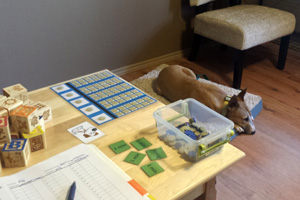
The dogs create a more pleasant environment and offer emotional support during academic sessions. Photo by Texas Tech University

Protopopova is an expert in behavior issues with dogs across a wide array of subjects, from interaction with children with ASD to analyzing what behaviors are more attractive for potential adopters and ways to bring those behaviors out to improve adoption rates.

But she said the methods and philosophies of how behavior works in animals is, at the core, the same as it is in children, and it is that connection that made this current research both attractive and interesting.

“With an iPad or toy as a reward, a child might become bored over time,” Protopopova said. “With a dog you might see the exact opposite situation over time where the child grows attached to the dog and the quality of the reward grows as well.”

Emotional interaction

Upon arriving at Texas Tech, Protopopova had a colleague in the College of Education, professor Jeanne Donaldson, who is now at Louisiana State University, and wanted to immediately connect the college and the Burkhart Center for Autism Education and Research with the Department of Animal & Food Sciences. The most natural way to make that connection, she said was to incorporate therapy dogs with the research being done involving applied behavior analysis in children with disabilities.

“Social behavior and social interaction has been an often neglected component of these kinds of programs,” Protopopova said, “and that is something researchers have attempted to improve, that social behavior and communication. There is some evidence that dogs or animals in general occasionally could bring out that social connection. That part of the research is definitely attractive to us.”

Measuring the effectiveness of using therapy dogs as a reward for academic performance in children with ASD was performed in two areas. The first was done biologically; stress responses were detected through the collection of saliva. Breanna Harris, a research assistant professor in the Department of Biological Sciences, used salivary cortisol, a stress hormone, to determine a student’s stress level in regard to anticipating interaction with the dog.

The second aspect of measuring effectiveness was done by observing the rate of work in the children and how motivated the children were to engage in academic tasks. Each child was given an individual task based on his or her education level, so those tasks involved the same things they were learning in school at the time or what parents had indicated the child needed extra help with.

A control condition was created where there were not rewards and children received praise only for engaging in academic tasks. A second control group saw children work toward receiving inanimate leisure items such as iPads or toys, which Protopopova said have been proven through prior research to be effective motivational tactics.

Two other control conditions involved the therapy dogs. One condition involved the dogs being used as a reward for work performed and would be present only after that work was completed. The second condition was what Protopopova termed more of the typical animal assisted intervention where the dog was continuously present in the room.

The conditions where there was no reward at all and where the dog was constantly around proved to be the most ineffective methods of motivation, researchers found. The two conditions where there were rewards provided upon completion of the work were the most effective; being rewarded with spending time with the therapy dog proved the most effective for some children.

“In fact, for most of the children, this was very useful as a reward because the dog motivated them quite a bit to do the work,” Protopopova said. “We did find, surprisingly to me, that one participant did in fact work where we hypothesized he wouldn’t during a session where the dog was present but not as a reward.”

Improvement over time

Single-use incidents of using the therapy dog show one thing, but the researchers wanted to determine whether prolonged exposure to the availability of a therapy dog as a reward for performing work continues those results.

For that reason, in this first study, children stayed in the program for anywhere from four to nine months to see if using the same dog repeatedly fosters the child’s attachment to the dog.

Prior to the child beginning the program, he or she is given a behavioral preference assessment where the child is asked to choose his or her favorite thing in the room, whether it’s a toy, an electronic device, a dog, etc. They also were given the choice of performing the academic test instead. At the end of the program, the child is tested again with the same assessment to see if their preferences had changed.

“We wanted to see how all these preferences for inanimate objects or activities changed,” Protopopova said. “Right now we are still collecting the final pieces of data because we’re still finishing up with a couple of participants. We don’t yet have the clear answers there, but it’s not as straightforward as we imagined, either. For some of the children, we did not see the attachment we hypothesized, or at least any evidence of it in our data so far. But it’s too early to tell.”

Protopopova said one of the advantages of this study is its single-subject design where each child’s program or sessions are designed specifically for that child’s needs. That will allow, if the program is used outside of an educational setting, for other children to enter the program with a focus on their unique behaviors and what is best to encourage them to learn difficult academic or self-care tasks in a non-stressful learning environment.

She said one family in the original group took the data gathered about their child and obtained a dog and will train it as a service dog because of the benefits the data showed for their child.

“This is definitely a strength,” Protopopova said. “Instead of a group design and us concluding that the average child would benefit from some procedure, which is not really that meaningful to individual families, we can give each family specific answers whether their child would or would not benefit from a dog.”

One major question to come out of the preliminary research, she said, is whether using a shelter dog to encourage behavior can be used to determine the severity of the disability. Does it work on children who are higher- or lower-functioning?

Protopopova and other researchers are beginning another one to answer new questions that rose from the original, smaller study.

The larger study will involve at least 30 children, and they are actively recruiting children to enter the study. Those children must be between the ages of 2 and 14 with autism spectrum disorder and/or other developmental disabilities.

The hope is the larger study will allow the research to be used in schools and centers on a regular basis.

“There we can answer more generalized questions,” Protopopova said. “How useful is this and who is it most useful for? Can we tell which children are going to benefit and which ones will not? So when we get those answers we are going to be a bit closer to really giving that program out to schools to say, ‘we have strong evidence that it will be useful for this person or not for this person.”


Source:  Texas Tech University media statement

Darling Companion

I stumbled across this movie today, Darling Companion, directed by Lawrence Kasdan (The Accidental Tourist, The Big Chill, The Empire Strikes Back, Raiders of the Lost Ark, Grand Canyon and many other movies).  It was released in 2012 but I don’t think it ever made it to theaters or, if it did, it was one of those that disappeared quite quickly.

There’s a dog in it, of course.  His name is Freeway and he is saved by Beth and Grace (Diane Keaton and Elisabeth Moss) on a cold January day when Beth spots him as they are driving down the freeway.  Beth needs something in her life because husband, Joseph (Kevin Kline) is absorbed in his work as a spinal surgeon.darling-companion

And then, after Freeway is part of Grace’s wedding a year after coming into their lives, Joseph takes Freeway for a walk and the dog chases a deer and is lost.  For the remainder of the film, the extended family searches for Freeway.

There’s some real romance and humor in this film and very nice scenery of Colorado.  Something of a predictable storyline, with aspects of dog adoption woven into the story which is a theme I’d support in any film.

Well worth seeing.  (Freeway is very cute).

Kathleen Crisley, specialist in dog massage, rehabilitation and nutrition/food therapy, The Balanced Dog, Christchurch, New Zealand

Workplace fostering

Most rescue and adoption groups are familiar with fostering programs – these are programs when a dog is taken to a home on a temporary basis so it can learn to adapt to a domestic living situation.

Foster carers are very special people who bring animals into their homes knowing that they may have had a rough start in life; they expect some teething problems.  Adopters will often ask to look at dogs who have been fostered because these dogs have a ‘head start’ in terms of settling in and can be less challenging for the adoptive family.

The folks at PetRescue, which supports 800 independent rescue groups in Australia, have taken fostering to a whole new level by developing a Workplace Foster Care Programme.  The rationale for the programme relies on research evidence into the human-animal bond and the positive impacts that pets in the workplace can have on productivity.

Things like encouraging staff to interact with one another, stress relief with a dog who wants pats or walkkies, and breaking the ice when new staff are introduced, are all aspects of workplace life that benefit when there’s a dog around.

Workplace Foster Care Programmes also raise awareness, so staff, clients and the general public learn about the benefits of adoption.

workplace foster dog

Vinomofo, a wine retailer based in Melbourne, was an early addition to the Workplace Foster Care Programme (photo by StartUp Daily)

The Sydney Morning Herald has recently covered the story of one company with a greyhound as its workplace foster dog.  Click here to view.

If I was looking for employment, I’d definitely be attracted by companies with a foster dog included in the benefit package.  (Sign me up!)

Kathleen Crisley, specialist in dog massage, rehabilitation and nutrition/food therapy, The Balanced Dog, Christchurch, New Zealand

Izzy’s letter to Santa

Dear Santa

This is my first-ever letter to you, although I will soon be 8.

I was a racing dog until the age of 5 ½ when I came to live with mummy.  I was still settling in during our first Christmas together and, last year, you might remember that we had our photo taken together. 

Back then, I just thought you were a guy that was over-dressed for a warm summer day.  I wasn’t sure about sitting next to you but that’s what mummy wanted and so I did it to make her happy. 

Then someone told me that you are the one who brings presents at Christmas.

So I’m writing because for Christmas I’d like a bed; I already have a bed – this one is for mummy.

You see, I don’t think there’s enough room for both of us in my bed.  When mummy is in bed with me in the hot weather,  I get too hot.  So I’d like another bed for mummy.

But there isn’t enough room in our bedroom for another bed and I do like sleeping close to mummy so I was hoping you could arrange to make the bedroom bigger, too.

Now I know I’m asking for a lot, but everyone says that you are really good at what you do – getting around the world in one night and leaving everyone presents.  And it isn’t like you’ve heard from me for the last 7 years.  That should count for something.

I have faith in you, Santa. 

You got this.

Love,

Izzy

Your dog remembers what you did

People have a remarkable ability to remember and recall events from the past, even when those events didn’t hold any particular importance at the time they occurred. Now, researchers reporting in the journal Current Biology have evidence that dogs have that kind of “episodic memory” too.

The study found that dogs can recall a person’s complex actions even when they don’t expect to have their memory tested.

“The results of our study can be considered as a further step to break down artificially erected barriers between non-human animals and humans,” says Claudia Fugazza of MTA-ELTE Comparative Ethology Research Group in Budapest, Hungary. “Dogs are among the few species that people consider ‘clever,’ and yet we are still surprised whenever a study reveals that dogs and their owners may share some mental abilities despite our distant evolutionary relationship.”

memory-research

This image shows Claudia Fugazza and her dog demonstrating the Do As I Do Method. Credit: Mirko Lui

Evidence that non-human animals use episodic-like memory has been hard to come by because you can’t just ask a dog what it remembers. In the new study, the researchers took advantage of a trick called “Do as I Do.” Dogs trained to “Do as I Do” can watch a person perform an action and then do the action themselves. For example, if their owner jumps in the air and then gives the “Do it!” command, the dog would jump in the air too.

The fact that dogs can be trained in this way alone wasn’t enough to prove episodic memory. That’s because it needed to be shown that dogs remember what they just saw a person do even when they weren’t expecting to be asked or rewarded. To get around this problem, the researchers first trained 17 dogs to imitate human actions with the “Do as I Do” training method. Next, they did another round of training in which dogs were trained to lie down after watching the human action, no matter what it was.

After the dogs had learned to lie down reliably, the researchers surprised them by saying “Do It” and the dogs did. In other words, the dogs recalled what they’d seen the person do even though they had no particular reason to think they’d need to remember. They showed episodic-like memory.

Dogs were tested in that way after one minute and after one hour. The results show they were able to recall the demonstrated actions after both short and long time intervals. However, their memory faded somewhat over time.

The researchers say that the same approach can most likely be used and adapted in a wide range of animal species, to better understand how animals’ minds process their own actions and that of others around them.

“From a broad evolutionary perspective, this implies that episodic-like memory is not unique and did not evolve only in primates but is a more widespread skill in the animal kingdom,” Fugazza says. “We suggest that dogs may provide a good model to study the complexity of episodic-like memory in a natural setting, especially because this species has the evolutionary and developmental advantage to live in human social groups.”

For all those dog owners out there: your dogs are paying attention and they’ll remember.

Source:  Science Daily

Kathleen Crisley, specialist in dog massage, rehabilitation and nutrition/food therapy, The Balanced Dog, Christchurch, New Zealand

Doggy quote of the month for December

“Children and dogs are as necessary to the welfare of the country as Wall Street and the railroads.”

– Harry S Truman, 33rd President of the United States

harry-truman

Cat TV

There’s a gap in the fence in our back yard.  And in the rental house next door, a new cat has moved in.  Izzy is fascinated.  Izzy watching cat tv

Unless it is raining, she enjoys watching Cat TV most days.

Izzy of course is not unique in this interest.  Cat TV is a favorite hobby of many dogs – so much so that the folks at PetPeek™ have created a window for your fence designed with your dog in mind.

The window is a 9.5 inch diameter acrylic dome that you install in your fence.

I’m not sure how much the neighbors would appreciate a noticeable window appearing in the fence…

There’s a product out there for every pet need.  Unfortunately, this product is not sold outside of the United States so I decide to buy one, I’ll have to use a freight forwarding service.

Kathleen Crisley, specialist in dog massage, rehabilitation and nutrition/food therapy, The Balanced Dog, Christchurch, New Zealand

The Last Will and Testament of an Extremely Distinguished Dog

For all those who have

loved and lost a beloved pet,

here is a dog’s life

beautifully remembered

…so says the dust cover on my edition of The Last Will and Testament of an Extremely Distinguished Dog, written by playwright Eugene O’Neill.

Written in the early 1940s about his dog Blemie, from Blemie’s point of view, this small book tells Blemie’s owner how he is feeling and what he wants for his owners after his passing…including things like having another dog and not to grieve for too long.

I see many owners who must face the grief over the loss of their dog (I deal with many older dogs in my massage practice); and I have lived through the loss of my own dogs.  I can relate.

Every pet parent needs support during the grieving process.  I highly recommend buying a copy of this book.

Kathleen Crisley, specialist in dog massage, rehabilitation and nutrition/food therapy, The Balanced Dog, Christchurch, New Zealand

Prepared for emergencies

We (New Zealand) has been in the news this week for all of the wrong reasons.  A 7.8 magnitude quake in the South Island with rural communities like Waiau and Kaikoura hit the hardest.  Being only 2 1/2 hours south of the epicenter of the quake, those of us in Christchurch felt it strongly – shaking and rolling for almost a full 2 minutes.  We’ve been through this in 2010 and again in 2011 – and our city is still rebuilding.

I decided that the item on my TO DO list to refresh my emergency supplies had better go to the top.  We know that we have many fault lines in the country and shaking on one can trigger activity in another.  Basically all New Zealanders should be ready for quake activity at all times.

Emergency supplies

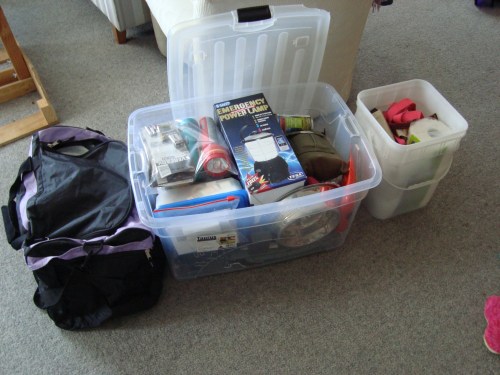
I have refilled my drinking water supplies (40 litres), for example.  I aim to do this every 6 months and so I have marked my calendar for when 6 months is up.  I bought new resealable containers this weekend and filled them with Izzy’s dry food., and I’ve taken the time to put more of my supplies in one place – the large plastic container is also new.

First aid kits for humans and dogs are in there.  Also a dog bowl, extra leash and collar.  Copies of Izzy’s vaccination record, microchip number and pet insurance are inside a zipped plastic bag and saved electronically in the cloud. We forget sometimes how much we rely on electronic records.  If the Big One hits, our power supplies will be down for some time.  Good old hard copies are worth keeping and updating.

I even realised that my email address on the NZ Companion Animal Register for Izzy’s microchip is outdated and so I’ll be phoning them in the morning to change it.

My water purification tablets have expired.  So a trip to the pharmacy this week is planned.

Izzy has a spare dog coat packed, along with a towel and temporary bed.  A new tennis ball for fun is also packed.  I’ve also ordered some more dehydrated dog food.

And one of the things that many emergency lists forget is a stake and chain – which I have had for years.  In a severe earthquake, fences will come down.  Your dog will need to be restrained safely wherever you are and you cannot rely on rope to tie them up.  A stressed dog can chew through that in minutes and be gone.

I also have an old dog tag that I’ve covered with a label.  A pen and paper are also in my kit.  I can leave notes if I need to but also write our temporary address on the dog tag because who knows where we may end up as temporary shelter…

From personal experience, I can tell you that during the first earthquake of 2010, I was much more calm knowing that I had supplies and was prepared.  I set about checking the safety of my house and setting up things like an emergency toilet…I was ready!

If you don’t prepare for yourself, then do it for your dog.  They rely on us for the care and safety.

Kathleen Crisley, specialist in dog massage, rehabilitation and nutrition/food therapy, The Balanced Dog, Christchurch, New Zealand

The Sound and the Furry – book review

In this 6th volume of the Chet and Bernie mysteries, the Little Detective Agency is hired to find Ralph Boutette, who has disappeared in Louisiana.

The Sound and the F

Ralph, an eccentric inventor, is part of the colourful Boutette family who seem constantly in conflict with another local family, the Robideaus.

Through their powers of investigation, Chet and Bernie uncover a story much larger than a family feud involving big oil and pending environmental disaster.

And Chet even tangles with a gator named Iko, to add to the authenticity of the bayou surrounds.

Not my favorite Chet and Bernie mystery, but still very entertaining.

Kathleen Crisley, specialist in dog massage, rehabilitation and nutrition/food therapy, The Balanced Dog, Christchurch, New Zealand