Aim to snuggle, not muzzle

Muzzle vs Snuggle

There’s an old saying:  you reap what you sow

In all my work with special needs dogs, I think this holds true.  If our starting point is muzzling a dog because of their breed, and they are unable to express their natural behaviors or experience the joy of freedom, then we sow the seeds of aggression.

If we aim to make all dogs companions and we work towards socializing and training them, we get the opposite.

Simple, isn’t it?

Kathleen Crisley, specialist in dog massage, rehabilitation and nutrition/food therapy, The Balanced Dog, Christchurch, New Zealand


Rare human disease found in dogs

Lung disease

A rare, severe form of pulmonary hypertension, which up until now, has only been classified as a human lung disease, has also been discovered in dogs according to a Michigan State University study. (Stock image) Credit: © Sylvie Bouchard / Fotolia

A rare, severe form of pulmonary hypertension, which up until now, has only been classified as a human lung disease, has also been discovered in dogs according to a Michigan State University study.

“Our research is the first to document the existence of pulmonary veno-occlusive disease, or PVOD, in dogs,” said Kurt Williams, the lead author of the study and an expert in respiratory pathology in MSU’s College of Veterinary Medicine. “PVOD is considered one of the most severe forms of pulmonary hypertension.”

The study is published in the journal Veterinary Pathology.

The number of pulmonary hypertension, or PH, cases reported in the United States is low, affecting 15 to 50 people per million each year. PVOD is diagnosed in only about 10 percent of PH cases where no other cause of the disease has been determined. Unfortunately, there are very few effective treatment options for PVOD and a lung transplant often becomes the best choice.

“PVOD might be more common in dogs than in people, but this has yet to be determined and needs to be looked at further,” Williams said.

Pulmonary hypertension develops because of abnormal blood vessels in the lungs, which makes it harder for the heart to push blood through and provide oxygen to the rest of the body. In cases of PVOD, the small veins in the lungs become blocked, increasing pressure in these blood vessels, and ultimately causing heart failure.

“The same process happens in canines,” Williams said. “These dogs also come in with similar symptoms as humans, yet because subtle changes in health may not be recognized as quickly in dogs, death can occur quickly once the animal is seen by a veterinarian.”

Symptoms include cough, increased rate of breathing, respiratory distress, loss of appetite and chronic fatigue. Fatal progression of the disease in humans can last up to two years.

“PVOD is a poorly understood disease not just because it’s so rare, but also because there’ve been no other animals known to have the disease,” Williams said. “Our finding changes things.”

Williams said that the discovery could be important for human medicine because the canine disease may serve as a model for human PVOD.

“It’s cases like this that help to remind us how important veterinary medicine is to medicine in general,” he said. “Our colleagues in the human medical community are becoming much more aware of the many diseases shared by our respective patients and how together we can learn from each other.”

Source:  Michigan State University media release

Teaching dogs to fly

Mark Vette, New Zealand-based animal training and behaviorist, has done it again.

Known for his achievement in teaching dogs to drive (See the Driving Dogs of New Zealand), Mark and his team have now taught three rescue dogs to fly…

Rescue dogs are great dogs with depths of intelligence and emotion that we have only begun to explore.

Kathleen Crisley, specialist in dog massage, rehabilitation and nutrition/food therapy, The Balanced Dog, Christchurch, New Zealand

Dogs at the wedding

Wedding photo

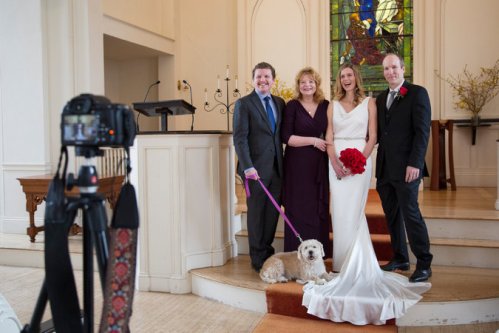
Penny, front and center, posed with the family following the wedding of Linnea Elizabeth Sanderson and Dr. Robert Collier Davidson, right, in February. Credit Kieran Kesner for The New York Times

Dogs are part of the family and, increasingly, they are being included in their owner’s Big Day.  (I’m invited to a wedding in October that will include the couple’s dogs – Bernese Mountain Dogs –  and look forward to sharing that with my readers).

In this article from the New York Times, a Vermont-based photographer says that half of the weddings on his schedule this season involve a dog. And most of the owners interviewed say that they wouldn’t think of not involving their beloved dog in the ceremony.

Did you include your dog in your wedding?  I’d love to see the photos!

Kathleen Crisley, specialist in dog massage, rehabilitation and nutrition/food therapy, The Balanced Dog, Christchurch, New Zealand

The Champions

In my local community of Christchurch, New Zealand, I am sponsoring a community viewing of The Champions, a documentary by Darcy Dennett.  Proceeds will go to four local dog charities:  K9 Rescue and Rehoming, SPCA Canterbury, Dogwatch and Christchurch Bull Breed Rescue.

This film, which follows the story of some of the dogs rescued from Michael Vick’s Bad Newz Kennels, is a good news story.  It makes you think about recovery and a dog’s capacity to endure and survive.  Since I am very familiar with the work of the Best Friends Animal Society, it is also great to see the work done by them and BADRAP in San Francisco in finding these dogs homes.

I commend this film to you and encourage you to see it for yourselves.

Champions_Movie_Poster_Download

Kathleen Crisley, specialist in dog massage, rehabilitation and nutrition/food therapy, The Balanced Dog, Christchurch, New Zealand

Previous posts relevant to the Vick case and dog fighting include:


Happy Mother’s Day, Izzy

Izzy didn’t choose to be a mother.  It was her final job as a racing greyhound to pass on her genes to another generation of racers.  One of those puppies, Bella, has been re-homed and I can see from the racing register that four other puppies are now racers…I so hope they are safe and healthy.

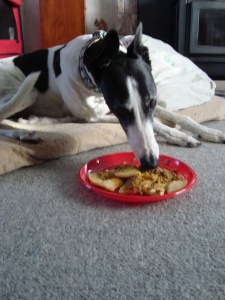
Izzy deserved to have a Mother’s Day.  She had breakfast in bed with buttermilk pancakes and liver/pumpkin gravy.

Tonight she is playing with her newest toy – a rubber chicken.

Happy Mother’s Day, Izzy!


Breakfast in Bed for Mother's DayIzzys Mothers Day Pancakes

Kathleen Crisley, specialist in dog massage, rehabilitation and nutrition/food therapy, The Balanced Dog, Christchurch, New Zealand

An interesting comparison

The Waipa District Council in New Zealand has created an interesting infographic for its citizens about the cost of having to clean up dumped rubbish.Waipa

Notice that they could have spent this money, amongst other things, on 150 dog poo bins at local parks.

What’s significant here is the use of the comparison.  Picking up dog poo matters to most people.  Be a responsible dog owner and clean up after your dog.

Kathleen Crisley, specialist in dog massage, rehabilitation and nutrition/food therapy, The Balanced Dog, Christchurch, New Zealand


Will computers replace dog trainers?

North Carolina State University researchers have developed and used a customized suite of technologies that allows a computer to train a dog autonomously (without human involvement), with the computer effectively responding to the dog based on the dog’s body language.

“Our approach can be used to train dogs efficiently and effectively,” says David Roberts, an assistant professor of computer science at NC State and co-author of a paper on the work. “We use sensors in custom dog harnesses to monitor a dog’s posture, and the computer reinforces the correct behavior quickly and with near-perfect consistency.”
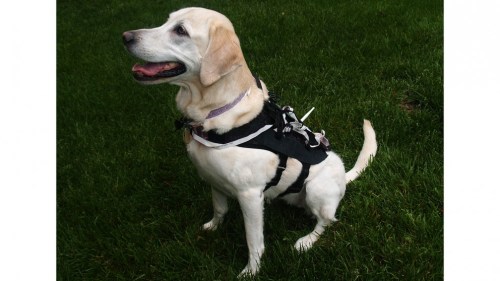
Dog training with computers

“Because the technology integrates fundamental principles of animal learning into a computational system, we are confident it can be applied to a wide range of canine behaviors,” says Alper Bozkurt, an assistant professor of electrical and computer engineering and co-author of the paper. “For example, it could be used to more quickly train service dogs. Ultimately, we think the technology will be used in conjunction with human-directed training.”

The dog harness fits comfortably onto the dog and is equipped with a variety of technologies that can monitor the dog’s posture and body language. Each harness also incorporates a computer the size of a deck of cards that transmits the sensor data wirelessly.

For the current study, the researchers wrote an algorithm that triggered a beeping sound and the release of dog treats from a nearby dispenser whenever the dog’s harness sensors detected that the dog went from standing to sitting.

The researchers had to ensure that the reinforcement was given shortly after the desired posture was exhibited, and also ensure that rewards were only given for the correct posture. This required a trade-off. If the algorithm ran long enough to ensure the correct posture with 100 percent certainty, the reinforcement was given too late to be effective for training purposes. But if the reinforcement was given immediately, there was a high rate of rewarding the wrong posture.

To address this, the researchers worked with 16 volunteers and their dogs to optimize the algorithm, finding the best possible combination of speed and accuracy. The researchers then compared the algorithm’s timing and accuracy to that of an expert human trainer.

The algorithm was highly accurate, rewarding the appropriate behavior 96 percent of the time. But the human trainer was better – with a 100 percent accuracy rate.

However, while the average response time was about the same for both algorithm and trainer, there was a lot of variation in the time of response from the trainer. The algorithm was incredibly consistent.

“That variation matters, because consistency is fundamentally important for all animal training,” Roberts says.

“This study was a proof of concept, and demonstrates that this approach works,” Bozkurt says. “Next steps include teaching dogs to perform specific behaviors on cue, and integrating computer-assisted training and human-directed training for use in various service dog applications.”

“In the long term, we’re interested in using this approach to animal-computer interaction to allow dogs to ‘use’ computers,” Roberts says. “For example, allowing an explosive detection dog to safely and clearly mark when it detects components of a bomb, or allowing diabetic alert dogs to use their physical posture and behaviors to call for help.”

Source:  North Caroline State University media release

Senior adults see benefits from dog ownership

The Centers for Disease Control and Prevention (USA) recommends that adults of all ages should engage in 150 or more minutes of moderate physical activity per week. Among adults 60 years of age or more, walking is the most common form of leisure-time physical activity because it is self-paced, low impact and does not require equipment.

Johnson and Dog - senior dogs

Rebecca Johnson and her team determined that older adults who also are pet owners benefit from the bonds they form with their canine companions. Photo by University of Missouri

Researchers at the University of Missouri have determined that older adults who also are pet owners benefit from the bonds they form with their canine companions. Dog walking is associated with lower body mass index, fewer doctor visits, more frequent exercise and an increase in social benefits for seniors.

“Our study explored the associations between dog ownership and pet bonding with walking behavior and health outcomes in older adults,” said Rebecca Johnson, a professor at the MU College of Veterinary Medicine, and the Millsap Professor of Gerontological Nursing in the Sinclair School of Nursing. “This study provides evidence for the association between dog walking and physical health using a large, nationally representative sample.”

The study analyzed 2012 data from the Health and Retirement study sponsored by the National Institute on Aging and the Social Security Administration. The study included data about human-animal interactions, physical activity, frequency of doctor visits and health outcomes of the participants.

“Our results showed that dog ownership and walking were related to increases in physical health among older adults,” said Johnson, who also serves as director of the Research Center for Human-Animal Interaction at MU. “These results can provide the basis for medical professionals to recommend pet ownership for older adults and can be translated into reduced health care expenditures for the aging population.”

Results from the study also indicated that people with higher degrees of pet bonding were more likely to walk their dogs and to spend more time walking their dogs each time than those who reported weaker bonds. Additionally, the study showed that pet walking offers a means to socialize with pet owners and others.

Retirement communities also could be encouraged to incorporate more pet-friendly policies such as including dog walking trails and dog exercise areas so that their residents could have access to the health benefits, Johnson said.

Source:  University of Missouri media release

Doggy quote of the month for May

“What do dogs do on their day off?  Can’t lie around – that’s their job!”

-George Carlin, comedian

Sid on sofa

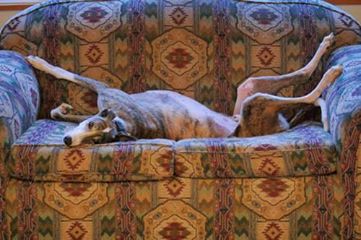
Sid the Greyhound, photo by John Visser